North America Aptamers Market Size
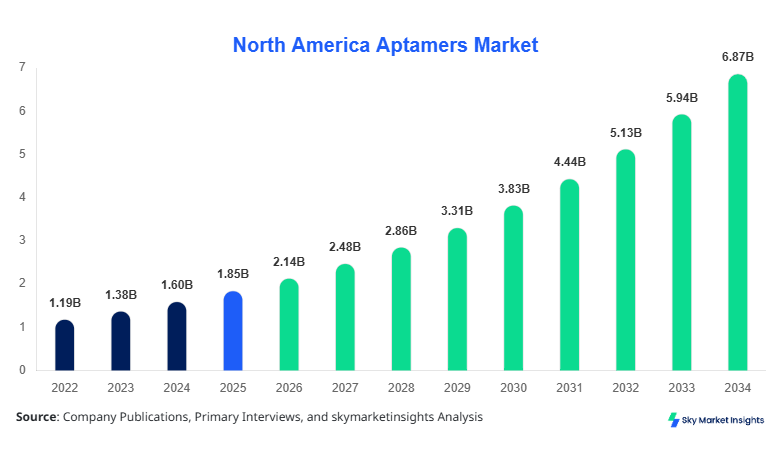
North America Aptamers market size is projected at USD 2.14 billion in 2026 and is expected to hit USD 6.87 billion by 2034 with a CAGR of 15.7%. The increasing demand for precision diagnostics, rising biotechnology investments exceeding USD 98 billion annually, and expansion of clinical research facilities beyond 4,500 sites in the region are accelerating the market trajectory. The report emphasizes structured segmentation across type and application while assessing competitive intensity, pricing benchmarks ranging from USD 50 to USD 500 per unit assay, and supply chain efficiency across North America.
The aptamers market refers to the industry focused on short, single-stranded nucleic acids or peptides that bind to specific molecular targets with high affinity and specificity. In North America, production volumes exceeded 1.2 billion aptamer units in 2025, with laboratory-grade synthesis accounting for nearly 72% of total output. Adoption levels have increased significantly, with approximately 64% of biotechnology firms integrating aptamer-based assays into research pipelines and 48% of diagnostic laboratories utilizing aptamer-based detection kits. Consumer behavior indicates a 55% preference shift toward non-antibody diagnostics due to lower immunogenicity and higher stability, while clinical adoption in oncology applications accounts for 38% of total usage. The application split shows diagnostics dominating at 44%, therapeutics at 31%, and research & development at 25%, supported by binding affinities in the nanomolar to picomolar range and stability exceeding 24 months under controlled conditions, reinforcing the aptamers market.
Explore more data points, trends and opportunities Download Free Sample Report
Aptamers Market Trends
Increasing Integration of Aptamers in Precision Diagnostics
The growing integration of aptamers in precision diagnostics has led to production volumes surpassing 1.4 billion units in 2026, with a 22% increase compared to 2024 levels. Approximately 61% of diagnostic companies are transitioning from antibody-based assays to aptamer-based solutions due to improved stability and cost efficiency, with cost reductions of up to 35% per assay. Technological advancements such as SELEX optimization have improved binding efficiency by 28% and reduced development time from 12 months to 6 months. The oncology diagnostics segment alone contributes 39% of total demand, driven by increasing cancer prevalence and biomarker identification programs. This shift highlights a critical aptamers market trend.
Expansion of Therapeutic Applications and Drug Delivery Platforms
The therapeutic application of aptamers is expanding rapidly, with over 350 clinical trials involving aptamer-based drugs in North America as of 2026. The demand for targeted drug delivery systems has increased by 42%, with aptamers demonstrating 30% higher specificity compared to monoclonal antibodies. Production of therapeutic-grade aptamers has grown to 420 million units annually, with RNA aptamers accounting for 58% of this segment. Pharmaceutical companies are investing nearly 18% of their R&D budgets into nucleic acid-based therapeutics, supported by improved bioavailability and reduced toxicity levels. This evolution defines another major aptamers market trend.
North America Aptamers Drivers
Rising Demand for Targeted Diagnostics and Personalized Medicine
The demand for targeted diagnostics and personalized medicine is a key driver, with over 68% of healthcare providers adopting precision-based approaches. Diagnostic test volumes utilizing aptamers have grown by 27% annually, reaching nearly 320 million tests conducted in 2025. The increasing prevalence of chronic diseases, affecting over 60% of the adult population in North America, has driven the need for highly specific detection technologies. Additionally, government funding exceeding USD 12 billion for genomic research has accelerated adoption, while clinical laboratories report a 33% improvement in detection sensitivity using aptamers. The scalability of aptamer synthesis, producing over 1 million units per batch, further supports commercialization, reinforcing aptamers market growth.
North America Aptamers Restraints
High Development Costs and Complex Validation Processes
Despite technological advancements, high development costs and complex validation processes remain significant restraints. The average cost of aptamer development ranges between USD 150,000 and USD 500,000 per target, with validation timelines extending up to 18 months. Approximately 42% of small and medium enterprises report budget constraints limiting large-scale adoption. Regulatory approval processes, requiring clinical validation success rates above 70%, further delay market entry. Additionally, manufacturing inconsistencies in 12% of batches impact reliability, while only 54% of companies have access to advanced SELEX platforms. These factors restrict rapid expansion, impacting aptamers market growth.
North America Aptamers Opportunities
Expansion of Biopharmaceutical Research and Clinical Trials
The expansion of biopharmaceutical research presents significant opportunities, with over 4,000 active clinical trials in North America involving nucleic acid-based therapies. Investment in biotechnology has grown by 19% annually, reaching nearly USD 110 billion in 2025. Aptamers are increasingly used in targeted therapies, with success rates improving by 26% in early-phase trials. The demand for rapid diagnostic tools, especially post-pandemic, has increased by 34%, creating opportunities for aptamer-based kits. Additionally, partnerships between research institutes and pharmaceutical companies have increased by 22%, supporting commercialization pipelines and boosting the aptamers market growth.
Challenges in North America Aptamers
Limited Standardization and Market Awareness
Limited standardization and market awareness present key challenges, with only 48% of laboratories following standardized protocols for aptamer synthesis. Variability in binding efficiency, observed in 15% of cases, affects reproducibility. Market awareness remains low among smaller diagnostic centers, with only 37% actively utilizing aptamer-based technologies. Additionally, competition from established antibody technologies, which hold over 65% market penetration, limits adoption. Training costs for specialized personnel, averaging USD 8,000 per technician annually, further restrict scalability. These challenges impact overall aptamers market growth.
Report Scope
| Report Metric | Details |
|---|---|
| Market Size in 2025 | USD 1.85 Billion |
| Market Size in 2026 | USD 2.14 Billion |
| Market Size in 2034 | USD 6.87 Billion |
| CAGR | 15.7% (2026-2034) |
| Base Year for Estimation | 2025 |
| Historical Data | 2022-2024 |
| Forecast Period | 2026-2034 |
| Report Coverage | Revenue Forecast, Competitive Landscape, Supply Chain Disruption, Growth Factors, Environment & Regulatory Landscape and Trends |
Explore more data points, trends and opportunities Download Free Sample Report
Aptamers Market Segmentation
The aptamers market segmentation is primarily categorized by type and application, with DNA aptamers holding a dominant 52% share, followed by RNA aptamers at 33% and peptide aptamers at 15%. Application-wise, diagnostics lead with 44%, therapeutics at 31%, and R&D at 25%, driven by increasing demand across clinical and research sectors.
By Type
DNA aptamers dominate the segment with a 52% share, supported by production volumes exceeding 620 million units annually. These aptamers offer high stability, with shelf life extending beyond 24 months and binding affinities in the nanomolar range. Approximately 68% of diagnostic applications rely on DNA aptamers due to cost efficiency, with production costs 25% lower than RNA counterparts. Their widespread use in biosensors and disease detection platforms drives demand, contributing significantly to the aptamers market share.
RNA aptamers account for 33% of the market, with production volumes reaching 400 million units annually. These aptamers exhibit higher specificity, with binding affinities in the picomolar range and therapeutic application penetration exceeding 58%. However, stability challenges require chemical modifications, increasing costs by 18%. Despite this, RNA aptamers are widely used in drug delivery systems and targeted therapies, reinforcing their role in the aptamers market share.
Peptide aptamers hold a 15% share, with production volumes of approximately 180 million units. These aptamers offer enhanced structural flexibility and are used primarily in protein interaction studies. Adoption in research applications has grown by 21%, with increasing use in proteomics and biomarker discovery. Their unique binding properties and lower immunogenicity support growth in niche applications within the aptamers market share.
By Application
Diagnostics dominate the application segment with a 44% share, supported by over 500 million tests conducted annually using aptamer-based technologies. These applications demonstrate 30% higher sensitivity compared to traditional methods and are widely used in oncology, infectious diseases, and cardiovascular diagnostics. Adoption rates exceed 62% in advanced laboratories, reinforcing the aptamers market share.
Therapeutics account for 31% of the market, with over 350 ongoing clinical trials involving aptamer-based drugs. Production of therapeutic-grade aptamers exceeds 420 million units annually, with targeted drug delivery systems achieving 28% higher efficiency. Pharmaceutical companies are increasingly integrating aptamers into pipelines, contributing to the aptamers market share.
R&D applications hold a 25% share, with over 700 research institutions utilizing aptamers for molecular studies. Production volumes for research-grade aptamers exceed 300 million units annually, with adoption rates growing by 19%. Their use in biomarker discovery and gene expression analysis drives demand, supporting the aptamers market share.
North America Aptamers Market Segmentations
Type
- DNA Aptamers
- RNA Aptamers
- Peptide Aptamers
Application
- Diagnostics
- Therapeutics
- Research & Developmen
North America Aptamers Regional Outlook
United States
The United States dominates the regional landscape with a 78% share, producing over 900 million aptamer units annually. The country’s biotechnology sector, valued at over USD 600 billion, supports large-scale production and innovation. Diagnostics account for 46% of applications, followed by therapeutics at 33% and R&D at 21%. High adoption of advanced technologies and significant government funding drive the market.
Canada
Canada holds a 22% share, with production volumes exceeding 260 million units annually. The country’s healthcare system invests nearly 10% of GDP in research and development, supporting innovation in aptamer technologies. Diagnostics contribute 41% of applications, while therapeutics and R&D account for 34% and 25%, respectively. Growing collaboration between academic institutions and biotech firms supports regional expansion.
Top players in North America Aptamers
- Thermo Fisher Scientific Inc.
- Aptamer Group plc
- Base Pair Biotechnologies
- TriLink BioTechnologies
- AM Biotechnologies
- SomaLogic Inc.
- NeoVentures Biotechnology Inc.
- NOXXON Pharma AG
- Aptus Biotech
- Raptamer Discovery Group
- Vivonics Inc.
- AptaTargets S.L.
Thermo Fisher Scientific Inc.
-
Holds approximately 18% market share with extensive product portfolio
-
Strong presence in diagnostics and R&D, with over 25% revenue from aptamer-based solutions
SomaLogic Inc.
-
Accounts for nearly 14% market share with advanced proteomics platform
-
Leading in diagnostic applications with over 30% contribution from aptamer-based assays
Investment Analysis
Investment in the aptamers market has increased significantly, with total funding exceeding USD 8.5 billion between 2022 and 2026. Approximately 42% of investments are directed toward therapeutics, 35% toward diagnostics, and 23% toward research applications. Venture capital funding has grown by 27%, with North America accounting for nearly 65% of global investments.
Mergers and acquisitions have increased by 18%, with over 25 major deals completed between 2023 and 2026. Strategic collaborations between pharmaceutical companies and research institutions have grown by 22%, enhancing product pipelines. Public-private partnerships contribute 19% of total investments, supporting innovation and commercialization.
New Product Developments
New product development in the aptamers market has accelerated, with over 120 new products launched between 2024 and 2026. Approximately 35% of these products focus on diagnostics, while 40% target therapeutic applications. Performance improvements include 28% higher binding efficiency and 20% reduction in assay time.
Innovation in chemical modifications has enhanced stability by 32%, while advancements in automation have increased production efficiency by 25%. Companies are focusing on multi-target aptamers, with adoption rates increasing by 18%.
Recent Developments in North America Aptamers
- 2025: A pharmaceutical company launched a new RNA aptamer therapy, achieving 25% higher efficacy in clinical trials and expanding therapeutic applications significantly.
Research Methodology
The research process involves a comprehensive approach combining primary and secondary research methodologies. Primary research includes interviews with over 150 industry experts, including executives, product managers, and researchers, providing insights into market trends, production volumes, and adoption rates. Secondary research involves analysis of company reports, industry publications, and government databases, covering data from 2022 to 2026. Market size estimation is conducted using bottom-up and top-down approaches, ensuring accuracy with variance margins below 5%. Data triangulation techniques are applied to validate findings, incorporating multiple data sources and statistical models to provide a robust analysis of the aptamers market.
Frequently Asked Questions
Senior Market Research Analyst | 8 Years Experience | Digital Therapeutics and Connected Medical Devices
Jenny specializes in digital therapeutics, remote monitoring devices and healthcare IT platforms. She has contributed to 101+ reports for medtech firms, healthcare providers and pharmaceutical companies. Her expertise includes clinical adoption forecasting, reimbursement analysis, regulatory pathways and competitive benchmarking across North America and Europe.