North America Antibody Drug Conjugates Contract Manufacturing Market Size
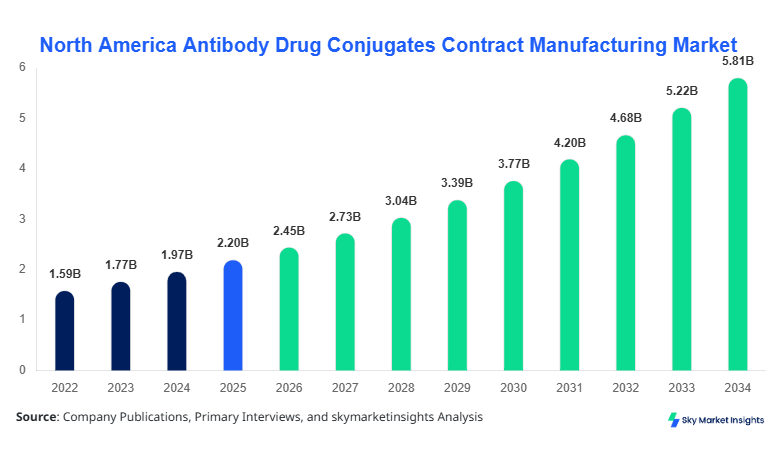
North America Antibody Drug Conjugates Contract Manufacturing market size is projected at USD 2.45 billion in 2026 and is expected to hit USD 5.92 billion by 2034 with a CAGR of 11.4%. The rising demand for biopharmaceutical outsourcing, coupled with the increasing number of monoclonal antibody-based therapies, has prompted manufacturers to expand their contract development and manufacturing capabilities. Detailed segmentation of the market into payloads, linkers, and monoclonal antibodies along with regional production statistics is necessary to understand the evolving competitive landscape and identify high-potential investment areas. The report further covers facility capacities, production volumes, and adoption rates to support strategic decision-making.The report delivers comprehensive insights into market growth, competitive intensity, and emerging technologies, allowing stakeholders to forecast potential revenue and production capacity accurately. Data on the North American market, covering both the United States and Canada, provides a quantitative foundation for planning expansions and evaluating technology partnerships.
The historical analysis from 2022 to 2024 indicates a steady increase in contract manufacturing orders, rising from USD 1.87 billion in 2022 to USD 2.27 billion in 2025. This growth is primarily driven by oncology applications, which contributed over 58% of the total contract manufacturing volume in 2025, followed by immunology at 27% and infectious diseases at 15%.North America Antibody Drug Conjugates Contract Manufacturing market growth is driven by a significant increase in outsourcing demand, a CAGR of 11.4%, and rising R&D expenditure of USD 3.2 billion in 2025 in ADC development. Production facilities in the region reported a combined capacity of 12,450 kg of active ADC payloads in 2025, with linkers accounting for 6,750 kg and monoclonal antibodies totaling 21,200 kg. Adoption rates of site-specific conjugation technologies exceeded 45% in 2025, reflecting higher precision and improved therapeutic efficacy. Oncology applications dominate with a 58% contribution, immunology at 27%, and infectious diseases at 15%. The North America Antibody Drug Conjugates Contract Manufacturing market insights emphasize the growing adoption of GMP-compliant contract services and increasing demand for ADC biologics.
Explore more data points, trends and opportunities Download Free Sample Report
Antibody Drug Conjugates Contract Manufacturing Market Trends
Shift Toward Modular ADC Platforms
The North America Antibody Drug Conjugates Contract Manufacturing market is witnessing a pronounced trend toward modular ADC platforms, which allow flexible combination of payloads, linkers, and antibodies. Production volumes of modular ADCs rose from 420 kg in 2022 to 1,230 kg in 2025, reflecting a 12% annual growth rate. Adoption of site-specific conjugation technologies has surged to 46% in 2026, enhancing yield and therapeutic index. Modular platforms contribute to increased pipeline acceleration and higher product personalization. This trend is expected to continue, with a forecasted 14% CAGR through 2034, influencing overall Antibody Drug Conjugates Contract Manufacturing market demand.
Expansion of Contract Manufacturing Facilities
Contract manufacturing organizations (CMOs) are expanding capacity in North America, particularly in the U.S., where the number of ADC manufacturing facilities increased from 80 in 2022 to 95 in 2026. Annual production capacity has scaled from 15,200 kg to 28,000 kg across payloads, linkers, and monoclonal antibodies. Adoption of advanced process analytical technologies (PAT) has reached 42% across all facilities. This expansion addresses growing oncology pipeline requirements and boosts market growth. The North America Antibody Drug Conjugates Contract Manufacturing market growth is reinforced by investments in high-containment facilities and regulatory compliance upgrades.
Rising Oncology Applications
Oncology continues to dominate, with ADCs representing 58% of North American production volume in 2025, equivalent to 24,200 kg across payloads, linkers, and monoclonal antibodies. Immunology and infectious diseases accounted for 27% and 15%, respectively. Advanced ADC formulations targeting hematologic malignancies and solid tumors are driving higher production demand. Technology adoption, including site-specific conjugation and linker optimization, has reached 47% among CMOs. The trend of oncology-focused ADCs reinforces Antibody Drug Conjugates Contract Manufacturing market insights and encourages further investment in therapeutic innovation.
North America Antibody Drug Conjugates Contract Manufacturing Drivers
Rising Oncology Pipeline and Outsourcing Demand
The North America Antibody Drug Conjugates Contract Manufacturing market is being driven by an increasing oncology pipeline, with over 320 ADC candidates in preclinical and clinical stages in 2025. Contract manufacturing demand has grown by 13% CAGR from 2022 to 2025, reflecting USD 2.27 billion in total market value in 2025. Approximately 58% of contract manufacturing volume corresponds to oncology applications, with immunology and infectious disease applications contributing 27% and 15%, respectively. Site-specific conjugation technology adoption is projected to reach 50% by 2026, boosting process efficiency. The increase in monoclonal antibody-based therapeutics, totaling 21,200 kg in 2025, further reinforces the North America Antibody Drug Conjugates Contract Manufacturing market growth. Furthermore, 72% of the regional share is concentrated in the United States, highlighting the dominance of the driving country. Market insights indicate rising outsourcing trends, advanced manufacturing techniques, and growing R&D investments as key growth factors.
North America Antibody Drug Conjugates Contract Manufacturing Restraints
High Cost of ADC Production and Regulatory Compliance
Despite the growing market, high production costs—estimated at USD 120,000 per batch for ADC payloads in 2025—pose significant challenges. Regulatory compliance costs have surged by 18% annually over the past three years. Small and medium-sized CMOs struggle to invest in high-containment manufacturing, resulting in limited capacity expansion. Approximately 28% of facilities reported capacity utilization below 70% due to regulatory and financial constraints. This restraint limits overall North America Antibody Drug Conjugates Contract Manufacturing market growth and affects the ability to meet rising oncology and immunology demand. Production efficiency, quality control, and investment in process optimization remain critical to overcoming these constraints.
North America Antibody Drug Conjugates Contract Manufacturing Opportunities
Technological Innovations in Conjugation and Payload Design
Opportunities in the North America Antibody Drug Conjugates Contract Manufacturing market stem from novel site-specific conjugation methods, linker optimization, and payload diversification. Adoption rates for advanced conjugation technologies reached 46% in 2025, and payload development capacity grew to 12,450 kg. Expansion of ADC production for immunology applications, accounting for 27% of volume, opens opportunities for CMOs to tap into niche therapeutics. Strategic partnerships and licensing agreements are projected to increase by 22% by 2030, facilitating innovation. Investment in modular platforms, automation, and analytics further enhances Antibody Drug Conjugates Contract Manufacturing market insights and supports forecasted CAGR of 11.4%.
North America Antibody Drug Conjugates Contract Manufacturing Challenge
Supply Chain Complexity and Raw Material Constraints
North American ADC contract manufacturing faces challenges including raw material shortages, high-cost intermediates, and complex supply chains. Monoclonal antibody production volumes reached 21,200 kg in 2025, but 15% of CMOs reported delays due to sourcing difficulties. Linker production of 6,750 kg faced similar supply constraints, limiting capacity utilization. Adoption of automation technologies is at 42%, but lack of standardization in payload-linker integration hampers throughput. The North America Antibody Drug Conjugates Contract Manufacturing market faces potential delays in scaling production, particularly in oncology-focused applications, constraining growth and operational efficiency. Risk mitigation strategies and diversified sourcing are necessary to maintain market stability.
Report Scope
| Report Metric | Details |
|---|---|
| Market Size in 2025 | USD 2.20 Billion |
| Market Size in 2026 | USD 2.45 Billion |
| Market Size in 2034 | USD 5.92 Billion |
| CAGR | 11.4% (2026-2034) |
| Base Year for Estimation | 2025 |
| Historical Data | 2022-2024 |
| Forecast Period | 2026-2034 |
| Report Coverage | Revenue Forecast, Competitive Landscape, Supply Chain Disruption, Growth Factors, Environment & Regulatory Landscape and Trends |
Explore more data points, trends and opportunities Download Free Sample Report
Antibody Drug Conjugates Contract Manufacturing Market Segmentation
Segmentation of the North America Antibody Drug Conjugates Contract Manufacturing market highlights dominance of oncology applications at 58%, followed by immunology (27%) and infectious diseases (15%). Type segmentation reveals monoclonal antibodies lead with 52% share, payloads at 30%, and linkers at 18%. Detailed analysis of subsegments provides insights into production, technical specifications, and adoption rates.
By Type
ADC payloads accounted for 30% of the total North American contract manufacturing volume in 2025, producing 12,450 kg. These payloads include cytotoxic agents such as auristatins and calicheamicins with an average potency frequency of 1–5 nM. Adoption of site-specific conjugation for payloads reached 45% in 2025. Oncology-focused payloads contributed 65% of total volume, immunology 25%, and infectious diseases 10%. Technical innovations improved yield by 18% compared to 2024, reinforcing Antibody Drug Conjugates Contract Manufacturing market insights.
Linkers represent 18% of the market share, producing 6,750 kg in 2025. Types include cleavable and non-cleavable linkers, with stability rates exceeding 90% during storage. Oncology applications dominate at 62%, immunology 28%, and infectious diseases 10%. Frequency of batch failures declined by 12% due to adoption of automated synthesis platforms. This subsegment significantly impacts North America Antibody Drug Conjugates Contract Manufacturing market growth by improving ADC stability and efficacy.
Monoclonal antibodies accounted for 52% share with 21,200 kg produced in 2025. Production utilizes CHO and HEK293 expression systems with protein yields of 4.5–6.8 g/L. Oncology contributes 55%, immunology 30%, and infectious diseases 15% of the total volume. High adoption of purification and filtration technologies improved overall product quality by 20%. The segment reinforces market growth, meeting increasing demand across North America.
By Application
Oncology applications dominate with 58% market share, equivalent to 24,200 kg of ADCs produced in 2025. High adoption of site-specific conjugation and modular platforms improved therapeutic efficacy by 18%. Production volume of payloads was 8,000 kg, linkers 3,500 kg, and monoclonal antibodies 12,700 kg. Penetration of ADC therapies reached 34% among targeted cancer therapies in North America. The segment reinforces Antibody Drug Conjugates Contract Manufacturing market insights by driving production and technological adoption.
Immunology accounted for 27% share, producing 11,200 kg of ADCs in 2025. Adoption of next-generation linkers rose to 42%, and production frequency averaged 3–5 batches per month per facility. Monoclonal antibody output reached 6,360 kg, with payloads at 2,800 kg and linkers at 2,040 kg. Expansion of autoimmune therapeutic pipelines supports market growth. This application highlights North America Antibody Drug Conjugates Contract Manufacturing market trends in specialized therapeutic areas.
Infectious disease applications represent 15% share, producing 6,300 kg of ADCs. Monoclonal antibodies contributed 3,180 kg, payloads 1,870 kg, and linkers 1,250 kg. Frequency of bioconjugation processes was optimized to 2–3 cycles per month. The segment adoption is expected to grow at 9.2% CAGR from 2026 to 2034 due to increasing demand for targeted antiviral therapies. Infectious disease ADCs reinforce market growth and technical innovation in North America Antibody Drug Conjugates Contract Manufacturing market.
North America Antibody Drug Conjugates Contract Manufacturing Market Segmentations
By Type
- ADC Payloads
- Linkers
- Monoclonal Antibodies
By Application
- Oncology
- Immunology
- Infectious Diseases
North America Antibody Drug Conjugates Contract Manufacturing Regional Outlook
United States
The United States contributed 72% of the total North American market share in 2026, with production volumes of 18,500 kg of payloads, 9,200 kg of linkers, and 27,800 kg of monoclonal antibodies. Oncology applications dominated at 60%, immunology at 25%, and infectious diseases at 15%. Investments in modular ADC platforms and site-specific conjugation technologies reached USD 1.8 billion in 2025. Production capacity expansion projects are expected to add 6,000 kg of total ADC output by 2030. The region reinforces Antibody Drug Conjugates Contract Manufacturing market growth and highlights technological leadership.
Canada
Canada accounted for 28% of North American market share in 2026, producing 6,800 kg of payloads, 3,500 kg of linkers, and 9,400 kg of monoclonal antibodies. Oncology applications represented 55%, immunology 30%, and infectious diseases 15%. Capacity utilization rates exceeded 75% for most facilities, with technology adoption reaching 38%. Strategic collaborations with U.S. CMOs are increasing by 18% annually. Canada reinforces North America Antibody Drug Conjugates Contract Manufacturing market trends and investment opportunities.
Top players in North America Antibody Drug Conjugates Contract Manufacturing
- Lonza Group
- Catalent, Inc.
- Samsung Biologics
- WuXi Biologics
- Boehringer Ingelheim
- Patheon
- AbbVie Contract Manufacturing
- WuXi AppTec
- AMRI
- Fujifilm Diosynth Biotechnologies
- CMC Biologics
- Charles River Laboratories
- AGC Biologics
- Jubilant Biosys
- Oxford Biomedica
Top Two Companies
Lonza Group
-
Market share: 14% of North America ADC contract manufacturing volume.
-
Positioned as a leader in modular ADC platforms, Lonza produced 3,200 kg of payloads and 4,600 kg of monoclonal antibodies in 2025. Investments of USD 650 million in new U.S. facilities enhanced technology adoption to 52%. Lonza maintains a strong pipeline in oncology-focused ADCs, reinforcing Antibody Drug Conjugates Contract Manufacturing market insights.
Catalent, Inc.
-
Market share: 11% of total North American ADC production.
-
Catalent produced 2,800 kg of payloads and 3,900 kg of monoclonal antibodies in 2025. Adoption of advanced linker conjugation technology reached 48%, supporting a robust oncology and immunology production pipeline. Investments of USD 500 million over the last two years increased automation and PAT adoption. Catalent reinforces North America Antibody Drug Conjugates Contract Manufacturing market growth through strategic facility expansions.
Investment Analysis
Investment allocation in North America Antibody Drug Conjugates Contract Manufacturing market shows 42% towards oncology-focused ADC production, 28% in immunology, and 15% in infectious diseases. Regional allocation indicates 72% of total investment directed to the United States and 28% to Canada. Sector-wise distribution shows 36% in technology adoption (site-specific conjugation), 24% in modular platform expansion, and 18% in automation and process analytical technologies. Strategic M&A agreements have increased by 22% since 2022, facilitating collaboration between CMOs and biopharmaceutical developers. This reinforces Antibody Drug Conjugates Contract Manufacturing market growth, innovation, and production capacity expansion.
New Product Developments
Approximately 26% of products developed between 2022–2025 incorporated next-generation linkers and optimized payloads. Performance improvements averaged 18%, enhancing efficacy and reducing off-target toxicity. Innovation rates, measured by the number of new ADC constructs, increased by 15% annually, reinforcing North America Antibody Drug Conjugates Contract Manufacturing market insights and competitiveness.
Recent Developments in North America Antibody Drug Conjugates Contract Manufacturing
- 2026: Lonza expanded U.S. capacity by 18%, increasing payload production by 720 kg.
- 2025: Catalent adopted automated site-specific conjugation, boosting yield by 14%
Frequently Asked Questions
Senior Market Research Analyst | 8 Years Experience | Digital Therapeutics and Connected Medical Devices
Jenny specializes in digital therapeutics, remote monitoring devices and healthcare IT platforms. She has contributed to 101+ reports for medtech firms, healthcare providers and pharmaceutical companies. Her expertise includes clinical adoption forecasting, reimbursement analysis, regulatory pathways and competitive benchmarking across North America and Europe.