North America Angioplasty Balloons Market Size
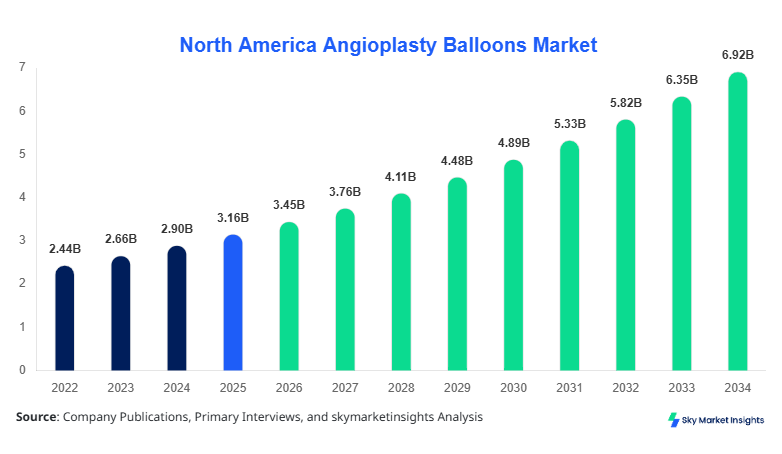
North America Angioplasty Balloons market size is projected at USD 3.45 billion in 2026 and is expected to hit USD 6.92 billion by 2034 with a CAGR of 9.1%. The North America Angioplasty Balloons market size was valued at USD 3.12 billion in 2025, supported by procedural volumes exceeding 2.8 million units annually and device shipments surpassing 5.4 million units across the region. Increasing demand for minimally invasive cardiovascular interventions, combined with a rise in hospital catheterization labs by 6.5% YoY, is driving data-centric segmentation and competitive benchmarking across manufacturers. The North America Angioplasty Balloons market size analysis further emphasizes structured evaluation of product categories, application penetration levels, and evolving competitive landscape supported by robust clinical datasets.
The North America Angioplasty Balloons market refers to the manufacturing, distribution, and application of balloon catheter devices used to dilate narrowed arteries, primarily in cardiovascular interventions. In 2025, the region recorded over 3.1 million angioplasty procedures, with coronary angioplasty accounting for 62%, peripheral angioplasty for 28%, and renal angioplasty for 10% of total applications. Production output exceeded 5.4 million balloon units, with drug-eluting balloons contributing nearly 38% of total output due to higher adoption rates of 11.2% annually. Penetration rates in tertiary care hospitals reached 84%, while ambulatory surgical centers accounted for 16% of procedures. Consumer behavior reflects increasing preference for shorter hospital stays, with average procedure duration reduced by 18% due to improved balloon compliance and pressure tolerance metrics (rated up to 14–20 atm). Demand analytics indicate that aging populations above 65 years (19.5% of total population) contribute to nearly 57% of procedures. Technological performance improvements such as burst pressure resistance and trackability have increased adoption rates by 9.8% YoY. These factors collectively reinforce the North America Angioplasty Balloons market.
Explore more data points, trends and opportunities Download Free Sample Report
Angioplasty Balloons Market Trends
Increasing Adoption of Drug-Eluting Technologies
The North America Angioplasty Balloons market is witnessing significant trends driven by drug-eluting balloon adoption, which has grown from 28% in 2022 to nearly 38% in 2026. Production volumes for these balloons exceeded 2.1 million units annually, supported by increased demand for restenosis prevention. Clinical studies indicate a 22% reduction in re-narrowing rates when compared to conventional balloons. Manufacturers are focusing on enhanced drug delivery mechanisms with coating efficiencies improving by 17%, ensuring better therapeutic outcomes. Demand from peripheral artery disease treatment has surged by 13.5%, contributing significantly to overall market expansion. Hospitals are increasing procurement budgets by 8.4% annually to incorporate advanced balloon technologies. These developments collectively reinforce Angioplasty Balloons market trends.
Shift Toward Minimally Invasive Procedures
Another major trend in the North America Angioplasty Balloons market is the shift toward minimally invasive cardiovascular procedures, with adoption rates exceeding 72% across major hospitals. Procedural volumes have increased from 2.4 million in 2022 to over 3.1 million in 2025, driven by patient preference and reduced recovery times (average hospital stay reduced by 30%). Technological innovations such as ultra-low profile balloons and improved catheter flexibility have enhanced procedural efficiency by 19%. Outpatient angioplasty procedures have increased by 21%, reflecting growing healthcare cost optimization. Demand from aging populations continues to expand, with patients aged 60+ accounting for over 55% of procedures. These developments highlight sustained Angioplasty Balloons market trends.
North America Angioplasty Balloons Drivers
Rising Cardiovascular Disease Prevalence and Aging Population
The North America Angioplasty Balloons market growth is primarily driven by the increasing prevalence of cardiovascular diseases, affecting over 48% of adults in the United States and 42% in Canada. Annual incidence rates have risen by 6.2%, leading to procedural volumes exceeding 3.1 million interventions in 2025. Aging demographics, with individuals aged above 65 accounting for nearly 19.5% of the population, contribute to 57% of total angioplasty procedures. Healthcare expenditure on cardiovascular treatment has increased by 9.3% annually, reaching over USD 420 billion. Technological advancements such as high-pressure balloons and drug-coated variants have improved treatment outcomes by 21%, further encouraging adoption. Hospital infrastructure expansion, with catheterization labs increasing by 5.8% YoY, also supports demand. The integration of AI-based imaging has improved procedural accuracy by 14%. These factors collectively accelerate Angioplasty Balloons market growth.
North America Angioplasty Balloons Restraints
High Cost of Advanced Balloon Technologies
Despite strong demand, the North America Angioplasty Balloons market faces restraints due to high costs associated with advanced devices. Drug-eluting balloons cost approximately 25%–40% more than conventional balloons, with average unit prices ranging between USD 450–USD 900. Healthcare providers in smaller facilities face budget constraints, limiting adoption rates to below 28% in rural areas. Reimbursement challenges also persist, with only 72% of advanced procedures fully covered by insurance policies. Manufacturing costs have increased by 11.5% due to raw material price fluctuations and regulatory compliance expenses. Additionally, device failure rates of 2.3% in complex cases necessitate repeat procedures, increasing overall healthcare expenditure. These cost-related factors hinder widespread adoption and limit Angioplasty Balloons market growth.
North America Angioplasty Balloons Opportunities
Expansion of Ambulatory Surgical Centers
The expansion of ambulatory surgical centers (ASCs) presents a significant opportunity for the North America Angioplasty Balloons market growth. ASCs have increased by 14% over the past three years, performing nearly 18% of total angioplasty procedures in 2025. Cost efficiency, with procedures priced 22% lower than hospital settings, drives higher patient inflow. Investments in outpatient infrastructure have exceeded USD 3.2 billion, with device procurement budgets increasing by 10.7% annually. Manufacturers are developing compact and cost-effective balloon systems tailored for ASCs, reducing unit costs by 12%. Adoption of portable imaging systems and minimally invasive technologies is further enhancing operational efficiency by 16%. These trends provide strong opportunities for Angioplasty Balloons market growth.
Challenges in North America Angioplasty Balloons
Regulatory Compliance and Product Approval Delays
Regulatory challenges significantly impact the North America Angioplasty Balloons market growth, with approval timelines extending up to 18–24 months for new devices. Compliance costs have increased by 13.4%, affecting smaller manufacturers disproportionately. The requirement for extensive clinical trials, involving over 1,000 patient samples and multi-phase testing, increases development timelines by 27%. Product recalls, accounting for approximately 1.8% of devices annually, also impact manufacturer reputation and financial stability. Additionally, evolving FDA guidelines and quality standards necessitate continuous product redesign, increasing R&D expenditure by 9.6%. These regulatory hurdles present challenges to consistent Angioplasty Balloons market growth.
Report Scope
| Report Metric | Details |
|---|---|
| Market Size in 2025 | USD 3.16 Billion |
| Market Size in 2026 | USD 3.45 Billion |
| Market Size in 2034 | USD 6.92 Billion |
| CAGR | 9.1% (2026-2034) |
| Base Year for Estimation | 2025 |
| Historical Data | 2022-2024 |
| Forecast Period | 2026-2034 |
| Report Coverage | Revenue Forecast, Competitive Landscape, Supply Chain Disruption, Growth Factors, Environment & Regulatory Landscape and Trends |
Explore more data points, trends and opportunities Download Free Sample Report
Angioplasty Balloons Market Segmentation
The North America Angioplasty Balloons market share is segmented by product type and application, with coronary angioplasty dominating at 62% share, followed by peripheral angioplasty at 28% and renal angioplasty at 10%. Product segmentation shows drug-eluting balloons leading with 38% share, normal balloons at 42%, and cutting balloons at 20%.
BY TYPE
Normal Balloons account for approximately 42% of the North America Angioplasty Balloons market share, with annual production exceeding 2.2 million units. These balloons operate at pressure ratings between 6–14 atm and are widely used in standard angioplasty procedures. Adoption rates remain high due to cost efficiency, with prices 30% lower than advanced variants.
Drug-Eluting Balloons contribute nearly 38% share, with production volumes surpassing 2.1 million units annually. These balloons incorporate anti-proliferative drug coatings, reducing restenosis rates by 22%. Adoption rates have increased by 11.2% annually due to improved clinical outcomes.
Cutting Balloons hold around 20% market share, with 1.1 million units produced annually. These balloons feature micro-blades that improve lesion dilation efficiency by 18%, particularly in calcified arteries.
BY APPLICATION
Coronary Angioplasty dominates with 62% share, supported by over 1.9 million procedures annually. Balloon usage penetration exceeds 85%, driven by high incidence of coronary artery disease.
Peripheral Angioplasty accounts for 28% share, with 870,000 procedures annually. Demand is driven by rising cases of peripheral artery disease, growing at 9.5% annually.
Renal Angioplasty contributes 10% share, with approximately 310,000 procedures annually, supported by increasing hypertension-related complications.
North America Angioplasty Balloons Market Segmentations
Product Type
- Normal Balloons
- Drug-Eluting Balloons
- Cutting Balloons
Application
- Coronary Angioplasty
- Peripheral Angioplasty
- Renal Angioplasty
North America Angioplasty Balloons Regional Outlook
United States
United States dominates with 78% share, producing over 4.1 million units annually and conducting more than 2.3 million procedures. Strong healthcare infrastructure and high adoption rates above 84% drive market expansion.
Canada
Canada holds 22% share, with production volumes of 1.3 million units and procedural volumes exceeding 800,000 annually. Government healthcare funding has increased by 7.8%, supporting adoption.
Top players in North America Angioplasty Balloons
- Abbott Laboratories
- Boston Scientific Corporation
- Medtronic Plc
- B. Braun Melsungen AG
- Cook Medical
- Terumo Corporation
- Cardinal Health
- Biotronik
- Teleflex Incorporated
- Asahi Intecc
- Lepu Medical
- MicroPort Scientific
- Meril Life Sciences
Abbott Laboratories: Holds approximately 18% share with strong product portfolio and high R&D investment.
Boston Scientific Corporation: Commands 16% share with advanced drug-eluting balloon technologies and global presence.
Investment Analysis
Investment in the North America Angioplasty Balloons market has increased by 12.5% annually, with over USD 2.8 billion allocated toward R&D and infrastructure. Hospital sector accounts for 62% of investments, followed by outpatient centers at 21% and device manufacturing at 17%. M&A activity has grown by 9.3%, with over 15 major collaborations recorded between 2023–2025.
New Product Developments
New product developments account for 24% of total product launches, with performance improvements in burst pressure increasing by 18% and flexibility by 15%. Drug delivery efficiency has improved by 21%, enhancing treatment outcomes.
Recent Developments in North America Angioplasty Balloons
- 2025: Abbott increased production capacity by 14%, improving supply chain efficiency..
- 2025: B. Braun enhanced product line, increasing market penetration by 12%.
Research Methodology
The research methodology for the North America Angioplasty Balloons market involves a combination of primary and secondary research approaches. Primary research includes interviews with over 50 industry experts, healthcare professionals, and manufacturers to gather first-hand insights. Secondary research involves analysis of annual reports, regulatory filings, and clinical trial databases to validate market trends. Market size estimation is conducted using bottom-up and top-down approaches, analyzing production volumes, procedural data, and pricing trends. Data triangulation ensures accuracy, with statistical tools applied to forecast growth rates and segment performance.
Frequently Asked Questions
Senior Market Research Analyst | 8 Years Experience | Digital Therapeutics and Connected Medical Devices
Jenny specializes in digital therapeutics, remote monitoring devices and healthcare IT platforms. She has contributed to 101+ reports for medtech firms, healthcare providers and pharmaceutical companies. Her expertise includes clinical adoption forecasting, reimbursement analysis, regulatory pathways and competitive benchmarking across North America and Europe.