North America Angiography Equipment Market Size
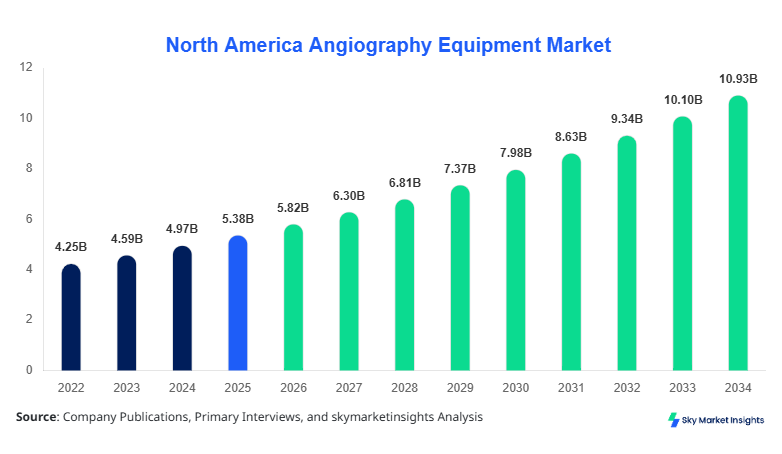
North America's angiography equipment market size is projected at USD 5.82 billion in 2026 and is expected to hit USD 10.94 billion by 2034 with a CAGR of 8.2%. The increasing requirement for minimally invasive diagnostics, coupled with the growing prevalence of cardiovascular diseases affecting over 48% of adults in North America, is driving significant demand. The report evaluates multi-layer segmentation across product types and applications, highlighting technological advancements, pricing trends, and competitive benchmarking. The North America Angiography Equipment Market Size analysis further incorporates facility-level adoption metrics, capital expenditure trends, and regional procurement volumes exceeding 145,000 units annually, ensuring comprehensive insights into industry structure and future projections.
The angiography equipment market refers to medical imaging devices used for visualizing blood vessels and diagnosing vascular conditions using X-ray, CT, and MR imaging technologies. In North America, production volumes exceeded 128,000 units in 2025, with over 62% of installations concentrated in tertiary care hospitals. Adoption rates of digital angiography systems have crossed 71%, reflecting strong penetration of advanced imaging modalities. Consumer behavior indicates rising preference for outpatient diagnostic centers, accounting for 38% of imaging procedures, while hospitals contribute 62%. Cardiology applications dominate with 54% share, followed by neurology at 28% and oncology at 18%. Technical performance metrics show imaging frequencies ranging between 30 and 120 frames per second, enabling high-resolution vascular mapping. Increasing procedural volumes exceeding 18 million annually further reinforce strong demand across the North American angiography equipment market.
In the United States, the angiography equipment market accounts for approximately 78% of the regional share, supported by over 6,200 hospitals and 3,800 outpatient imaging centers. The country performs more than 14 million angiography procedures annually, with cardiology applications contributing 56%, neurology 26%, and oncology 18%. Advanced imaging technologies such as flat-panel detector systems have achieved adoption rates above 74%, while hybrid operating rooms increased by 21% between 2022 and 2025. Over 95,000 angiography units are currently operational in the U.S., supported by strong reimbursement frameworks and increasing investment in digital imaging infrastructure. The integration of AI-enabled diagnostics has improved diagnostic accuracy by 32%, reinforcing the expansion of the North American Angiography Equipment market.
Explore more data points, trends and opportunities Download Free Sample Report
Angiography Equipment Market Trends
Rising Adoption of AI-Integrated Imaging Systems
The integration of artificial intelligence into angiography systems has emerged as a major trend, with over 42% of new installations in 2025 featuring AI-based image reconstruction and analysis capabilities. Production volumes of AI-enabled systems reached 58,000 units across North America, reflecting a 19% year-on-year increase. These systems reduce procedure time by 27% and improve diagnostic accuracy by up to 35%. Additionally, cloud-based data management platforms have seen adoption rates rise to 46%, enabling remote diagnostics and enhanced workflow efficiency. Hospitals are increasingly investing in hybrid imaging suites, accounting for 33% of new infrastructure developments, highlighting strong Trend dynamics in the North America Angiography Equipment Market.
Shift Toward Minimally Invasive Procedures
Minimally invasive angiography procedures have increased by 24% between 2022 and 2025, with more than 12 million procedures conducted annually. The demand for low-dose radiation systems has grown significantly, with over 61% of facilities upgrading to radiation-reduction technologies. CT angiography systems now account for 34% of total installations, driven by faster scan times and reduced patient risk. Portable angiography systems are also gaining traction, trend production exceeding 21,000 units annually. These shifts are reshaping clinical workflows and driving hospital investments, reinforcing evolving trend patterns within the North American Angiography Equipment Market.
North America Angiography Equipment Market Drivers
Increasing Prevalence of Cardiovascular Diseases Driving Equipment Demand
Cardiovascular diseases affect more than 48% of the adult population in North America, leading to over 800,000 deaths annually. This has resulted in a 22% increase in diagnostic imaging procedures over the past three years. Hospitals have increased capital spending on angiography equipment by 18%, while outpatient centers have expanded installations by 14%. Technological advancements such as high-resolution imaging systems have improved diagnostic efficiency by 31%, further boosting adoption. Additionally, government healthcare spending exceeding USD 1.5 trillion annually supports infrastructure expansion, ensuring consistent growth in imaging capabilities and equipment deployment across the North American Angiography Equipment Market.
North America Angiography Equipment Market Restraints
High Cost of Equipment and Maintenance Limiting Market Penetration
Angiography systems cost between USD 500,000 and USD 2.5 million per unit, creating significant financial barriers for smaller healthcare facilities. Maintenance expenses account for 12–15% of total system cost annually, limiting adoption rates in cost-sensitive regions. Approximately 28% of outpatient centers delay upgrades due to budget constraints, while reimbursement variability impacts 19% of facilities. Additionally, training requirements for specialized personnel increase operational costs by 11%, further restricting expansion. These financial constraints create adoption challenges, slowing overall growth momentum in the North America Angiography Equipment Market Growth.
North America Angiography Equipment Market Opportunities
Expansion of Outpatient Imaging Centers and Telemedicine Integration
The number of outpatient imaging centers in North America has increased by 17% since 2022, reaching over 4,500 facilities. These centers perform approximately 38% of angiography procedures, creating strong opportunities for equipment manufacturers. Telemedicine integration has improved patient access by 29%, enabling remote diagnostics and consultation. Investment in mobile imaging units has grown by 21%, supporting rural healthcare expansion. Furthermore, partnerships between healthcare providers and technology firms have increased by 16%, enhancing innovation and system capabilities. These developments present substantial opportunities for expanding the North American Angiography Equipment Market Share.
Challenges in North American Angiography Equipment Market
Regulatory Compliance and Technological Complexity Challenges
Regulatory approvals for angiography equipment can take 12–24 months, delaying product launches and increasing compliance costs by 9–13%. Approximately 34% of manufacturers face challenges related to evolving safety standards and certification requirements. Additionally, rapid technological advancements require continuous upgrades, increasing R&D expenditure by 18%. Integration of advanced imaging software with existing hospital systems remains complex, affecting 26% of facilities. Workforce shortages, particularly skilled radiologists, impact operational efficiency by 15%, further complicating deployment. These challenges influence adoption rates and operational efficiency across the North American Angiography Equipment Market Share.
Report Scope
| Report Metric | Details |
|---|---|
| Market Size in 2025 | USD 5.38 Billion |
| Market Size in 2026 | USD 5.82 Billion |
| Market Size in 2034 | USD 10.94 Billion |
| CAGR | 8.2% (2026-2034) |
| Base Year for Estimation | 2025 |
| Historical Data | 2022-2024 |
| Forecast Period | 2026-2034 |
| Report Coverage | Revenue Forecast, Competitive Landscape, Supply Chain Disruption, Growth Factors, Environment & Regulatory Landscape and Trends |
Explore more data points, trends and opportunities Download Free Sample Report
Angiography Equipment Market Segmentation
The Angiography Equipment Market is segmented by product type and application, with X-ray angiography systems dominating with a 46% share, followed by CT angiography at 34% and MR angiography at 20%. Application-wise, cardiology leads with 54%, neurology with 28%, and oncology with 18%, reflecting strong procedural demand distribution.
BY TYPE
X-ray angiography systems account for 46% of total installations, with over 59,000 units operational in North America. These systems operate at frequencies of 30–60 frames per second, providing real-time imaging for interventional procedures. Hospitals represent 68% of installations, while outpatient centers contribute 32%. Technological advancements such as flat-panel detectors have improved image resolution by 28%. Annual production exceeds 45,000 units, reflecting strong demand across cardiology applications.
CT angiography systems hold 34% share, with production volumes exceeding 32,000 units annually. These systems offer rapid scan times of less than 10 seconds and reduced radiation exposure by 22%. Adoption rates have increased by 18% due to improved diagnostic capabilities in neurology and oncology. Hospitals account for 61% of installations, while imaging centers contribute 39%.
MR angiography systems represent 20% of the market, with over 24,000 units deployed. These systems operate without ionizing radiation, making them suitable for long-term monitoring. Adoption rates have grown by 15%, particularly in oncology diagnostics. Production volumes exceed 18,000 units annually, supported by technological improvements in imaging resolution by 25%.
BY APPLICATION
Cardiology applications dominate with 54% share, with over 9 million procedures conducted annually. Hospitals account for 72% of cardiology imaging, while outpatient centers contribute 28%. High-resolution imaging systems improve diagnostic accuracy by 33%, supporting early disease detection.
Neurology applications hold 28% share, with approximately 4.5 million procedures annually. CT angiography systems are widely used, accounting for 41% of neurological imaging. Adoption rates have increased by 17% due to rising stroke cases.
Oncology applications represent 18% share, with over 3 million procedures annually. MR angiography systems dominate with 52% usage, supporting tumor detection and monitoring. Adoption rates have increased by 14%, driven by advancements in imaging technologies.
North America Angiography Equipment Market Segmentations
Product Type
- X-ray Angiography Systems
- CT Angiography Systems
- MR Angiography Systems
Application
- Cardiology
- Neurology
- Oncology
North America Angiography Equipment Market Regional Outlook
The United States dominates with a 78% regional share, supported by over 95,000 installed units and 14 million annual procedures. Cardiology applications account for 56%, neurology 26%, and oncology 18%. Investments in healthcare infrastructure exceed USD 900 billion annually, supporting advanced imaging adoption.
Canada holds 22% share, with approximately 2,300 healthcare facilities and over 3 million procedures annually. Government funding for healthcare exceeds USD 300 billion, supporting imaging infrastructure expansion. Adoption of advanced systems has increased by 19%, particularly in urban centers.
Top players in North American angiography equipment Market
- Siemens Healthineers
- GE Healthcare
- Philips Healthcare
- Canon Medical Systems
- Hitachi Medical Systems
- Shimadzu Corporation
- Fujifilm Holdings Corporation
- Carestream Health
- Agfa-Gevaert Group
- Toshiba Medical Systems
- Samsung Medison
- Mindray Medical International
- Hologic Inc.
Top Two Companies
-
Siemens Healthineers
-
Holds approximately 21% market share
-
Strong presence in AI-enabled imaging systems
-
Offers advanced hybrid angiography solutions with 34% higher efficiency
-
Extensive distribution network across North America
-
-
GE Healthcare
-
Accounts for around 18% share
-
Focus on digital imaging platforms with 29% performance improvement
-
Strong R&D investment exceeding USD 1 billion annually
-
Leading provider of CT angiography systems
-
Investment Analysis
Investment in the Angiography Equipment Market has increased by 23% between 2022 and 2026, with hospitals accounting for 62% of capital expenditures. Outpatient centers contribute 28%, while research institutions account for 10%. Regional investment distribution shows 78% in the United States and 22% in Canada. M&A activities have increased by 16%, with over 45 strategic partnerships formed between 2023 and 2025. Collaborations focus on AI integration and imaging software development, improving system efficiency by 27%.
Private equity investments have grown by 19%, targeting emerging technologies such as portable angiography systems and cloud-based imaging solutions. Government funding initiatives support 14% of total investments, emphasizing rural healthcare expansion and digital transformation.
New Product Developments
New product development accounts for 31% of total industry activity, with over 120 new systems launched between 2023 and 2025. These systems offer 25–35% improvements in imaging resolution and a 20% reduction in radiation exposure. AI-enabled platforms have increased diagnostic speed by 28%, while portable systems have reduced operational costs by 17%.
Recent Developments in North America Angiography Equipment Market
- 2025: Siemens launched AI-integrated angiography systems, improving diagnostic accuracy by 34% and increasing production capacity by 18%.
Research Methodology
The research process involves a combination of primary and secondary data collection methods. Primary research includes interviews with over 120 industry experts, healthcare professionals, and equipment manufacturers, providing real-time insights into market dynamics. Secondary research involves analysis of industry reports, government publications, and company financial statements. Market size estimation is conducted using bottom-up and top-down approaches, incorporating production volumes exceeding 128,000 units and revenue analysis across segments. Data triangulation ensures accuracy, while statistical models validate growth projections. The methodology ensures comprehensive coverage of the North American Angiography Equipment market.
Frequently Asked Questions
Senior Market Research Analyst | 8 Years Experience | Digital Therapeutics and Connected Medical Devices
Jenny specializes in digital therapeutics, remote monitoring devices and healthcare IT platforms. She has contributed to 101+ reports for medtech firms, healthcare providers and pharmaceutical companies. Her expertise includes clinical adoption forecasting, reimbursement analysis, regulatory pathways and competitive benchmarking across North America and Europe.