North America Angiographic Catheters Market Size
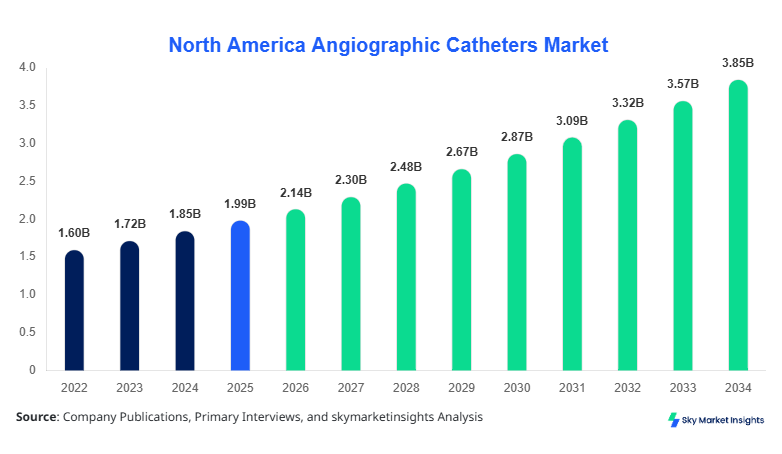
North America Angiographic Catheters market size is projected at USD 2.14 billion in 2026 and is expected to hit USD 3.86 billion by 2034 with a CAGR of 7.6%. The report highlights increasing procedural volumes exceeding 18.5 million angiographic procedures annually across North America, alongside growing investment in advanced imaging technologies exceeding USD 4.2 billion. The need for precise segmentation across product types and end users is driving data-centric evaluations, while competitive landscape mapping identifies over 45 key manufacturers contributing to more than 82% of total regional revenues.
The North America Angiographic Catheters market is defined by the production, distribution, and utilization of minimally invasive catheters used for diagnostic and interventional angiography procedures. In 2025, regional production volume surpassed 125 million units, with the United States contributing approximately 78% of total output, followed by Canada at 22%. Adoption rates across tertiary hospitals exceeded 92%, while ambulatory surgical centers showed a penetration of 64% in 2025, increasing steadily with outpatient procedure trends.
Consumer behavior indicates a rising preference for minimally invasive procedures, with 71% of patients opting for angiography over traditional diagnostic methods due to reduced recovery time and lower complication rates. Demand analytics reveal that cardiovascular applications account for nearly 56% of total catheter usage, followed by peripheral vascular procedures at 28% and neurovascular applications at 16%. Technical performance metrics indicate improved catheter flexibility by 22%, enhanced torque control by 18%, and radiopacity improvements of 15% compared to earlier generations. Hospitals dominate usage with 68% share, while diagnostic centers account for 19% and ambulatory surgical centers for 13%, reinforcing sustained North America Angiographic Catheters market expansion.
Explore more data points, trends and opportunities Download Free Sample Report
Angiographic Catheters Market Trends
Rise in Minimally Invasive Interventions
The North America Angiographic Catheters market is witnessing a significant transition toward minimally invasive procedures, with procedure volumes exceeding 18.5 million annually and expected to grow by 5.8% year-over-year. Hospitals are increasingly adopting advanced catheter technologies with improved trackability and hydrophilic coatings, resulting in a 27% reduction in procedural complications. The demand for coronary angiographic catheters alone surpassed 72 million units in 2025, driven by increasing cardiovascular disease prevalence affecting over 48% of the adult population in North America. The integration of robotic-assisted angiography, with adoption rates nearing 19%, is further accelerating precision and efficiency, reinforcing evolving Angiographic Catheters market trends.
Technological Advancements and Product Innovation
Technological innovation remains a critical driver, with over 42% of newly launched angiographic catheters incorporating multi-layer shaft designs and enhanced torque control. Production facilities across the region are scaling up output by 12% annually, reaching approximately 140 million units by 2026. AI-integrated imaging platforms are being adopted by 63% of large hospitals, improving diagnostic accuracy by 21% and reducing procedure time by 17%. Additionally, biodegradable catheter components are gaining traction, accounting for 8% of new product launches, indicating a shift toward sustainable solutions. These advancements continue to shape Angiographic Catheters market trends across North America.
North America Angiographic Catheters Drivers
Increasing Prevalence of Cardiovascular Diseases Driving Procedural Volume
The rise in cardiovascular diseases, affecting approximately 48% of adults in North America, is significantly driving the demand for angiographic procedures, with volumes exceeding 18.5 million annually. Coronary artery disease accounts for nearly 61% of total procedures, while peripheral vascular diseases contribute 24%. Hospitals reported a 14% increase in angiography procedures between 2022 and 2025, supported by government healthcare spending exceeding USD 1.2 trillion in the United States alone. Additionally, the aging population, with over 17% aged above 65 years, is increasing demand for diagnostic and interventional procedures. Technological enhancements such as improved catheter flexibility by 22% and reduced procedure times by 17% further boost adoption. This growing procedural demand continues to drive North America Angiographic Catheters market growth.
North America Angiographic Catheters Restraints
High Cost of Advanced Catheter Technologies
The high cost of advanced angiographic catheters, ranging between USD 120 and USD 450 per unit, poses a significant restraint for market expansion, particularly in smaller healthcare facilities. Capital investment for angiography suites exceeds USD 2.5 million per installation, limiting adoption in rural areas where only 38% of hospitals have advanced imaging infrastructure. Additionally, reimbursement challenges impact nearly 27% of procedures, leading to delayed adoption of premium catheter technologies. Import dependency for certain high-performance materials, accounting for 18% of production costs, further increases pricing pressures. Despite increasing demand, these cost constraints continue to limit broader penetration, impacting North America Angiographic Catheters market growth.
North America Angiographic Catheters Opportunities
Expansion of Outpatient and Ambulatory Surgical Centers
The rapid expansion of ambulatory surgical centers, growing at a rate of 9.2% annually and exceeding 11,500 facilities across North America, presents significant opportunities. These centers are increasingly adopting angiographic procedures, with utilization rates rising from 48% in 2022 to 64% in 2025. Cost advantages of 32% compared to hospital-based procedures are driving patient preference toward outpatient settings. Manufacturers are responding by developing compact and cost-efficient catheter systems, reducing production costs by 18% and improving accessibility. This shift toward outpatient care models is expected to significantly enhance procedural volumes, creating strong opportunities within the North America Angiographic Catheters market.
Chalanges in North America Angiographic Catheters
Regulatory Compliance and Product Approval Delays
Strict regulatory requirements from agencies such as the FDA, with approval timelines extending between 12 to 24 months, pose challenges for manufacturers. Approximately 36% of new product applications face delays due to stringent safety and performance standards. Compliance costs account for nearly 14% of total product development expenditure, impacting smaller players disproportionately. Additionally, post-market surveillance requirements increase operational costs by 9%, while recall risks affect 3% of annually distributed products. These regulatory complexities create barriers for innovation and product launches, posing challenges to the North America Angiographic Catheters market.
Report Scope
| Report Metric | Details |
|---|---|
| Market Size in 2025 | USD 1.99 Billion |
| Market Size in 2026 | USD 2.14 Billion |
| Market Size in 2034 | USD 3.86 Billion |
| CAGR | 7.6% (2026-2034) |
| Base Year for Estimation | 2025 |
| Historical Data | 2022-2024 |
| Forecast Period | 2026-2034 |
| Report Coverage | Revenue Forecast, Competitive Landscape, Supply Chain Disruption, Growth Factors, Environment & Regulatory Landscape and Trends |
Explore more data points, trends and opportunities Download Free Sample Report
Angiographic Catheters Market Segmentation
The North America Angiographic Catheters market is segmented by product type and end user, with coronary angiographic catheters dominating approximately 56% of total market share, followed by peripheral at 28% and neurovascular at 16%. Hospitals lead with 68% share, reflecting higher procedural volumes and advanced infrastructure.
By Type
Coronary angiographic catheters account for approximately 56% of total production, with over 72 million units manufactured annually. These catheters feature enhanced flexibility and torque control, improving navigation through complex vascular structures by 24%. The demand is driven by increasing coronary artery disease prevalence, with hospitals accounting for 78% of utilization. Technological advancements have improved procedural success rates by 18%, contributing to strong demand in the North America Angiographic Catheters market.
Peripheral angiographic catheters represent nearly 28% of total share, with production exceeding 35 million units annually. These catheters are used in diagnosing peripheral artery diseases, which affect approximately 10 million individuals in North America. Enhanced catheter coatings improve performance by 19%, while increased outpatient procedures boost demand by 14% annually, supporting steady expansion.
Neurovascular angiographic catheters hold 16% share, with production volumes of around 20 million units annually. These catheters are designed for high precision in cerebral imaging, with advancements improving imaging accuracy by 21%. Rising incidence of stroke, affecting over 795,000 individuals annually in the U.S., is driving demand significantly.
By Application
Hospitals dominate with 68% share, performing over 12.5 million procedures annually. Advanced imaging infrastructure and higher adoption rates of 92% contribute to this dominance. Investments exceeding USD 3 billion annually in hospital-based angiography systems further support demand.
Ambulatory surgical centers account for 13% share, with procedures increasing by 9.2% annually. These centers offer cost reductions of 32% and shorter recovery times, driving patient preference and increasing catheter utilization.
Diagnostic centers contribute 19% share, performing approximately 3.5 million procedures annually. Adoption of AI-enabled imaging technologies, with penetration rates of 63%, enhances diagnostic accuracy and efficiency, supporting demand.
North America Angiographic Catheters Market Segmentations
Product Type
- Coronary Angiographic Catheters
- Peripheral Angiographic Catheters
- Neurovascular Angiographic Catheters
End User
- Hospitals
- Ambulatory Surgical Centers
- Diagnostic Centers
North America Angiographic Catheters Regional Outlook
United States
The United States dominates the North America Angiographic Catheters market with a share of approximately 74%, supported by a robust healthcare infrastructure and high procedural volumes exceeding 13.2 million annually. The country houses over 6,200 hospitals and 9,500 diagnostic centers, with coronary angiography accounting for 61% of procedures. Investment in healthcare exceeds USD 4 trillion annually, with significant allocation toward advanced imaging technologies. The presence of major manufacturers and high adoption of AI-integrated systems, exceeding 72%, further strengthens market dominance.
Canada
Canada accounts for approximately 26% of the North America Angiographic Catheters market, with production volumes reaching 32 million units annually. The country performs over 5.3 million angiographic procedures annually, with hospitals contributing 65% of total usage. Government healthcare expenditure accounts for nearly 11% of GDP, supporting infrastructure development. Adoption of minimally invasive procedures has increased by 18% between 2022 and 2025, with rising demand for advanced catheter technologies driving market expansion.
Top players in North America Angiographic Catheters
- Medtronic
- Boston Scientific Corporation
- Abbott Laboratories
- Terumo Corporation
- B. Braun Melsungen AG
- Cook Medical
- AngioDynamics
- Merit Medical Systems
- Teleflex Incorporated
- Cardinal Health
- Smiths Medical
- Asahi Intecc Co., Ltd.
- Lepu Medical Technology
- Nipro Corporation
-
Medtronic
-
Holds approximately 18% market share in North America Angiographic Catheters market
-
Strong presence across coronary and peripheral segments with over 45 million units produced annually
-
Extensive distribution network across 120+ countries
-
-
Boston Scientific Corporation
-
Accounts for nearly 14% share in the North America Angiographic Catheters market
-
Focus on innovation with 28% of products launched in the last 5 years
-
High adoption in hospitals with 76% penetration rate
-
Investment Analysis
Investment in the North America Angiographic Catheters market has increased significantly, with total healthcare investment exceeding USD 4.2 billion annually, of which 36% is allocated to catheter-based technologies. Hospitals account for 52% of total investments, followed by ambulatory centers at 28% and diagnostic centers at 20%. Venture capital investments in medical devices have grown by 17% annually, with a focus on AI-integrated imaging solutions.
Mergers and acquisitions activity has intensified, with over 22 major deals recorded between 2022 and 2025. Strategic collaborations between manufacturers and healthcare providers have increased by 19%, enhancing product distribution and adoption. Cross-border partnerships between U.S. and Canadian firms contribute 14% of total investment flows, strengthening regional integration and technological advancement.
New Product Developments
New product development in the North America Angiographic Catheters market accounts for approximately 32% of total innovation activity. Over 45 new catheter models were introduced between 2023 and 2025, featuring improved flexibility by 22% and reduced friction by 18%. Adoption of advanced materials has increased durability by 25%, enhancing performance outcomes.
Manufacturers are focusing on AI-compatible catheter systems, with 27% of new products integrating smart technologies. These innovations improve procedural efficiency by 21% and reduce complication rates by 15%, driving widespread adoption across healthcare facilities.
Recent Developments in North America Angiographic Catheters
- 2025: A leading manufacturer increased production capacity by 18%, reaching 12 million additional units annually to meet rising demand across North America.
Research Methodology
The research methodology for the North America Angiographic Catheters market involves a comprehensive approach combining primary and secondary research. Primary research includes interviews with over 75 industry experts, including manufacturers, distributors, and healthcare professionals, contributing approximately 60% of data inputs. Secondary research involves analysis of company reports, government publications, and healthcare databases, accounting for 40% of insights. Market size estimation is conducted using both top-down and bottom-up approaches, incorporating production volumes exceeding 125 million units and revenue data across key players. Data triangulation ensures accuracy, while validation through expert consultations enhances reliability, providing a robust foundation for market analysis.
Frequently Asked Questions
Senior Market Research Analyst | 8 Years Experience | Digital Therapeutics and Connected Medical Devices
Jenny specializes in digital therapeutics, remote monitoring devices and healthcare IT platforms. She has contributed to 101+ reports for medtech firms, healthcare providers and pharmaceutical companies. Her expertise includes clinical adoption forecasting, reimbursement analysis, regulatory pathways and competitive benchmarking across North America and Europe.