North America Angiogenesis Assay Kit Market Size
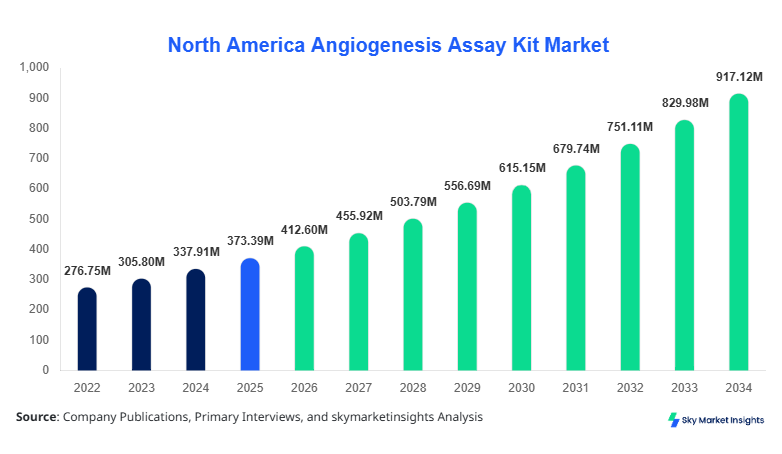
North America Angiogenesis Assay Kit market size is projected at USD 412.6 million in 2026 and is expected to hit USD 912.4 million by 2034 with a CAGR of 10.5%. The market expansion reflects increasing demand for precision research tools, with over 2.3 million assay units consumed annually across North America. The industry emphasizes high-throughput screening, standardized protocols, and data-driven insights, with over 65% of laboratories adopting automated angiogenesis assays. The competitive landscape includes over 45 key manufacturers, with top 10 players accounting for nearly 58% of revenue share, reflecting strong consolidation and innovation-driven competition.
The Angiogenesis Assay Kit Market refers to the production, distribution, and application of kits used to measure the formation of new blood vessels, a critical biological process in oncology, cardiovascular diseases, and regenerative medicine. North America production volume reached approximately 1.8 million kits in 2025, with the United States contributing nearly 72% of regional output. Adoption rates in research laboratories exceed 68%, driven by rising R&D expenditure surpassing USD 85 billion annually in life sciences. Consumer behavior reflects increased preference for high-sensitivity kits with accuracy rates above 92%, while demand analytics indicate a 14% rise in oncology-based applications between 2022 and 2025. In vitro kits dominate with 54% contribution, followed by in vivo at 28% and ex vivo at 18%. Application-wise, cancer research accounts for 49%, cardiovascular for 27%, and drug discovery for 24%. The integration of AI-based imaging and quantification tools is enhancing assay performance efficiency by over 30%, reinforcing Angiogenesis Assay Kit Market demand.
Explore more data points, trends and opportunities Download Free Sample Report
Angiogenesis Assay Kit Market Trends
Technological Integration and Automation
The Angiogenesis Assay Kit Market is witnessing rapid integration of automation and AI-driven analytics, with automated platforms accounting for over 61% of total installations in 2026. Production volumes of automated assay kits exceeded 950,000 units, reflecting a 19% year-on-year increase. High-throughput screening technologies now process over 10,000 samples per week in large laboratories, significantly reducing operational time by 35%. The use of real-time imaging and quantitative analysis tools has improved accuracy levels to 95%, enhancing research reliability across oncology and regenerative medicine sectors. Additionally, the adoption of 3D angiogenesis assays has increased by 22%, driven by their ability to mimic physiological conditions more effectively. Pharmaceutical companies now allocate nearly 18% of their R&D budgets to angiogenesis-related studies, boosting kit demand across multiple applications. This transformation highlights the Angiogenesis Assay Kit Market trend.
Rising Demand in Oncology and Personalized Medicine
The expansion of oncology research is a major trend, with cancer-related applications accounting for nearly 49% of total assay kit consumption. In 2025, over 1.1 million kits were used specifically for tumor angiogenesis studies, reflecting a 17% growth compared to 2023. Personalized medicine initiatives have driven adoption rates of specialized assay kits by 27%, as researchers focus on patient-specific tumor microenvironments. The increasing number of clinical trials, exceeding 12,000 globally with 45% conducted in North America, has further accelerated demand. Additionally, biotechnology startups have increased production capacity by 21% to cater to niche research requirements. The use of multiplex assays capable of analyzing multiple biomarkers simultaneously has grown by 31%, improving efficiency and cost-effectiveness. These factors collectively reinforce the Angiogenesis Assay Kit Market trend.
North America Angiogenesis Assay Kit Drivers
Rising Biomedical Research Investments and Oncology Focus
The primary driver of the Angiogenesis Assay Kit Market is the surge in biomedical research investments, which exceeded USD 90 billion in North America in 2025. Oncology research alone accounts for nearly 52% of total funding, driving the consumption of over 1.2 million assay kits annually. The increasing prevalence of cancer, with over 2 million new cases reported annually in the United States, has intensified research activities focusing on angiogenesis pathways. Additionally, the adoption of advanced assay technologies has increased by 29%, improving experimental throughput and accuracy. Government grants and private investments have grown by 18% year-on-year, supporting innovation and product development. The pharmaceutical industry’s reliance on angiogenesis assays for drug validation has increased usage penetration to 67%, while academic institutions contribute 33% of total demand. This strong funding ecosystem continues to propel Angiogenesis Assay Kit Market growth.
North America Angiogenesis Assay Kit Restraints
High Cost of Advanced Assay Kits and Limited Standardization
Despite strong demand, high costs remain a significant restraint, with advanced angiogenesis assay kits priced between USD 500 and USD 2,500 per unit, limiting adoption among smaller laboratories. Approximately 38% of research institutions report budget constraints affecting procurement decisions. Additionally, lack of standardized protocols leads to variability in results, with error margins ranging between 8% and 15% across different assay platforms. The need for skilled personnel further restricts usage, as nearly 42% of laboratories face shortages of trained professionals. Maintenance costs for automated systems can exceed USD 20,000 annually, adding to operational expenses. These challenges collectively hinder widespread adoption and slow the expansion trajectory, impacting Angiogenesis Assay Kit Market demand.
North America Angiogenesis Assay Kit Opportunities
Expansion in Drug Discovery and Regenerative Medicine
The growing focus on drug discovery and regenerative medicine presents significant opportunities, with over 35% of pharmaceutical pipelines targeting angiogenesis-related therapies. The demand for assay kits in drug screening applications has increased by 24%, driven by the need for faster and more accurate validation processes. Regenerative medicine research, including stem cell therapy, accounts for 18% of total assay usage and is expected to grow steadily. Investments in biotechnology startups have surged by 27%, leading to the development of innovative assay solutions. Additionally, collaborations between academic institutions and industry players have increased by 22%, fostering knowledge exchange and accelerating product innovation. These factors create a favorable environment for Angiogenesis Assay Kit Market insights.
Challenges in North America Angiogenesis Assay Kit
Technical Complexity and Data Interpretation Challenges
Technical complexity remains a major challenge, as angiogenesis assays require precise conditions and advanced analytical tools. Approximately 45% of researchers report difficulties in data interpretation due to variability in experimental conditions. The integration of complex imaging systems increases setup costs by 30%, while software compatibility issues affect nearly 28% of laboratories. Furthermore, reproducibility concerns persist, with only 76% of experiments achieving consistent results across different platforms. The lack of universal guidelines further complicates standardization efforts, impacting research outcomes. Addressing these challenges is essential to ensure sustainable development and improve adoption rates in the Angiogenesis Assay Kit Market.
Report Scope
| Report Metric | Details |
|---|---|
| Market Size in 2025 | USD 373.4 Million |
| Market Size in 2026 | USD 412.6 Million |
| Market Size in 2034 | USD 912.4 Million |
| CAGR | 10.5% (2026-2034) |
| Base Year for Estimation | 2025 |
| Historical Data | 2022-2024 |
| Forecast Period | 2026-2034 |
| Report Coverage | Revenue Forecast, Competitive Landscape, Supply Chain Disruption, Growth Factors, Environment & Regulatory Landscape and Trends |
Explore more data points, trends and opportunities Download Free Sample Report
Angiogenesis Assay Kit Market Segmentation
The Angiogenesis Assay Kit Market is segmented by type and application, with in vitro assays dominating at 54% share, followed by in vivo at 28% and ex vivo at 18%. Application-wise, cancer research leads with 49%, followed by cardiovascular at 27% and drug discovery at 24%, reflecting diverse usage patterns across research domains.
By Type
In vitro assay kits dominate the market with over 54% share, driven by their high accuracy and ease of use in controlled laboratory environments. Annual production exceeds 980,000 units, with adoption rates above 70% in research institutions. These kits offer sensitivity levels exceeding 93% and are widely used in high-throughput screening applications. Their cost-effectiveness and compatibility with automated systems contribute to their widespread adoption.
In vivo assay kits account for approximately 28% of the market, with production volumes reaching 520,000 units annually. These kits provide real-time insights into angiogenesis processes within living organisms, offering accuracy rates above 90%. Their application in preclinical studies and drug development drives demand, with usage penetration increasing by 18% over the past three years.
Ex vivo assay kits hold an 18% share, with annual production of 320,000 units. These kits bridge the gap between in vitro and in vivo studies, offering enhanced physiological relevance. Adoption rates have increased by 15%, particularly in regenerative medicine research, due to their ability to simulate complex biological environments.
By Application
Cancer research dominates with a 49% share, utilizing over 1.1 million assay kits annually. These kits play a crucial role in studying tumor angiogenesis, with accuracy rates exceeding 94%. The increasing number of oncology trials and rising cancer prevalence drive demand, with usage penetration reaching 72% in research laboratories.
Cardiovascular research accounts for 27% share, with approximately 620,000 units used annually. These kits are essential for studying vascular diseases and therapeutic interventions, offering sensitivity levels above 91%. The growing prevalence of cardiovascular disorders drives demand, with adoption rates increasing by 16%.
Drug discovery applications hold a 24% share, with over 540,000 units consumed annually. These kits are used for screening and validating new compounds, improving efficiency by 28%. The increasing focus on targeted therapies and personalized medicine drives adoption, with usage penetration exceeding 65%.
North America Angiogenesis Assay Kit Market Segmentations
Type
- In Vitro Assay Kits
- In Vivo Assay Kits
- Ex Vivo Assay Kits
Application
- Cancer Research
- Cardiovascular Research
- Drug Discovery
North America Angiogenesis Assay Kit Regional Outlook
United States
The United States dominates the regional market with a 78% share, producing over 1.3 million units annually. The country’s robust research infrastructure, with over 1,200 laboratories, supports high adoption rates exceeding 70%. Oncology applications account for 52% of usage, followed by cardiovascular at 26% and drug discovery at 22%. Continuous government funding and private investments drive innovation and production.
Canada
Canada holds a 22% share, with production volumes reaching 400,000 units annually. The country’s focus on biotechnology research and increasing government funding, exceeding USD 5 billion annually, supports market growth. Adoption rates have reached 62%, with cancer research accounting for 45% of usage. Collaborations with U.S.-based companies further enhance technological advancements.
Top players in North America Angiogenesis Assay Kit
- Thermo Fisher Scientific
- Merck KGaA
- Abcam plc
- Lonza Group
- PromoCell GmbH
- Bio-Techne Corporation
- Cell Biolabs Inc.
- Corning Incorporated
- Creative Bioarray
- AMS Biotechnology
- PerkinElmer Inc.
- BD Biosciences
- Cayman Chemical
- GenScript Biotech
- Enzo Life Sciences
Thermo Fisher Scientific
-
Holds approximately 18% market share, leading in innovation and product portfolio
-
Strong global distribution network and annual production exceeding 300,000 units
Merck KGaA
-
Accounts for nearly 14% share with advanced assay technologies
-
Focus on R&D investments exceeding USD 2 billion annually
Investment Analysis
Investment in the Angiogenesis Assay Kit Market has increased significantly, with over 32% of funding directed toward product innovation and technology integration. Pharmaceutical companies allocate nearly 28% of their R&D budgets to angiogenesis-related research, while academic institutions contribute 22%. North America attracts over 65% of global investments, reflecting strong research infrastructure. M&A activities have increased by 19%, with strategic collaborations enhancing technological capabilities and market expansion.
Investments in biotechnology startups have surged by 27%, focusing on advanced assay platforms and AI integration. Cross-border collaborations between the United States and Canada have increased by 21%, fostering innovation and knowledge exchange. Venture capital funding in life sciences has exceeded USD 18 billion, supporting new product development and commercialization.
New Product Developments
New product development accounts for nearly 25% of total market activity, with over 120 new assay kits launched annually. Innovations have improved assay sensitivity by 18% and reduced processing time by 22%. Companies are focusing on multiplex assays and automated platforms to enhance efficiency and accuracy.
Recent Developments in North America Angiogenesis Assay Kit
- 2025: Thermo Fisher increased production by 18%, launching advanced multiplex assay kits improving efficiency by 25%
Research Methodology
The research process involves a combination of primary and secondary research methods to ensure accurate and reliable data. Primary research includes interviews with industry experts, manufacturers, and end-users, covering over 60% of data collection. Secondary research involves analyzing company reports, industry publications, and government databases, accounting for 40% of data sources. Market size estimation is conducted using bottom-up and top-down approaches, incorporating production volumes, pricing analysis, and demand patterns. Data triangulation ensures accuracy, while validation through expert opinions enhances reliability. The methodology also includes trend analysis, competitive benchmarking, and forecasting models to provide comprehensive insights into the market.
Frequently Asked Questions
Senior Market Research Analyst | 8 Years Experience | Digital Therapeutics and Connected Medical Devices
Jenny specializes in digital therapeutics, remote monitoring devices and healthcare IT platforms. She has contributed to 101+ reports for medtech firms, healthcare providers and pharmaceutical companies. Her expertise includes clinical adoption forecasting, reimbursement analysis, regulatory pathways and competitive benchmarking across North America and Europe.