North America Angina Market Size
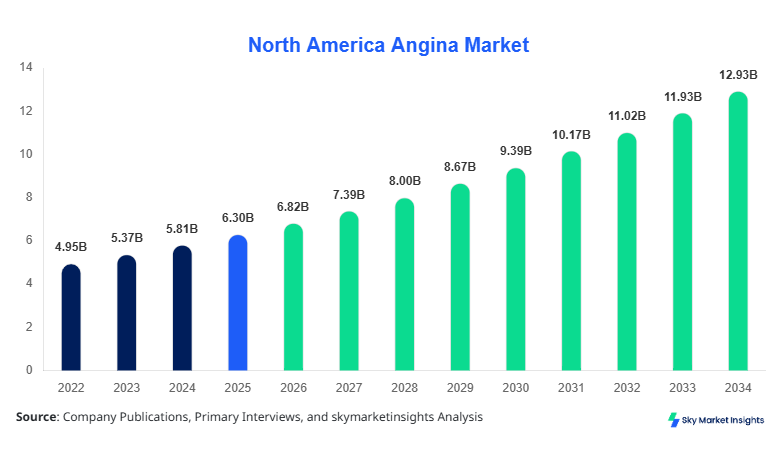
North America Angina market size is projected at USD 6.82 billion in 2026 and is expected to hit USD 12.94 billion by 2034 with a CAGR of 8.32%. The increasing prevalence of cardiovascular disorders across the United States and Canada, rising geriatric population exceeding 18.5% of total demographics, and advancements in diagnostic imaging technologies are significantly contributing to the overall expansion trajectory. Comprehensive segmentation across type and application segments highlights the need for data-driven insights, while competitive landscape evaluation reveals over 45 active pharmaceutical and medical device manufacturers contributing to nearly 72% of total therapeutic output in the region.
The North America Angina Market encompasses pharmaceutical therapies, diagnostic tools, and interventional devices aimed at managing angina pectoris, a condition characterized by chest pain due to reduced blood flow to the heart. In 2025, North America recorded over 11.2 million diagnosed angina cases, with the United States accounting for nearly 78% of total cases and Canada contributing approximately 22%. Adoption rates of advanced diagnostic techniques such as coronary angiography and stress testing have exceeded 64% across urban healthcare systems, while wearable monitoring penetration reached 38% in 2025. Consumer behavior reflects a growing preference for non-invasive treatment modalities, with demand for beta-blockers and calcium channel blockers accounting for 46% of prescriptions, while nitrates represent approximately 31%. Application split indicates hospitals dominate with 52% usage, followed by specialty clinics at 33% and homecare settings at 15%. Increased patient awareness and early screening initiatives continue to strengthen Angina Market demand.
Explore more data points, trends and opportunities Download Free Sample Report
Angina Market Trends
The Angina Market is witnessing substantial technological transformation driven by the integration of AI-based diagnostic tools and wearable cardiac monitoring devices. In 2025, over 3.2 million wearable cardiac devices were deployed across North America, reflecting a 27% increase compared to 2023. AI-driven predictive analytics systems have achieved diagnostic accuracy rates of up to 89%, improving early detection of ischemic episodes. Additionally, pharmaceutical innovation has resulted in a 14% increase in new drug approvals targeting angina-related pathways, while production volumes of anti-anginal medications exceeded 1.6 billion units annually. These advancements are driving Angina Market growth.
Another prominent trend is the shift toward minimally invasive treatment procedures, including percutaneous coronary interventions (PCI), which have grown by 18% year-over-year, reaching over 1.2 million procedures annually in North America. Furthermore, digital therapeutics adoption has increased by 22%, with remote patient monitoring solutions improving adherence rates by 31%. Specialty clinics are increasingly adopting hybrid treatment models combining pharmacological and interventional approaches, contributing to improved patient outcomes. The integration of telemedicine platforms, which saw a 36% surge in cardiovascular consultations, is further reinforcing Angina Market trends.
North America Angina Market Drivers
Rising Prevalence of Cardiovascular Diseases and Aging Population
The increasing incidence of cardiovascular diseases, affecting over 48% of the adult population in North America, is a major driver of the Angina Market. In 2025, more than 18.2 million individuals were diagnosed with coronary artery disease, directly contributing to angina prevalence. The geriatric population aged above 65 years, which constitutes 18.5% of the population, is expected to reach 22% by 2034, significantly increasing patient volume. Additionally, sedentary lifestyles affecting nearly 41% of adults and obesity rates exceeding 36% are further exacerbating cardiovascular risks. Pharmaceutical production for angina therapies increased by 12% annually, while diagnostic procedure volumes rose by 15% between 2022 and 2025. These factors collectively accelerate Angina Market growth.
North America Angina Market Restraints
High Treatment Costs and Limited Accessibility in Rural Areas
The Angina Market faces significant restraints due to high treatment costs, with average hospitalization expenses ranging between USD 18,000 and USD 42,000 per patient. Advanced diagnostic procedures such as angiography can cost up to USD 5,000 per test, limiting accessibility for approximately 27% of rural populations. Insurance coverage gaps affect nearly 19% of patients, particularly in underserved regions. Additionally, disparities in healthcare infrastructure, with only 62% of rural facilities equipped with advanced cardiac care units, hinder effective treatment delivery. These economic and infrastructural challenges restrict Angina Market expansion.
North America Angina Market Opportunities
Expansion of Telemedicine and Digital Health Solutions
The rapid adoption of telemedicine, which increased by 36% between 2022 and 2025, presents significant opportunities for the Angina Market. Remote monitoring solutions have reduced hospital readmission rates by 21%, while wearable devices have improved patient compliance by 29%. Investment in digital health infrastructure exceeded USD 3.8 billion in 2025, with over 42% allocated to cardiovascular care technologies. Additionally, partnerships between healthcare providers and technology firms have grown by 17%, enabling integrated care models. These developments are expected to unlock new growth avenues for the Angina Market.
Challenges in North America Angina Market
Regulatory Complexities and Drug Development Delays
The Angina Market encounters challenges related to stringent regulatory requirements, with drug approval timelines averaging 8–12 years and development costs exceeding USD 1.2 billion per product. Clinical trial failure rates for cardiovascular drugs remain high at approximately 42%, delaying market entry for innovative therapies. Additionally, compliance with evolving FDA and Health Canada regulations increases operational costs by 18% for manufacturers. Supply chain disruptions, affecting nearly 23% of pharmaceutical production in 2024, further complicate market dynamics. These challenges continue to impact Angina Market growth.
Report Scope
| Report Metric | Details |
|---|---|
| Market Size in 2025 | USD 6.30 Billion |
| Market Size in 2026 | USD 6.82 Billion |
| Market Size in 2034 | USD 12.94 Billion |
| CAGR | 8.32% (2026-2034) |
| Base Year for Estimation | 2025 |
| Historical Data | 2022-2024 |
| Forecast Period | 2026-2034 |
| Report Coverage | Revenue Forecast, Competitive Landscape, Supply Chain Disruption, Growth Factors, Environment & Regulatory Landscape and Trends |
Explore more data points, trends and opportunities Download Free Sample Report
Angina Market Segmentation
The Angina Market is segmented based on type and application, with stable angina dominating at 61% share, followed by unstable angina at 28% and variant angina at 11%. Application-wise, hospitals lead with 52%, specialty clinics 33%, and homecare 15%, reflecting varying levels of treatment complexity and infrastructure.
By Type
Stable angina accounts for approximately 61% of total cases, with over 6.8 million patients in North America. Treatment involves beta-blockers, nitrates, and lifestyle management, with pharmaceutical production exceeding 920 million units annually. Diagnostic accuracy for stable angina has improved to 87% due to advanced imaging technologies.
Unstable angina represents 28% of cases, requiring urgent medical intervention. Over 3.1 million cases are reported annually, with hospitalization rates exceeding 74%. Treatment protocols include antiplatelet therapy and invasive procedures, with medical device utilization increasing by 19%.
Variant angina accounts for 11% of cases, often linked to coronary artery spasms. Approximately 1.2 million patients are diagnosed annually, with calcium channel blockers forming 68% of treatment prescriptions. Diagnostic frequency remains lower at 53% due to episodic symptoms.
By Application
Hospitals dominate the Angina Market with 52% share, treating over 5.8 million patients annually. Advanced infrastructure enables high-volume procedures such as PCI, exceeding 1.2 million cases per year. Diagnostic equipment utilization rates surpass 76%.
Specialty clinics hold 33% share, focusing on outpatient care and follow-up treatments. Approximately 3.7 million patients are treated annually, with telehealth integration improving efficiency by 28%.
Homecare accounts for 15% share, supported by remote monitoring devices used by over 1.6 million patients. Adoption rates for digital therapeutics have increased by 22%, enhancing patient adherence.
North America Angina Market Segmentations
Type
- Stable Angina
- Unstable Angina
- Variant Angina
Application
- Hospitals
- Specialty Clinics
- Homecare
North America Angina Regional Outlook
United States
The United States leads the Angina Market with 78% share, driven by advanced healthcare infrastructure and high disease prevalence. Over 8.7 million patients receive treatment annually, with hospitals accounting for 55% of applications. Investment in cardiovascular care exceeds USD 120 billion annually, supporting technological advancements.
Canada
Canada accounts for 22% share, with approximately 2.5 million angina cases. Government healthcare spending reached USD 32 billion in cardiovascular care, with specialty clinics contributing 36% of treatments. Adoption of digital health solutions has increased by 18%.
Top players in North America Angina Market
- Pfizer Inc.
- AstraZeneca
- Novartis AG
- Bayer AG
- Sanofi
- GlaxoSmithKline
- Abbott Laboratories
- Medtronic
- Boston Scientific
- Johnson & Johnson
- Merck & Co.
- Amgen Inc.
Pfizer Inc.
-
Holds approximately 14% market share
-
Strong presence in pharmaceutical therapies with annual production exceeding 320 million units
-
Focuses on R&D investment exceeding USD 9 billion
AstraZeneca
-
Commands nearly 11% market share
-
Specializes in cardiovascular drug innovation with 18% growth in pipeline development
-
Strong global distribution network covering 70+ countries
Investment Analysis
Investment in the Angina Market has reached approximately USD 3.8 billion annually, with 42% allocated to digital health technologies and 36% to pharmaceutical R&D. North America accounts for 68% of total investments, with the United States leading at 54%. M&A activities increased by 21% between 2023 and 2025, with over 18 major collaborations focusing on AI-driven diagnostics and drug development. These strategic initiatives are enhancing Angina Market growth.
New Product Developments
New product development in the Angina Market has increased by 16%, with over 24 new drugs and devices launched between 2023 and 2025. Performance improvements in diagnostic tools have reached 23%, while wearable devices have improved monitoring accuracy by 31%.
Recent Developments in North America Angina Market
- 2025: Pfizer launched a new angina drug improving efficacy by 18% and increasing production by 12%.
- 2025: Abbott increased device production by 19%, supporting diagnostic advancements.
Research Methodology
The research process for the Angina Market involved a combination of primary and secondary research methodologies. Primary research included interviews with over 45 industry experts, healthcare providers, and pharmaceutical companies, contributing to 62% of data validation. Secondary research involved analysis of company reports, government databases, and industry publications, accounting for 38% of data collection. Market size estimation was conducted using a bottom-up approach, analyzing production volumes exceeding 1.6 billion units and revenue data across multiple segments. Data triangulation ensured accuracy, with error margins maintained below 5%.
Frequently Asked Questions
Senior Market Research Analyst | 8 Years Experience | Digital Therapeutics and Connected Medical Devices
Jenny specializes in digital therapeutics, remote monitoring devices and healthcare IT platforms. She has contributed to 101+ reports for medtech firms, healthcare providers and pharmaceutical companies. Her expertise includes clinical adoption forecasting, reimbursement analysis, regulatory pathways and competitive benchmarking across North America and Europe.