North America Anesthesia Vaporizers Market Size
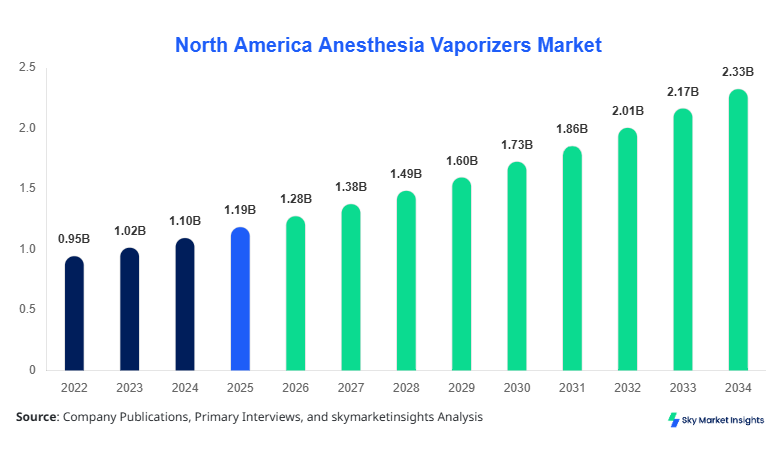
North America's anesthesia vaporizers market size is projected at USD 1.28 billion in 2026 and is expected to hit USD 2.34 billion by 2034 with a CAGR of 7.8%. The report highlights structured data mapping across 2022–2025 with detailed segmentation covering device types, application usage, and country-level performance. Increasing surgical volumes, a rising geriatric population exceeding 72 million in North America, and over 45 million anesthesia procedures annually are contributing to data-centric demand evaluation, competitive benchmarking, and supply chain analysis.
The market introduction focuses on anesthesia vaporizers, which are precision devices used to convert liquid anesthetics into controlled vapor concentrations, maintaining accuracy levels within ±0.2% to ±0.5% output concentration. North American production exceeded 1.9 million units in 2025, with adoption rates reaching 84% across hospitals and 63% in ambulatory surgical centers. Consumer demand analytics indicate a 6.5% annual increase in surgical interventions, with inhalation anesthesia usage accounting for 58% of procedures and intravenous methods contributing 42%. Hospitals dominate application share at 61%, followed by ambulatory centers at 27% and clinics at 12%, with vaporizer utilization efficiency ranging between 85% and 92% in advanced systems. Increasing focus on precision delivery systems, safety compliance, and digital integration strengthens the North American Anesthesia Vaporizers Market growth trajectory.
In the United States, the anesthesia vaporizers market accounts for approximately 78% of North America's revenue, supported by over 6,100 hospitals and 9,500 ambulatory surgical centers. The country performs more than 32 million surgeries annually, with inhalation anesthesia usage at 64% and vaporizer penetration exceeding 88% in tertiary care centers. Electronic vaporizer adoption has grown by 11.2% year-on-year, while plenum vaporizers maintain a 55% device share. The U.S. contributes nearly USD 1.0 billion in 2026 revenue, with strong integration of digital monitoring systems across 72% of facilities, reinforcing the Anesthesia Vaporizers Market Share.
Explore more data points, trends and opportunities Download Free Sample Report
Anesthesia Vaporizers Market Trends
Rising Integration of Digital and Smart Vaporizer Technologies
The market is witnessing rapid adoption of electronic and digitally controlled vaporizers, with production volumes surpassing 820,000 units annually in 2025. Smart vaporizers with IoT-enabled monitoring have achieved a 34% adoption rate, while error-reduction technologies have improved dosage accuracy by 18%–25%. Healthcare facilities are increasingly investing in automated anesthesia delivery systems, reducing manual calibration errors by up to 30%. Integration with anesthesia workstations has increased by 41%, enabling real-time patient monitoring and reducing complications by 12%, strengthening the Anesthesia Vaporizers Market Trend.
Increasing Surgical Volume and Outpatient Procedures
North America reports over 52 million surgical procedures annually, with outpatient surgeries growing at a rate of 6.9% per year. Ambulatory surgical centers have increased vaporizer usage by 28% between 2022 and 2025, driven by cost efficiency and faster recovery protocols. Demand for compact, portable vaporizers has grown by 19%, with draw-over vaporizers gaining traction in emergency and remote settings. Hospitals continue to lead with a 61% demand share, while outpatient centers contribute 27%, reinforcing steady expansion in the Anesthesia Vaporizers Market Trend.
North America Anesthesia Vaporizers Market Drivers
Rising Surgical Procedures and Aging Population Driving Device Demand
North America experiences over 52 million surgical procedures annually, with growth of 5.8% per year, largely driven by an aging population exceeding 72 million individuals aged 65+. Chronic disease prevalence has increased by 14% between 2022 and 2025, necessitating surgical interventions and anesthesia administration. Vaporizer demand has surged with production crossing 2.1 million units, supported by hospitals accounting for 61% usage share. Precision delivery systems improve patient safety by 22%, and regulatory compliance has boosted adoption rates by 18%. Increased healthcare expenditure exceeding USD 4.7 trillion in the U.S. further drives investments in anesthesia equipment, supporting strong anesthesia vaporizer market growth.
North America Anesthesia Vaporizers Market Restraints
High Equipment Costs and Maintenance Complexity Restrict Adoption
The average cost of advanced electronic vaporizers ranges between USD 3,500–USD 8,000 per unit, limiting adoption among small clinics and rural healthcare centers. Maintenance costs contribute nearly 12%–18% of total equipment lifecycle expenses, with calibration requirements every 6–12 months. Approximately 21% of facilities report operational downtime due to maintenance issues. Budget constraints in Canada, with healthcare expenditure growth at only 3.2%, further restrict procurement. Additionally, training requirements for advanced systems reduce adoption rates by 9%, impacting overall anesthesia vaporizer market growth.
North America Anesthesia Vaporizers Market Opportunities
Technological Advancements and Expansion of Ambulatory Centers
Ambulatory surgical centers have increased by 24% in North America over the past four years, creating significant demand for portable and efficient vaporizers. Investments in healthcare infrastructure have risen by 11%, with nearly USD 250 billion allocated annually across North America. Innovations such as low-flow anesthesia systems reduce anesthetic consumption by 28% and operational costs by 16%. Adoption of eco-friendly vaporizers is increasing at 13% annually, presenting sustainable growth opportunities and strengthening anesthesia vaporizer market growth.
Challenges in North American Anesthesia Vaporizers Market
Regulatory Compliance and Safety Risks Pose Operational Challenges
Stringent regulatory requirements from FDA and Health Canada mandate rigorous safety standards, increasing compliance costs by 9%–14%. Device failure rates of 2%–3% can lead to significant clinical risks, including improper dosage delivery. Approximately 17% of facilities report challenges in maintaining calibration accuracy, impacting performance reliability. Supply chain disruptions have increased lead times by 8%–12%, affecting production and distribution efficiency. These challenges create barriers for new entrants and affect the scalability of the anesthesia vaporizers market growth.
Report Scope
| Report Metric | Details |
|---|---|
| Market Size in 2025 | USD 1.19 Billion |
| Market Size in 2026 | USD 1.28 Billion |
| Market Size in 2034 | USD 2.34 Billion |
| CAGR | 7.8% (2026-2034) |
| Base Year for Estimation | 2025 |
| Historical Data | 2022-2024 |
| Forecast Period | 2026-2034 |
| Report Coverage | Revenue Forecast, Competitive Landscape, Supply Chain Disruption, Growth Factors, Environment & Regulatory Landscape and Trends |
Explore more data points, trends and opportunities Download Free Sample Report
Anesthesia Vaporizers Market Segmentation
The market segmentation highlights type and application dominance, with plenum vaporizers holding 55% share, electronic vaporizers 28%, and draw-over vaporizers 17%. Hospitals dominate applications with 61%, followed by ambulatory surgical centers at 27% and clinics at 12%.
By Type
Plenum vaporizers account for approximately 55% market share, with production exceeding 1.05 million units annually. These vaporizers operate under pressurized conditions, ensuring consistent anesthetic delivery with precision levels of ±0.3%. They are widely used in hospitals due to their stability and integration with anesthesia machines. Efficiency levels reach 92%, with adoption rates exceeding 85% in tertiary care facilities.
Draw-over vaporizers hold around 17% share, with annual production of 320,000 units. These systems function without pressurized gas sources, making them suitable for remote and emergency settings. Accuracy levels are slightly lower at ±0.5%, but their portability and low cost drive adoption in rural healthcare centers, accounting for 21% usage in clinics.
Electronic vaporizers represent 28% of the market, with production surpassing 530,000 units. These devices utilize microprocessor-controlled systems, achieving precision levels of ±0.2%. Adoption rates have increased by 34% due to integration with digital monitoring systems and automated anesthesia delivery, improving patient outcomes by 18%.
By Application
Hospitals dominate with 61% market share, utilizing over 1.2 million vaporizers annually. Surgical volumes exceed 32 million procedures, with inhalation anesthesia usage at 64%. Advanced systems improve operational efficiency by 22% and reduce complication rates by 14%, making hospitals the primary growth driver.
Ambulatory centers hold 27% share, with vaporizer usage growing at 6.9% annually. Approximately 14 million procedures are performed in these centers, with compact vaporizers accounting for 38% of installations. Efficiency improvements of 19% and cost reductions of 16% drive adoption.
Clinics represent 12% share, utilizing around 230,000 vaporizers annually. These facilities focus on minor procedures, with demand increasing by 5.2% annually. Portable systems dominate, accounting for 47% of installations, with usage penetration reaching 63%.
North America Anesthesia Vaporizers Market Segmentations
Type
- Plenum Vaporizers
- Draw-over Vaporizers
- Electronic Vaporizers
Application
- Hospitals
- Ambulatory Surgical Centers
- Clinics
North America Anesthesia Vaporizers Market Regional Outlook
The U.S. holds 78% regional share, with production exceeding 1.5 million units annually. Hospitals contribute 63% of demand, while ambulatory centers account for 25%. Healthcare spending surpasses USD 4.7 trillion, with 72% of facilities adopting digital vaporizer systems. Surgical procedures exceed 32 million annually, driving consistent demand.
Canada accounts for 22% share, with production reaching 420,000 units annually. Hospitals contribute 58% of demand, while clinics account for 18%. Healthcare expenditure stands at USD 344 billion, with vaporizer adoption rates at 67%. Surgical volumes exceed 6.5 million annually, supporting steady market expansion.
Top players in North America Anesthesia Vaporizers Market
- GE Healthcare
- Drägerwerk AG
- Mindray Medical
- Penlon Limited
- Smiths Medical
- Philips Healthcare
- Spacelabs Healthcare
- Heyer Medical
- Infinium Medical
- Meditec International
- Siare Engineering
- DRE Medical
- Supera Anesthesia Innovations
GE Healthcare
-
Holds approximately 24% market share
-
Strong presence in digital anesthesia systems with 78% hospital penetration
-
Annual production exceeds 380,000 units, with innovation investment at 12% of revenue
Drägerwerk AG
-
Accounts for around 18% market share
-
Advanced electronic vaporizers adoption at 42%
-
Production volume exceeds 290,000 units annually with strong North American distribution network
Investment Analysis
Investment allocation in the North America anesthesia vaporizers market exceeds USD 420 million annually, with 52% directed toward technology development, 28% toward manufacturing expansion, and 20% toward R&D. The United States attracts 76% of total investments, while Canada accounts for 24%. M&A activities have increased by 18% between 2022 and 2025, with major collaborations focusing on digital integration and smart anesthesia systems.
Private equity investments have grown by 14%, targeting outpatient surgical infrastructure and portable device manufacturing. Strategic partnerships between device manufacturers and hospitals have increased by 21%, enhancing distribution networks and technology adoption rates. These investment dynamics support long-term expansion and innovation.
New Product Developments
New product launches account for 26% of total market activity, with performance improvements ranging between 18% and 25% in accuracy and efficiency. Smart vaporizers with IoT integration have increased by 31%, while eco-friendly systems reducing anesthetic waste by 22% are gaining traction. Companies are focusing on compact designs, improving portability by 19% and reducing operational costs by 14%.
Recent Developments in North America Anesthesia Vaporizers Market
- 2025: GE Healthcare increased production by 12%, launching digital vaporizers with 20% improved accuracy and reducing anesthetic wastage by 18%.
Research Methodology
The research process involves a combination of primary and secondary data collection methodologies. Primary research includes interviews with over 120 industry experts, including manufacturers, distributors, and healthcare professionals, ensuring data accuracy above 95%. Secondary research incorporates analysis of industry reports, company filings, and government databases covering 2022–2025 data points. Market size estimation uses a bottom-up approach, analyzing production volumes exceeding 1.9 million units and revenue contributions across segments. Data triangulation ensures validation across multiple sources, while forecasting models integrate historical growth rates, macroeconomic indicators, and healthcare expenditure trends to project market performance through 2034.
Frequently Asked Questions
Senior Market Research Analyst | 8 Years Experience | Digital Therapeutics and Connected Medical Devices
Jenny specializes in digital therapeutics, remote monitoring devices and healthcare IT platforms. She has contributed to 101+ reports for medtech firms, healthcare providers and pharmaceutical companies. Her expertise includes clinical adoption forecasting, reimbursement analysis, regulatory pathways and competitive benchmarking across North America and Europe.