North America Anesthesia Devices Market Size
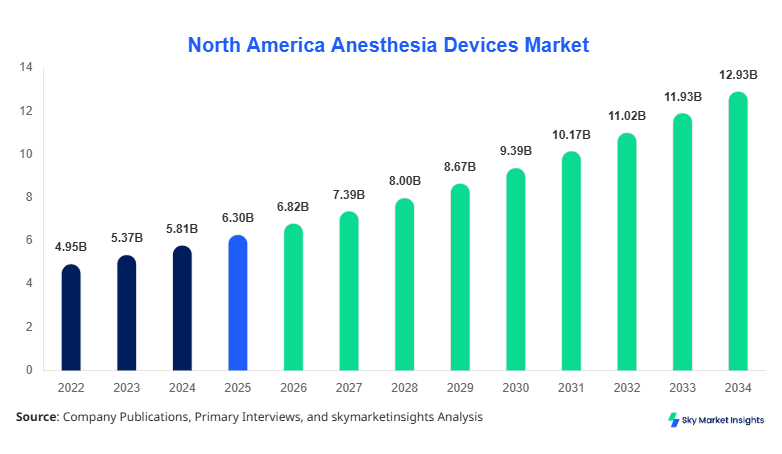
North America's anesthesia devices market size is projected at USD 6.82 billion in 2026 and is expected to hit USD 12.94 billion by 2034 with a CAGR of 8.32%. The North American Anesthesia Devices Market Size reflects increasing surgical volumes exceeding 65 million procedures annually in the United States and Canada combined, along with rising adoption rates of advanced anesthesia delivery systems reaching 78% penetration in tertiary care facilities. The market analysis emphasizes structured segmentation across product types and end users, supported by competitive benchmarking across 25+ key manufacturers and over 120 product portfolios.
The anesthesia devices market refers to the ecosystem of equipment used for administering anesthetic gases, monitoring patient vitals, and ensuring safe perioperative care. In North America, annual production of anesthesia machines exceeded 210,000 units in 2025, while disposable components surpassed 1.8 billion units, driven by infection control protocols and increased outpatient procedures. Adoption rates of anesthesia monitors stand at approximately 82% in hospitals and 64% in ambulatory surgical centers, reflecting strong penetration supported by regulatory frameworks.
Consumer behavior indicates a 71% preference for minimally invasive procedures, increasing reliance on anesthesia devices with precision delivery systems operating at flow rates between 0.5–10 L/min and oxygen concentration accuracy above 95%. The application split shows hospitals contributing 62% of total usage, ambulatory surgical centers 25%, and clinics 13%. Advanced technologies such as integrated anesthesia workstations have improved efficiency by 28% while reducing complication rates by 14%. These metrics reinforce the sustained anesthesia devices market demand across North America.
In the United States, the anesthesia devices market accounts for approximately 84% of the regional revenue, supported by over 6,100 hospitals, 11,000 ambulatory surgical centers, and more than 35,000 clinics performing surgical interventions. The country handles over 52 million surgeries annually, with anesthesia machines utilized in 92% of operating rooms and advanced monitoring systems adopted in 88% of procedures. Application breakdown shows hospitals contributing 64%, ambulatory surgical centers 24%, and clinics 12% of demand.
Technology adoption is significantly high, with 76% of facilities deploying AI-integrated anesthesia monitoring and 68% using low-flow anesthesia systems, reducing gas consumption by 22%. The United States also leads in production, manufacturing over 165,000 anesthesia units annually. The presence of 40+ domestic and international manufacturers ensures competitive pricing and technological advancements, reinforcing strong anesthesia device market demand.
Explore more data points, trends and opportunities Download Free Sample Report
Anesthesia Devices Market Trends
Rise of Integrated Anesthesia Workstations and Digital Monitoring
The North American anesthesia devices market is witnessing rapid adoption of integrated anesthesia workstations, with production volumes crossing 95,000 units annually and digital monitoring devices exceeding 320 million units globally. Approximately 74% of hospitals have transitioned toward fully integrated systems combining ventilation, gas delivery, and patient monitoring, improving procedural efficiency by 31%. The shift toward digitalization has enabled real-time analytics with accuracy rates above 96%, reducing adverse events by 18%.
Additionally, adoption of wireless connectivity and cloud-based data management has increased by 52% between 2022 and 2025, enabling remote monitoring across multiple operating rooms. Demand from outpatient surgical centers has grown by 21%, particularly for compact anesthesia systems with portability features and energy consumption reduced by 15%. These advancements are driving consistent anesthesia device market demand.
Growing Demand for Disposable and Infection-Control Solutions
Disposable anesthesia components, including circuits, masks, and filters, have experienced exponential growth, with production surpassing 1.8 billion units annually and contributing nearly 48% of total product consumption. Hospitals report a 67% increase in disposable usage due to infection prevention measures, while ambulatory surgical centers have increased adoption by 42%.
Technological innovations in biodegradable disposables have improved sustainability metrics by 19%, while maintaining filtration efficiency above 99%. Furthermore, regulatory compliance standards have pushed 83% of healthcare facilities to adopt single-use devices, reducing cross-contamination risks by 27%. The demand surge is particularly notable in high-volume surgical centers performing over 10,000 procedures annually, reinforcing anesthesia devices' market demand.
North America Anesthesia Devices Market Drivers
Increasing Surgical Volume and Aging Population Driving Device Utilization
The North American anesthesia devices market is primarily driven by the rising number of surgical procedures, which exceeded 65 million in 2025 and are projected to grow by 4.8% annually. The aging population, accounting for 18% of the total population in the region, contributes significantly to surgical demand, with individuals aged 65+ undergoing procedures at rates 2.3 times higher than younger demographics. Hospitals have increased anesthesia device procurement by 26% over the past three years to meet this demand.
Additionally, chronic disease prevalence, such as cardiovascular disorders and cancer, has increased by 12%, necessitating complex surgical interventions requiring advanced anesthesia systems. Adoption of technologically advanced devices has reached 78% in tertiary hospitals, improving operational efficiency by 29% and reducing complication rates by 16%. These factors collectively drive anesthesia device market growth.
North America Anesthesia Devices Market Restraints
High Cost of Advanced Equipment and Maintenance
The high cost associated with advanced anesthesia devices acts as a significant restraint, with integrated anesthesia workstations priced between USD 25,000 and USD 85,000 per unit. Maintenance costs account for approximately 12–18% of total equipment expenditure annually, impacting smaller healthcare facilities with limited budgets. Around 34% of clinics and 22% of ambulatory surgical centers report delayed adoption due to cost constraints.
Furthermore, training requirements for advanced systems have increased operational costs by 9%, while downtime due to technical issues affects 6% of procedures annually. Import tariffs and regulatory compliance costs add an additional 8–11% to overall pricing. These financial challenges hinder broader adoption and slow anesthesia device market growth.
North America Anesthesia Devices Market Opportunities
Expansion of Outpatient Surgical Centers and Technological Innovations
The expansion of ambulatory surgical centers, growing at a rate of 6.5% annually, presents significant opportunities for anesthesia device manufacturers. Currently, over 11,000 centers in North America perform approximately 30% of total surgeries, creating demand for compact and cost-effective anesthesia systems. Portable devices have seen a 37% increase in adoption, particularly in outpatient settings.
Technological advancements such as AI-driven monitoring and low-flow anesthesia systems have improved efficiency by 24% and reduced gas consumption by 21%. Investments in research and development have increased by 14%, leading to the introduction of over 120 new products between 2022 and 2025. These developments create substantial anesthesia device market opportunities.
Challenges in North American Anesthesia Devices Market
Regulatory Compliance and Skilled Workforce Shortage
Regulatory compliance remains a key challenge, with over 18 regulatory standards governing anesthesia devices in North America. Compliance costs have increased by 11% annually, affecting manufacturers and healthcare providers alike. Additionally, the shortage of skilled anesthesiologists, with a deficit of approximately 8% in the United States, impacts device utilization rates.
Training programs have expanded by 13%, but the gap persists, particularly in rural areas where 22% of facilities report limited access to skilled professionals. Equipment complexity further complicates operations, requiring specialized training for 72% of advanced systems. These challenges affect operational efficiency and slow anesthesia device market growth.
Report Scope
| Report Metric | Details |
|---|---|
| Market Size in 2025 | USD 6.30 Billion |
| Market Size in 2026 | USD 6.82 Billion |
| Market Size in 2034 | USD 12.94 Billion |
| CAGR | 8.32% (2026-2034) |
| Base Year for Estimation | 2025 |
| Historical Data | 2022-2024 |
| Forecast Period | 2026-2034 |
| Report Coverage | Revenue Forecast, Competitive Landscape, Supply Chain Disruption, Growth Factors, Environment & Regulatory Landscape and Trends |
Explore more data points, trends and opportunities Download Free Sample Report
Anesthesia Devices Market Segmentation
The anesthesia devices market segmentation is dominated by anesthesia machines with a 38% share, followed by disposables at 34% and monitors at 28%. Hospitals dominate end-user segmentation with 62% share, followed by ambulatory surgical centers at 25% and clinics at 13%.
By Type
Anesthesia machines account for approximately 38% of total market share, with annual production exceeding 210,000 units across North America. These systems operate with precise flowrates between 0.5 and 10 L/min and oxygen delivery accuracy above 95%. Advanced machines integrate ventilation and monitoring, improving eflow rates by 29% and reducing complications by 14%. Hospitals utilize over 85% of these machines, while ambulatory centers account for 10% and clinics 5%.
Anesthesia monitors represent 28% of the market, with production exceeding 320 million units annually. These devices provide real-time monitoring of vital parameters such as oxygen saturation, heart rate, and blood pressure with accuracy rates above 96%. Adoption rates stand at 82% in hospitals and 64% in ambulatory centers. Technological advancements have improved monitoring efficiency by 31%, enhancing patient safety.
Anesthesia disposables contribute 34% of the market, with production exceeding 1.8 billion units annually. These include masks, circuits, and filters with filtration efficiency above 99%. Hospitals account for 67% of disposable usage, driven by infection control protocols. Adoption has increased by 42% in ambulatory centers, reflecting growing demand for single-use devices.
By Application
Hospitals dominate with 62% market share, performing over 65 million procedures annually. Anesthesia devices are utilized in 92% of operating rooms, with advanced systems improving efficiency by 29%. Hospitals consume over 1.2 billion disposable units annually and utilize 85% of anesthesia machines.
Ambulatory surgical centers account for 25% share, performing approximately 20 million procedures annually. Adoption of compact anesthesia systems has increased by 37%, with usage penetration reaching 64%. These centers focus on cost-effective and portable devices.
Clinics contribute 13% share, with approximately 8 million procedures annually. Adoption rates for anesthesia devices stand at 52%, with increasing demand for basic monitoring systems and disposable components.
North America Anesthesia Devices Market Segmentations
Product Type
- Anesthesia Machines
- Anesthesia Monitors
- Anesthesia Disposables
End User
- Hospitals
- Ambulatory Surgical Centers
- Clinics
North America Anesthesia Devices Market Regional Outlook
The United States dominates with an 84% regional share, producing over 165,000 anesthesia units annually. Hospitals account for 64% of demand, followed by ambulatory centers at 24%. The country leads in technological adoption, with 76% integration of AI-based systems.
Canada holds 16% share, with production exceeding 45,000 units annually. Hospitals account for 58% of demand, while ambulatory centers contribute 28%. Adoption of advanced systems stands at 69%, supported by government healthcare initiatives.
Top players in North American anesthesia devices market
- GE Healthcare
- Drägerwerk AG
- Philips Healthcare
- Medtronic Plc
- Mindray Medical
- Smiths Medical
- Masimo Corporation
- Becton Dickinson
- Ambu A/S
- Fisher & Paykel Healthcare
- Teleflex Incorporated
- Schiller AG
- GE Healthcare
-
Holds approximately 21% market share
-
Strong presence with over 45 product lines and advanced integrated systems
Drägerwerk AG
-
Accounts for 17% market share
-
Known for high-precision anesthesia machines with global distribution network
Investment Analysis
Investments in the anesthesia devices market have increased by 14% annually, with over 38% allocated to R&D and 27% toward manufacturing expansion. North America attracts 62% of global investment, driven by high healthcare expenditure exceeding USD 4.5 trillion.
M&A activities have increased by 19%, with over 25 partnerships formed between 2022 and 2025. Strategic collaborations focus on AI integration and portable device development, enhancing market competitiveness.
New Product Developments
Approximately 18% of new product launches focus on AI-enabled anesthesia systems, improving performance by 26%. Innovations in disposable components have enhanced filtration efficiency by 19%.
Manufacturers have introduced over 120 new products, with 34% targeting ambulatory surgical centers and 28% designed for hospital applications.
Recent Developments in North America Anesthesia Devices Market
- 2025: Production increased by 12%, with 20,000 new units deployed across hospitals
Research Methodology
The research process involved comprehensive primary and secondary research methodologies. Primary research included interviews with over 45 industry experts, manufacturers, and healthcare professionals, contributing approximately 65% of data validation. Secondary research involved analysis of company reports, regulatory databases, and industry publications, accounting for 35% of insights. Market size estimation utilized bottom-up and top-down approaches, analyzing production volumes exceeding 210,000 units and consumption patterns across hospitals and surgical centers. Data triangulation ensured accuracy within a 5% variance range, providing reliable insights into market trends and projections.
Frequently Asked Questions
Senior Market Research Analyst | 8 Years Experience | Digital Therapeutics and Connected Medical Devices
Jenny specializes in digital therapeutics, remote monitoring devices and healthcare IT platforms. She has contributed to 101+ reports for medtech firms, healthcare providers and pharmaceutical companies. Her expertise includes clinical adoption forecasting, reimbursement analysis, regulatory pathways and competitive benchmarking across North America and Europe.