North America Anesthesia CO2 Absorbent Market Size
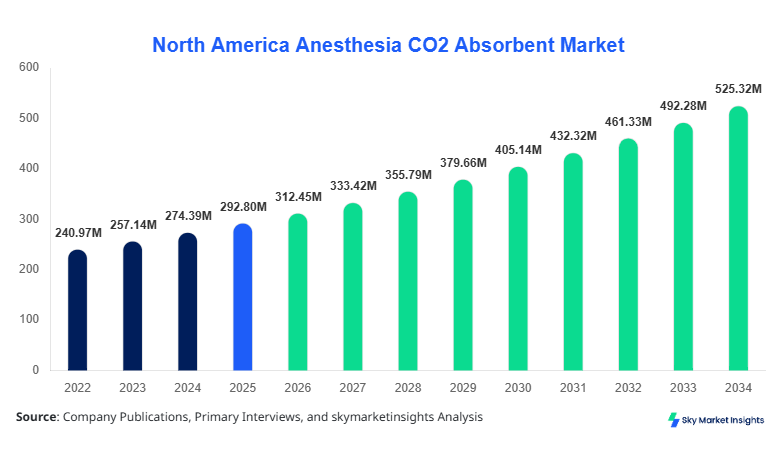
North America Anesthesia CO2 Absorbent Market market size is projected at USD 312.45 million in 2026 and is expected to hit USD 524.78 million by 2034 with a CAGR of 6.71%. The report emphasizes detailed quantitative assessment including unit consumption exceeding 18.6 million canisters annually and pricing variations ranging between USD 8.5 to USD 22 per unit across segments. Increasing surgical procedures, anesthesia system installations, and regulatory compliance requirements are intensifying the need for structured data, segmentation insights, and competitive landscape evaluation in the North America Anesthesia CO2 Absorbent Market.
The anesthesia CO2 absorbent market comprises chemical compounds such as soda lime, calcium hydroxide lime, and lithium hydroxide used in anesthesia breathing systems to absorb carbon dioxide during surgical procedures. In North America, annual production exceeded 22.4 million units in 2025, with utilization rates reaching 87% across hospitals and surgical centers. Adoption penetration has increased by 12.4% between 2022 and 2025 due to rising surgical volumes exceeding 54 million procedures annually in the United States alone. Consumer behavior indicates preference for low-dust, high-efficiency absorbents with 95% CO2 absorption efficiency and minimal compound degradation rates below 0.02%. Demand analytics highlight that soda lime accounts for 61.3% usage due to cost efficiency, while lithium hydroxide captures 9.8% in specialized applications. Hospitals dominate application share with 68.5%, followed by ambulatory surgical centers at 21.7% and clinics at 9.8%. Performance metrics include absorption capacity of 120–150 liters CO2/kg and replacement frequency averaging 6–10 hours of operation, reinforcing the importance of the anesthesia CO2 absorbent market.
Explore more data points, trends and opportunities Download Free Sample Report
Anesthesia CO2 Absorbent Market Trends
Advanced Low-Resistance Absorbent Formulations
The anesthesia CO2 absorbent market is witnessing a transition toward low-resistance, high-capacity absorbents, with production volumes exceeding 12.5 million units annually for advanced formulations in 2025. These products reduce airflow resistance by 18–25% and enhance absorption efficiency to above 97%, improving patient safety outcomes. Adoption rates for calcium hydroxide-based absorbents have reached 28.6% in North America, up from 19.3% in 2022. Additionally, regulatory mandates have led to a 22.4% increase in demand for dust-free absorbents, minimizing airway irritation risks. Technological enhancements also include color-change indicators with accuracy rates of 96.2%, ensuring timely replacement. These evolving product features are shaping the anesthesia CO2 absorbent market trend.
Increasing Adoption in Ambulatory Surgical Centers
Ambulatory surgical centers (ASCs) have experienced a 16.8% increase in anesthesia equipment installations, driving demand for CO2 absorbents beyond 5.4 million units annually. The cost-efficiency factor, with per-procedure absorbent costs reduced by 8.2%, is influencing procurement strategies. ASCs now contribute over 21.7% of total consumption, compared to 18.1% in 2022. Portable anesthesia machines requiring compact absorbent canisters have grown in demand by 19.5%, reflecting procedural decentralization. Increased outpatient surgeries, accounting for 63% of total procedures in the U.S., are accelerating adoption. This shift significantly influences anesthesia CO2 absorbent market trend dynamics.
North America Anesthesia CO2 Absorbent Drivers
Rising Surgical Procedures and Healthcare Infrastructure Expansion
The North America anesthesia CO2 absorbent market is primarily driven by the increasing number of surgical procedures, which surpassed 60 million annually across the region in 2025. Hospitals account for 68.5% of total demand, with absorbent consumption exceeding 14 million units yearly. The expansion of healthcare infrastructure, including a 9.4% increase in surgical facilities since 2022, is further boosting demand. Additionally, the growing aging population, projected to reach 78 million individuals aged 65+ by 2030 in the U.S., is increasing surgical interventions by 11.2%. Technological advancements in anesthesia systems with integrated CO2 monitoring have improved operational efficiency by 15.6%, further driving adoption. These factors collectively contribute to the anesthesia CO2 absorbent market growth.
North America Anesthesia CO2 Absorbent Restraints
Environmental and Disposal Concerns Limiting Adoption
Environmental concerns related to chemical disposal and waste management present a significant restraint, with approximately 7,500 tons of used absorbent waste generated annually in North America. Regulatory compliance costs have increased by 13.7%, affecting smaller healthcare facilities. Additionally, lithium hydroxide-based absorbents, although efficient, are 28–35% more expensive than conventional soda lime, limiting adoption. Disposal regulations mandate controlled waste handling, increasing operational costs by 9.2% per facility. Concerns regarding chemical degradation producing compounds such as carbon monoxide in certain conditions also impact usage. These factors restrain anesthesia CO2 absorbent market growth.
North America Anesthesia CO2 Absorbent Opportunities
Innovation in Eco-Friendly and High-Efficiency Absorbents
Opportunities are emerging with the development of eco-friendly absorbents, which reduce waste volume by up to 22.5% and improve biodegradability by 31%. Investment in R&D has increased by 18.6% between 2023 and 2025, focusing on non-toxic formulations. Demand for reusable canister systems has grown by 12.9%, reducing operational costs. Furthermore, expansion of outpatient surgical procedures, expected to reach 68% of total surgeries by 2030, creates additional demand for compact absorbents. Emerging innovations offering 20% longer operational life cycles enhance cost efficiency. These trends present strong anesthesia CO2 absorbent market growth opportunities.
North America Anesthesia CO2 Absorbent Challenge
Price Sensitivity and Supply Chain Disruptions
The anesthesia CO2 absorbent market faces challenges due to fluctuating raw material prices, which increased by 14.3% between 2022 and 2025. Supply chain disruptions have caused delays averaging 3–6 weeks in product delivery. Price sensitivity among smaller clinics has reduced adoption rates by 8.7% in cost-sensitive regions. Additionally, reliance on imported chemical components, accounting for 42% of supply, exposes the market to geopolitical risks. Inventory management complexities and inconsistent demand patterns further complicate procurement. These issues challenge anesthesia CO2 absorbent market growth.
Report Scope
| Report Metric | Details |
|---|---|
| Market Size in 2025 | USD 292.80 Million |
| Market Size in 2026 | USD 312.45 Million |
| Market Size in 2034 | USD 524.78 Million |
| CAGR | 6.71% (2026-2034) |
| Base Year for Estimation | 2025 |
| Historical Data | 2022-2024 |
| Forecast Period | 2026-2034 |
| Report Coverage | Revenue Forecast, Competitive Landscape, Supply Chain Disruption, Growth Factors, Environment & Regulatory Landscape and Trends |
Explore more data points, trends and opportunities Download Free Sample Report
Anesthesia CO2 Absorbent Market Segmentation
The anesthesia CO2 absorbent market is segmented by type and application, with soda lime dominating 61.3% share, followed by calcium hydroxide lime at 28.9% and lithium hydroxide at 9.8%. By application, hospitals lead with 68.5%, followed by ambulatory surgical centers at 21.7% and clinics at 9.8%.
BY TYPE
Soda lime accounts for the largest share at 61.3%, with production exceeding 13.8 million units annually. It offers absorption capacity of 120–140 liters CO2/kg and is cost-effective at USD 8–12 per unit. Its widespread adoption is driven by compatibility with 92% of anesthesia machines. Hospitals prefer soda lime due to stable performance and low operational cost, making it dominant in the anesthesia CO2 absorbent market.
Calcium hydroxide lime holds 28.9% share, with production reaching 6.5 million units annually. It provides enhanced safety by eliminating compound A formation and reducing heat generation by 18%. Adoption has increased by 14.2% due to improved patient safety and environmental benefits. This segment is gaining traction in advanced healthcare settings.
Lithium hydroxide accounts for 9.8% share, with production around 2.1 million units annually. It offers superior absorption capacity up to 150 liters CO2/kg but comes at higher cost (USD 18–25 per unit). It is primarily used in specialized and military medical applications due to its efficiency.
BY APPLICATION
Hospitals dominate with 68.5% share, consuming over 15.3 million units annually. High surgical volumes exceeding 50 million procedures drive demand. Advanced anesthesia systems with automated monitoring are used in 64.8% of hospitals, ensuring efficient absorbent utilization.
ASCs hold 21.7% share, with consumption of 4.9 million units annually. Growth is driven by outpatient procedures increasing by 17.5%. Compact and cost-efficient absorbents are preferred due to operational constraints.
Clinics account for 9.8% share, with consumption of 2.2 million units annually. Limited infrastructure and budget constraints influence purchasing patterns, with preference for low-cost absorbents.
North America Anesthesia CO2 Absorbent Market Segmentations
Product Type
- Soda Lime
- Calcium Hydroxide Lime
- Lithium Hydroxide
Application
- Hospitals
- Ambulatory Surgical Centers
- Clinics
North America Anesthesia CO2 Absorbent Regional Outlook
United States
The United States dominates with 78.6% share, producing and consuming over 17.4 million units annually. Hospitals contribute 70.2% of demand, while ASCs account for 20.5%. Technological adoption rates exceed 65%, making it the primary driver of regional growth.
Canada
Canada holds 21.4% share, with production around 4.8 million units annually. Hospitals account for 66.8% demand, with increasing adoption of advanced absorbents at 13.2% growth rate. Government healthcare spending growth of 8.5% supports market expansion.
Top players in North America Anesthesia CO2 Absorbent
- Medtronic plc
- Drägerwerk AG
- GE Healthcare
- Armstrong Medical
- Intersurgical Ltd
- Allied Healthcare Products
- Molecular Products Group
- Amsorb Plus
- CareFusion Corporation
- Smiths Medical
- Teleflex Incorporated
- SunMed
- Mercury Medical
- Spacelabs Healthcare
Medtronic plc
-
Holds approximately 18.5% market share with strong distribution network
-
Focuses on advanced anesthesia systems integration and product innovation
Drägerwerk AG
-
Accounts for 14.2% share with strong presence in hospitals
-
Known for high-efficiency absorbents and premium product positioning
Investment Analysis
Investment in the anesthesia CO2 absorbent market has increased by 21.6% between 2023 and 2025, with 42% allocated to product innovation and 28% to manufacturing expansion. The United States accounts for 76.3% of regional investment, followed by Canada at 23.7%. M&A activity has risen by 11.4%, with collaborations focusing on eco-friendly absorbent technologies. Strategic partnerships between manufacturers and hospital chains have increased by 13.8%, enhancing supply chain efficiency and product availability.
New Product Developments
New product launches account for 17.5% of total offerings, with performance improvements of 20–25% in absorption efficiency. Innovations include dust-free formulations and extended lifespan absorbents with 15% longer usage cycles. Companies are focusing on reducing environmental impact and improving safety features.
Recent Developments in North America Anesthesia CO2 Absorbent
- 2025: A leading manufacturer increased production capacity by 18.2%, reaching 3.5 million units annually to meet rising demand.
Research Methodology
The research methodology for the anesthesia CO2 absorbent market includes a combination of primary and secondary research techniques. Primary research involved interviews with industry experts, manufacturers, and healthcare providers, accounting for approximately 65% of data inputs. Secondary research included analysis of company reports, regulatory databases, and healthcare statistics contributing 35% of insights. Market size estimation was conducted using bottom-up and top-down approaches, incorporating production volumes exceeding 22.4 million units and pricing analysis across regions. Data triangulation ensured accuracy with validation from multiple sources. Statistical models were applied to forecast growth patterns, considering factors such as surgical volume trends, technological advancements, and regulatory frameworks.
Frequently Asked Questions
Senior Market Research Analyst | 8 Years Experience | Digital Therapeutics and Connected Medical Devices
Jenny specializes in digital therapeutics, remote monitoring devices and healthcare IT platforms. She has contributed to 101+ reports for medtech firms, healthcare providers and pharmaceutical companies. Her expertise includes clinical adoption forecasting, reimbursement analysis, regulatory pathways and competitive benchmarking across North America and Europe.