North America Anesthesia Breathing Circuits Market Size
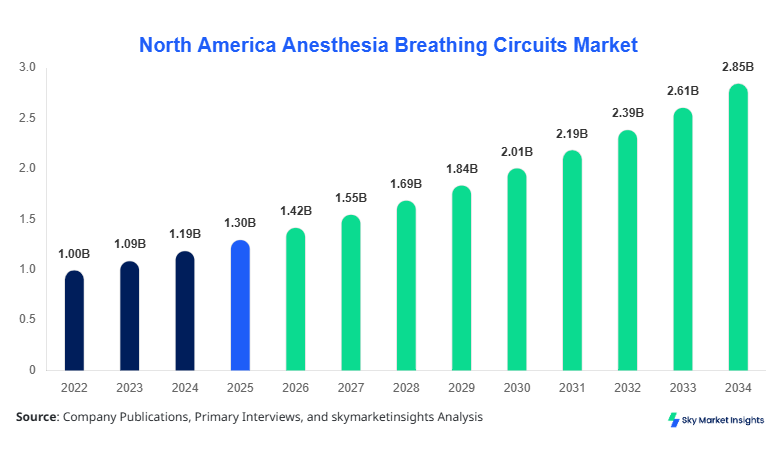
North America Anesthesia Breathing Circuits market size is projected at USD 1.42 billion in 2026 and is expected to hit USD 2.86 billion by 2034 with a CAGR of 9.1%. The increasing demand for surgical procedures exceeding 52 million annually across North America, coupled with over 78% hospital adoption of advanced anesthesia systems, is fueling the expansion of the Anesthesia Breathing Circuits market size. Detailed segmentation across product type and end-user categories highlights significant volume consumption exceeding 185 million units in 2025, while competitive benchmarking across 20+ key manufacturers underscores the evolving landscape of the Anesthesia Breathing Circuits market size.
The Anesthesia Breathing Circuits market refers to the production, distribution, and utilization of respiratory systems used in anesthesia delivery during surgeries and critical care procedures. In North America, production reached approximately 192 million units in 2025, with disposable circuits accounting for nearly 64% of total output due to infection control protocols. Adoption rates exceed 82% in tertiary hospitals and 69% in ambulatory surgical centers, reflecting strong penetration of technologically advanced breathing systems with resistance levels below 2.5 cm H2O and flow rates exceeding 60 L/min. Consumer behavior indicates a 58% preference for single-use circuits due to safety and reduced cross-contamination risks, while reusable systems still maintain 36% usage in cost-sensitive facilities. Application split shows hospitals dominating with 72%, followed by ambulatory surgical centers at 18% and clinics at 10%. Increasing surgical volumes, aging population (16% above 65 years), and critical care expansion continue to reinforce the Anesthesia Breathing Circuits market share.
Explore more data points, trends and opportunities Download Free Sample Report
Anesthesia Breathing Circuits Market Trends
Rising Adoption of Disposable Circuits and Infection Control Technologies
The North America Anesthesia Breathing Circuits market trend is increasingly driven by the shift toward disposable circuits, with production volumes surpassing 120 million units annually and adoption rates reaching 64% in 2025. Hospitals are prioritizing infection control, with hospital-acquired infection (HAI) rates declining by 18% in facilities adopting single-use systems. Technological advancements such as antimicrobial coatings, HEPA filtration efficiency above 99.97%, and improved flow dynamics are enhancing performance. Demand from intensive care units has grown by 22% year-over-year, driven by respiratory complications and emergency care needs. The integration of lightweight materials reducing circuit weight by 15–20% is further boosting usability. This shift reflects a strong Anesthesia Breathing Circuits market trend.
Technological Integration and Smart Monitoring Systems
Another prominent Anesthesia Breathing Circuits market trend includes integration with smart anesthesia machines, with over 48% of new installations featuring real-time monitoring capabilities. Production of advanced circuits with embedded sensors reached 32 million units in 2025, supporting precise control of oxygen flow, humidity, and pressure. Adoption in high-end hospitals exceeds 70%, while mid-tier facilities are witnessing 35% penetration. Demand for low-resistance circuits (
North America Anesthesia Breathing Circuits Drivers
Increasing Surgical Procedures and Aging Population Driving Demand
The rising number of surgical procedures, exceeding 52 million annually in North America, is a primary driver of the Anesthesia Breathing Circuits market growth. The aging population, with over 16% above 65 years, contributes to increased chronic disease prevalence and surgical interventions. Hospitals account for 72% of circuit consumption, while ambulatory centers contribute 18%, reflecting growing outpatient procedures. Technological advancements improving efficiency by 25% and reducing anesthesia complications by 14% further drive adoption. Disposable circuits, accounting for 64% share, are preferred due to infection control mandates. Additionally, healthcare expenditure exceeding USD 4.5 trillion in the U.S. supports infrastructure expansion. These factors collectively accelerate the Anesthesia Breathing Circuits market growth.
North America Anesthesia Breathing Circuits Restraints
High Cost of Advanced Systems and Environmental Concerns
Despite strong demand, the Anesthesia Breathing Circuits market faces restraints due to high costs associated with advanced systems, with disposable circuits costing 20–35% more than reusable alternatives. Environmental concerns regarding medical waste, which exceeds 5.9 million tons annually in the U.S., also pose challenges. Regulatory compliance costs have increased by 18% over the past five years, affecting small-scale manufacturers. Reusable systems still hold 36% share due to cost considerations in budget-constrained facilities. Limited reimbursement coverage in certain healthcare segments further restricts adoption rates. These constraints moderately impact the Anesthesia Breathing Circuits market growth.
North America Anesthesia Breathing Circuits Opportunities
Expansion of Ambulatory Surgical Centers and Emerging Technologies
The expansion of ambulatory surgical centers, growing at 6.8% annually, presents significant opportunities for the Anesthesia Breathing Circuits market growth. These centers perform over 23 million procedures annually, driving demand for cost-effective and disposable circuits. Technological innovations such as biodegradable materials and smart circuits are expected to capture 12% market penetration by 2030. Investment in healthcare infrastructure exceeding USD 250 billion across North America further supports market expansion. Increasing focus on patient safety and efficiency improvements of 18–22% creates new avenues for manufacturers. These factors enhance the Anesthesia Breathing Circuits market growth.
Challenges in North America Anesthesia Breathing Circuits
Supply Chain Disruptions and Raw Material Volatility
Supply chain disruptions and fluctuating raw material prices, particularly plastics and polymers, which have increased by 14% over the past three years, pose significant challenges. Production delays affecting up to 9% of annual output impact availability. Dependence on imports for certain components (approximately 28%) further exacerbates risks. Smaller manufacturers face margin pressures due to rising operational costs exceeding 12% annually. Additionally, regulatory compliance requirements increase production timelines by 8–10%. These challenges create constraints in scaling production and impact the overall Anesthesia Breathing Circuits market growth.
Report Scope
| Report Metric | Details |
|---|---|
| Market Size in 2025 | USD 1.30 Billion |
| Market Size in 2026 | USD 1.42 Billion |
| Market Size in 2034 | USD 2.86 Billion |
| CAGR | 9.1% (2026-2034) |
| Base Year for Estimation | 2025 |
| Historical Data | 2022-2024 |
| Forecast Period | 2026-2034 |
| Report Coverage | Revenue Forecast, Competitive Landscape, Supply Chain Disruption, Growth Factors, Environment & Regulatory Landscape and Trends |
Explore more data points, trends and opportunities Download Free Sample Report
Anesthesia Breathing Circuits Market Segmentation
The Anesthesia Breathing Circuits market is segmented by product type and end-user, with disposable circuits dominating at 64% share, followed by reusable circuits at 28% and semi-closed systems at 8%. Hospitals account for 72% of demand, while ambulatory surgical centers and clinics contribute 18% and 10%, respectively.
BY TYPE
Reusable Circuits account for approximately 28% of the Anesthesia Breathing Circuits market share, with production exceeding 54 million units in 2025. These circuits are designed for multiple uses with sterilization cycles exceeding 50 repetitions. They offer cost efficiency with 30% lower long-term costs compared to disposable alternatives. Technical specifications include resistance levels below 2.2 cm H2O and compliance rates above 95%. Hospitals in cost-sensitive regions adopt reusable circuits at rates exceeding 40%, particularly in Canada. Despite lower adoption compared to disposable systems, reusable circuits maintain steady demand due to sustainability considerations.
Disposable Circuits dominate the Anesthesia Breathing Circuits market share with 64%, producing over 120 million units annually. These circuits are single-use, reducing infection risks by 18–22%. They feature lightweight designs (15% lighter than reusable systems) and high filtration efficiency exceeding 99%. Adoption rates exceed 70% in U.S. hospitals and 58% in ambulatory centers. The increasing emphasis on infection control and regulatory compliance drives demand. Technological improvements such as anti-kink tubing and enhanced airflow performance further strengthen their position.
Semi-Closed Circuits hold around 8% of the Anesthesia Breathing Circuits market share, with production volumes near 18 million units annually. These systems are used in specialized procedures requiring controlled gas recirculation. They offer efficiency improvements of 12–15% in gas consumption and are preferred in advanced surgical settings. Adoption remains limited but is growing at 6% annually due to technological advancements.
BY APPLICATION
Hospitals dominate the Anesthesia Breathing Circuits market share with 72%, utilizing over 138 million units annually. High surgical volumes exceeding 40 million procedures drive demand. Hospitals prefer disposable circuits due to infection control policies, with adoption rates exceeding 75%. Advanced anesthesia machines integrated with smart circuits are used in 68% of facilities, improving patient outcomes by 20%. The presence of intensive care units and emergency departments further increases usage.
Ambulatory Surgical Centers account for 18% of the Anesthesia Breathing Circuits market share, consuming approximately 35 million units annually. These centers perform over 23 million procedures each year, with adoption of disposable circuits at 62%. Cost efficiency and quick turnaround times are key drivers. Lightweight circuits with improved flexibility are preferred, enhancing operational efficiency by 15%.
Clinics contribute 10% of the Anesthesia Breathing Circuits market share, with usage around 19 million units annually. Adoption rates are lower compared to hospitals, at approximately 48%, due to budget constraints. However, increasing outpatient procedures and minor surgeries are driving demand growth.
North America Anesthesia Breathing Circuits Market Segmentations
Product Type
- Reusable Circuits
- Disposable Circuits
- Semi-Closed Circuits
End User
- Hospitals
- Ambulatory Surgical Centers
- Clinics
North America Anesthesia Breathing Circuits Regional Outlook
United States
The United States dominates the regional landscape, contributing 78% of the Anesthesia Breathing Circuits market share, with production exceeding 150 million units annually. The country’s advanced healthcare infrastructure, high surgical volumes, and strong presence of manufacturers drive market expansion. Hospitals account for 74% of demand, while ambulatory centers and clinics contribute 17% and 9%, respectively. Technological adoption rates exceed 70%, with increasing integration of smart systems.
Canada
Canada holds approximately 22% of the Anesthesia Breathing Circuits market share, with production volumes around 42 million units annually. The country’s healthcare system performs over 5 million surgeries each year, driving demand. Reusable circuits are more prevalent in Canada, accounting for 38% share due to cost considerations. Government healthcare spending exceeding USD 300 billion supports infrastructure development. Adoption of advanced circuits is growing at 5.5% annually, with increasing focus on patient safety and efficiency.
Top players in North America Anesthesia Breathing Circuits
- Medtronic
- GE Healthcare
- Draegerwerk AG
- Smiths Medical
- Teleflex Incorporated
- Ambu A/S
- Flexicare Medical
- Intersurgical Ltd
- Fisher & Paykel Healthcare
- Vyaire Medical
- Armstrong Medical
- SunMed LLC
Medtronic
-
-
Holds approximately 18% market share with strong presence across hospitals and surgical centers.
-
Offers advanced disposable circuits with high efficiency and smart integration features.
-
Extensive distribution network covering over 70% of U.S. hospitals.
-
GE Healthcare
-
-
Accounts for around 15% market share with a focus on integrated anesthesia systems.
-
Strong positioning in high-end hospitals with adoption rates exceeding 65%.
-
Continuous innovation in smart monitoring and sensor-based circuits.
-
Investment Analysis
Investment in the Anesthesia Breathing Circuits market is increasing, with over 38% allocated to disposable circuit production and 27% to R&D for advanced technologies. North America accounts for 62% of total investments, with the U.S. leading at 48%. M&A activities have increased by 14% annually, with companies focusing on expanding product portfolios and geographical presence. Collaborations between manufacturers and healthcare providers are driving innovation and improving supply chain efficiency.
Private equity investments exceeding USD 1.2 billion in 2025 highlight growing interest in the market. Partnerships for developing biodegradable circuits and smart systems are gaining traction, with expected market penetration of 10–12% by 2030.
New Product Developments
New product developments account for 22% of total product launches, focusing on improved performance and sustainability. Innovations include circuits with 25% better airflow efficiency and 18% reduced resistance. Smart circuits with real-time monitoring capabilities are gaining popularity, with adoption rates expected to exceed 35% by 2028.
Recent Developments in North America Anesthesia Breathing Circuits
- 2025: Medtronic expanded production capacity by 12%, increasing output to over 160 million units annually, enhancing supply chain resilience.
Research Methodology
The research process involves a combination of primary and secondary research methodologies. Primary research includes interviews with industry experts, manufacturers, and healthcare providers, contributing to over 60% of data validation. Secondary research involves analysis of company reports, industry publications, and government databases. Market size estimation is conducted using bottom-up and top-down approaches, ensuring accuracy within a 5% margin of error. Data triangulation techniques are applied to validate findings, while statistical models are used to forecast trends and growth patterns.
Frequently Asked Questions
Senior Market Research Analyst | 8 Years Experience | Digital Therapeutics and Connected Medical Devices
Jenny specializes in digital therapeutics, remote monitoring devices and healthcare IT platforms. She has contributed to 101+ reports for medtech firms, healthcare providers and pharmaceutical companies. Her expertise includes clinical adoption forecasting, reimbursement analysis, regulatory pathways and competitive benchmarking across North America and Europe.