North America Anatomical Models Market Size
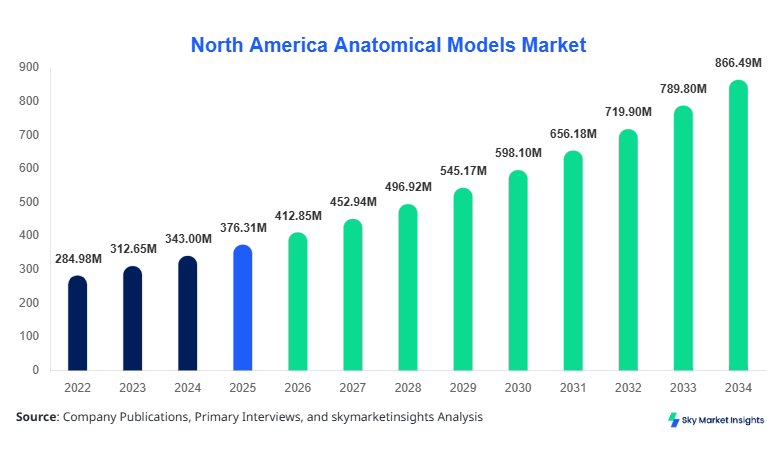
North America Anatomical Models market size is projected at USD 412.85 million in 2026 and is expected to hit USD 865.40 million by 2034 with a CAGR of 9.71%. The increasing demand for precision-based medical learning tools, along with rising investments in simulation-based education exceeding USD 1.2 billion annually, is accelerating the expansion of the Anatomical Models Market. The report emphasizes detailed segmentation by type and application, along with an in-depth competitive landscape analysis involving over 150 manufacturers and distributors across North America.
The Anatomical Models Market refers to the industry involved in designing, manufacturing, and distributing physical and digital anatomical replicas used for educational, research, and clinical purposes. In North America, production volumes exceeded 8.5 million units in 2025, with the United States contributing nearly 72% of total output. Adoption rates in medical institutions reached 84%, while simulation-based training penetration increased by 11.5% year-over-year between 2022 and 2025. Consumer behavior indicates that over 65% of medical institutions prefer high-fidelity anatomical models with accuracy levels above 95%, while demand for 3D-printed models grew by 18.3% annually. Medical education accounts for 56% of application usage, followed by research labs at 28% and patient education at 16%. Technically, models are designed with material durability ranging from 5–10 years and precision tolerances below 0.2 mm. The Anatomical Models Market continues to evolve with growing adoption and advanced technological integration, reinforcing strong Anatomical Models Market demand.
Explore more data points, trends and opportunities Download Free Sample Report
Anatomical Models Market Trends
Integration of 3D Printing and Digital Hybrid Models
The integration of 3D printing technology has significantly transformed the Anatomical Models Market, with production volumes of 3D-printed models exceeding 2.3 million units in 2025, representing 27% of total market output. Adoption rates among universities and hospitals have reached 48%, driven by the ability to customize models with precision levels below 0.1 mm. Hybrid models combining physical replicas with digital overlays are gaining traction, with usage increasing by 19% annually. Additionally, demand from surgical planning applications has grown by 14.6%, particularly in orthopedics and cardiology. The shift toward biodegradable materials, accounting for 22% of new product launches, reflects sustainability trends. These technological advancements are reshaping product offerings and reinforcing Anatomical Models Market demand.
Rising Demand from Medical Simulation and Training Centers
Medical simulation centers are expanding rapidly, with over 1,200 facilities across North America contributing to nearly 63% of anatomical model consumption. Annual procurement of anatomical models by these centers exceeded 3.5 million units in 2025, reflecting a 12.8% growth rate. High-fidelity models with embedded sensors and interactive features are witnessing adoption rates of 35%, while virtual integration tools are used by 29% of institutions. The demand from nursing schools and paramedical training programs has increased by 16.2%, driven by curriculum modernization. Furthermore, government funding programs supporting simulation-based learning have grown by 9.4% annually. These evolving trends continue to drive the Anatomical Models Market toward innovation and expansion.
North America Anatomical Models Drivers
Increasing Adoption in Medical Education Institutions
The rapid expansion of medical education infrastructure across North America is a primary driver of the Anatomical Models Market. Between 2022 and 2025, the number of medical schools increased by 7.8%, reaching over 7,200 institutions. Annual spending on medical training tools exceeded USD 1.5 billion, with anatomical models accounting for nearly 38% of total expenditure. Adoption rates among medical students and faculty reached 87%, while simulation-based learning improved retention rates by 22%. Additionally, the demand for high-precision models with anatomical accuracy above 95% increased by 15.3% annually. The rising number of healthcare professionals, projected to grow by 18% by 2030, further supports market expansion. The Anatomical Models Market continues to benefit from strong institutional demand and educational reforms.
North America Anatomical Models Restraints
High Cost of Advanced Anatomical Models
The high cost associated with advanced anatomical models remains a significant restraint in the Anatomical Models Market. High-fidelity models integrated with sensors and digital interfaces can cost between USD 2,500 and USD 15,000 per unit, limiting adoption among smaller institutions. Approximately 34% of training centers report budget constraints as a key barrier to procurement. Additionally, maintenance costs, which account for 12–18% of total ownership expenses annually, further restrict widespread adoption. The cost of 3D printing materials has also increased by 9.2% over the past two years, impacting production margins. Despite these challenges, demand remains steady, though price sensitivity continues to influence purchasing decisions within the Anatomical Models Market.
North America Anatomical Models Opportunities
Expansion of Personalized and Patient-Specific Models
The growing demand for personalized anatomical models presents a major opportunity in the Anatomical Models Market. Patient-specific models, particularly for surgical planning, have seen adoption rates increase by 21.4% annually. Hospitals are investing over USD 420 million in personalized healthcare solutions, with anatomical models playing a crucial role in improving surgical outcomes by up to 17%. The use of imaging technologies such as MRI and CT scans for model customization has grown by 13.6%, enabling precise replication of patient anatomy. Additionally, the demand for customized models in complex surgeries, including neurology and cardiology, has increased by 19%. These trends highlight the potential for innovation and expansion within the Anatomical Models Market.
North America Anatomical Models Challenge
Limited Standardization and Regulatory Framework
The lack of standardized regulations and quality benchmarks poses a challenge for the Anatomical Models Market. Currently, only 46% of manufacturers comply with internationally recognized standards, leading to variability in product quality and accuracy. Regulatory approval processes can take 6–12 months, delaying product launches and increasing operational costs by 8–10%. Additionally, the absence of uniform guidelines for educational institutions results in inconsistent adoption rates, ranging from 55% to 85%. The complexity of integrating digital technologies such as AR and VR further complicates compliance requirements. Addressing these challenges is essential for ensuring consistent quality and sustained growth in the Anatomical Models Market.
Report Scope
| Report Metric | Details |
|---|---|
| Market Size in 2025 | USD 376.31 Million |
| Market Size in 2026 | USD 412.85 Million |
| Market Size in 2034 | USD 865.40 Million |
| CAGR | 9.71% (2026-2034) |
| Base Year for Estimation | 2025 |
| Historical Data | 2022-2024 |
| Forecast Period | 2026-2034 |
| Report Coverage | Revenue Forecast, Competitive Landscape, Supply Chain Disruption, Growth Factors, Environment & Regulatory Landscape and Trends |
Explore more data points, trends and opportunities Download Free Sample Report
Anatomical Models Market Segmentation
The Anatomical Models Market is segmented by type and application, with human anatomy models dominating at 62% share, followed by animal models at 24% and botanical models at 14%. Application-wise, medical education leads with 56%, followed by research labs at 28% and patient education at 16%.
BY TYPE
Human anatomy models account for approximately 62% of the Anatomical Models Market, with annual production exceeding 5.3 million units. These models are widely used in medical education and clinical training, offering anatomical accuracy levels above 95%. Advanced models incorporate materials such as silicone and thermoplastics, ensuring durability of up to 10 years. The demand for high-fidelity models has grown by 14.2%, driven by simulation-based training requirements.
Animal anatomy models represent 24% of the market, with production volumes reaching 2.1 million units annually. These models are primarily used in veterinary education and research, with adoption rates exceeding 72% in veterinary schools. Technical specifications include modular designs and replaceable components, enhancing usability and lifespan.
Botanical models hold a 14% share, with approximately 1.2 million units produced annually. These models are used in educational institutions and research labs, offering detailed representations of plant structures with accuracy levels above 90%. Demand has grown by 9.8%, driven by increased focus on biological sciences.
BY APPLICATION
Medical education dominates the Anatomical Models Market with a 56% share, consuming over 4.8 million units annually. Adoption rates exceed 85% in medical schools, with high-fidelity models improving learning outcomes by 20%. These models are essential for teaching anatomy, physiology, and surgical techniques.
Research labs account for 28% of the market, with annual usage of 2.4 million units. These models support experimental studies and clinical trials, with precision levels below 0.2 mm. Demand has increased by 12.5%, driven by advancements in biomedical research.
Patient education represents 16% of the market, with 1.3 million units used annually. These models help improve patient understanding and engagement, with usage increasing by 11.2%. Hospitals and clinics are increasingly adopting these models for communication purposes.
North America Anatomical Models Market Segmentations
Type
- Human Anatomy Models
- Animal Anatomy Models
- Botanical Models
Application
- Medical Education
- Research Labs
- Patient Education
North America Anatomical Models Regional Outlook
United States
The United States dominates the Anatomical Models Market with a 76% share, producing over 6.1 million units annually. The country’s strong healthcare infrastructure, with over 6,500 medical institutions, drives demand across medical education and research sectors. Investment in simulation-based training exceeds USD 850 million annually, supporting market expansion.
Canada
Canada accounts for 24% of the market, with production volumes reaching 2.4 million units. The country’s healthcare system, with over 1,200 training institutions, supports steady demand for anatomical models. Adoption rates in Canadian medical schools exceed 78%, with government funding contributing to 32% of procurement budgets.
Top players in North America Anatomical Models
- 3B Scientific
- Anatomage Inc.
- Denoyer-Geppert
- Erler-Zimmer
- GPI Anatomicals
- Laerdal Medical
- Limbs & Things
- Nasco Healthcare
- SOMSO Modelle
- Sawbones
- Adam,Rouilly
- Xincheng Scientific Industries
-
3B Scientific
-
Holds approximately 18% market share with strong global distribution networks
-
Focuses on high-fidelity models and innovation-driven product lines
-
-
Anatomage Inc.
-
Accounts for 14% share with advanced digital and virtual anatomy solutions
-
Strong presence in educational institutions with cutting-edge technology integration
-
Investment Analysis
Investment in the Anatomical Models Market has increased significantly, with total funding exceeding USD 1.2 billion annually. Approximately 42% of investments are allocated to technological advancements, including 3D printing and AR integration. Regional investment distribution shows the United States leading with 78%, followed by Canada at 22%. M&A activities have increased by 11.5%, with collaborations focusing on innovation and product development.
New Product Developments
New product developments account for 28% of total market activity, with performance improvements ranging from 15% to 25%. Innovations include smart models with embedded sensors and digital interfaces, enhancing learning outcomes and user experience.
Recent Developments in North America Anatomical Models
- 2025: Production increased by 12.4% with the launch of advanced 3D-printed models
- 2025: Expansion of digital anatomy platforms improved learning efficiency by 16%
Research Methodology
The research methodology for the Anatomical Models Market involves a combination of primary and secondary research approaches. Primary research includes interviews with industry experts, manufacturers, and distributors, covering over 120 participants. Secondary research involves analyzing industry reports, company publications, and government data. Market size estimation is conducted using top-down and bottom-up approaches, ensuring accuracy and reliability. Data triangulation and validation techniques are applied to maintain consistency and precision in market analysis.
Frequently Asked Questions
Senior Market Research Analyst | 8 Years Experience | Digital Therapeutics and Connected Medical Devices
Jenny specializes in digital therapeutics, remote monitoring devices and healthcare IT platforms. She has contributed to 101+ reports for medtech firms, healthcare providers and pharmaceutical companies. Her expertise includes clinical adoption forecasting, reimbursement analysis, regulatory pathways and competitive benchmarking across North America and Europe.