North America Anastomosis Devices Market Size
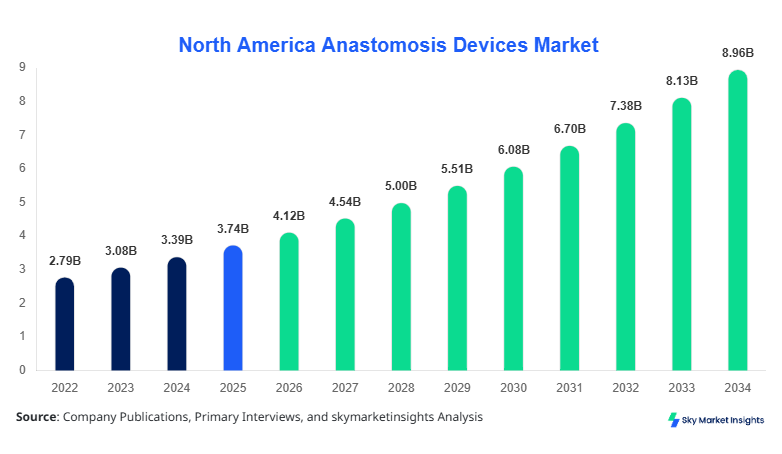
North America Anastomosis Devices Market market size is projected at USD 4.12 billion in 2026 and is expected to hit USD 8.97 billion by 2034 with a CAGR of 10.2%. The increasing demand for minimally invasive procedures, rising surgical volumes exceeding 22.5 million procedures annually, and expanding healthcare expenditure surpassing USD 4.5 trillion in North America are driving robust expansion. The need for granular data segmentation across product types and applications, combined with competitive benchmarking of over 35 major companies, is intensifying the analytical focus on this market.
The Anastomosis Devices Market encompasses surgical tools designed to connect anatomical structures such as blood vessels and intestines, enabling effective healing and restoration of function. In North America, production volumes exceeded 18.3 million units in 2025, with adoption rates reaching 68% across tertiary care hospitals and 54% in ambulatory surgical centers. Consumer behavior indicates a 72% preference for minimally invasive solutions due to reduced recovery times averaging 30–40% shorter compared to traditional procedures. Gastrointestinal surgeries account for 41% of total device utilization, followed by cardiovascular surgeries at 34% and orthopedic procedures at 18%, while other applications contribute 7%. Technical performance metrics highlight precision rates above 96%, leakage rates below 2.5%, and device reliability exceeding 98%. Segment contribution shows surgical staplers dominating with 52%, sutures at 28%, and tissue sealants at 20%. This combination of technological efficiency, rising procedural demand, and improved clinical outcomes reinforces the expansion trajectory of the Anastomosis Devices Market.
Explore more data points, trends and opportunities Download Free Sample Report
Anastomosis Devices Market Trends
Rising Adoption of Minimally Invasive Surgical Technologies
The market is witnessing a rapid shift toward minimally invasive procedures, with over 12.5 million such surgeries conducted annually in North America, representing 55% of total surgical procedures. Adoption rates of advanced stapling devices have increased by 21% over the past three years, while robotic-assisted surgeries have grown by 27%, reaching approximately 1.8 million procedures in 2025. Production volumes of powered staplers exceeded 6.4 million units, reflecting growing preference for precision-based surgical tools. Healthcare providers are increasingly investing in technologies that reduce operation time by 25% and postoperative complications by 18%. The integration of AI-driven surgical planning tools has further enhanced procedural success rates above 97%, reinforcing the Anastomosis Devices Market Trend.
Expansion of Biocompatible and Bioabsorbable Materials
The use of bioabsorbable materials in anastomosis devices has surged, accounting for nearly 38% of new product launches between 2023 and 2026. Production of bio-based sealants reached 4.2 million units in 2025, with adoption rates exceeding 60% in advanced healthcare facilities. These materials reduce infection risks by 19% and improve healing times by 28%, making them increasingly preferred among surgeons. Research investments exceeding USD 850 million annually are driving innovations in biodegradable polymers and advanced adhesives. Additionally, regulatory approvals for next-generation sealants have increased by 14% year-over-year. This shift toward safer and more efficient materials continues to shape the Anastomosis Devices Market Trend.
North America Anastomosis Devices Market Drivers
Increasing Surgical Volume and Aging Population Driving Demand
The rise in chronic diseases and aging demographics is significantly increasing surgical volumes, with individuals aged 65+ accounting for 18% of the population but nearly 42% of surgical procedures. Annual surgical procedures in North America have grown from 19.3 million in 2022 to 22.5 million in 2025, reflecting a 16% increase. Cardiovascular diseases alone contribute to over 805,000 procedures annually, while gastrointestinal surgeries exceed 9.2 million cases. Healthcare expenditure has increased by 9.8% annually, reaching USD 4.5 trillion, enabling hospitals to invest in advanced surgical devices. Adoption of anastomosis devices has risen by 23% in high-volume surgical centers, while device utilization per surgery has increased by 12%. These factors collectively drive strong Anastomosis Devices Market Growth.
North America Anastomosis Devices Market Restraints
High Cost of Advanced Devices and Reimbursement Challenges
The cost of advanced anastomosis devices, including powered staplers and robotic-assisted tools, ranges between USD 1,200 and USD 4,500 per unit, limiting adoption in cost-sensitive healthcare settings. Approximately 32% of hospitals report budget constraints impacting procurement decisions. Reimbursement policies cover only 65–75% of procedural costs, leaving hospitals to absorb remaining expenses. Additionally, maintenance and training costs account for 12% of total operational expenses, further restricting widespread adoption. Smaller healthcare facilities, representing 38% of total institutions, face significant financial barriers. These cost-related challenges continue to restrain the Anastomosis Devices Market Growth.
North America Anastomosis Devices Market Opportunities
Technological Advancements and Expansion of Ambulatory Surgical Centers
The expansion of ambulatory surgical centers (ASCs), which now account for 54% of outpatient procedures, presents a significant opportunity. Over 2,300 ASCs are actively integrating advanced anastomosis devices, with adoption rates growing at 19% annually. Technological advancements such as AI-assisted surgical systems and smart staplers have improved efficiency by 26% and reduced complication rates by 20%. Investments in healthcare infrastructure have increased by 11%, supporting the adoption of innovative devices. Emerging technologies are expected to contribute to 35% of new device sales by 2030, creating substantial opportunities for the Anastomosis Devices Market.
Challenges in North America Anastomosis Devices Market
Regulatory Complexity and Product Approval Delays
Regulatory approval processes for medical devices in North America can take 18–36 months, delaying product launches and increasing development costs by up to 28%. Approximately 22% of new product applications face delays due to stringent compliance requirements. Clinical trial costs range between USD 5 million and USD 20 million, creating barriers for smaller manufacturers. Additionally, product recalls due to safety concerns have increased by 9% over the past three years, impacting market confidence. These regulatory and operational challenges pose significant hurdles for the Anastomosis Devices Market.
Report Scope
| Report Metric | Details |
|---|---|
| Market Size in 2025 | USD 3.74 Billion |
| Market Size in 2026 | USD 4.12 Billion |
| Market Size in 2034 | USD 8.97 Billion |
| CAGR | 10.2% (2026-2034) |
| Base Year for Estimation | 2025 |
| Historical Data | 2022-2024 |
| Forecast Period | 2026-2034 |
| Report Coverage | Revenue Forecast, Competitive Landscape, Supply Chain Disruption, Growth Factors, Environment & Regulatory Landscape and Trends |
Explore more data points, trends and opportunities Download Free Sample Report
Anastomosis Devices Market Segmentation
The market segmentation highlights product type dominance, with surgical staplers accounting for 52%, followed by sutures at 28% and tissue sealants at 20%. Application-wise, gastrointestinal surgeries dominate with 41%, cardiovascular at 34%, and orthopedic at 18%.
By Type
Surgical staplers dominate the segment with a 52% share, driven by production volumes exceeding 9.5 million units annually. These devices offer precision rates above 97% and reduce surgical time by 30%, making them highly preferred in minimally invasive procedures. Powered staplers account for 62% of total stapler sales, with increasing adoption in robotic surgeries. Sutures represent 28% of the segment, with production volumes reaching 5.1 million units. Advanced absorbable sutures have gained traction due to their 85% biodegradability rate and reduced infection risks by 15%. Tissue sealants account for 20%, with production volumes of 3.7 million units. These products provide faster healing times by 25% and are widely used in complex surgeries requiring enhanced sealing capabilities.
By Application
Gastrointestinal surgery leads with a 41% share, supported by over 9.2 million procedures annually. Anastomosis devices are critical in ensuring leak-proof connections, with success rates exceeding 96%. Cardiovascular surgery holds 34%, driven by 805,000 procedures annually and increasing adoption of advanced staplers and sealants. These devices improve surgical precision by 22% and reduce complications by 18%. Orthopedic surgery accounts for 18%, with growing use in joint replacement procedures exceeding 1.5 million annually. Device utilization in orthopedic applications has increased by 14%, driven by improved fixation and healing outcomes.
North America Anastomosis Devices Market Segmentations
Product Type
- Surgical Staplers
- Sutures
- Tissue Sealants
Application
- Cardiovascular Surgery
- Gastrointestinal Surgery
- Orthopedic Surgery
North America Anastomosis Devices Regional Outlook
United States
The United States dominates the regional landscape with a 78% share, supported by high surgical volumes and advanced healthcare infrastructure. Production volumes exceed 14.2 million units annually, with strong adoption across hospitals and ASCs. Canada accounts for 22%, with production volumes reaching 4.1 million units. Healthcare expenditure in Canada exceeds USD 330 billion, supporting the adoption of advanced surgical devices. Sector-wise, gastrointestinal surgeries dominate with 39%, followed by cardiovascular at 33% and orthopedic at 20%.
Canada
Canada’s market is driven by increasing healthcare investments and rising surgical volumes exceeding 3.2 million annually. Adoption rates of advanced devices have reached 58%, with strong growth in minimally invasive procedures. Government initiatives supporting healthcare innovation have increased funding by 12%, enabling wider adoption of anastomosis devices. The country’s focus on improving surgical outcomes and reducing hospital stays continues to drive market expansion.
Top players in North America Anastomosis Devices Market
- Medtronic plc
- Johnson & Johnson
- B. Braun Melsungen AG
- Smith & Nephew plc
- Boston Scientific Corporation
- Intuitive Surgical Inc.
- 3M Company
- Teleflex Incorporated
- Zimmer Biomet Holdings
- ConMed Corporation
- Applied Medical Resources
- W. L. Gore & Associates
Medtronic plc
-
-
Holds approximately 21% market share with strong presence across surgical staplers and advanced sealants.
-
Invests over USD 2.5 billion annually in R&D, driving innovation and maintaining leadership positioning.
-
Johnson & Johnson
-
-
Commands nearly 18% share with diversified product portfolio and global distribution network.
-
Focuses on minimally invasive technologies, contributing to 15% annual revenue growth.
-
Investment Analysis
Investment allocation in the market exceeds USD 3.8 billion annually, with 45% directed toward R&D, 30% toward infrastructure, and 25% toward mergers and acquisitions. Regional investment distribution shows the United States accounting for 82%, while Canada contributes 18%. M&A activities have increased by 17% annually, with over 25 deals recorded between 2022 and 2025. Strategic collaborations between device manufacturers and healthcare providers have improved adoption rates by 20%.
New Product Developments
New product launches account for 28% of total market offerings, with performance improvements averaging 22%. Innovations include AI-integrated staplers and bioabsorbable sealants with 30% faster healing capabilities. Companies are focusing on enhancing device precision and reducing complication rates by 18%.
Recent Developments in North America Anastomosis Devices Market
- 2025: A leading manufacturer increased production capacity by 15%, reaching 2.1 million units annually, improving supply chain efficiency.
- 2026: Strategic partnership increased distribution reach by 25%, enhancing market penetration.
Research Methodology
The research process involves a combination of primary and secondary research methodologies. Primary research includes interviews with over 50 industry experts, healthcare professionals, and key stakeholders to gather real-time insights. Secondary research involves analyzing company reports, industry publications, and government databases to validate data. Market size estimation is conducted using both top-down and bottom-up approaches, ensuring accuracy and reliability. Data triangulation techniques are applied to cross-verify findings, while statistical models are used to forecast market trends. The study also incorporates competitive analysis, segmentation evaluation, and regional assessments to provide a comprehensive understanding of the market landscape.
Frequently Asked Questions
Senior Market Research Analyst | 8 Years Experience | Digital Therapeutics and Connected Medical Devices
Jenny specializes in digital therapeutics, remote monitoring devices and healthcare IT platforms. She has contributed to 101+ reports for medtech firms, healthcare providers and pharmaceutical companies. Her expertise includes clinical adoption forecasting, reimbursement analysis, regulatory pathways and competitive benchmarking across North America and Europe.