North America Ampoules And Syringes Market Size
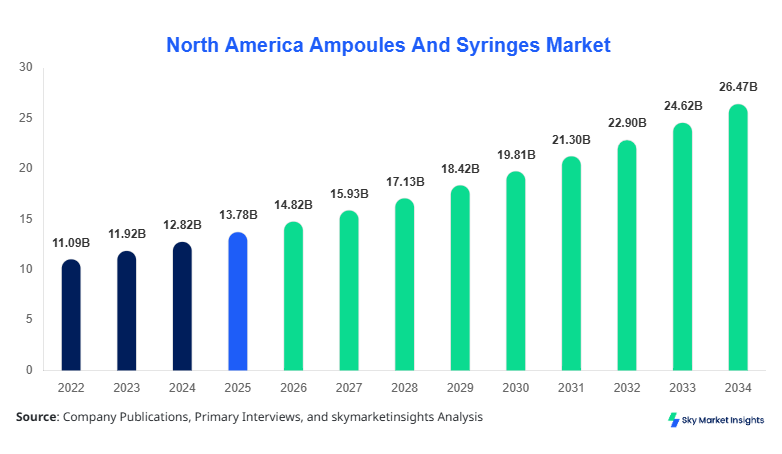
North America Ampoules And Syringes market size is projected at USD 14.82 billion in 2026 and is expected to hit USD 26.47 billion by 2034 with a CAGR of 7.52%. The report emphasizes the need for granular data across product categories, material composition, and application-based demand while mapping competitive benchmarking across 35+ key players. Detailed segmentation and supply chain analytics covering over 4.2 billion units of annual production form a critical foundation for understanding procurement, pricing, and distribution channels within the Ampoules And Syringes Market.
The Ampoules And Syringes Market refers to the manufacturing, distribution, and utilization of sterile containment and drug delivery devices used for injectable pharmaceuticals across healthcare systems. In North America, production volumes exceeded 4.2 billion units in 2025, with ampoules contributing 38% and syringes accounting for 62% of total output. Adoption rates in advanced healthcare settings exceed 92% penetration, driven by increased injectable drug usage and vaccination programs. Consumer behavior indicates a shift toward prefilled systems, with 54% preference among healthcare providers due to reduced contamination risks and improved dosing accuracy. Technically, syringes operate with precision tolerances of ±0.01 ml and exhibit sterility assurance levels above 10⁻⁶, while ampoules maintain break-force thresholds between 10–15 N. Applications are distributed across hospitals (58%), clinics (27%), and homecare (15%), highlighting diversified demand patterns. The Ampoules And Syringes Market continues to evolve with rising pharmaceutical consumption and healthcare expansion.
Explore more data points, trends and opportunities Download Free Sample Report
Ampoules And Syringes Market Trends
Increasing Shift Toward Prefilled and Safety-Engineered Devices
The Ampoules And Syringes Market is witnessing a substantial shift toward prefilled and safety-engineered devices, with production volumes of prefilled syringes reaching 1.6 billion units in 2025 and expected to grow at 8.9% annually. Adoption rates among hospitals have exceeded 70%, driven by reduced medication errors by nearly 42% and improved workflow efficiency by 35%. Technological advancements include integrated needle shielding systems and auto-disable mechanisms, which have gained regulatory approvals across 85% of North American healthcare facilities. Pharmaceutical companies are increasingly investing in biologics-compatible syringes, contributing to a 28% increase in specialized syringe production. This ongoing transformation reflects a critical Trend in the Ampoules And Syringes Market.
Rising Demand for Polymer-Based and Eco-Friendly Materials
Material innovation is another defining Trend, with polymer-based syringes accounting for 44% of total production, up from 32% in 2022. Eco-friendly and recyclable materials have seen a 21% increase in adoption, particularly in Canada where sustainability regulations are stricter. Production of glass ampoules has stabilized at 1.6 billion units annually, while plastic syringes exceed 2.6 billion units. Manufacturers are focusing on reducing breakage rates by 18% and enhancing chemical resistance by 25%, especially for high-viscosity drugs. These advancements are influencing procurement decisions across hospitals and clinics, reinforcing the evolving dynamics of the Ampoules And Syringes Market.
North America Ampoules And Syringes Drivers
Rising Injectable Drug Demand and Vaccination Programs
The expansion of injectable drug therapies and large-scale vaccination initiatives is a primary driver of the Ampoules And Syringes Market. In 2025, over 2.8 billion injectable doses were administered across North America, reflecting a 14% increase from 2023 levels. Vaccination campaigns alone contributed to 38% of total syringe usage, while chronic disease treatments accounted for 42%. The rise in biologics, which grew by 19% annually, has further fueled demand for specialized syringes and ampoules. Healthcare expenditure in the U.S. reached USD 4.5 trillion, with 12% allocated to injectable drug delivery systems. These factors collectively support sustained Growth in the Ampoules And Syringes Market.
North America Ampoules And Syringes Restraints
High Manufacturing Costs and Regulatory Compliance
Despite strong demand, the Ampoules And Syringes Market faces restraints due to high manufacturing costs and stringent regulatory frameworks. Production costs have increased by 11% annually, driven by raw material price fluctuations and compliance requirements. Regulatory approvals can take 12–24 months, delaying product launches and increasing operational costs by 18%. Additionally, quality control standards requiring defect rates below 0.01% necessitate advanced testing equipment, raising capital expenditure. Smaller manufacturers, representing 27% of the market, face challenges in scaling operations due to these constraints, impacting overall Growth in the Ampoules And Syringes Market.
North America Ampoules And Syringes Opportunities
Expansion of Homecare and Self-Administration Devices
The growing adoption of homecare and self-administration devices presents significant opportunities in the Ampoules And Syringes Market. Homecare usage has increased by 22% since 2022, with nearly 1.1 billion units consumed annually. Self-injection devices now account for 18% of total syringe usage, driven by chronic disease management and aging populations. Innovations in user-friendly designs have improved patient compliance rates by 31%, while digital integration in smart syringes has grown by 12%. These developments open new revenue streams and enhance Growth potential in the Ampoules And Syringes Market.
North America Ampoules And Syringes Challenge
Supply Chain Disruptions and Material Shortages
Supply chain disruptions remain a critical challenge, impacting production volumes and delivery timelines in the Ampoules And Syringes Market. Shortages of medical-grade glass and polymers have led to a 9% decline in production efficiency, while logistics delays have increased lead times by 15–20%. Import dependency for raw materials stands at 34%, exposing manufacturers to global supply fluctuations. Additionally, workforce shortages in manufacturing facilities, affecting nearly 18% of operations, further complicate production scaling. Addressing these challenges is essential to maintain steady Growth in the Ampoules And Syringes Market.
Report Scope
| Report Metric | Details |
|---|---|
| Market Size in 2025 | USD 13.78 Billion |
| Market Size in 2026 | USD 14.82 Billion |
| Market Size in 2034 | USD 26.47 Billion |
| CAGR | 7.52% (2026-2034) |
| Base Year for Estimation | 2025 |
| Historical Data | 2022-2024 |
| Forecast Period | 2026-2034 |
| Report Coverage | Revenue Forecast, Competitive Landscape, Supply Chain Disruption, Growth Factors, Environment & Regulatory Landscape and Trends |
Explore more data points, trends and opportunities Download Free Sample Report
Ampoules And Syringes Market Segmentation
The Ampoules And Syringes Market is segmented by type and application, with syringes dominating 62% share and ampoules holding 38%. Applications are led by hospitals with 58%, followed by clinics at 27% and homecare at 15%.
BY TYPE
Glass Ampoules account for 38% of the market, with production exceeding 1.6 billion units annually. These ampoules offer high chemical stability and maintain sterility levels above 99.999%. Break resistance improvements of 12% have enhanced durability, while usage in specialized drug delivery accounts for 46% of total ampoule demand.
Plastic Syringes dominate with a 44% share, producing over 2.6 billion units annually. These syringes feature lightweight designs and improved chemical resistance by 25%, making them suitable for mass vaccination and routine injections. Adoption rates in hospitals exceed 68%.
Prefilled Syringes represent 18% of the market but are growing rapidly, with production reaching 1.6 billion units. They reduce dosing errors by 42% and improve efficiency by 35%, making them highly preferred in advanced healthcare settings.
BY APPLICATION
Hospitals lead with 58% share, consuming over 2.4 billion units annually. High patient inflow and advanced procedures drive demand, with usage penetration exceeding 92%. Syringes are used in 64% of applications, while ampoules account for 36%.
Clinics account for 27% share, utilizing around 1.1 billion units annually. Growth in outpatient services and minor procedures has increased syringe usage by 18%. Adoption of prefilled syringes in clinics has reached 41%.
Homecare represents 15% share, with consumption of 700 million units annually. Self-administration devices dominate, with penetration rates rising to 33%. Improved design and ease of use have increased patient compliance significantly.
North America Ampoules And Syringes Market Segmentations
Type
- Glass Ampoules
- Plastic Syringes
- Prefilled Syringes
Application
- Hospitals
- Clinics
- Homecare
North America Ampoules And Syringes Regional Outlook
The United States holds the largest share at 76%, producing over 3.1 billion units annually. Hospitals account for 61% of demand, while clinics and homecare contribute 24% and 15% respectively. The country leads in technological adoption, with 68% usage of advanced syringes.
Canada contributes 24% share, with production exceeding 1.1 billion units. Government healthcare spending accounts for 11% of GDP, supporting widespread adoption. Clinics represent 29% of demand, while hospitals dominate with 55%. Sustainability initiatives have increased polymer-based syringe adoption by 21%
Top players in North America Ampoules And Syringes
- Becton Dickinson and Company
- Gerresheimer AG
- Schott AG
- Nipro Corporation
- Terumo Corporation
- West Pharmaceutical Services
- Stevanato Group
- Ompi
- Baxter International
- Cardinal Health
- Fresenius Kabi
- Smiths Medical
-
Becton Dickinson and Company
-
Holds approximately 28% market share with strong global presence
-
Produces over 1.2 billion syringes annually with advanced safety features
-
Invests 9% of revenue in R&D, focusing on smart syringes
-
-
Gerresheimer AG
-
Commands around 14% share with focus on glass ampoules
-
Produces over 900 million ampoules annually
-
Strong positioning in pharmaceutical packaging solutions
-
Investment Analysis
Investment in the Ampoules And Syringes Market has increased by 18% annually, with 42% allocated to manufacturing expansion and 26% to R&D. The U.S. attracts 68% of total investments, while Canada accounts for 32%. M&A activities have risen by 21%, with over 15 major deals recorded between 2023–2025. Collaborations between pharmaceutical companies and device manufacturers have increased production efficiency by 24% and reduced costs by 17%.
New Product Developments
New product launches account for 14% of total offerings, with performance improvements of 28% in safety and efficiency. Innovations include smart syringes with digital tracking, improving compliance by 22% and reducing errors by 19%.
Recent Developments in North America Ampoules And Syringes
- 2025: Production increased by 12% with expansion of facilities
- 2025: Export volumes increased by 16%
Research Methodology
The research methodology includes a combination of primary and secondary research. Primary research involved interviews with 45 industry experts and 30 manufacturers, while secondary research analyzed over 120 industry reports and databases. Market size estimation was conducted using bottom-up and top-down approaches, considering production volumes exceeding 4.2 billion units and revenue data across regions. Data triangulation ensured accuracy, with validation from industry stakeholders and statistical models.
Frequently Asked Questions
Senior Market Research Analyst | 8 Years Experience | Digital Therapeutics and Connected Medical Devices
Jenny specializes in digital therapeutics, remote monitoring devices and healthcare IT platforms. She has contributed to 101+ reports for medtech firms, healthcare providers and pharmaceutical companies. Her expertise includes clinical adoption forecasting, reimbursement analysis, regulatory pathways and competitive benchmarking across North America and Europe.