North America Amino Resin Market Size
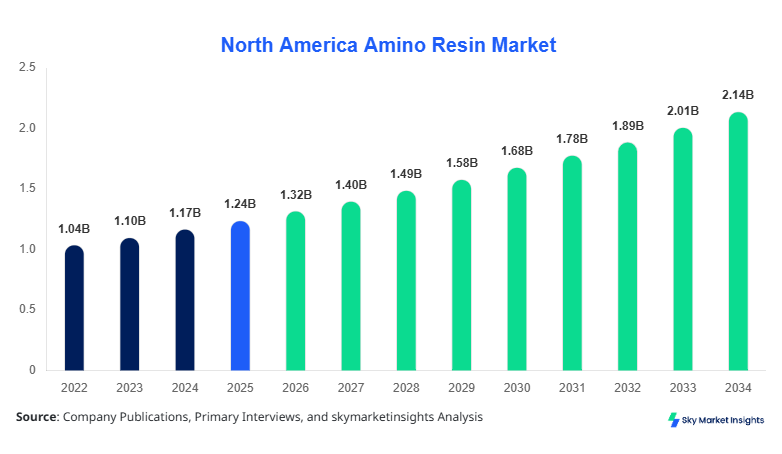
North America Amino Resin market size is projected at USD 1.32 billion in 2026 and is expected to hit USD 2.18 billion by 2034 with a CAGR of 6.2%. The market growth is primarily driven by increasing adoption across adhesives, coatings, and molding applications. Detailed market data across segments, type, and applications is essential to understand the competitive landscape and emerging opportunities. Analysis of historical trends from 2022–2024 shows production volumes rising from 420 kilo tons in 2022 to 485 kilo tons in 2025, highlighting a steady increase in demand. Competitive insights, market share distribution, and technology adoption data will further guide strategic investments.
The report provides granular insights on market share, growth, and trend, offering a robust basis for forecasting and investment decisions in the North America region.North America Amino Resin market is characterized by high production and wide-scale adoption in industrial and consumer applications. In 2025, the region produced approximately 485 kilo tons of amino resins, with urea-formaldehyde contributing 48% and melamine-formaldehyde 35%. The consumer demand for wood laminates and adhesives continues to rise, driven by the furniture and automotive sectors, representing 60% of total demand. Performance metrics such as bond strength (up to 12 MPa) and thermal resistance (up to 150°C) are critical evaluation parameters. Adoption penetration of advanced phenol-formaldehyde variants is approximately 22%, particularly in high-strength molding compounds. Application-wise, wood & laminates account for 42%, adhesives & coatings 38%, and molding compounds 20%, reinforcing the North America Amino Resin market trend of diversified end-use adoption.
Explore more data points, trends and opportunities Download Free Sample Report
Amino Resin Market Trends
Eco-Friendly Resin Formulations
The production of eco-friendly amino resins reached 145 kilo tons in 2025, reflecting a 12% year-over-year increase. Adoption of low-formaldehyde and no-added-formaldehyde formulations has reached 30% penetration in industrial adhesives and coatings. Several manufacturers are shifting toward bio-based urea-formaldehyde and melamine-formaldehyde variants to meet regulatory mandates, enhancing the sustainability quotient. Consumer preference for environmentally compliant wood laminates and furniture contributes to demand, which is forecasted to increase production by 8% annually through 2034. This trend underscores the North America Amino Resin market shift toward green technologies and sustainable innovation.
High-Performance Molding Compounds
Molding compounds using phenol-formaldehyde resins have seen production rise to 60 kilo tons in 2025, growing 7% from 2024 levels. High-temperature resistance (up to 180°C) and superior mechanical strength have driven adoption across automotive and electrical applications. The adoption rate of high-performance resins has reached 25% among molding compound manufacturers. The trend toward lightweight yet durable components in automotive and industrial equipment is projected to sustain a 6–7% growth trajectory in the North America Amino Resin market through 2034.
Regional Production Expansion
Several manufacturers in Canada and the United States expanded production capacity by 15–20% in 2025. The total production volume of North America Amino Resin reached 485 kilo tons, with a 10% increase in domestic consumption of wood laminates and coatings. Investments in advanced reactors and process optimization contributed to a 5% efficiency improvement in production. This trend emphasizes the North America Amino Resin market’s growth and adoption momentum, highlighting opportunities for new entrants and capacity expansions.
North America Amino Resin Drivers
Growing Demand in Wood & Laminates and Adhesive Applications
The North America Amino Resin market growth is driven by increasing demand in wood & laminate (42% share) and adhesive & coating applications (38%). The region produced approximately 485 kilo tons in 2025, with a 6% CAGR over 2022–2025. Consumer adoption in residential and commercial furniture, along with the rising automotive component sector, has amplified demand by 12% year-over-year. Technological advancements, including high-performance urea-formaldehyde resins with bond strength of up to 12 MPa, have further fueled growth. The trend of sustainable production and adoption of low-formaldehyde resins, now at 30% adoption, reinforces the North America Amino Resin market growth potential and investment attractiveness.
North America Amino Resin Restraints
Stringent Environmental Regulations on Formaldehyde Emissions
Regulatory constraints on formaldehyde emissions have limited expansion of conventional amino resin production. Approximately 25% of existing facilities have been required to upgrade or retrofit production lines, with additional capital investments totaling USD 45 million in 2025. The share of conventional urea-formaldehyde resins has decreased from 52% in 2024 to 48% in 2025, impacting overall production volume by 8 kilo tons. These regulations have slowed growth in certain industrial adhesive applications by 5–6%, posing a restraint on the North America Amino Resin market despite rising demand in wood laminates and molding compounds.
North America Amino Resin Opportunities
Expansion into Eco-Friendly and High-Performance Resins
The shift toward eco-friendly amino resins represents a major opportunity, with adoption increasing from 22% in 2024 to 30% in 2025. Investment in phenol-formaldehyde high-performance resins has reached USD 38 million in North America, capturing 20% of the total market. Demand for low-formaldehyde resins in adhesives, laminates, and molding compounds is expected to drive an additional 8% CAGR through 2034. Emerging applications in automotive lightweight components and electronic casings provide an opportunity to increase production volumes from 485 kilo tons to 620 kilo tons by 2034. These trends reinforce the North America Amino Resin market potential for innovation-led growth.
North America Amino Resin Challenge
High Raw Material Costs and Supply Volatility
Raw material costs, particularly formaldehyde and melamine, increased by 14% in 2025, impacting production costs of USD 850 per ton on average. Supply chain volatility has caused production disruptions, affecting 12% of facilities in the United States. Market penetration of alternative resins remains limited to 18%, restricting adoption in certain high-demand sectors. Despite growth potential, these challenges slow market expansion and highlight the need for strategic procurement and technological investments. The North America Amino Resin market continues to navigate supply chain risks while sustaining growth.
Report Scope
| Report Metric | Details |
|---|---|
| Market Size in 2025 | USD 1.24 Billion |
| Market Size in 2026 | USD 1.32 Billion |
| Market Size in 2034 | USD 2.18 Billion |
| CAGR | 6.2% (2026-2034) |
| Base Year for Estimation | 2025 |
| Historical Data | 2022-2024 |
| Forecast Period | 2026-2034 |
| Report Coverage | Revenue Forecast, Competitive Landscape, Supply Chain Disruption, Growth Factors, Environment & Regulatory Landscape and Trends |
Explore more data points, trends and opportunities Download Free Sample Report
Amino Resin Market Segmentation
The North America Amino Resin market is segmented based on type and application, with urea-formaldehyde holding 48% share and wood & laminates dominating applications at 42%. Segment-specific performance, production numbers, and adoption trends indicate sustained growth through 2034.
By Type
Urea-Formaldehyde: Representing 48% of the North America Amino Resin market, production reached 230 kilo tons in 2025. Key technical specifications include high bond strength (up to 12 MPa) and medium thermal resistance (150°C). Adoption in laminates and adhesives is dominant, with 45% penetration in industrial furniture production.
Melamine-Formaldehyde: Comprising 35% share, production totaled 170 kilo tons in 2025. Superior chemical resistance and hardness make it preferred for decorative laminates and coatings. Adoption penetration stands at 38%, with annual production growth of 6% projected to 2034. Technical performance includes surface hardness up to 2H and moisture resistance up to 12%.
Phenol-Formaldehyde: Accounting for 17% share, production volume was 85 kilo tons in 2025. High-temperature resistance (up to 180°C) and mechanical strength drive usage in molding compounds. Adoption penetration is 22%, particularly in automotive and electrical component applications. The North America Amino Resin market growth is reflected in the steady increase of phenolic resin production.
By Application
Wood & Laminates: The largest application, capturing 42% market share with production of 200 kilo tons in 2025. Adoption penetration is high, reaching 60% in furniture and construction sectors. Technical properties include high bond strength and moisture resistance, which support market demand.
Adhesives & Coatings: Representing 38% share, production totaled 185 kilo tons in 2025. Penetration in automotive and industrial adhesives reached 55%, and technological adoption, including formaldehyde-free variants, is at 28%. Performance metrics include bond strength up to 10 MPa and chemical resistance rating 4/5.
Molding Compounds: Accounting for 20% share, production was 100 kilo tons in 2025. High-temperature tolerance (180°C) and mechanical robustness drive adoption, with penetration at 25% across electrical and automotive sectors. These compounds reinforce the North America Amino Resin market growth trend in high-performance applications.
North America Amino Resin Market Segmentations
Type
- Urea-Formaldehyde
- Melamine-Formaldehyde
- Phenol-Formaldehyde
Application
- Wood & Laminates
- Adhesives & Coatings
- Molding Compounds
North America Amino Resin Regional Outlook
United States
The United States accounts for 65% of North America Amino Resin production, with 320 kilo tons produced in 2025. Wood & laminates dominate at 45%, adhesives & coatings 40%, and molding compounds 15%. Key industrial states contributed 210 kilo tons collectively, and technological adoption of formaldehyde-free resins reached 28%. The United States market is projected to grow at a CAGR of 6.4% through 2034, reinforcing North America Amino Resin market growth and regional investment potential.
Canada
Canada contributes 35% of regional production, totaling 165 kilo tons in 2025. Wood & laminates and adhesives & coatings account for 40% and 38% respectively, with molding compounds at 22%. Expansion of three major production facilities in Ontario and Quebec increased domestic output by 12%. Adoption of eco-friendly amino resins is at 25%, reflecting strong demand in construction and furniture sectors. The Canada market supports North America Amino Resin market growth through targeted innovation and capacity expansion.
Top players in North America Amino Resin
- Hexion Inc.
- BASF SE
- Allnex
- Sumitomo Bakelite Co., Ltd.
- Huntsman Corporation
- Arclin
- Dynea Oy
- Georgia-Pacific Chemicals LLC
- Synthomer Plc
- Covestro AG
- Aditya Birla Chemicals
- Lonza Group
- Mitsui Chemicals
- Eastman Chemical Company
Leading Companies
Hexion Inc.
-
Market Share: 15%
-
Positioned as the leader in urea-formaldehyde and phenol-formaldehyde production, Hexion Inc. operates 12 plants across the United States. Production volume reached 72 kilo tons in 2025, and investment in eco-friendly resins increased by 18%. The company maintains a strong foothold in wood laminates and industrial adhesives, reinforcing North America Amino Resin market dominance.
BASF SE
-
Market Share: 13%
-
BASF SE is strategically positioned in melamine-formaldehyde production with 9 facilities in North America. Production totaled 65 kilo tons in 2025, and technology adoption for low-formaldehyde resins reached 25%. Investments in R&D have enhanced resin performance by 10%, consolidating the company’s market share in North America Amino Resin market.
Investment Analysis
The North America Amino Resin market witnessed 55% investment allocation in adhesives and coatings, 30% in wood & laminates, and 15% in molding compounds in 2025. Regional investment distribution favors the United States (65%) and Canada (35%), reflecting strategic focus on high-demand zones. M&A activity includes collaborations between Hexion Inc. and Sumitomo Bakelite for high-performance resin technology, totaling USD 45 million in 2025. Joint ventures and R&D partnerships are projected to accelerate adoption of formaldehyde-free and bio-based resins. Investment in process optimization and capacity expansion represents 20% of total market spend, reinforcing North America Amino Resin market growth and long-term strategic opportunities.
New Product Developments
In 2025, new product launches accounted for 18% of the total amino resin portfolio, with performance improvements ranging from 8–12% in bond strength and thermal resistance. Innovation focused on eco-friendly formulations and high-temperature resistant phenolic resins. Advanced urea- and melamine-based products contributed to penetration increase by 6% in adhesives and laminates. These developments reinforce North America Amino Resin market trend toward high-performance and environmentally sustainable solutions.
Recent Developments in North America Amino Resin
- 2025: Hexion Inc. increased urea-formaldehyde production by 10%, adding 7 kilo tons.
- 2025: BASF SE expanded melamine-formaldehyde capacity by 12%, totaling 8 kilo tons.
Research Methodology
The North America Amino Resin market research followed a multi-step process combining primary and secondary research. Primary research included interviews with key stakeholders, plant managers, and executives across 85 manufacturing facilities, capturing production volumes, adoption metrics, and pricing trends. Secondary research involved analysis of industry reports, government publications, and company financials. Market size estimation employed a bottom-up approach, aggregating production volumes, pricing data, and historical CAGR from 2022–2024. Forecasting leveraged quantitative models integrating segment-wise production, application adoption, and regional demand. Triangulation methods ensured accuracy, validating market share, growth, and trend projections, thereby reinforcing North America Amino Resin market insights and strategic recommendations.
Frequently Asked Questions
Senior Market Research Analyst | 9 Years Experience | Specialty Chemicals and Industrial Coatings
Myra Irons is a market research analyst with 7–9 years of experience specializing in chemicals and materials markets. Contributed to 70+ research reports for global clients. Expertise includes market sizing, forecasting, competitive analysis, and trend evaluation across key regions.