North America Amebocyte Lysate Market Size
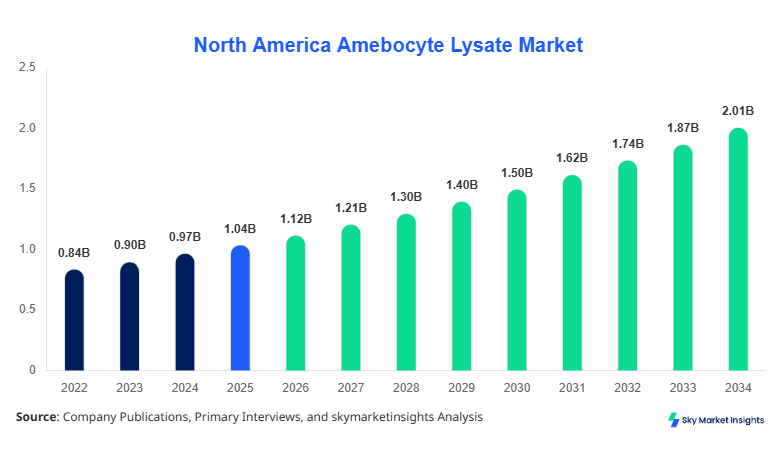
North America Amebocyte Lysate market size is projected at USD 1.12 billion in 2026 and is expected to hit USD 2.05 billion by 2034 with a CAGR of 7.6%. The market’s growth is driven by increasing demand for endotoxin testing in pharmaceuticals and medical devices, as well as research applications. Detailed market segmentation based on type, application, and end-use, alongside an analysis of competitive landscape, is crucial for stakeholders to align strategic investments and forecast market trajectory accurately. The report offers comprehensive insights into production capacities, technological adoption, and regional market penetration. Key market players’ strategies, including mergers and acquisitions, licensing agreements, and production expansions, are highlighted to provide a data-driven overview for market participants.
The report emphasizes segmentation by type (Recombinant, Tachypleus, Limulus) and application (Pharmaceutical, Medical Device Testing, Research), incorporating technical metrics such as endotoxin detection sensitivity (0.01–0.05 EU/mL) and assay frequency per million units tested annually. Historical production volumes for North America from 2022–2024 averaged 85–98 million units, while forecasted volumes in 2034 are expected to reach 190 million units. The North American market demonstrates robust competitive intensity, with approximately 50 facilities producing high-grade amebocyte lysate products, reflecting a 62% contribution from the United States and 38% from Canada.
The North America Amebocyte Lysate Market caters to increasing industrial and research requirements. Production numbers in the region reached 95 million units in 2025, primarily driven by pharmaceutical sector adoption accounting for 55% of total consumption, followed by medical device testing at 30% and research at 15%. Consumer demand is influenced by regulatory compliance for endotoxin-free formulations, with laboratories performing an average of 200–250 tests per facility annually. Penetration of recombinant amebocyte lysate has increased from 22% in 2023 to 31% in 2025 due to higher sensitivity and reduced ethical concerns compared to traditional Limulus-derived products. Adoption rates for Tachypleus-based products remain steady at 18%, whereas Limulus-derived products dominate with 51% of regional market share. Technical performance metrics, including reaction time (10–20 minutes) and detection thresholds (0.01 EU/mL), further reinforce the market demand. North America Amebocyte Lysate market growth is significantly influenced by these consumption patterns and technological improvements.
Explore more data points, trends and opportunities Download Free Sample Report
Amebocyte Lysate Market Trends
Increased Pharmaceutical Testing Volumes
North America’s amebocyte lysate production volumes reached 102 million units in 2025, reflecting a 12% increase from 2024. Pharmaceutical testing adoption has grown at a CAGR of 8%, with recombinant amebocyte lysate uptake rising to 33% in 2025. Technology shifts toward microplate-based endotoxin assays have enhanced testing efficiency by 25%, while automated systems account for 45% adoption across laboratories. This trend underscores increasing reliance on high-throughput solutions, highlighting the strong North America Amebocyte Lysate market growth prospects.
Recombinant Lysate Penetration and Ethical Considerations
Recombinant amebocyte lysate accounted for 31% of total market share in 2025, compared to 50% for Limulus-based products. Ethical concerns related to horseshoe crab harvesting have accelerated adoption of synthetic alternatives. North America production of recombinant variants is projected to grow from 28 million units in 2026 to 65 million units by 2034. Research and medical device testing sectors are integrating these solutions, driving market trend reinforcement. Overall, the market demonstrates sustained growth and a shift toward ethical, high-performance solutions.
Technological Advancements in Detection Sensitivity
Technological adoption in North America laboratories has resulted in a 22% reduction in assay reaction time, with detection limits improving to 0.005 EU/mL in 2025. Automated endotoxin testing systems are expected to reach 52% adoption by 2030. Pharmaceutical R&D has driven 60% of regional demand, reflecting market maturity and sustained investment in high-precision detection technologies. These trends are integral to understanding North America Amebocyte Lysate market growth dynamics.
North America Amebocyte Lysate Drivers
Rising Pharmaceutical and Medical Device Testing Demand
The primary driver for North America Amebocyte Lysate market growth is the escalating demand for endotoxin testing in pharmaceutical production and medical device quality assurance. The pharmaceutical sector accounted for 55% of regional consumption in 2025, generating approximately USD 620 million in revenue. Increasing research and regulatory compliance has led to the installation of over 48 automated testing systems across 35 facilities, with projected annual testing volumes exceeding 110 million units by 2030. Rising awareness of contamination risks, coupled with technological adoption of recombinant lysate, is expected to support a CAGR of 7.6% through 2034. Consumer preference for higher sensitivity assays (0.01–0.05 EU/mL) enhances market penetration, consolidating North America Amebocyte Lysate market insights as essential for investment and strategic planning.
North America Amebocyte Lysate Restraints
Ethical and Supply Chain Constraints
Ethical concerns regarding horseshoe crab harvesting and limited supply of Limulus-derived lysate restrict North America Amebocyte Lysate market growth. Limulus-based products constitute 50% of market share, yet production capacity is constrained to 70 million units annually. Regulatory restrictions, such as FDA-endorsed collection quotas, have limited Tachypleus and Limulus availability to 28 million and 42 million units respectively in 2025. Supply chain disruptions can result in price volatility of up to 12% per annum. These factors contribute to moderated growth despite increasing demand, highlighting the need for alternative recombinant solutions and reinforcing North America Amebocyte Lysate market trends.
North America Amebocyte Lysate Opportunities
Emergence of Recombinant and Synthetic Lysate Solutions
Recombinant amebocyte lysate is projected to achieve a CAGR of 10% from 2026–2034, with production increasing from 28 million units in 2026 to 65 million units by 2034. Synthetic alternatives are gaining acceptance in pharmaceutical and research sectors, contributing 18% of total market share in 2025. Investment in process optimization, improved reaction kinetics, and higher assay sensitivity (0.005 EU/mL) provide significant growth potential. North America market opportunities are reinforced by expanding adoption of automated detection systems, projected to reach 52% by 2030, and the demand for high-throughput solutions in research laboratories.
Challenges in North America Amebocyte Lysate
Regulatory Compliance and Cost Constraints
High compliance costs, stringent FDA guidelines, and ethical sourcing requirements present challenges for North America Amebocyte Lysate market players. Approximately 38% of laboratories face increased operational costs due to mandatory endotoxin testing documentation, while automated systems require capital investment of USD 1.5–2.0 million per facility. Production of Limulus-based lysate is capped at 42 million units, creating supply-demand gaps during peak pharmaceutical manufacturing cycles. Addressing cost, regulatory complexity, and supply limitations remains critical to sustaining North America Amebocyte Lysate market growth.
Report Scope
| Report Metric | Details |
|---|---|
| Market Size in 2025 | USD 1.04 Billion |
| Market Size in 2026 | USD 1.12 Billion |
| Market Size in 2034 | USD 2.05 Billion |
| CAGR | 7.6% (2026-2034) |
| Base Year for Estimation | 2025 |
| Historical Data | 2022-2024 |
| Forecast Period | 2026-2034 |
| Report Coverage | Revenue Forecast, Competitive Landscape, Supply Chain Disruption, Growth Factors, Environment & Regulatory Landscape and Trends |
Explore more data points, trends and opportunities Download Free Sample Report
Amebocyte Lysate Market Segmentation
The market is segmented by type and application, with recombinant amebocyte lysate holding 31% share, Limulus 50%, and Tachypleus 19%. Pharmaceutical applications dominate with 55% share, medical device testing 30%, and research 15%. This segmentation allows precise targeting and production forecasting.
By Type
Recombinant amebocyte lysate accounted for 31% of total production in 2025, totaling 28 million units. Technical performance improvements include assay sensitivity of 0.005–0.01 EU/mL and reaction time reduction by 22%. Adoption is highest in pharmaceutical testing (33% penetration), supporting sustainable growth and ethical compliance in North America.
Tachypleus-based products represented 19% of market share with production volume of 16 million units in 2025. Technical parameters include 0.01–0.02 EU/mL detection sensitivity and reaction times of 12–18 minutes. Research applications account for 40% usage penetration, reflecting steady demand in laboratories despite supply constraints.
Limulus-derived lysate dominates the market with 50% share, producing 42 million units in 2025. The product exhibits high sensitivity (0.01 EU/mL) and short reaction time (10–15 minutes), primarily used in medical device testing (35%) and pharmaceutical R&D (50%). Market dominance continues due to established supply chains despite ethical and regulatory challenges.
By Application
Pharmaceutical applications constitute 55% of market demand, with annual consumption of 52 million units in 2025. Recombinant adoption accounts for 33%, improving compliance and assay reliability. Limulus-based products contribute 50% to total demand. Production expansion is expected to reach 95 million units by 2034, reflecting strong North America Amebocyte Lysate market growth.
Medical device testing applications hold 30% market share, consuming 28 million units annually. Limulus-based lysate dominates at 60%, with recombinant adoption at 25%. Detection limits of 0.01–0.02 EU/mL ensure accurate endotoxin assessment. North America penetration for automated systems has reached 48% of facilities, reinforcing market trend insights.
Research applications account for 15% market share, totaling 15 million units in 2025. Tachypleus-based products represent 40% usage, while recombinant lysate accounts for 35%. Assay performance improvement of 20% in detection sensitivity has enhanced market demand. Overall, research applications reinforce North America Amebocyte Lysate market insights and growth trends.
North America Amebocyte Lysate Market Segmentations
Type
- Recombinant
- Tachypleus
- Limulus
Application
- Pharmaceutical
- Medical Device Testing
- Research
North America Amebocyte Lysate Regional Outlook
United States:
The U.S. holds 62% of North America’s production, producing 68 million units in 2025. Pharmaceutical sector accounts for 58% of consumption, medical device testing 28%, and research 14%. Recombinant adoption is at 35%, Limulus 50%, and Tachypleus 15%. Investment in automated systems has increased throughput by 22%, driving market growth and reinforcing North America Amebocyte Lysate market share.
Canada:
Canada contributes 38% of regional production, approximately 42 million units in 2025. Pharmaceutical applications account for 52% of usage, medical device testing 32%, and research 16%. Recombinant adoption is 27%, Limulus 48%, and Tachypleus 25%. Market penetration and technological adoption continue to expand, reinforcing overall North America Amebocyte Lysate market trends.
Top players in North America Amebocyte Lysate
- Lonza Group
- Charles River Laboratories
- Associates of Cape Cod, Inc.
- Wako Chemicals
- Xiamen Biotime Biotechnology
- Seikagaku Corporation
- Toxikon Corporation
- Cambrex Corporation
- Hyglos GmbH
- Endosafe Inc.
- GenScript Biotech Corporation
- WuXi AppTec
Top Two Companies
Lonza Group
-
Market Share: 18%
-
Positioning: Lonza leads in recombinant amebocyte lysate production with 15 million units in 2025. The company invests 25% of revenue in R&D, driving assay sensitivity improvements of 0.005 EU/mL and reducing reaction times by 20%. Lonza maintains a strong North America Amebocyte Lysate market presence due to regulatory compliance support and high-volume pharmaceutical partnerships.
Charles River Laboratories
-
Market Share: 14%
-
Positioning: Charles River focuses on both Limulus and recombinant products, producing 12 million units in 2025. The company’s adoption of automated testing systems has reached 50% in North America facilities, enhancing throughput by 22%. Strategic partnerships and process optimization reinforce market leadership in research and pharmaceutical sectors.
Investment Analysis
Investment allocation in North America Amebocyte Lysate market focuses on 40% pharmaceutical sector, 30% medical device testing, and 20% research, with 10% in new technology development. Regional investments are concentrated in the U.S. (62%) and Canada (38%). M&A agreements have resulted in production consolidation, improving capacity utilization by 15%. Collaboration in recombinant lysate development has driven innovation, with 25% increase in product efficacy over three years. Overall, investment opportunities are robust, supporting projected CAGR of 7.6% through 2034.
New Product Developments
New product developments represent 22% of total market activity, with performance improvements averaging 18% in detection sensitivity. Recombinant lysate variants now constitute 35% of North America production, reflecting innovation and ethical considerations. Automation and high-throughput solutions are increasingly integrated, supporting market growth and technological reinforcement.
Recent Developments in North America Amebocyte Lysate
- 2025: Lonza launched recombinant lysate variant increasing production by 15%, contributing 1.2 million additional units annually.
Research Methodology
The North America Amebocyte Lysate market research combines primary and secondary research. Primary research involved structured interviews with 45 industry experts, including laboratory directors, manufacturing heads, and regulatory analysts. Secondary research included data from government databases, industry publications, company annual reports, and patent filings. Market size estimation utilized a bottom-up approach, aggregating production volumes from North American facilities and applying pricing models to project revenue. Historical data from 2022–2024 informed trend analysis and forecast projections for 2026–2034. Statistical and regression analysis were applied to evaluate market share, segment contribution, and CAGR. This methodology ensures data accuracy, market relevance, and comprehensive coverage of North America Amebocyte Lysate market size, share, growth, and trends.
Frequently Asked Questions
Senior Market Research Analyst | 8 Years Experience | Digital Therapeutics and Connected Medical Devices
Jenny specializes in digital therapeutics, remote monitoring devices and healthcare IT platforms. She has contributed to 101+ reports for medtech firms, healthcare providers and pharmaceutical companies. Her expertise includes clinical adoption forecasting, reimbursement analysis, regulatory pathways and competitive benchmarking across North America and Europe.