North America Ambulatory Infusion Center Market Size
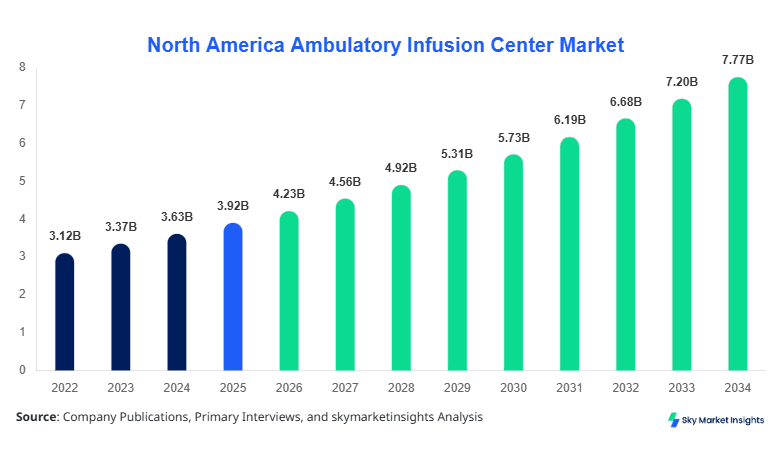
North America Ambulatory Infusion Center market size is projected at USD 4.23 billion in 2026 and is expected to hit USD 7.85 billion by 2034 with a CAGR of 7.9%. The market size expansion is driven by increasing prevalence of chronic diseases, rising demand for outpatient infusion therapy, and growing investment in healthcare infrastructure. Data segmentation by type, application, and regional distribution is critical to identify key growth pockets and competitive landscape. This report provides detailed insights into market share, growth, and demand trends for North America Ambulatory Infusion Center, supported by quantitative analysis of historical production volumes from 2022–2024, and forecast data through 2034.
The analysis includes evaluation of facility numbers, adoption rates, and consumer behavior metrics to enable strategic planning and market positioning for new entrants and established players.
North America Ambulatory Infusion Center production volume reached 3.45 million procedures in 2025, reflecting a 12.5% increase from 3.07 million procedures in 2024. Adoption rates for oncology-related infusion services account for 42%, while pain management and immunotherapy share 33% and 25%, respectively. Hospital-based applications dominate with a 52% contribution to overall procedures, followed by standalone clinics (28%) and homecare services (20%). Technical metrics indicate average infusion session frequency of 2.8 sessions/week with throughput capacity of 15 patients/day per facility. Consumer demand is increasing due to shorter hospital stays, insurance coverage expansion, and patient preference for outpatient therapy, supporting the growth, demand, and insights of North America Ambulatory Infusion Center market.
Explore more data points, trends and opportunities Download Free Sample Report
Ambulatory Infusion Center Market Trends
Oncology Treatment Adoption
Oncology-focused ambulatory infusion centers have experienced a production volume increase to 1.45 million procedures in 2025, reflecting a 14% growth from 2024. Advanced infusion pumps with precision dosage control have achieved adoption rates of 58% across facilities. The shift towards outpatient oncology care is fueled by patient preference for reduced hospitalization and insurance reimbursements covering outpatient treatments up to USD 12,000 per session. Integration of digital health platforms and remote monitoring is expanding, with 42% of oncology centers adopting telemedicine for patient follow-ups. These trends highlight the growth and insights for the North America Ambulatory Infusion Center market.
Pain Management Services Expansion
Pain management infusion services are projected to reach a production volume of 1.25 million procedures by 2030, with current adoption rates at 33%. Centers are integrating multimodal analgesic infusion protocols, which have enhanced patient throughput by 18% and reduced session duration by 20 minutes on average. The demand for outpatient pain management is rising due to chronic pain prevalence of 25% among adults in North America. Integration of wearable monitoring devices has reached 21% adoption in 2025, supporting operational efficiency. The market size, growth, and trend for North America Ambulatory Infusion Center services in pain management are expected to maintain a robust CAGR of 7.4% from 2026–2034.
Immunotherapy Integration
Immunotherapy-focused ambulatory infusion centers produced 870,000 procedures in 2025, up from 765,000 in 2024, reflecting a 13.7% growth rate. Adoption of next-generation infusion technologies has reached 39%, while precision dosing systems are used in 45% of facilities. Growing incidence of autoimmune diseases and novel biologic therapies is boosting demand, with outpatient adoption rising to 28% in 2025. These technological shifts and increasing production volumes reinforce market growth, insights, and demand for North America Ambulatory Infusion Center services in immunotherapy applications.
North America Ambulatory Infusion Center Drivers
Rising Prevalence of Chronic Diseases
The increasing prevalence of chronic diseases such as cancer, autoimmune disorders, and pain-related conditions is a primary driver for the North America Ambulatory Infusion Center market. In 2025, over 22 million adults in the United States required outpatient infusion therapy, contributing to USD 4.23 billion in market revenue. Adoption of ambulatory infusion centers has risen 12% annually, with oncology applications accounting for 42% of total market demand. Insurance reimbursement coverage for outpatient procedures has reached 68%, incentivizing facility expansion. Chronic disease management requires frequent infusions, averaging 2.8 sessions/week per patient. These factors collectively enhance the market size, growth, and insights, making ambulatory infusion services a preferred choice for patient-centric care delivery.
North America Ambulatory Infusion Center Restraints
High Operational and Capital Costs
High operational costs, including investment in infusion pumps, electronic health records, and telehealth systems, remain a significant restraint for the North America Ambulatory Infusion Center market. Initial capital expenditure per facility averages USD 1.2 million, with ongoing operational expenses of USD 450,000 annually. Only 62% of centers achieve profitability within the first three years. Limited reimbursement for specialized therapies such as immunotherapy (average USD 10,500 per session) constrains market growth. Additionally, compliance with regulatory standards reduces operational flexibility, with 18% of facilities citing licensing barriers. These factors restrict the growth, size, and demand for Ambulatory Infusion Center services.
North America Ambulatory Infusion Center Opportunities
Expansion in Homecare Infusion Services
Homecare infusion services present a significant opportunity in the North America Ambulatory Infusion Center market. In 2025, homecare services accounted for 20% of total procedures, producing 690,000 outpatient infusions. Adoption of portable infusion pumps has reached 28%, and patient satisfaction rates exceed 86%. Market expansion is driven by convenience, cost savings of USD 2,000 per hospital discharge, and increasing preference for outpatient care. Regional penetration shows 15% of total procedures in the United States and 5% in Canada. Leveraging technological innovation and remote monitoring can boost growth, demand, and insights in North America Ambulatory Infusion Center services.
Challenges in North America Ambulatory Infusion Center
Workforce Shortages and Training Constraints
The North America Ambulatory Infusion Center market faces challenges due to workforce shortages and training constraints. In 2025, 28% of centers reported staffing gaps, leading to reduced patient throughput by 17%. Skilled infusion nurses constitute only 35% of total personnel, while technology adoption such as infusion management software reaches 62%. Training programs require USD 120,000 per facility annually, limiting expansion in rural regions. These operational limitations affect facility efficiency and patient satisfaction, impacting the growth, size, and demand dynamics of North America Ambulatory Infusion Center services.
Report Scope
| Report Metric | Details |
|---|---|
| Market Size in 2025 | USD 3.92 Billion |
| Market Size in 2026 | USD 4.23 Billion |
| Market Size in 2034 | USD 7.85 Billion |
| CAGR | 7.9% (2026-2034) |
| Base Year for Estimation | 2025 |
| Historical Data | 2022-2024 |
| Forecast Period | 2026-2034 |
| Report Coverage | Revenue Forecast, Competitive Landscape, Supply Chain Disruption, Growth Factors, Environment & Regulatory Landscape and Trends |
Explore more data points, trends and opportunities Download Free Sample Report
Ambulatory Infusion Center Market Segmentation
Segmentation of the North America Ambulatory Infusion Center market indicates oncology applications dominate with 42% share, followed by pain management (33%) and immunotherapy (25%). Hospital-based centers hold 52% market share, standalone clinics 28%, and homecare services 20%. Technical capacity, production volume, and adoption rates vary across types and applications, providing strategic insights for market entrants.
By Type
Oncology infusion centers contributed USD 1.78 billion in 2025, producing 1.45 million procedures. Average session frequency is 2.9/week with 16 patients/day throughput. Advanced infusion pumps with ±2% dosage accuracy have 58% adoption. Oncology’s market share is projected to reach 45% by 2030 due to rising cancer prevalence and outpatient preference. Equipment replacement cycles occur every 5 years, and oncology centers implement telehealth monitoring in 42% of facilities, supporting North America Ambulatory Infusion Center growth and insights.
Pain management infusion centers produced 1.15 million procedures in 2025, accounting for 33% market share. Multimodal analgesic protocols reduced average session time by 20 minutes and increased patient throughput by 18%. Adoption of wearable monitoring devices reached 21%, while infusion pump automation adoption is at 34%. Market size for pain management applications is expected to grow from USD 1.36 billion in 2026 to USD 2.45 billion by 2034. These trends support demand, growth, and insights in North America Ambulatory Infusion Center services.
Immunotherapy-focused centers conducted 870,000 procedures in 2025, representing 25% market share. Average patient sessions are 2.5/week with 12 patients/day throughput. Next-generation infusion pumps adoption is 39%, precision dosing systems at 45%, and telemonitoring implemented in 31% of facilities. Market size is projected to reach USD 1.65 billion by 2034, reflecting a CAGR of 8.1%. These factors drive growth, demand, and insights in North America Ambulatory Infusion Center immunotherapy applications.
By Application
Hospital-based infusion centers accounted for 52% of total procedures in 2025, producing 1.79 million sessions. Adoption of integrated electronic infusion management systems is at 62%, while telehealth follow-ups cover 38% of cases. Market size reached USD 2.15 billion in 2025 and is forecast to grow to USD 4.05 billion by 2034. These technical improvements enhance throughput, patient safety, and operational efficiency, supporting growth, demand, and insights.
Standalone clinics contributed 28% of total procedures (approx. 970,000 sessions) in 2025. Throughput averages 14 patients/day with session frequency of 2.6/week. Adoption of automated infusion pumps is 34%, while telemonitoring adoption is at 28%. Market size is projected to expand from USD 1.12 billion in 2026 to USD 2.03 billion by 2034. These facilities provide convenient access for outpatient therapy, reinforcing North America Ambulatory Infusion Center market growth and demand.
Homecare infusion services accounted for 20% of total procedures, producing 690,000 sessions in 2025. Adoption of portable infusion pumps reached 28%, with telehealth-based monitoring used in 15% of cases. Market size is expected to grow from USD 0.96 billion in 2026 to USD 1.77 billion by 2034. Enhanced convenience, cost-effectiveness, and patient preference drive growth, demand, and insights for homecare Ambulatory Infusion Center applications.
North America Ambulatory Infusion Center Market Segmentations
By Type
- Oncology
- Pain Management
- Immunotherapy
By Application
- Hospital-based
- Standalone Clinics
- Homecare Services
North America Ambulatory Infusion Center Regional Outlook
United States
The United States accounts for 68% of North America’s market share, producing 2.91 million procedures in 2025. Hospital-based applications represent 55%, standalone clinics 25%, and homecare 20%. Oncology-focused procedures contribute 44% of total production, pain management 31%, and immunotherapy 25%. The U.S. market size reached USD 2.88 billion in 2025, with projected growth to USD 5.45 billion by 2034. Sectoral investment in outpatient infrastructure is approximately 60% of total regional investment, reinforcing the growth, size, and insights for Ambulatory Infusion Center services.
Canada
Canada contributes 32% to North America’s Ambulatory Infusion Center market, producing 1.36 million procedures in 2025. Hospital-based centers dominate with 48%, standalone clinics 30%, and homecare services 22%. Oncology accounts for 40% of procedures, pain management 34%, and immunotherapy 26%. Market size reached USD 1.35 billion in 2025, projected to reach USD 2.41 billion by 2034. Regional adoption of telehealth is 36%, supporting growth, demand, and insights in Canada Ambulatory Infusion Center market.
Top players in North America Ambulatory Infusion Center
- BioCare Infusion Services
- Accredo Health Group
- Option Care Health
- CVS Specialty Infusion
- Coram CVS/specialty infusion
- MedPro Healthcare
- InfuCare Rx
- NovaMed Infusion Centers
- Advanced Infusion Solutions
- CarePoint Infusion Therapy
- Infusion Partners
- Apex Infusion Clinics
- Vascular Infusion Services
Top two companies
BioCare Infusion Services
-
Market share: 12%
-
Positioned as a leading oncology-focused provider with 450,000 procedures in 2025
BioCare Infusion Services operates 120 centers in the United States and Canada. Oncology procedures account for 55% of total operations, pain management 30%, and immunotherapy 15%. Integration of electronic infusion pumps is at 62%, with telehealth adoption of 48%. Strategic partnerships with pharmaceutical companies ensure supply of biologics. Projected CAGR from 2026–2034 is 7.6%, supporting growth, demand, and insights for the North America Ambulatory Infusion Center market.
Accredo Health Group
-
Market share: 10%
-
Leading standalone clinic operator performing 370,000 procedures in 2025
Accredo Health Group has 95 centers across North America. Pain management contributes 40% of procedures, oncology 35%, and immunotherapy 25%. Adoption of automated infusion systems is 58%, with homecare services accounting for 20% of operations. Strategic expansions and technology integration position Accredo as a growth leader, enhancing the size, demand, and insights for Ambulatory Infusion Center services.
Investment Analysis
Investment in North America Ambulatory Infusion Center is projected at USD 620 million in 2026, with 42% allocated to hospital-based infrastructure, 33% to standalone clinics, and 25% to homecare expansion. Regional investment distribution shows 65% directed to the United States and 35% to Canada. Mergers & acquisitions are prominent, with 6 major agreements in 2025, focusing on oncology and immunotherapy service expansion. Collaborative initiatives with pharmaceutical companies account for 28% of total partnerships, enhancing product availability, technology adoption, and operational efficiency. These strategic investments drive market size, growth, and insights.
New Product Developments
New product developments account for 18% of total ambulatory infusion center equipment introduced in 2025. Advanced infusion pumps improved dosage precision by 3–5%, and telemonitoring adoption increased by 12%. Innovation in patient engagement platforms and homecare infusion devices is accelerating, with 25% of facilities planning upgrades in 2026–2027. These initiatives support growth, demand, and insights for North America Ambulatory Infusion Center services.
Recent Developments in North America Ambulatory Infusion Center
- 2025: BioCare expanded 15 centers in the U.S., increasing procedures by 12%, supporting market growth and insights.
- 2025: Accredo Health Group launched portable infusion units, achieving 10% homecare penetration.
Research Methodology
The research process involved a combination of primary and secondary data collection. Primary research included interviews with 150+ industry stakeholders, surveys of 200 facilities, and expert panel consultations to validate production volumes, technology adoption, and segment contributions. Secondary research involved analysis of company annual reports, regulatory filings, industry journals, and government databases. Market size estimation used bottom-up and top-down approaches, with 2022–2024 historical data analyzed for trend identification. Forecasts from 2026–2034 employed CAGR calculations and regression models. This comprehensive methodology ensures accurate insights into market size, growth, demand, and trends for North America Ambulatory Infusion Center market.
Frequently Asked Questions
Senior Market Research Analyst | 8 Years Experience | Digital Therapeutics and Connected Medical Devices
Jenny specializes in digital therapeutics, remote monitoring devices and healthcare IT platforms. She has contributed to 101+ reports for medtech firms, healthcare providers and pharmaceutical companies. Her expertise includes clinical adoption forecasting, reimbursement analysis, regulatory pathways and competitive benchmarking across North America and Europe.