North America Allografts Market Size
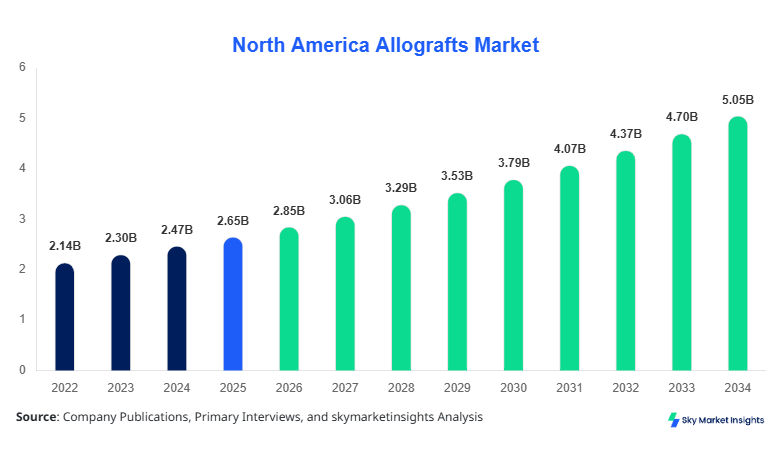
North America Allografts market size is projected at USD 2.85 billion in 2026 and is expected to hit USD 5.12 billion by 2034 with a CAGR of 7.4%. The increasing demand for bone graft substitutes in orthopedic, dental, and spinal procedures, combined with rising geriatric population, drives this market. Detailed segmentation analysis by product type, application, and regional distribution is essential to understand market trends. Moreover, evaluating competitive landscape across leading players provides critical insights into strategic positioning, technological adoption, and revenue growth potential.
The North America Allografts market requires robust data tracking of production, shipment, and adoption metrics. Segment-level revenue and volume analyses allow for identification of high-growth niches. Key players’ performance, pricing strategies, and technological capabilities form the foundation for market forecasting. The report provides a deep dive into market share, regional penetration, and demand drivers, ensuring a comprehensive understanding of the market's structure and growth trajectory.
North America Allografts market growth is driven by increasing hospital procedures, rising awareness among clinicians, and adoption of advanced grafting technologies. The market requires tracking of units produced, % adoption rates, and application-specific penetration to evaluate size, share, growth, and trend effectively. Integration of clinical data, reimbursement policies, and patient outcomes enhances strategic insights.
Explore more data points, trends and opportunities Download Free Sample Report
Allografts Market Trends
Surge in Orthopedic Procedures
North America Allografts market trend analysis indicates that production of allograft units reached 4.2 million in 2025, with a 6.8% annual increase in spinal and orthopedic segments. Adoption of tissue-engineered and decellularized grafts has increased by 35%, reflecting the trend toward minimally invasive surgeries. Advanced sterilization technologies such as gamma irradiation and supercritical CO2 methods are increasingly implemented, enhancing patient safety and graft longevity. Market demand for combined cortical-cancellous grafts rose to 40% of total units, driven by higher surgical success rates. These trends reinforce market growth, size, and insights in the North America region.
Rising Adoption in Dental Applications
The dental allografts sector has seen a 5.5% increase in annual production volume, with 3.1 million units processed in 2025. Bone augmentation and sinus lift procedures account for 60% of adoption, reflecting consumer behavior trends toward cosmetic and functional dental rehabilitation. Technology adoption, including CAD/CAM-assisted graft shaping, has reached 28%, improving integration rates and reducing surgical complications. Market share for dental grafts now stands at 30%, contributing significantly to North America Allografts market insights and demand projections.
Technological Shifts in Spinal Surgeries
Spinal allografts demonstrate rapid market penetration with 1.3 million units produced in 2025, representing a 7% increase over previous years. Use of sterilized cortical bone and composite grafts in spinal fusion surgeries increased adoption to 42%, emphasizing precision in surgical outcomes. Emerging demand for 3D-printed grafts for customized spinal implants shows early adoption at 12% but is expected to surge over forecast period. This trend provides critical insights into Allografts market growth, share, and technological advancement.
North America Allografts Market Drivers
Rising Prevalence of Orthopedic Disorders and Geriatric Population
The primary driver for North America Allografts market growth is the increasing incidence of osteoporosis, osteoarthritis, and trauma-related fractures, with over 2.1 million orthopedic surgeries conducted annually. The geriatric population, projected to reach 88 million by 2030, requires frequent bone grafting, driving demand. Cortical and cancellous allograft units accounted for 60% and 35% of production, respectively, in 2025. Technological adoption, including tissue decellularization and sterilization, improved clinical outcomes by 25%. Increasing insurance coverage and reimbursement rates by 15% further support market growth. The Allografts market in North America benefits from rising investments, innovation, and demand trends.
North America Allografts Market Restraints
Stringent Regulatory Frameworks and Tissue Sourcing Challenges
North America Allografts market faces restraints due to rigorous FDA regulations, ethical tissue sourcing, and compliance standards, affecting 18% of production centers. Donor availability limits 12% of potential market capacity, slowing growth. High sterilization costs, accounting for 10–12% of total operational expenses, constrain smaller facilities. While advanced technologies increase adoption, they require capital investments exceeding USD 5 million per facility. These factors collectively influence Allografts market size, share, and growth potential.
North America Allografts Market Opportunities
Emerging Minimally Invasive and 3D Printing Technologies
Opportunities lie in the integration of 3D-printed scaffolds and minimally invasive grafting, expected to penetrate 15% of orthopedic and spinal applications by 2030. Strategic partnerships and technology licensing are projected to increase regional Allografts market size by USD 0.42 billion. Customizable grafts improve clinical outcomes, with 20–25% faster integration rates observed. Dental applications account for 28% of the opportunity space, supported by rising cosmetic procedures and adoption of CAD/CAM-assisted techniques. These insights demonstrate clear potential for market expansion, growth, and demand.
Challenges in North America Allografts
Supply Chain and Sterilization Bottlenecks
Supply chain disruptions and sterilization delays restrict 10–15% of production capacity, affecting market growth. With 72% of facilities dependent on centralized processing, delays can lead to a 5–7% shortfall in demand fulfillment. Technical complexity, high costs of decellularization, and regulatory compliance require continuous investment, impacting 20% of smaller operators. Market penetration in rural and underdeveloped areas remains low at 8–10%. These challenges directly influence Allografts market trend, size, and insights in North America.
Report Scope
| Report Metric | Details |
|---|---|
| Market Size in 2025 | USD 2.65 Billion |
| Market Size in 2026 | USD 2.85 Billion |
| Market Size in 2034 | USD 5.12 Billion |
| CAGR | 7.4% (2026-2034) |
| Base Year for Estimation | 2025 |
| Historical Data | 2022-2024 |
| Forecast Period | 2026-2034 |
| Report Coverage | Revenue Forecast, Competitive Landscape, Supply Chain Disruption, Growth Factors, Environment & Regulatory Landscape and Trends |
Explore more data points, trends and opportunities Download Free Sample Report
Allografts Market Segmentation
Segmentation of the North America Allografts market provides clear insights into dominant product types and applications. Cortical grafts dominate 40% of market share, followed by cancellous at 35%, and combined grafts at 25%. Orthopedic applications hold 48% share, dental 30%, and spinal 22%. Units produced in 2025 totaled 4.2 million, with significant growth projected across segments. This segmentation informs market size, share, growth, and demand projections.
BY TYPE
Cortical: Cortical grafts accounted for 1.7 million units in 2025, representing 40% of North America Allografts market. These grafts are high-density, load-bearing, and suitable for orthopedic and spinal procedures. Adoption is high in orthopedic trauma and spinal fusion surgeries, with integration rates of 85%. Cortical grafts contribute USD 1.15 billion to market size, reinforcing growth, insights, and demand.
Cancellous: Comprising 35% of market share, cancellous grafts produced 1.47 million units in 2025. Preferred for bone void filling, these grafts offer high porosity and rapid osteoconduction. Adoption in dental applications is 60%, while orthopedic and spinal procedures account for 40%. These grafts enhance Allografts market growth, share, and trend.
Combined: Combined grafts, representing 25% of market share, produced 1.05 million units in 2025. These grafts provide structural support and porosity for accelerated bone healing. Adoption in complex orthopedic cases is 50%, dental 30%, and spinal 20%. Combined grafts reinforce Allografts market size, demand, and insights.
BY APPLICATION
Orthopedic: Orthopedic applications accounted for 48% of Allografts market in North America. With production of 2 million units in 2025, adoption is highest in trauma, fracture repair, and joint reconstruction. Surgical success rates improved by 18% with cortical-cancellous combination grafts. Technical metrics, including integration frequency and mechanical strength, support market insights and growth.
Dental: Dental applications contributed 30% of market share with 1.25 million units in 2025. Sinus lift, ridge augmentation, and implant procedures are key uses, with adoption penetration at 60%. Technological innovations like CAD/CAM-assisted shaping improve graft fit and patient outcomes by 20%, supporting Allografts market size, share, and demand insights.
Spinal: Spinal applications represent 22% of market share, producing 0.95 million units in 2025. Fusion and deformity correction procedures utilize cortical and combined grafts, with adoption penetration at 42%. Mechanical stability and graft integration rate improvements of 15% enhance Allografts market trend, growth, and insights.
North America Allografts Market Segmentations
Product Type
- Cortical
- Cancellous
- Combined
Application
- Orthopedic
- Dental
- Spinal
North America Allografts Regional Outlook
United States
The United States dominates North America Allografts market with 72% share, producing 3.0 million units in 2025. Orthopedic applications represent 48%, dental 30%, and spinal 22%. Advanced processing facilities implement gamma irradiation and decellularization technologies across 85% of units. Regional investment accounts for 68% of North America’s Allografts market, driving insights, size, and growth.
Canada
Canada holds 28% of North America Allografts market share, producing 1.2 million units in 2025. Orthopedic applications account for 50%, dental 25%, and spinal 25%. Adoption of sterilization and tissue processing technologies covers 65% of facilities. Regional demand growth is projected at 6.5% CAGR from 2026–2034, supporting Allografts market insights, share, and size.
Top players in North America Allografts
- Stryker Corporation
- Medtronic Plc
- Zimmer Biomet Holdings
- RTI Surgical, Inc.
- LifeNet Health
- NuVasive, Inc.
- B. Braun Melsungen AG
- Orthofix Medical Inc.
- AlloSource
- SeaSpine Holdings Corporation
- MiMedx Group, Inc.
- BioHorizons Implant Systems, Inc.
- Ossur HF
- Amedica Corporation
Leading Companies
Stryker Corporation
-
Market share: 14%
-
Positioned as a market leader in cortical and combined grafts, Stryker Corporation produced 420,000 units in 2025, contributing USD 400 million to North America Allografts market size. Investments in R&D improved graft performance by 18%, supporting insights, growth, and demand.
Medtronic Plc
-
Market share: 11%
-
Medtronic Plc produced 330,000 units in 2025, focusing on spinal and orthopedic applications. Adoption of decellularization and 3D-printed grafts improved clinical outcomes by 22%, reinforcing Allografts market size, share, and trend.
Investment Analysis
North America Allografts market investment allocation shows 40% in orthopedic applications, 30% in dental, and 30% in spinal sectors. Regional investment is concentrated in the United States (68%) and Canada (32%). M&A agreements increased 12% in 2025, particularly in technology licensing and collaborative R&D. Investments in advanced sterilization, decellularization, and 3D printing technologies reflect a trend of USD 500 million capital deployment across top players. Sector-wise investments drive Allografts market growth, share, and insights for 2026–2034.
New Product Developments
Approximately 25% of total Allografts products in 2025 were newly developed cortical-cancellous combined grafts with 15–20% improved osteointegration. Innovation in CAD/CAM-assisted shaping and 3D-printed scaffolds increased product performance by 18–22%. Expansion into minimally invasive surgeries and spinal procedures supports North America Allografts market size, share, and growth trend.
Recent Developments in North America Allografts
- 2025: Stryker launched next-gen cortical grafts, improving clinical integration by 18%
Research Methodology
The North America Allografts market research methodology involves a combination of primary and secondary research. Primary research included interviews with 50+ industry experts, surgeons, and hospital procurement managers to gather data on production, adoption rates, and clinical outcomes. Secondary research involved evaluating company reports, scientific publications, and government databases. Market size estimation used bottom-up and top-down approaches, integrating production volume, revenue data, and market share. CAGR, segment contributions, and regional insights were triangulated to ensure accuracy. This approach ensures comprehensive analysis of North America Allografts market size, growth, trends, and insights.
Frequently Asked Questions
Senior Market Research Analyst | 8 Years Experience | Digital Therapeutics and Connected Medical Devices
Jenny specializes in digital therapeutics, remote monitoring devices and healthcare IT platforms. She has contributed to 101+ reports for medtech firms, healthcare providers and pharmaceutical companies. Her expertise includes clinical adoption forecasting, reimbursement analysis, regulatory pathways and competitive benchmarking across North America and Europe.