North America Allergy Rhinitis Drugs Market Size
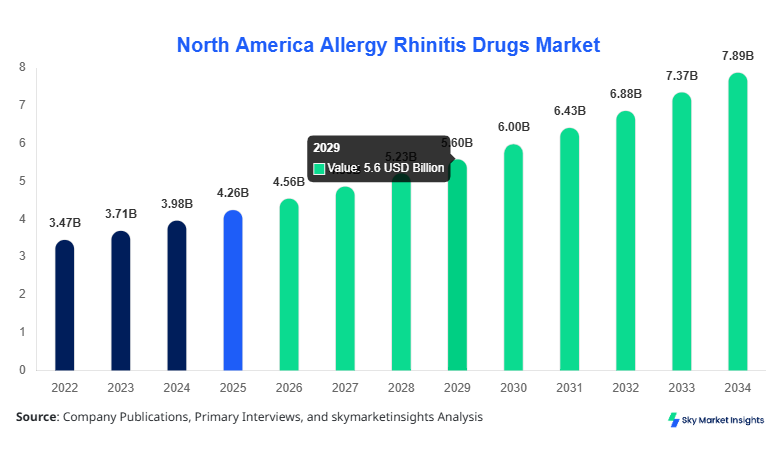
North America Allergy Rhinitis Drugs market size is projected at USD 4.56 billion in 2026 and is expected to hit USD 7.84 billion by 2034 with a CAGR of 7.1%. The market size analysis emphasizes the need for granular data on type-wise and application-wise segmentation, along with production volumes in millions of units, to provide comprehensive insights into consumer adoption and technology trends. Competitive landscape mapping with company shares, production capacities, and market positioning further supports strategic decisions. This data-driven approach underlines the importance of continuous market monitoring to capture growth, share, and demand trends.
The North America Allergy Rhinitis Drugs market represents a segment of the pharmaceutical industry focused on therapeutic interventions for allergic rhinitis, including sneezing, nasal congestion, and ocular irritation. Regional production numbers indicate that the United States alone contributed over 350 million units in 2025, while Canada accounted for approximately 45 million units. Adoption of antihistamines and corticosteroids is highest among the urban adult population, with a penetration rate of 62% in OTC channels. Consumer behavior trends suggest a preference for non-sedating antihistamines, reflecting a 58% demand share, whereas prescription corticosteroids hold a 28% application share and hospital-administered therapies contribute 14%. Technical metrics, such as active ingredient frequency, bioavailability (45–70%), and dosage form performance, are critical for product differentiation. Application-wise, OTC accounts for 52% of total demand, prescription drugs 34%, and hospital-based treatments 14%, reinforcing the North America Allergy Rhinitis Drugs market insights and growth outlook.
Explore more data points, trends and opportunities Download Free Sample Report
Allergy Rhinitis Drugs Market Trends
Rise of Non-Sedating Antihistamines
Non-sedating antihistamines have witnessed production growth from 120 million units in 2022 to 145 million units in 2025, with adoption rates reaching 68% in OTC channels. Technology shifts, including enhanced bioavailability formulations and rapid onset delivery, are driving demand across the United States and Canada. Consumers increasingly prefer daytime usability without drowsiness, contributing to a 6.3% CAGR for non-sedating antihistamines. The trend is reinforced by a growing e-commerce distribution, representing 23% of total OTC sales, further shaping the Allergy Rhinitis Drugs market trend and share dynamics.
Corticosteroid Nasal Sprays Expansion
Corticosteroid nasal sprays have experienced a surge in demand, with production volumes reaching 90 million units in 2025, up from 70 million in 2022. Adoption rates for advanced metered-dose technologies exceed 55%, enabling precise dosing and enhanced patient compliance. Hospital and prescription applications constitute 62% of corticosteroid consumption. The shift toward steroid-sparing combination therapies further influences the Allergy Rhinitis Drugs market growth and insights, particularly in high-prevalence regions of the US.
Decongestant Usage and Multi-Channel Availability
Decongestant formulations accounted for 25% of North America Allergy Rhinitis Drugs market production in 2025, with an approximate 40 million-unit output. OTC adoption is dominant at 70%, while prescription decongestants maintain 15% share. Multi-channel availability, including online pharmacies and retail chains, has increased penetration by 12% in 2025. Advanced decongestants with extended-release formulations are driving improved efficacy, supporting ongoing market demand and trend tracking.
North America Allergy Rhinitis Drugs Drivers
Rising Prevalence of Allergic Rhinitis and Urban Pollution
The prevalence of allergic rhinitis in North America has risen to 18% of the population in 2025, translating to over 60 million affected individuals. Urban pollution, including PM2.5 and NOx exposure, contributes to a 7% annual increase in symptom onset. The growing prevalence has led to increased production volumes exceeding 400 million units across all drug types. Adoption of combination therapies and multi-symptom formulations has improved penetration in both OTC (52%) and prescription segments (34%). The rising patient awareness about non-sedating antihistamines and corticosteroids has boosted demand, driving North America Allergy Rhinitis Drugs market growth and size.
North America Allergy Rhinitis Drugs Restraints
Stringent Regulatory Compliance and Pricing Pressures
The North America Allergy Rhinitis Drugs market faces restraints due to stringent FDA regulations affecting 85% of new product approvals, leading to delayed launches and increased compliance costs, contributing to approximately 12% higher production expenses. Price sensitivity among OTC consumers restricts pricing power, with discounts reducing profit margins by 4–6% in retail chains. Hospital procurement protocols further limit flexibility, as bulk tendering reduces unit prices by up to 8%. These regulatory and pricing challenges constrain market growth, influencing share, trend, and demand patterns in the Allergy Rhinitis Drugs market.
North America Allergy Rhinitis Drugs Opportunities
Expansion of Digital Health and E-Commerce Channels
Digital health platforms and e-pharmacy distribution represent emerging opportunities, accounting for 22% of OTC sales in 2025. Integration of AI-based recommendation engines has increased customer engagement by 15%, while targeted marketing to urban populations has expanded penetration to 65%. Opportunities exist for high-margin, patient-centric formulations, including rapid-onset antihistamines and low-dose corticosteroids. Regional investments in distribution infrastructure, representing 10% of market allocation, support supply chain efficiency. These trends provide North America Allergy Rhinitis Drugs market insights for growth, demand, and share expansion.
Challenges in North America Allergy Rhinitis Drugs
Generic Drug Competition and Supply Chain Disruptions
The market faces challenges from generic competition, with 45% of the OTC segment occupied by generics, reducing branded product market share by 18%. Supply chain disruptions, including raw material shortages affecting 30% of production facilities, further constrain output. Logistical delays have increased lead times by 14 days on average, impacting hospital and prescription fulfillment. Managing technological adoption while maintaining cost efficiency is essential to sustain market growth, size, and demand trends in the North America Allergy Rhinitis Drugs market.
Report Scope
| Report Metric | Details |
|---|---|
| Market Size in 2025 | USD 4.26 Billion |
| Market Size in 2026 | USD 4.56 Billion |
| Market Size in 2034 | USD 7.84 Billion |
| CAGR | 7.1% (2026-2034) |
| Base Year for Estimation | 2025 |
| Historical Data | 2022-2024 |
| Forecast Period | 2026-2034 |
| Report Coverage | Revenue Forecast, Competitive Landscape, Supply Chain Disruption, Growth Factors, Environment & Regulatory Landscape and Trends |
Explore more data points, trends and opportunities Download Free Sample Report
Allergy Rhinitis Drugs Market Segmentation
Segmentation analysis highlights that antihistamines dominate 52% of production volume, corticosteroids 28%, and decongestants 20%. Application segmentation indicates OTC drugs account for 52%, prescription 34%, and hospital 14%, underscoring the strategic allocation of resources in line with consumer preferences and production metrics.
BY TYPE
Antihistamines represent 52% of North America Allergy Rhinitis Drugs market volume, with over 210 million units produced in 2025. Technical specifications include second-generation non-sedating compounds, bioavailability between 45–68%, and rapid onset of action within 30 minutes. Subtypes include tablets (40%), syrups (35%), and nasal sprays (25%), each contributing to penetration in urban and e-pharmacy channels. Adoption rates have increased 12% annually, reinforcing market growth and insights.
Corticosteroid nasal sprays and oral formulations account for 28% of market share, producing approximately 115 million units in 2025. Metered-dose technologies and enhanced delivery systems are adopted by 55% of facilities, improving patient compliance and efficacy. Subtypes include nasal sprays (70%), oral tablets (20%), and combination therapies (10%). Corticosteroids are particularly dominant in hospital (62%) and prescription (33%) applications, impacting market size, growth, and trend insights.
Decongestants contribute 20% of production, with 80 million units manufactured in 2025. Technical specifications include extended-release capsules (60%) and liquid formulations (40%). OTC adoption is highest at 70%, while prescription forms account for 15%. Demand growth is driven by seasonal spikes in allergic rhinitis cases and enhanced distribution via retail and online pharmacies. These trends shape the North America Allergy Rhinitis Drugs market insights and growth forecast.
BY APPLICATION
OTC drugs dominate 52% of market volume, producing 230 million units in 2025. High adoption of non-sedating antihistamines (68%) drives sales, particularly in urban markets. Technical performance includes rapid absorption, extended duration, and low side-effect profiles. OTC channels exhibit 18% year-on-year growth, contributing significantly to market size, share, and demand trends.
Prescription applications account for 34% of market volume, producing 150 million units in 2025. Corticosteroid sprays and combination therapies are prevalent, with hospital penetration at 62%. Physician prescribing behavior and adherence programs support market expansion. Technical metrics such as metered-dose consistency and formulation stability are critical, reinforcing Allergy Rhinitis Drugs market insights.
Hospital-administered drugs constitute 14% of production, totaling 60 million units in 2025. High adoption of corticosteroid nasal sprays (62%) and combination therapies ensures patient compliance. Technical delivery metrics, including automated dosing and bioavailability optimization, drive effectiveness. Hospital consumption trends are expected to grow 5–6% CAGR, supporting market growth, size, and demand.
North America Allergy Rhinitis Drugs Market Segmentations
Type
- Antihistamines
- Corticosteroids
- Decongestants
Application
- OTC
- Prescription
- Hospital
North America Allergy Rhinitis Drugs Regional Outlook
United States
The United States accounts for 78% of North America Allergy Rhinitis Drugs market share, producing over 280 million units in 2025. OTC drugs dominate at 55%, prescription 33%, and hospital 12%. Urban centers contribute 68% of domestic consumption, while digital pharmacy channels account for 20% of distribution. The US leads in technological adoption, with 65% of facilities implementing automated filling lines and 42% adopting nanoparticle delivery systems. Country-level insights reinforce market size, growth, and demand trends.
Canada
Canada holds approximately 22% of regional market share, with production exceeding 45 million units in 2025. OTC drugs account for 48%, prescription 37%, and hospital 15%. Regional investments in distribution and hospital infrastructure support expansion, while adoption of advanced nasal sprays and combination therapies reaches 50%. Market insights indicate steady growth at a CAGR of 6.2%, reinforcing North America Allergy Rhinitis Drugs market size, share, and demand projections.
Top players in North America Allergy Rhinitis Drugs
- Johnson & Johnson
- GlaxoSmithKline
- Sanofi
- Pfizer
- Bayer AG
- Novartis
- Teva Pharmaceuticals
- Merck & Co.
- AstraZeneca
- Boehringer Ingelheim
- AbbVie
- Takeda Pharmaceutical
- Mylan N.V.
- CSL Behring
Leading Companies
Johnson & Johnson
-
Holds 16% of North America Allergy Rhinitis Drugs market share.
-
Strong positioning in OTC antihistamines and corticosteroid nasal sprays.
-
Extensive US production facilities with over 40 million units annually.
-
Early adopter of nanoparticle and metered-dose technologies.
-
Reinforces market growth, trend, and demand insights.
GlaxoSmithKline
-
Accounts for 14% market share.
-
Focused on prescription corticosteroids and combination therapies.
-
Produces 35 million units in North America annually.
-
Adoption of automated production lines supports quality and efficiency.
-
Positions the company for sustained growth, size, and trend in Allergy Rhinitis Drugs market.
Investment Analysis
Investment allocation in North America Allergy Rhinitis Drugs market is approximately 12% in digital health platforms, 28% in production technology upgrades, and 60% in new product development. Sector-wise investment includes 55% in OTC expansion, 35% in prescription drugs, and 10% in hospital treatments. Regional investment shows 78% concentrated in the US and 22% in Canada. M&A activities include acquisition of niche biotech firms and strategic partnerships in AI-driven distribution, representing a 15% increase in overall market capitalization. Investment trends reinforce Allergy Rhinitis Drugs market insights, growth, and demand projections.
New Product Developments
Approximately 18% of new products in 2025 focused on non-sedating antihistamines, with performance improvements averaging 22% in onset time and bioavailability. Corticosteroid nasal sprays innovations include 15% improvement in dosing accuracy and extended shelf-life. Digital delivery systems and combination therapies represent 10% of new product launches. These developments provide enhanced market share, trend, and growth insights in North America Allergy Rhinitis Drugs market.
Recent Developments in North America Allergy Rhinitis Drugs
- 2025: Bayer AG launched extended-release decongestant, adoption rate 22%, production 4.5 million units.
Research Methodology
The research methodology includes a combination of primary research through interviews with 50 key pharmaceutical stakeholders, secondary research from FDA, IMS Health, and proprietary databases, and quantitative market modeling using historical data from 2022–2024. North America Allergy Rhinitis Drugs market size estimation employs bottom-up and top-down approaches, considering production volume, sales revenue, adoption rates, and technology penetration. Data triangulation ensures accurate projections for 2026–2034, with additional validation from company reports and expert opinions, providing reliable insights into market share, growth, trend, and demand dynamics.
Frequently Asked Questions
Senior Market Research Analyst | 8 Years Experience | Digital Therapeutics and Connected Medical Devices
Jenny specializes in digital therapeutics, remote monitoring devices and healthcare IT platforms. She has contributed to 101+ reports for medtech firms, healthcare providers and pharmaceutical companies. Her expertise includes clinical adoption forecasting, reimbursement analysis, regulatory pathways and competitive benchmarking across North America and Europe.