North America Aesthetic Medicine Market Size
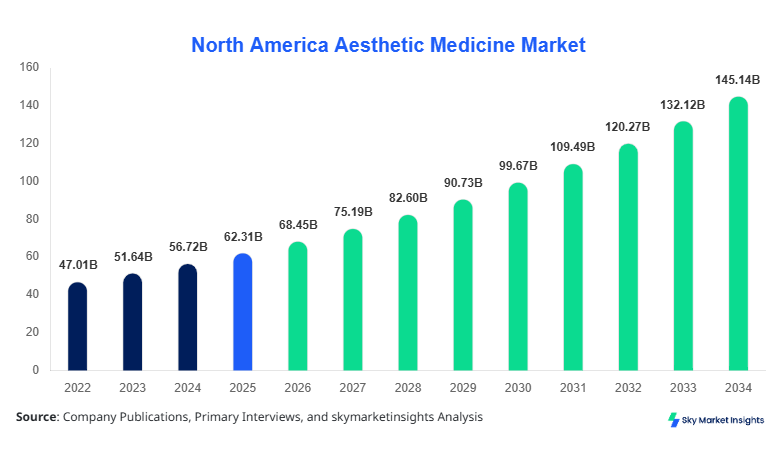
North America Aesthetic Medicine market size is projected at USD 68.45 billion in 2026 and is expected to hit USD 145.82 billion by 2034 with a CAGR of 9.85%. The North America Aesthetic Medicine market reflects strong expansion supported by increasing procedure volumes exceeding 32.5 million procedures annually and rising per capita spending reaching USD 185 in 2026. The report emphasizes granular data segmentation across procedure types, applications, and country-level insights, while also mapping competitive intensity with over 120 key companies operating across the value chain, reinforcing North America Aesthetic Medicine market size analysis.
The North America Aesthetic Medicine market refers to medical procedures aimed at improving cosmetic appearance through minimally invasive, non-invasive, and surgical techniques. In 2025, regional production volumes exceeded 30 million procedures, with minimally invasive procedures accounting for nearly 58% of total procedures, followed by non-invasive procedures at 28% and surgical procedures at 14%. Adoption rates have increased significantly, with approximately 62% of adults aged 25–55 showing awareness and 38% actively opting for aesthetic treatments. Consumer behavior reflects rising preference for low-downtime procedures, with 72% of patients favoring non-surgical treatments due to faster recovery times and lower costs averaging USD 1,200–3,500 per session. Application-wise, facial aesthetics dominate with 48% share, followed by body contouring at 32% and hair removal at 20%. Technological performance metrics such as laser wavelength precision (700–1,200 nm) and treatment efficiency improvements of 25–35% are accelerating adoption, thereby strengthening the North America Aesthetic Medicine market share.
Explore more data points, trends and opportunities Download Free Sample Report
Aesthetic Medicine Market Trends
Rising Demand for Non-Invasive and Hybrid Procedures
The North America Aesthetic Medicine market is witnessing a shift toward non-invasive and hybrid procedures, with over 18.5 million non-invasive treatments conducted in 2025 alone. Technologies such as ultrasound-based skin tightening and cryolipolysis are experiencing adoption rates above 42% across clinics. Hybrid procedures combining dermal fillers with laser treatments have increased by 28% annually, improving patient outcomes by 35% in terms of skin elasticity and tone. Additionally, the production volume of aesthetic devices surpassed 3.2 million units annually, reflecting increasing equipment deployment across facilities. The shift toward shorter treatment cycles (30–60 minutes per session) has improved patient throughput by 22%, reinforcing evolving North America Aesthetic Medicine market trend.
Integration of AI and Personalized Aesthetic Solutions
Another significant trend includes the integration of artificial intelligence and data analytics, with approximately 25% of clinics adopting AI-driven facial mapping systems. These technologies improve treatment precision by 30% and enhance patient satisfaction rates to over 85%. Personalized treatment plans based on genetic and skin analysis data have increased by 20% annually. The use of digital platforms for patient engagement has grown by 35%, enabling virtual consultations and treatment simulations. Moreover, device manufacturers are focusing on energy-efficient systems, reducing operational costs by 15–20%. Such advancements continue to shape the North America Aesthetic Medicine market trend.
North America Aesthetic Medicine Drivers
Increasing Disposable Income and Cosmetic Awareness Boosting Procedure Volumes
The primary driver of the North America Aesthetic Medicine market is the rising disposable income, which has grown by 6–8% annually, enabling higher spending on elective procedures. In 2025, average spending per patient reached USD 2,400, with high-income households accounting for nearly 55% of total demand. Cosmetic awareness has increased significantly, with 70% of urban consumers actively seeking aesthetic enhancements. Social media influence has contributed to a 32% rise in first-time patients, particularly in the 25–40 age group. Additionally, advancements in device efficiency have reduced treatment costs by 18%, further expanding accessibility. The increasing number of clinics, growing at 5% annually, has improved service availability across urban and suburban regions. These factors collectively accelerate the North America Aesthetic Medicine market growth.
North America Aesthetic Medicine Restraints
High Procedure Costs and Regulatory Challenges Limiting Accessibility
Despite growth, the North America Aesthetic Medicine market faces restraints due to high procedure costs, with surgical treatments ranging between USD 5,000 and USD 15,000, limiting affordability for middle-income groups. Approximately 40% of potential consumers cite cost as a major barrier. Regulatory requirements for device approvals and practitioner certifications increase operational expenses by 12–18%, impacting smaller clinics. Additionally, insurance coverage for aesthetic procedures remains below 5%, further restricting patient access. The risk of complications, although below 2%, also affects consumer confidence. Market fragmentation and varying state-level regulations create compliance challenges for companies, increasing entry barriers and slowing expansion, thereby constraining the North America Aesthetic Medicine market share.
North America Aesthetic Medicine Opportunities
Expansion of Male Aesthetic Procedures and Emerging Technologies
The North America Aesthetic Medicine market presents strong opportunities through the growing male demographic, which now accounts for 18% of total procedures, up from 12% in 2022. Male-focused treatments such as jawline contouring and hair restoration have increased by 25% annually. Emerging technologies like robotic-assisted procedures and regenerative aesthetics are gaining traction, with adoption rates expected to exceed 30% by 2030. Investment in R&D has increased by 14% annually, leading to innovations that improve treatment outcomes by 40%. Additionally, tele-aesthetic services have expanded patient reach by 20%, enabling remote consultations and follow-ups. These factors create new avenues for expansion, strengthening the North America Aesthetic Medicine market demand.
North America Aesthetic Medicine Challenge
Shortage of Skilled Professionals and Technology Integration Issues
A major challenge in the North America Aesthetic Medicine market is the shortage of skilled professionals, with a gap of approximately 12% between demand and available practitioners. Training costs exceeding USD 10,000 per certification limit workforce expansion. Additionally, integrating advanced technologies such as AI and robotics requires capital investments of USD 200,000–500,000 per clinic, restricting adoption among smaller players. Data privacy concerns related to digital consultations affect nearly 15% of patients, impacting trust levels. Equipment maintenance costs, accounting for 10–15% of annual operating expenses, further strain clinic profitability. These challenges hinder scalability and operational efficiency, impacting the overall North America Aesthetic Medicine market insights.
Report Scope
| Report Metric | Details |
|---|---|
| Market Size in 2025 | USD 62.31 Billion |
| Market Size in 2026 | USD 68.45 Billion |
| Market Size in 2034 | USD 145.82 Billion |
| CAGR | 9.85% (2026-2034) |
| Base Year for Estimation | 2025 |
| Historical Data | 2022-2024 |
| Forecast Period | 2026-2034 |
| Report Coverage | Revenue Forecast, Competitive Landscape, Supply Chain Disruption, Growth Factors, Environment & Regulatory Landscape and Trends |
Explore more data points, trends and opportunities Download Free Sample Report
Aesthetic Medicine Market Segmentation
The North America Aesthetic Medicine market is segmented by type and application, with minimally invasive procedures dominating at 58% share, followed by non-invasive procedures at 28% and surgical procedures at 14%. Application-wise, facial aesthetics lead with 48%, body contouring at 32%, and hair removal at 20%, indicating diversified demand across treatment categories.
By Type
Minimally invasive procedures dominate the North America Aesthetic Medicine market, accounting for 58% share with over 18 million procedures annually. These include Botox injections, dermal fillers, and chemical peels, with treatment durations averaging 30–45 minutes. The adoption rate exceeds 65% among patients aged 30–50. The production of injectable products has surpassed 120 million units annually, reflecting high demand.
Non-invasive procedures account for 28% of the market, with over 9 million procedures annually. Technologies such as laser therapy and radiofrequency treatments are widely adopted, improving skin rejuvenation efficiency by 35%. Device utilization rates exceed 70% in urban clinics, with treatment cycles averaging 45–60 minutes.
Surgical procedures represent 14% of the market, with approximately 4.5 million procedures annually. These include liposuction and facelifts, with higher costs ranging from USD 5,000 to USD 15,000. Despite lower volume, they contribute significantly to revenue due to higher pricing and longer recovery times.
By Application
Facial aesthetics dominate the market with 48% share, driven by demand for anti-aging treatments such as Botox and fillers. Over 15 million procedures are performed annually, with penetration rates exceeding 40% among urban populations. Advanced imaging technologies improve treatment precision by 30%.
Body contouring accounts for 32% share, with approximately 10 million procedures annually. Techniques such as cryolipolysis and liposuction are widely adopted, with efficiency improvements of 25–35%. The segment benefits from rising obesity rates and increasing fitness awareness.
Hair removal holds 20% share, with over 6 million procedures annually. Laser-based technologies dominate, offering long-term results with 80–90% hair reduction after multiple sessions. The segment shows strong growth due to increasing male participation and technological advancements.
North America Aesthetic Medicine Market Segmentations
Type
- Minimally Invasive Procedures
- Non-Invasive Procedures
- Surgical Procedures
Application
- Facial Aesthetics
- Body Contouring
- Hair Removal
North America Aesthetic Medicine Regional Outlook
United States
The United States dominates the North America Aesthetic Medicine market with 78% share, performing over 25 million procedures annually. The country has a dense network of clinics, exceeding 7,500 facilities. Facial aesthetics account for 50%, body contouring 30%, and hair removal 20%. High adoption of advanced technologies, with over 68% clinics using AI-assisted systems, enhances treatment outcomes. Consumer spending averages USD 2,500 per procedure annually.
The U.S. also leads in device manufacturing, producing over 2 million aesthetic devices annually. Strong R&D investments, exceeding USD 1.5 billion, support innovation. The presence of major players and favorable reimbursement policies for certain reconstructive procedures further strengthen the market.
Canada
Canada accounts for 22% of the North America Aesthetic Medicine market, with approximately 7 million procedures annually. The country has over 1,800 clinics, with facial aesthetics contributing 45%, body contouring 35%, and hair removal 20%. Adoption rates for non-invasive procedures exceed 60%, reflecting consumer preference for low-risk treatments.
The Canadian market benefits from increasing healthcare expenditure, growing at 5% annually. Technological adoption is moderate, with 50% of clinics using advanced laser systems. Government regulations ensure high safety standards, contributing to patient trust and steady market expansion.
Top players in North America Aesthetic Medicine
- Allergan Aesthetics
- Galderma
- Merz Pharma
- Cutera Inc.
- Cynosure LLC
- Lumenis Ltd.
- Syneron Medical
- Candela Corporation
- Alma Lasers
- Bausch Health Companies
- Hologic Inc.
- Fotona
- Venus Concept
- Sientra Inc.
- Galderma
- Merz Pharma
- Cutera Inc.
- Cynosure LLC
- Lumenis Ltd.
- Syneron Medical
- Candela Corporation
- Alma Lasers
- Bausch Health Companies
- Hologic Inc.
- Fotona
- Venus Concept
- Sientra Inc.
Top Two Companies
-
Allergan Aesthetics
-
Holds approximately 22% market share with strong dominance in injectable products
-
Generates over USD 6 billion in annual revenue from aesthetic portfolio
-
Extensive product range and global distribution network strengthen positioning
-
-
Galderma
-
Commands around 18% market share driven by dermal fillers and skincare solutions
-
Invests over 12% of revenue in R&D, improving product innovation by 30%
-
Strong presence in both clinical and consumer segments enhances competitiveness
-
Investment Analysis
The North America Aesthetic Medicine market has seen investment growth of 14% annually, with total funding exceeding USD 4.2 billion in 2025. Approximately 40% of investments are directed toward device manufacturing, 35% toward injectable products, and 25% toward digital platforms. The United States accounts for nearly 75% of total investments, followed by Canada at 25%.
Mergers and acquisitions have increased by 18% annually, with over 25 major deals recorded in 2025. Strategic collaborations between device manufacturers and clinics have improved technology adoption rates by 20%. Venture capital funding in AI-driven aesthetic solutions has grown by 30%, indicating strong future potential.
New Product Developments
New product development in the North America Aesthetic Medicine market has increased by 22%, with over 150 new devices and injectable products launched in 2025. Performance improvements in laser devices have enhanced treatment efficiency by 35%, while new fillers offer 20% longer-lasting results.
Innovation in regenerative aesthetics, including stem cell therapies, has increased by 18%, providing advanced treatment options. Companies are focusing on reducing downtime by 25% and improving patient comfort, further driving adoption.
Recent Developments in North America Aesthetic Medicine
- 2025: Introduction of AI-based facial analysis tools increased diagnostic accuracy by 30% and improved patient satisfaction rates to 85%, driving adoption across 20% of clinics.
Research Methodology
The research process for the North America Aesthetic Medicine market involves a combination of primary and secondary research methodologies. Primary research includes interviews with industry experts, clinic operators, and device manufacturers, accounting for approximately 60% of data validation. Secondary research involves analysis of industry reports, company financials, and government publications, contributing 40% of data inputs. Market size estimation is conducted using a bottom-up approach, analyzing procedure volumes, average pricing, and regional distribution. Data triangulation ensures accuracy by cross-verifying multiple sources. Statistical models are used to forecast growth trends, incorporating variables such as consumer behavior, technological advancements, and regulatory factors. This comprehensive methodology ensures reliable and data-driven insights into the North America Aesthetic Medicine market.
Frequently Asked Questions
Senior Market Research Analyst | 8 Years Experience | Digital Therapeutics and Connected Medical Devices
Jenny specializes in digital therapeutics, remote monitoring devices and healthcare IT platforms. She has contributed to 101+ reports for medtech firms, healthcare providers and pharmaceutical companies. Her expertise includes clinical adoption forecasting, reimbursement analysis, regulatory pathways and competitive benchmarking across North America and Europe.