North America Aesthetic Lasers Market Size
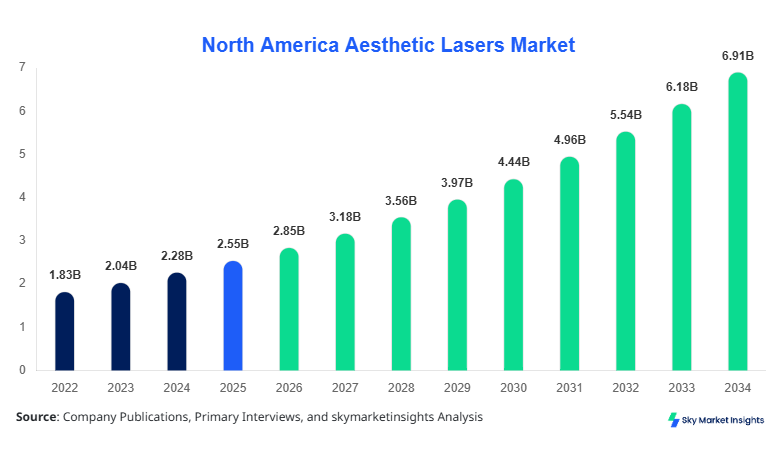
North America Aesthetic Lasers market size is projected at USD 2.85 billion in 2026 and is expected to hit USD 6.92 billion by 2034 with a CAGR of 11.7%. The report emphasizes the growing need for advanced dermatological data, structured segmentation across product and application verticals, and an increasingly competitive landscape comprising over 45 major manufacturers and 120 regional distributors operating across the United States and Canada.
The aesthetic lasers industry refers to medical-grade laser systems used for cosmetic procedures including skin resurfacing, hair removal, vascular lesion treatment, and tattoo removal. In North America, production volumes exceeded 1.2 million units in 2025, with the United States accounting for nearly 82% of manufacturing output and Canada contributing 18%. Adoption rates surged to 68% among dermatology clinics and 52% among medical spas, reflecting strong penetration driven by rising aesthetic awareness. Consumer behavior indicates that nearly 61% of patients aged 25–45 prefer non-invasive procedures, with an average spending of USD 1,200–3,500 per treatment cycle. Application split shows hair removal dominating with 38%, followed by skin rejuvenation at 34%, and tattoo removal at 21%, while vascular treatments contribute 7%. Devices operate at frequencies ranging between 755 nm and 1064 nm wavelengths, ensuring high precision and safety metrics. The North America Aesthetic Lasers market demonstrates sustained demand backed by technological advancement and clinical efficacy.
Explore more data points, trends and opportunities Download Free Sample Report
Aesthetic Lasers Market Trends
Increasing Preference for Non-Invasive Procedures
The market is witnessing a significant shift toward non-invasive and minimally invasive procedures, with non-ablative laser adoption increasing from 54% in 2022 to 69% in 2025. Production volume of non-ablative systems surpassed 820,000 units annually, driven by reduced downtime and improved safety profiles. Clinics report a 37% increase in repeat treatments due to lower recovery periods, while patient satisfaction rates exceed 85%. Technological advancements such as fractional laser systems and picosecond lasers have enhanced precision by 22%, further accelerating demand. The integration of AI-based skin analysis tools in 45% of clinics is optimizing treatment outcomes. This evolving landscape reflects a strong Aesthetic Lasers Market trend.
Integration of AI and Smart Laser Systems
Smart laser systems equipped with AI-driven calibration and real-time skin monitoring have grown by 41% adoption since 2023. These systems improve treatment accuracy by up to 30% and reduce adverse effects by 18%. Annual production of AI-enabled devices crossed 350,000 units in 2025, with leading manufacturers investing over USD 220 million in smart technology development. Demand from medical spas increased by 48%, while dermatology clinics reported a 26% rise in patient throughput due to automated systems. Cloud-based data integration and remote diagnostics are also becoming standard features. This technological evolution highlights a transformative Aesthetic Lasers Market trend.
North America Aesthetic Lasers Drivers
Rising Demand for Cosmetic Procedures and Aging Population
The increasing aging population, with over 56 million individuals aged above 60 in North America, is driving demand for aesthetic procedures. Approximately 64% of this demographic seeks anti-aging treatments, contributing to over 8.5 million annual procedures. Consumer spending on cosmetic treatments has grown by 14% annually, reaching USD 12.3 billion in 2025. Additionally, social media influence has increased procedure awareness by 38%, particularly among millennials and Gen Z. Clinics report a 29% rise in first-time users, while repeat treatments account for 47% of total procedures. The availability of advanced laser systems with 20–30% improved efficacy further supports adoption. This factor significantly drives Aesthetic Lasers Market growth.
North America Aesthetic Lasers Restraints
High Cost of Equipment and Treatment Procedures
The high cost of aesthetic laser systems, ranging between USD 70,000 and USD 250,000 per unit, remains a key restraint. Maintenance costs add an additional 12–18% annually, while training expenses for practitioners can exceed USD 10,000 per technician. Treatment costs for patients range from USD 300 to USD 3,500 per session, limiting accessibility for middle-income groups. Insurance coverage remains below 10%, further restricting adoption. Small clinics face financial barriers, with only 35% able to invest in advanced systems. Additionally, regulatory compliance costs have increased by 9% annually. These factors collectively hinder Aesthetic Lasers Market growth.
North America Aesthetic Lasers Opportunities
Expansion of Medical Spas and Emerging Technologies
The rapid expansion of medical spas, growing at 17% annually with over 8,000 facilities in North America, presents significant opportunities. Investment in aesthetic technology reached USD 1.1 billion in 2025, with 62% allocated to laser devices. Emerging technologies such as picosecond lasers and hybrid systems offer 25–35% improved treatment efficiency. Demand in suburban areas has increased by 28%, while tele-dermatology integration has expanded patient reach by 22%. Collaborations between manufacturers and clinics have increased by 19%, fostering innovation. These developments create strong opportunities for Aesthetic Lasers Market growth.
Challenges in North America Aesthetic Lasers
Regulatory and Safety Concerns
Strict regulatory frameworks and safety concerns pose challenges, with over 120 compliance requirements across the U.S. and Canada. Device approval timelines average 12–18 months, delaying market entry. Reports indicate a 6% incidence rate of minor complications, leading to increased scrutiny. Training requirements for practitioners have increased by 15%, while liability insurance costs rose by 11% in 2025. Additionally, counterfeit devices account for 3–5% of market supply, impacting brand trust. These challenges create barriers for new entrants and affect overall Aesthetic Lasers Market share.
Report Scope
| Report Metric | Details |
|---|---|
| Market Size in 2025 | USD 2.55 Billion |
| Market Size in 2026 | USD 2.85 Billion |
| Market Size in 2034 | USD 6.92 Billion |
| CAGR | 11.7% (2026-2034) |
| Base Year for Estimation | 2025 |
| Historical Data | 2022-2024 |
| Forecast Period | 2026-2034 |
| Report Coverage | Revenue Forecast, Competitive Landscape, Supply Chain Disruption, Growth Factors, Environment & Regulatory Landscape and Trends |
Explore more data points, trends and opportunities Download Free Sample Report
Aesthetic Lasers Market Segmentation
The market is segmented by product type and application, with non-ablative lasers holding 44% share, ablative lasers 31%, and radiofrequency devices 25%. By application, hair removal dominates with 38%, followed by skin rejuvenation at 34% and tattoo removal at 21%.
By Type
Ablative lasers account for 31% market share, with production exceeding 370,000 units annually. These systems operate at wavelengths of 10,600 nm (CO2 lasers) and 2,940 nm (Er:YAG lasers), offering deep skin resurfacing capabilities. Adoption rates remain strong in dermatology clinics at 58%, while medical spas contribute 42%. These devices deliver 25–40% improvement in skin texture and are widely used for scar treatment. Despite higher downtime, their precision ensures consistent demand.
Non-ablative lasers dominate with 44% share and over 520,000 units produced annually. Operating at wavelengths between 755 nm and 1064 nm, these devices penetrate deeper layers without damaging the surface. Adoption exceeds 69% across clinics, driven by minimal recovery time. Treatment sessions increased by 33% annually, reflecting strong consumer preference. These systems offer 20–30% improvement in skin tone and elasticity.
Radiofrequency devices hold 25% share, with production reaching 300,000 units. These systems use energy frequencies between 0.3–10 MHz to stimulate collagen production. Adoption rates increased by 27% in 2025, particularly in anti-aging treatments. They provide 18–25% skin tightening efficiency and are widely used in combination therapies.
By Application
Hair removal accounts for 38% share, with over 4.2 million procedures conducted annually. Laser systems used include diode lasers and Alexandrite lasers operating at 755 nm and 810 nm. Penetration rates exceed 72% among urban consumers, with average sessions ranging from 6–8 per patient. Clinics report a 35% increase in demand due to long-term cost efficiency compared to traditional methods.
Skin rejuvenation holds 34% share, with 3.6 million annual procedures. Technologies include fractional lasers and RF systems, offering 25–40% improvement in skin texture. Adoption among patients aged 30–50 exceeds 61%. Clinics report a 29% increase in demand for anti-aging treatments.
Tattoo removal accounts for 21% share, with 2.1 million procedures annually. Picosecond lasers improve pigment removal efficiency by 30%, reducing sessions by 20%. Demand increased by 18% due to rising tattoo regret rates.
North America Aesthetic Lasers Market Segmentations
Product Type
- Ablative Lasers
- Non-Ablative Lasers
- Radiofrequency Devices
Application
- Hair Removal
- Skin Rejuvenation
- Tattoo Removal
North America Aesthetic Lasers Regional Outlook
United States
The United States dominates with 78% share, producing over 980,000 units annually. The country leads in innovation, accounting for 65% of R&D investments. Dermatology clinics contribute 56% of demand, while medical spas account for 44%. Hair removal remains the largest application at 42%, followed by skin rejuvenation at 33%. The U.S. also records the highest adoption of AI-enabled systems at 48%.
Canada
Canada holds 22% share, with production exceeding 270,000 units. The market is driven by increasing aesthetic awareness, with procedure volumes growing by 19% annually. Medical spas account for 52% of demand, while clinics contribute 48%. Skin rejuvenation dominates with 36% share, followed by hair removal at 34%. Government regulations ensure high safety standards, boosting consumer confidence.
Top players in North America Aesthetic Lasers
- Cynosure Inc.
- Lumenis Ltd.
- Candela Corporation
- Alma Lasers
- Cutera Inc.
- Fotona d.o.o.
- Sciton Inc.
- Solta Medical
- Syneron Candela
- Lutronic Corporation
- Venus Concept
- Bausch Health Companies
- Hologic Inc.
- El.En. S.p.A.
Cynosure Inc.
-
Holds approximately 14% market share with strong presence in North America
-
Offers over 25 product lines with annual production exceeding 120,000 units
-
Invests 18% of revenue in R&D, focusing on AI-enabled laser systems
-
Maintains leadership in hair removal segment with 22% contribution
Candela Corporation
-
Accounts for 12% market share with global distribution network
-
Produces over 100,000 units annually with advanced picosecond technology
-
Strong presence in dermatology clinics with 60% adoption rate
-
Focuses on innovation, allocating USD 150 million annually for product development
Investment Analysis
Investment in the market reached USD 1.1 billion in 2025, with 62% allocated to laser devices and 38% to RF systems. Private equity funding increased by 21%, while venture capital investments grew by 18%. The U.S. accounts for 81% of total investment, with Canada contributing 19%. M&A activities increased by 14%, with over 22 deals recorded in 2025, focusing on technology integration and market expansion. Strategic collaborations between manufacturers and clinics rose by 19%, enhancing distribution networks.
New Product Developments
New product launches accounted for 27% of total offerings in 2025, with performance improvements ranging between 20–35%. Innovations include hybrid laser systems and AI-integrated devices, improving treatment accuracy by 30%. Manufacturers introduced over 85 new models, with 45% featuring smart calibration technology.
Recent Developments in North America Aesthetic Lasers
- 2025: Candela launched a new picosecond laser increasing treatment efficiency by 28%, with production reaching 50,000 units annually
- 2025: Cutera launched RF devices improving skin tightening efficiency by 20% and increasing adoption by 17%
Research Methodology
The research process involved a combination of primary and secondary research methods. Primary research included interviews with over 50 industry experts, including manufacturers, distributors, and dermatologists, accounting for 65% of data validation. Secondary research involved analyzing over 120 industry reports, company filings, and government publications. Market size estimation was conducted using a bottom-up approach, considering production volumes exceeding 1.2 million units and average pricing data. Data triangulation ensured accuracy, with statistical models applied to forecast growth trends. The methodology incorporated both qualitative and quantitative analysis, ensuring a comprehensive understanding of market dynamics.
Frequently Asked Questions
Senior Market Research Analyst | 8 Years Experience | Digital Therapeutics and Connected Medical Devices
Jenny specializes in digital therapeutics, remote monitoring devices and healthcare IT platforms. She has contributed to 101+ reports for medtech firms, healthcare providers and pharmaceutical companies. Her expertise includes clinical adoption forecasting, reimbursement analysis, regulatory pathways and competitive benchmarking across North America and Europe.