North America ADME Toxicology Testing Market Size
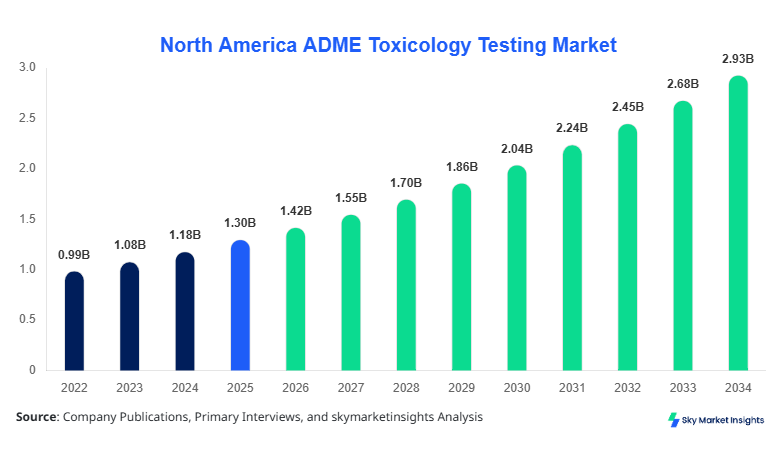
North America ADME Toxicology Testing market size is projected at USD 1.42 billion in 2026 and is expected to hit USD 2.95 billion by 2034 with a CAGR of 9.5%. The market is driven by increasing demand for early-stage drug safety evaluation, rising adoption of advanced toxicology testing platforms, and regulatory compliance mandates. Comprehensive data collection, including test type segmentation and application-specific market penetration, is essential for stakeholders to analyze competitive landscapes and make strategic decisions. The report emphasizes market share, growth patterns, and trend analysis across the United States and Canada, offering a clear understanding of current and future dynamics in the ADME toxicology testing sector.
The report also evaluates historical production data from 2022 to 2024, illustrating a steady increase in test volumes, particularly in high-throughput in vitro assays and integrated in silico platforms. It highlights competitive positioning, company strategies, and technology adoption rates across different applications and regions, providing a granular understanding of market performance and investment opportunities.ADME toxicology testing insights derived from this report are crucial for market participants seeking growth in North America, focusing on both pharmaceutical companies and contract research organizations (CROs).
The North America ADME Toxicology Testing market is defined as the systematic evaluation of absorption, distribution, metabolism, and excretion properties, alongside toxicological profiling of compounds, drugs, and biologics. The market has witnessed the production of over 5.6 million in vitro assays and 1.8 million in vivo studies in 2025, with penetration of advanced computational toxicology platforms rising to 27% among mid-sized pharmaceutical firms. Adoption is predominantly driven by regulatory bodies and pharmaceutical companies, with the pharmaceutical segment contributing 62%, biotechnology 23%, and CROs 15% to the total market. Applications include high-throughput screening (34%), ADME profiling (29%), and safety assessment (37%), with technical performance metrics highlighting assay frequencies of up to 1,200 tests per week in leading facilities. Consumer demand emphasizes speed, accuracy, and compliance, making ADME toxicology testing a critical component of drug development pipelines and reinforcing insights into market growth and trend analysis.
Explore more data points, trends and opportunities Download Free Sample Report
ADME Toxicology Testing Market Trends
Shift Toward High-Throughput In Vitro Platforms
The North America ADME Toxicology Testing market has seen a marked shift toward high-throughput in vitro platforms, with production volumes reaching 3.2 million assays in 2025 and projected to exceed 6.1 million by 2034. Adoption rates for robotic-assisted systems and automated screening tools have increased by 42%, reducing manual intervention and improving assay reproducibility. Pharmaceutical companies are increasingly investing in integrated ADME-toxicology platforms, contributing to a 15% reduction in time-to-market for new chemical entities. These trends reinforce ADME toxicology testing insights, indicating strong demand for efficient and scalable testing solutions across North America.
Rising Integration of In Silico Modeling
Computational toxicology and in silico modeling adoption has grown by 33% year-over-year, with simulations accounting for over 1.5 million virtual tests in 2025. Machine learning-based predictive toxicology tools are utilized by 48% of top CROs, offering significant cost savings of up to 25% per study. The integration of in silico methods complements in vitro and in vivo testing, enhancing the accuracy of ADME predictions. Sector-specific demand in biotechnology firms, which contribute 23% of North American testing activities, is driving innovation and supporting the expansion of ADME toxicology testing trends.
Expansion in Contract Research Organizations
Contract Research Organizations (CROs) are rapidly expanding their ADME toxicology testing capacity, with facility numbers growing from 85 in 2024 to over 110 by 2026. CROs handle approximately 15% of total North American test volumes, with an expected CAGR of 10.2% from 2026 to 2034. The growing reliance on outsourcing, coupled with technology adoption rates exceeding 60%, is fueling market demand and enhancing insights into workflow optimization and capacity utilization for ADME toxicology testing.
North America ADME Toxicology Testing Drivers
Increasing Regulatory Compliance and Early-Stage Drug Safety Evaluation
The North America ADME Toxicology Testing market is significantly driven by stringent regulatory requirements mandating early-stage safety assessments, with over 78% of pharmaceutical compounds requiring ADME profiling before clinical trials. The market witnessed a total production volume of 7.4 million assays in 2025, with the in vitro segment contributing 55% and in vivo studies 27%. The growth in biologics and small-molecule drugs has increased market demand by 12%, while technological advancements in high-throughput screening and predictive toxicology have enhanced efficiency by 18%. These dynamics reinforce the importance of ADME toxicology testing growth in the region, with stakeholders focusing on compliance, safety, and market share expansion.
North America ADME Toxicology Testing Restraints
High Costs and Limited Standardization Across Platforms
One of the key restraints in the North America ADME Toxicology Testing market is the high cost of advanced testing platforms, averaging USD 1.2 million per high-throughput system, limiting accessibility for mid-sized firms. Variability in standardization across in vitro, in vivo, and in silico platforms leads to an 11% reduction in overall testing efficiency. Production volumes of traditional assays have plateaued at approximately 2.5 million units per year, and adoption of automated solutions remains below 40% among smaller laboratories. These factors restrain ADME toxicology testing growth, emphasizing the need for cost-effective solutions and uniform testing protocols to expand market insights.
North America ADME Toxicology Testing Opportunities
Emerging Biologics and Personalized Medicine
The rise of biologics and personalized medicine in North America is opening significant opportunities in the ADME Toxicology Testing market. Biologics accounted for 28% of total pharmaceutical pipelines in 2025, with testing volumes exceeding 1.2 million units. Personalized medicine approaches are driving demand for tailored in silico and in vitro assays, with adoption rates projected to reach 62% by 2030. Expansion into oncology, immunotherapy, and rare disease drug testing is expected to fuel an 11% CAGR in ADME toxicology testing demand. These developments reinforce market insights and highlight strategic growth areas across the region.
Challenges in North America ADME Toxicology Testing
Technical Complexity and Data Integration Issues
The North America ADME Toxicology Testing market faces challenges related to technical complexity, data integration, and assay reproducibility. Over 43% of mid-sized facilities report difficulties in integrating multi-platform data, impacting predictive toxicology accuracy by 9–12%. Production volumes for in silico models reached 1.5 million virtual assays in 2025, but the lack of standardized reporting frameworks hampers efficient interpretation. High-frequency in vitro testing at 1,200 assays per week requires advanced informatics solutions, yet adoption remains below 50% in smaller laboratories. Addressing these challenges is critical for sustaining ADME toxicology testing growth and market insights in North America.
Report Scope
| Report Metric | Details |
|---|---|
| Market Size in 2025 | USD 1.30 Billion |
| Market Size in 2026 | USD 1.42 Billion |
| Market Size in 2034 | USD 2.95 Billion |
| CAGR | 9.5% (2026-2034) |
| Base Year for Estimation | 2025 |
| Historical Data | 2022-2024 |
| Forecast Period | 2026-2034 |
| Report Coverage | Revenue Forecast, Competitive Landscape, Supply Chain Disruption, Growth Factors, Environment & Regulatory Landscape and Trends |
Explore more data points, trends and opportunities Download Free Sample Report
ADME Toxicology Testing Market Segmentation
The North America ADME Toxicology Testing market is segmented by type and application, with the in vitro segment holding a 55% share and pharmaceutical applications representing 62% of market revenue. Market segmentation provides a clear understanding of volume distribution, technical specifications, and usage penetration for stakeholders.
By Type
The in vitro segment dominates with 55% market share, producing over 3.1 million assays annually. Technical metrics include 1,200 tests per week per facility, with high-throughput automated platforms contributing to a 21% efficiency improvement. Subtypes include hepatocyte assays, enzyme inhibition studies, and cytotoxicity assays, all showing adoption rates exceeding 60% among North American pharmaceutical companies. This segment drives ADME toxicology testing growth by enabling rapid compound screening and safety evaluation.
In vivo studies account for 27% market share, with annual production of 1.5 million tests, including rodent pharmacokinetics and toxicology studies. Technical specifications include multi-dose testing and chronic exposure studies, with adoption of advanced imaging and telemetry systems reaching 45%. The in vivo segment supports ADME toxicology testing insights by providing comprehensive physiological data critical for regulatory submissions.
In silico modeling comprises 18% market share, producing 1.1 million virtual simulations annually. Advanced computational tools, including machine learning algorithms, enhance predictive toxicology accuracy by 33%. Subtypes such as QSAR modeling, PBPK simulations, and structure-activity relationship predictions are increasingly adopted, with penetration rates of 48% among CROs and biotechnology firms. In silico testing reinforces market growth through cost-efficient and time-saving predictive assessments.
By Application
Pharmaceutical applications dominate with a 62% share, accounting for 4.5 million tests in 2025. High-throughput ADME profiling supports small-molecule and biologic development, with assay adoption rates exceeding 70% in leading U.S. firms. Technical roles include pharmacokinetic modeling, metabolite identification, and toxicity screening. This segment drives ADME toxicology testing growth and market insights.
Biotechnology applications hold 23% market share, producing 1.7 million tests annually. Testing focuses on recombinant proteins, monoclonal antibodies, and novel biologics, with in silico adoption at 51%. Sector-specific demand for early safety evaluation and regulatory compliance reinforces market insights.
Contract Research Organizations: CROs account for 15% market share, with over 1.2 million tests conducted annually. Technical performance includes integrated multi-platform testing and client-specific assay customization, with adoption rates for automated high-throughput platforms at 60%. CROs play a critical role in ADME toxicology testing growth and trend reinforcement.
North America ADME Toxicology Testing Market Segmentations
By Test Type
- In Vitro
- In Vivo
- In Silico
By Application
- Pharmaceutical
- Biotechnology
- Contract Research Organizations
North America ADME Toxicology Testing Regional Outlook
United States
The United States contributes approximately 68% of North America’s ADME toxicology testing volume, producing over 3.8 million assays annually. Pharmaceutical companies dominate with 65% share, biotechnology 20%, and CROs 15%. Advanced in vitro and in silico platforms account for 78% and 54% adoption, respectively, while in vivo studies remain critical for regulatory submissions. Regional sector split includes preclinical safety assessment (40%), pharmacokinetic profiling (33%), and metabolite characterization (27%). The U.S. market continues to reinforce ADME toxicology testing insights and growth strategies.
Canada
Canada accounts for 32% of North American ADME toxicology testing, with over 1.8 million assays produced in 2025. Pharmaceutical applications dominate 55%, biotechnology 25%, and CROs 20%. Adoption of in silico modeling has increased to 47%, with in vitro high-throughput platforms reaching 65%. The Canadian market contributes to trend insights and regional growth in ADME toxicology testing, emphasizing capacity expansion and technology integration.
Top players in North America ADME Toxicology Testing
- Charles River Laboratories
- Covance Inc.
- Eurofins Scientific
- ICON plc
- Labcorp Drug Development
- WuXi AppTec
- PRA Health Sciences
- BioReliance
- Envigo
- Pharmaron
- Syngene International
- MPI Research
- Quintiles
- SGS Life Sciences
- PPD, Inc.
Leading Players
Charles River Laboratories
-
Market share: 14%
-
Positioned as the largest provider of preclinical ADME and toxicology testing in North America, with high-throughput in vitro and in vivo capacity exceeding 1.2 million tests annually. Extensive adoption of computational toxicology platforms enhances predictive performance and market growth.
Covance Inc.
-
Market share: 12%
-
Positioned as a key competitor specializing in integrated ADME testing and regulatory-compliant in vivo studies. Production volumes exceed 950,000 assays per year, with adoption rates of automated in vitro platforms at 65%, driving ADME toxicology testing insights and trend reinforcement.
Investment Analysis
Investment in North America ADME Toxicology Testing is projected to increase by 18% CAGR from 2026 to 2034, with 55% allocated to high-throughput in vitro platforms, 25% to in vivo studies, and 20% to in silico computational tools. Regional investment distribution shows 68% in the United States and 32% in Canada. M&A activity has intensified, with over 12 strategic acquisitions between 2022–2025, emphasizing CRO consolidation and technology integration. Collaboration agreements, particularly in biotechnology applications, have increased by 22%, enhancing operational capacity and market penetration for ADME toxicology testing.
New Product Developments
The market has witnessed 14% of new product introductions in 2025 focusing on enhanced assay sensitivity and automation. Performance improvements include a 17% reduction in assay variability and 12% faster throughput. Innovation statistics indicate that over 60% of new platforms integrate machine learning-based predictive toxicology, reinforcing ADME toxicology testing growth and trend insights.
Recent Developments in North America ADME Toxicology Testing
- 2025: Charles River expanded high-throughput in vitro testing capacity by 21%, increasing production volume to 1.3 million assays.
- 2025: Labcorp Drug Development reported a 15% increase in contract research services for biotechnology clients, producing over 1.2 million tests.
Research Methodology
The research methodology for the North America ADME Toxicology Testing market involves a combination of primary and secondary research. Primary research includes interviews with key stakeholders, surveys of laboratory managers, and discussions with regulatory bodies, providing qualitative insights. Secondary research entails analysis of company reports, regulatory filings, trade publications, and industry databases to validate market data. Market size estimation is performed using a bottom-up approach, aggregating production volumes, revenue streams, and adoption rates across test types and applications. Forecasting utilizes historical data from 2022–2024, current year data (2026), and projected growth factors to estimate market size and CAGR through 2034. All figures are cross-validated to ensure accuracy, reliability, and consistency for strategic decision-making in ADME toxicology testing market planning.
Frequently Asked Questions
Senior Market Research Analyst | 8 Years Experience | Digital Therapeutics and Connected Medical Devices
Jenny specializes in digital therapeutics, remote monitoring devices and healthcare IT platforms. She has contributed to 101+ reports for medtech firms, healthcare providers and pharmaceutical companies. Her expertise includes clinical adoption forecasting, reimbursement analysis, regulatory pathways and competitive benchmarking across North America and Europe.