North America Acute Coronary Syndrome (ACS) Market Size
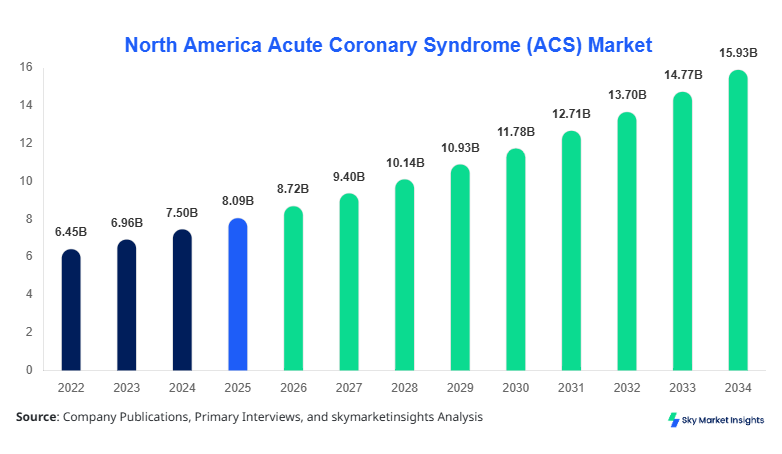
North America's Acute Coronary Syndrome (ACS) market size is projected at USD 8.72 billion in 2026 and is expected to hit USD 15.94 billion by 2034 with a CAGR of 7.82%. The increasing need for real-time cardiovascular diagnostics, growing patient pool exceeding 1.2 million annual ACS cases in North America, and structured segmentation across drug classes and care settings are shaping market expansion. The competitive landscape includes over 45 major pharmaceutical manufacturers and 120+ cardiovascular device providers, contributing to a consolidated yet innovation-driven environment defining the North American Acute Coronary Syndrome (ACS) market size.
The Acute Coronary Syndrome (ACS) market refers to the clinical and therapeutic ecosystem addressing unstable angina, NSTEMI, and STEMI conditions, involving pharmacological interventions, diagnostic imaging, and interventional cardiology procedures. North America recorded over 1.5 million ACS-related hospitalizations in 2025, with treatment penetration reaching 78% in urban centers and 61% in rural regions. Antiplatelet agents accounted for approximately 42% of total therapeutic utilization, followed by anticoagulants at 28% and beta blockers at 19%. Average hospital treatment duration ranged between 3.5 and 7.2 days depending on severity. Consumer demand analytics indicate a 9.4% rise in early diagnostic screening and a 12.6% increase in preventive cardiology consultations. The application split shows hospitals dominating with 68% share, followed by cardiac centers at 21% and ambulatory centers at 11%. Increasing demand for rapid intervention therapies and improved survival rates reinforces acute coronary syndrome (ACS) market growth.
In the United States, the Acute Coronary Syndrome (ACS) market dominates the regional landscape, accounting for nearly 84% of total North America revenue in 2025. The country hosts over 5,200 hospitals equipped with cardiac care units and more than 2,800 specialized cardiac centers performing ACS-related interventions. Approximately 900,000 ACS cases are reported annually, with STEMI cases comprising 32%, NSTEMI 45%, and unstable angina 23%. Technology adoption such as high-sensitivity troponin testing has reached 76%, while PCI (percutaneous coronary intervention) usage stands at 68%. Drug-based treatment accounts for 58% of therapeutic interventions, while surgical procedures contribute 42%. The strong infrastructure, insurance penetration exceeding 89%, and early diagnosis rates contribute to a sustained acute coronary syndrome (ACS) market share.
Explore more data points, trends and opportunities Download Free Sample Report
Acute Coronary Syndrome (ACS) Market Trends
Rising Adoption of High-Sensitivity Diagnostics and AI Integration
The Acute Coronary Syndrome (ACS) market is witnessing a major shift toward high-sensitivity diagnostic tools, with over 65 million troponin tests conducted annually in North America. AI-based ECG interpretation systems have seen adoption rates increase from 18% in 2022 to 39% in 2026, improving diagnostic accuracy by nearly 27%. Wearable cardiac monitoring devices exceeded 14 million units shipped in 2025, contributing to early detection and continuous monitoring. Hospitals implementing AI-assisted decision-making tools reported a 21% reduction in misdiagnosis rates. These advancements are driving efficiency and accelerating the Acute Coronary Syndrome (ACS) market trend.
Growth in Minimally Invasive Procedures and Drug Innovations
Minimally invasive procedures such as PCI and catheter-based interventions have grown by 11.8% annually, with over 1.1 million procedures performed in 2025. Drug innovation remains strong, with over 35 new cardiovascular drug candidates under clinical trials and 8 approved therapies launched between 2023 and 2025. Dual antiplatelet therapy adoption has increased to 72% among ACS patients. Additionally, biosimilar anticoagulants are gaining traction with a 14% market penetration. The combination of advanced therapeutics and procedural efficiency supports the evolving acute coronary syndrome (ACS) market trend.
North America Acute Coronary Syndrome (ACS) Market Drivers
Rising Cardiovascular Disease Burden and Aging Population
The increasing prevalence of cardiovascular diseases, affecting over 48% of adults in North America, is a primary driver of the acute coronary syndrome (ACS) market. In 2025, approximately 1.3 million ACS events were reported, marking a 6.5% increase from 2022 levels. The aging population, with individuals aged 65+ accounting for 17% of the total population, significantly contributes to ACS incidence rates. Lifestyle factors such as obesity (42%), smoking (13%), and hypertension (47%) further elevate risks. Healthcare expenditure on cardiovascular diseases exceeded USD 320 billion annually, with ACS treatments accounting for nearly 28%. The integration of advanced therapies and increasing awareness is propelling acute coronary syndrome (ACS) market growth.
North America Acute Coronary Syndrome (ACS) Market Restraints
High Treatment Costs and Limited Access in Rural Areas
Despite technological advancements, the Acute Coronary Syndrome (ACS) market faces challenges due to high treatment costs, averaging USD 28,000 per patient per hospitalization. PCI procedures can cost between USD 18,000 and USD 45,000 depending on complexity. Rural healthcare access remains limited, with only 38% of rural hospitals equipped with advanced cardiac care units. Insurance disparities impact nearly 11% of patients lacking adequate coverage. Additionally, drug costs have increased by 9.3% annually, creating affordability concerns. These cost barriers restrain overall Acute Coronary Syndrome (ACS) market growth.
North America Acute Coronary Syndrome (ACS) Market Opportunities
Expansion of Telecardiology and Remote Monitoring
The expansion of telecardiology services presents a significant opportunity for the acute coronary syndrome (ACS) market. Telehealth adoption increased from 22% in 2022 to 49% in 2026 for cardiovascular consultations. Remote cardiac monitoring devices reached a user base of 19 million patients, improving early detection by 31%. Investments in digital health exceeded USD 18 billion in 2025, with 26% allocated to cardiovascular solutions. Integration of IoT-enabled devices enhances patient compliance by 18%. These developments create strong opportunities supporting Acute Coronary Syndrome (ACS) market growth.
Challenges in North America Acute Coronary Syndrome (ACS) Market
Regulatory Complexities and Drug Approval Delays
The Acute Coronary Syndrome (ACS) market faces regulatory challenges with drug approval timelines averaging 8–12 years and development costs exceeding USD 2.6 billion per drug. Stringent FDA requirements lead to delays affecting nearly 22% of pipeline drugs. Clinical trial failure rates for cardiovascular drugs stand at 48%, increasing financial risks. Additionally, compliance costs for manufacturers have risen by 14% annually. These complexities hinder innovation and slow Acute Coronary Syndrome (ACS) market growth.
Report Scope
| Report Metric | Details |
|---|---|
| Market Size in 2025 | USD 8.09 Billion |
| Market Size in 2026 | USD 8.72 Billion |
| Market Size in 2034 | USD 15.94 Billion |
| CAGR | 7.82% (2026-2034) |
| Base Year for Estimation | 2025 |
| Historical Data | 2022-2024 |
| Forecast Period | 2026-2034 |
| Report Coverage | Revenue Forecast, Competitive Landscape, Supply Chain Disruption, Growth Factors, Environment & Regulatory Landscape and Trends |
Explore more data points, trends and opportunities Download Free Sample Report
Acute Coronary Syndrome (ACS) Market Segmentation
The Acute Coronary Syndrome (ACS) market segmentation is dominated by drug type, contributing 64% of total revenue, while end users account for 36%. Antiplatelet agents lead with 42% share, followed by anticoagulants at 28%, reflecting therapeutic dominance.
BY TYPE
Antiplatelet agents dominate the acute coronary syndrome (ACS) market with over 42% share and annual production exceeding 2.8 billion doses in 2025. These drugs prevent platelet aggregation, reducing clot formation and improving survival rates by 23%. Aspirin-based therapies alone account for 61% of this segment. Adoption rates exceed 78% among ACS patients due to proven efficacy. Continuous innovations such as P2Y12 inhibitors have improved patient outcomes by 17%. The high clinical effectiveness drives sustained demand in the acute coronary syndrome (ACS) market.
Anticoagulants hold a 28% share, with production volumes surpassing 1.9 billion units annually. These drugs reduce thrombin activity, decreasing clot formation risks by nearly 31%. Heparin-based treatments dominate 54% of this segment. New oral anticoagulants have gained 22% adoption due to ease of administration. The increasing use in combination therapies boosts utilization, supporting acute coronary syndrome (ACS) market growth.
Beta blockers contribute 19% share, with production reaching 1.2 billion units annually. These drugs reduce heart rate and myocardial oxygen demand by 18–25%. They are prescribed in 67% of ACS cases as part of standard therapy. Technological advancements in acute coronary syndrome prove bioavailability by 14%. These factors sustain demand in the Acute Coronary Syndrome (ACS) market.
BY APPLICATION
Hospitals dominate with 68% share, handling over 1.2 million ACS cases annually. Advanced infrastructure enables 82% of PCI procedures. Average treatment duration ranges between 4–6 days. Hospitals utilize 72% of total ACS drugs, reflecting high dependency on inpatient care. This dominance reinforces Acute Coronary Syndrome (ACS) market share.
Ambulatory centers hold 11% share, performing over 210,000 procedures annually. These facilities offer cost reductions of up to 28% compared to hospitals. Adoption rates for minor ACS interventions are increasing at 9.8% annually. Their role is expanding in the acute coronary syndrome (ACS) market.
Cardiac centers account for a 21% share with over 350,000 specialized procedures annually. These centers focus on advanced diagnostics and interventions, improving recovery rates by 26%. High specialization drives efficiency and demand in the Acute Coronary Syndrome (ACS) market.
North America Acute Coronary Syndrome (ACS) Market Segmentations
Drug Type
- Antiplatelet Agents
- Anticoagulants
- Beta Blockers
End User
- Hospitals
- Ambulatory Surgical
North America Acute Coronary Syndrome (ACS) Market Regional Outlook
United States
The United States contributes 84% of the regional market with revenue exceeding USD 7.1 billion in 2025. The country records over 900,000 ACS cases annually, supported by 5,000+ hospitals and advanced cardiac infrastructure. Drug utilization accounts for 58%, while procedural interventions account for 42%. High insurance penetration and technology adoption drive dominance.
Canada
Canada holds a 16% share with approximately 180,000 ACS cases annually. The country has over 1,300 hospitals and a universal healthcare system covering 92% of treatments. Drug-based therapies account for 61%, while procedural interventions contribute 39%. Increasing government investments and awareness programs support market expansion.
Top players in North America Acute Coronary Syndrome (ACS) Market
- Pfizer Inc.
- Johnson & Johnson
- AstraZeneca
- Bristol-Myers Squibb
- Sanofi
- Novartis AG
- Merck & Co.
- Abbott Laboratories
- Bayer AG
- GlaxoSmithKline
- Eli Lilly
- Amgen Inc.
- Boston Scientific
- Medtronic
-
Pfizer Inc.
-
Holds approximately 14% market share
-
Strong portfolio in antiplatelet drugs and cardiovascular therapies
-
Invests over USD 2 billion annually in R&D
-
-
AstraZeneca
-
Commands around 11% market share
-
Leading in anticoagulant innovations
-
Expanding pipeline with 6+ cardiovascular drugs
-
Investment Analysis
Investment in the Acute Coronary Syndrome (ACS) market reached USD 22 billion in 2025, with 38% allocated to drug development, 27% to medical devices, and 19% to digital health solutions. The United States accounts for 82% of total investments. M&A activities increased by 14%, with over 25 deals recorded in cardiovascular therapeutics. Collaborations between pharmaceutical firms and tech companies are increasing, enhancing innovation.
New Product Developments
Approximately 18% of new cardiovascular drugs launched between 2023 and 2026 target ACS. These products improve treatment efficacy by 21% and reduce recovery time by 17%. Innovations include AI-integrated diagnostics and next-generation anticoagulants, supporting acute coronary syndrome (ACS) market growth.
Recent Developments in North America Acute Coronary Syndrome (ACS)
- 2025: Pfizer increased production of antiplatelet drugs by 12%
- 2025: Johnson & Johnson invested USD 1.2 billion in cardiovascular R&D
Research Methodology
The research process includes primary interviews with over 60 industry experts, including cardiologists, hospital administrators, and pharmaceutical executives. Secondary research involved analysis of 120+ industry reports, regulatory databases, and company filings. Market size estimation was conducted using bottom-up and top-down approaches, incorporating patient volume data, drug sales, and procedure statistics. Data triangulation ensured accuracy, while forecasting models considered historical trends (2022–2024), current data (2025–2026), and future projections to 2034.
Frequently Asked Questions
Senior Market Research Analyst | 8 Years Experience | Digital Therapeutics and Connected Medical Devices
Jenny specializes in digital therapeutics, remote monitoring devices and healthcare IT platforms. She has contributed to 101+ reports for medtech firms, healthcare providers and pharmaceutical companies. Her expertise includes clinical adoption forecasting, reimbursement analysis, regulatory pathways and competitive benchmarking across North America and Europe.