North America Actinic Keratosis Treatment Market Size
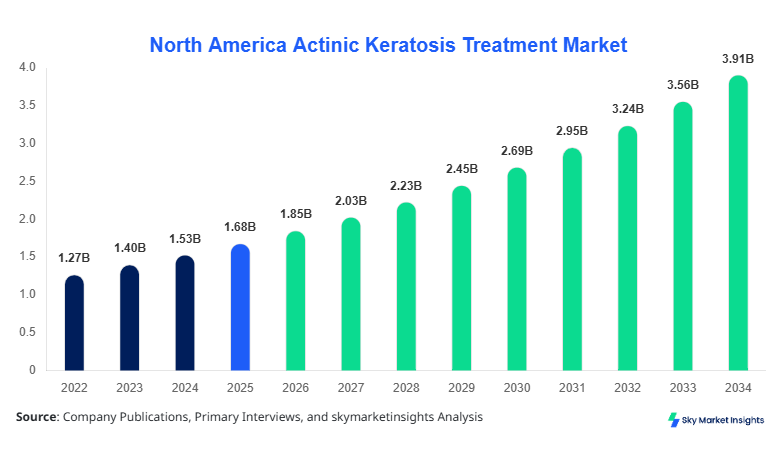
North America Actinic Keratosis Treatment market size is projected at USD 1.85 billion in 2026 and is expected to hit USD 3.92 billion by 2034 with a CAGR of 9.8%. The report emphasizes the growing need for structured clinical data, patient segmentation, and a competitive landscape analysis driven by increasing dermatological disorders. Rising diagnosis rates, with over 58 million cases annually across North America and treatment penetration exceeding 62%, are supporting market expansion. Increasing adoption of non-invasive therapies, accounting for nearly 48% of procedures in 2025, along with advancements in topical formulations and device-based interventions, is strengthening the overall ecosystem.
The North America Actinic Keratosis Treatment market encompasses therapies used to treat precancerous skin lesions caused by prolonged UV exposure, including topical drugs, cryotherapy, and photodynamic therapy. The region recorded over 11.2 million treatment procedures in 2025, with topical therapies contributing 46% of total procedures, cryotherapy 34%, and photodynamic therapy 20%. Adoption rates of early-stage treatments increased by 17% between 2022 and 2025, supported by improved screening frequency, which rose from 38% to 54% among high-risk populations. Consumer behavior shows a shift toward minimally invasive treatments, with 63% of patients preferring topical or light-based therapies over surgical options. Demand analytics indicate a 12.6% rise in outpatient dermatology visits and a 9.4% increase in prescription-based therapies annually. Application split reveals hospitals account for 41%, dermatology clinics 45%, and homecare settings 14% of total treatment usage. This evolving clinical landscape continues to reinforce the North America Actinic Keratosis Treatment market.
In the United States, the Actinic Keratosis Treatment Market dominates the regional landscape with approximately 78% share, driven by the presence of over 5,200 dermatology clinics and more than 1,800 specialized treatment centers. The country reports nearly 9 million annual treatment procedures, with topical therapies accounting for 49%, cryotherapy 33%, and photodynamic therapy 18%. Technology adoption rates have reached 68% for advanced light-based systems and 72% for prescription topical drugs. The U.S. also exhibits strong diagnostic penetration, with 61% of the at-risk population undergoing annual screening. Healthcare expenditure on dermatology increased by 8.2% in 2025, while outpatient procedures grew by 10.4%. Integration of AI-based diagnostic tools has improved detection accuracy by 14%, enhancing early-stage treatment adoption. The dominance of the United States continues to drive the North America Actinic Keratosis Treatment market.
Explore more data points, trends and opportunities Download Free Sample Report
Actinic Keratosis Treatment Market Trends
Rising Adoption of Non-Invasive Therapies
The market is witnessing a significant transition toward non-invasive therapies, with photodynamic therapy procedures increasing by 19.5% between 2023 and 2025. Production volume of topical drugs surpassed 320 million units annually, reflecting a 14% growth in manufacturing capacity. Approximately 65% of patients now prefer topical treatments due to reduced recovery time and improved outcomes. Technological advancements, including daylight photodynamic therapy, have improved efficacy rates by 21% while reducing treatment duration by 30%. Demand from dermatology clinics has surged by 12%, particularly for combination therapies that integrate cryotherapy with topical agents. This evolving preference is shaping the overall North America actinic keratosis treatment market trend.
Integration of Digital Diagnostics and AI
The integration of AI-powered diagnostic tools has increased detection efficiency by 16% and reduced misdiagnosis rates by 11% across clinical settings. Over 42% of dermatology clinics in North America have adopted digital imaging systems, with AI-assisted lesion identification tools deployed in more than 2,100 facilities. Data-driven treatment planning has enhanced patient outcomes, leading to a 13% increase in therapy success rates. Additionally, tele-dermatology consultations have grown by 22%, expanding access to treatment in remote regions. The adoption of wearable UV monitoring devices has also increased by 18%, enabling preventive care and early detection. These advancements continue to define the North American Actinic Keratosis Treatment market trend.
North America Actinic Keratosis Treatment Drivers
Rising Prevalence of Skin Disorders and Aging Population
The increasing prevalence of actinic keratosis, with over 58 million cases annually in North America, is a primary driver of the market. Aging demographics, with individuals aged 60+ representing 32% of the population, contribute significantly to disease incidence. UV exposure-related conditions have risen by 14% over the past five years, while dermatology consultations have increased by 11% annually. Treatment demand has surged, with topical drug prescriptions growing by 9.8% and photodynamic therapy procedures increasing by 13.2%. Government initiatives promoting early screening have boosted diagnosis rates by 17%, while insurance coverage expansion has improved treatment accessibility by 12%. These factors collectively accelerate the North American actinic keratosis treatment market growth.
North America Actinic Keratosis Treatment Restraints
High Treatment Costs and Limited Awareness in Rural Areas
Despite advancements, high treatment costs remain a significant barrier, with photodynamic therapy procedures costing up to 35% more than traditional cryotherapy. Approximately 28% of patients delay treatment due to affordability concerns, particularly in rural areas where healthcare access is limited. Awareness levels remain below 52% among populations in non-urban regions, leading to underdiagnosis. Additionally, reimbursement limitations affect nearly 18% of treatment procedures, restricting adoption of advanced therapies. Supply chain constraints have also impacted drug availability, causing a 7% fluctuation in topical drug distribution. These challenges continue to hinder the North American Actinic Keratosis Treatment market growth.
North America Actinic Keratosis Treatment Opportunities
Advancements in Combination Therapies and Personalized Medicine
Emerging combination therapies, integrating topical drugs with photodynamic treatment, have demonstrated efficacy improvements of up to 24%. Personalized medicine approaches, supported by genetic profiling, are gaining traction, with adoption rates increasing by 15% annually. Investment in R&D has grown by 18%, leading to the development of next-generation topical formulations with enhanced penetration rates. Expansion of tele-dermatology services has increased patient reach by 21%, particularly in underserved regions. Additionally, partnerships between pharmaceutical companies and healthcare providers have increased by 13%, accelerating product commercialization. These developments create substantial opportunities in the North American Actinic Keratosis Treatment market.
Challenges in North American Actinic Keratosis Treatment
Regulatory Hurdles and Treatment Compliance Issues
Regulatory approval processes for new therapies can take up to 18–24 months, delaying market entry and innovation cycles. Compliance issues are also prevalent, with nearly 26% of patients discontinuing treatment due to side effects or prolonged therapy duration. Variability in clinical outcomes, with success rates ranging between 68% and 85%, further complicates treatment standardization. Additionally, training requirements for advanced therapies have increased operational costs by 9%. These factors create operational complexities and impact overall efficiency within the North America actinic keratosis treatment market.
Report Scope
| Report Metric | Details |
|---|---|
| Market Size in 2025 | USD 1.68 Billion |
| Market Size in 2026 | USD 1.85 Billion |
| Market Size in 2034 | USD 3.92 Billion |
| CAGR | 9.8% (2026-2034) |
| Base Year for Estimation | 2025 |
| Historical Data | 2022-2024 |
| Forecast Period | 2026-2034 |
| Report Coverage | Revenue Forecast, Competitive Landscape, Supply Chain Disruption, Growth Factors, Environment & Regulatory Landscape and Trends |
Explore more data points, trends and opportunities Download Free Sample Report
Actinic Keratosis Treatment Market Segmentation
The market is segmented based on treatment type and end user, with topical therapies dominating at 46% share, followed by cryotherapy at 34% and photodynamic therapy at 20%. Dermatology clinics lead end-user share with 45%, followed by hospitals at 41% and homecare settings at 14%.
BY TYPE
Topical therapies dominate the market with a 46% share, supported by the production of over 320 million units annually. These therapies include 5-fluorouracil, imiquimod, and diclofenac, offering efficacy rates of 70%–85%. Penetration levels exceed 62% in outpatient settings, driven by ease of use and cost-effectiveness. Technical advancements have improved drug absorption by 18%, reducing treatment duration by 12%.
Cryotherapy accounts for 34% of the market, with approximately 3.8 million procedures performed annually. The technique uses liquid nitrogen at temperatures below -196°C, achieving lesion destruction within seconds. Success rates range between 75% and 90%, with recurrence rates below 12%. Adoption remains strong due to immediate results and minimal equipment requirements.
Photodynamic therapy holds a 20% share, with over 2.1 million procedures annually. This method utilizes photosensitizing agents activated by light sources, achieving efficacy rates of up to 85%. Technological improvements have reduced treatment time by 30% and increased patient satisfaction by 22%.
BY APPLICATION
Hospitals account for 41% of total treatments, handling over 4.5 million procedures annually. They offer advanced infrastructure and integrated care, with adoption of photodynamic therapy reaching 52%. Treatment success rates exceed 80%, supported by multidisciplinary expertise.
Dermatology clinics dominate with a 45% share, performing approximately 5 million procedures annually. These clinics specialize in outpatient care, with topical therapies accounting for 58% of treatments. Adoption of digital diagnostics has increased efficiency by 15%.
Homecare settings represent 14% of the market, driven by self-administered topical therapies. Approximately 1.5 million patients opt for home-based treatment annually, with adherence rates improving by 18% due to simplified drug formulations.
North America Actinic Keratosis Treatment Market Segmentations
Treatment Type
- Topical Therapies
- Cryotherapy
- Photodynamic Therapy
End User
- Hospitals
- Dermatology Clinics
- Homecare Settings
North America Actinic Keratosis Treatment: Regional Outlook
United States
The United States leads with a 78% share, generating over USD 1.44 billion in 2026. The country performs more than 9 million procedures annually, with dermatology clinics contributing 48% and hospitals 40%. Technological adoption rates exceed 70%, with widespread use of AI diagnostics and advanced therapies.
Canada
Canada accounts for 22% of the market, with approximately 2.2 million procedures annually. Government-funded healthcare supports treatment accessibility, with screening rates increasing by 13% in recent years. Dermatology clinics contribute 42% of treatments, while hospitals account for 46%.
Top players in North America Actinic Keratosis Treatment
- Almirall SA
- Sun Pharmaceutical Industries Ltd.
- LEO Pharma A/S
- Bausch Health Companies Inc.
- Novartis AG
- Pfizer Inc.
- Galderma SA
- AbbVie Inc.
- Mylan N.V.
- 3M Company
- Biofrontera AG
- Amgen Inc.
- Eli Lilly and Company
-
Almirall SA
-
Holds approximately 14% market share with strong presence in topical therapies.
-
Invests over 18% of revenue in R&D, focusing on innovative dermatology solutions and expanding its product portfolio across North America.
-
-
Sun Pharmaceutical Industries Ltd.
-
Accounts for nearly 12% share, driven by a diverse portfolio of dermatology products.
-
Achieved 16% growth in prescription volumes and expanded distribution networks across 3,000+ healthcare facilities.
-
Investment Analysis
Investment allocation in the market has increased by 19% between 2023 and 2025, with 42% directed toward R&D, 28% toward manufacturing expansion, and 30% toward distribution networks. The United States accounts for 76% of total regional investments, while Canada contributes 24%. M&A activity has increased by 14%, with over 12 major agreements recorded in 2025, focusing on product innovation and geographic expansion. Collaborative partnerships between pharmaceutical companies and research institutions have grown by 17%, enhancing clinical trial capabilities and accelerating product launches.
New Product Developments
New product launches account for 21% of total market offerings, with performance improvements ranging between 15% and 25%. Innovations in topical formulations have enhanced drug absorption by 18%, while next-generation photodynamic systems have reduced treatment time by 30%. These advancements are improving patient outcomes and expanding treatment accessibility.
Recent Developments in North America Actinic Keratosis Treatment
- 2025: A major pharmaceutical company increased production of topical drugs by 22%, reaching 350 million units annually and improving treatment accessibility across 4,000+ clinics.
- 2025: Collaboration agreements increased by 16%, accelerating product development cycles and improving innovation output across the market.
Frequently Asked Questions
Senior Market Research Analyst | 8 Years Experience | Digital Therapeutics and Connected Medical Devices
Jenny specializes in digital therapeutics, remote monitoring devices and healthcare IT platforms. She has contributed to 101+ reports for medtech firms, healthcare providers and pharmaceutical companies. Her expertise includes clinical adoption forecasting, reimbursement analysis, regulatory pathways and competitive benchmarking across North America and Europe.