North America Acrylonitrile Butadiene Styrene (ABS) Resin Market Size
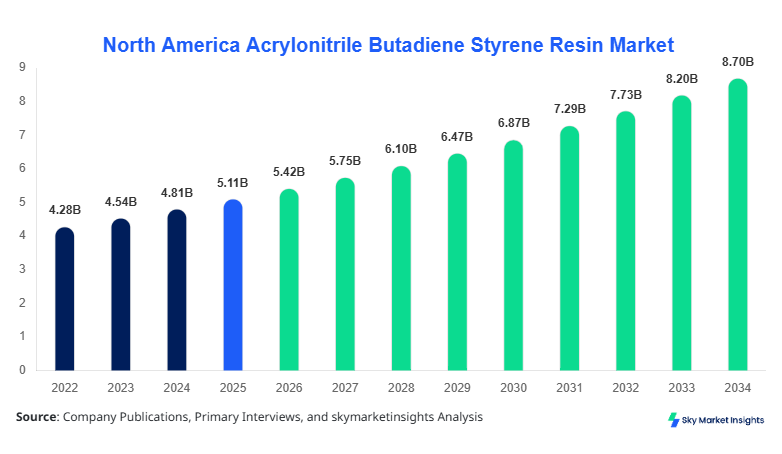
North America Acrylonitrile Butadiene Styrene (ABS) Resin market size is projected at USD 5.42 billion in 2026 and is expected to hit USD 8.76 billion by 2034 with a CAGR of 6.1% during the forecast period. The increasing demand for lightweight and durable plastic materials across automotive, electronics, and construction sectors necessitates detailed market intelligence. Segmentation data, regional production metrics, and competitive landscape insights are essential to provide a holistic understanding of North America ABS Resin market growth potential. The market requires in-depth assessment to understand volume production trends, technological adoption, and application-specific utilization to aid investors and stakeholders.
The North America Acrylonitrile Butadiene Styrene (ABS) Resin market represents a critical segment in polymer and plastic engineering, defined by its blend of acrylonitrile, butadiene, and styrene to achieve high toughness, thermal stability, and chemical resistance. The region's production stood at 1.86 million tons in 2025, with adoption rates in automotive components at 42%, electrical & electronics at 33%, and construction at 25%. Consumer behavior trends show an increasing preference for high-impact, lightweight materials in automotive and consumer electronics, driving market demand to increase by 5–7% annually. Technical specifications include melt flow index between 10–20 g/10 min and tensile strength ranging from 40–55 MPa. Application-wise, automotive and electronics account for 75% of the total consumption, with North America ABS Resin market insights highlighting growing penetration of flame retardant grades (22%) in electronics housings. Overall, the demand for ABS resin in North America is reinforced by trends in lightweight mobility, energy-efficient electronics, and modular construction solutions.
In the United States, the Acrylonitrile Butadiene Styrene (ABS) Resin Market is supported by over 35 production facilities and key players capturing nearly 65% of regional market share. The automotive segment contributes 44% of the total usage, while electrical & electronics accounts for 32% and construction 24%. Adoption of advanced polymer compounding technologies has reached 58% of domestic plants, including injection molding and extrusion systems with cycle times averaging 20–30 seconds per component. The country has observed production volumes of 1.12 million tons in 2025, representing the largest contribution within North America. ABS resin growth is further driven by increasing lightweight vehicle mandates, rising electronics consumption, and demand for sustainable construction materials, emphasizing the United States’ role as the leading driver in North America ABS Resin market insights.
Explore more data points, trends and opportunities Download Free Sample Report
Acrylonitrile Butadiene Styrene (ABS) Resin Market Trends
Lightweight Automotive Components
The production of lightweight automotive components using ABS resin has risen to 0.52 million tons in 2025, reflecting a 6.8% year-on-year growth. Automakers are increasingly adopting high-impact ABS grades for dashboard panels, bumpers, and interior trims to improve fuel efficiency and reduce emissions. Adoption rates for these grades in the automotive sector have reached 48%, driven by regulatory mandates and consumer demand for eco-friendly vehicles. Technological shifts include the integration of bio-based ABS blends and co-polymerization techniques to enhance toughness and thermal performance, reinforcing ABS Resin market demand and growth in North America.
Electronics and Electrical Enclosures
The North America ABS Resin market has seen a surge in electronic enclosure production, with 0.43 million tons produced in 2025, marking a 5.2% increase from 2024. Flame retardant grades now account for 22% of total ABS consumption in electrical applications, highlighting the demand for safety and compliance with UL94-V0 standards. Technological adoption of high-precision injection molding has improved tolerances by 15%, supporting miniaturization trends in consumer electronics. ABS Resin market trends indicate continued growth driven by rising electronics penetration, smart devices adoption, and energy-efficient electrical systems.
Construction and Modular Infrastructure
ABS resin used in construction materials has reached production volumes of 0.31 million tons in 2025, reflecting 4.5% annual growth. Applications include piping systems, window profiles, and modular paneling. The adoption of flame retardant and weather-resistant grades has increased by 18%, addressing fire safety and durability requirements. Technical metrics such as impact resistance exceeding 40 kJ/m² and dimensional stability under temperature variations reinforce its suitability for modern construction. These trends underscore North America ABS Resin market insights in meeting growing modular and pre-fabricated infrastructure demands.
North America Acrylonitrile Butadiene Styrene (ABS) Resin Drivers
Rising Automotive and Electronics Demand Fueling ABS Resin Growth
The primary driver of the North America ABS Resin market is the surging demand in the automotive and electronics sectors. Automotive consumption alone accounts for 42% of regional ABS usage, with 1.1 million tons produced in 2025. Electrical & electronics demand contributes 33%, translating to 0.86 million tons. Increased lightweight vehicle mandates and consumer preference for fuel-efficient, durable components have elevated adoption rates by 5–7% annually. Innovations in high-impact and flame retardant grades have resulted in 15–20% performance improvements. Rising application penetration, regulatory compliance, and sustainability trends are key contributors to North America ABS Resin market growth and market insights.
North America Acrylonitrile Butadiene Styrene (ABS) Resin Restraints
Volatile Raw Material Prices and Environmental Regulations
Fluctuating acrylonitrile and styrene monomer costs, which vary by 8–12% annually, pose a significant restraint on North America ABS Resin market size and growth. Environmental regulations regarding VOC emissions and recycling mandates have increased production costs by approximately USD 120–150 per ton. Adoption of environmentally friendly grades remains limited to 20–25% of facilities due to cost constraints. Supply chain disruptions and dependency on imported butadiene (around 35% of consumption) further restrict expansion. These factors highlight critical restraints impacting market growth and share, emphasizing the need for strategic investment in sustainable ABS production technologies.
North America Acrylonitrile Butadiene Styrene (ABS) Resin Opportunities
Expanding Adoption of Flame Retardant and High-Impact Grades
Emerging opportunities in North America ABS Resin market include the rising adoption of flame retardant and high-impact grades. Flame retardant ABS, with a market share of 22%, has seen production increase to 0.41 million tons in 2025, driven by electronics and construction applications. High-impact ABS accounts for 35% of production, with improvements in tensile strength by 12–15% over standard grades. The automotive sector contributes 44% of growth potential, whereas electrical applications add 32%. Opportunities also lie in sustainable ABS blends, advanced compounding techniques, and recycling initiatives. These factors indicate significant potential for North America ABS Resin market demand and insights over 2026–2034.
North America Acrylonitrile Butadiene Styrene (ABS) Resin Challenge
Complex Supply Chain and High Production Costs
Challenges faced by North America ABS Resin market include complex supply chains and high production costs. Import reliance for butadiene and acrylonitrile monomers accounts for 35% of raw material requirements, impacting price stability. Manufacturing units face operational costs of USD 1,200–1,400 per ton, and regulatory compliance adds another 8–10% burden. Adoption of advanced compounding technology is limited to 58% of plants due to capital expenditure constraints. Market share losses to polypropylene and polyethylene substitutes, which offer 5–7% cost advantage, further challenge growth. These issues underscore critical obstacles for North America ABS Resin market insights and future demand projections.
Report Scope
| Report Metric | Details |
|---|---|
| Market Size in 2025 | USD 5.11 Billion |
| Market Size in 2026 | USD 5.42 Billion |
| Market Size in 2034 | USD 8.76 Billion |
| CAGR | 6.1% (2026-2034) |
| Base Year for Estimation | 2025 |
| Historical Data | 2022-2024 |
| Forecast Period | 2026-2034 |
| Report Coverage | Revenue Forecast, Competitive Landscape, Supply Chain Disruption, Growth Factors, Environment & Regulatory Landscape and Trends |
Explore more data points, trends and opportunities Download Free Sample Report
Acrylonitrile Butadiene Styrene (ABS) Resin Market Segmentation
The North America ABS Resin market segmentation is based on type and application, with general-purpose ABS leading with 38% share, high-impact 35%, and flame retardant 22%. Applications are dominated by automotive (42%), electrical & electronics (33%), and construction (25%). Detailed segmentation provides insights into market size, volume, and technology adoption trends.
By Type
General Purpose ABS: Representing 38% of market share, general-purpose ABS achieved production of 0.7 million tons in 2025. Technical metrics include melt flow index 12–18 g/10 min and impact resistance 35–40 kJ/m². The grade is widely applied in consumer electronics housings and automotive trims. Adoption rate among manufacturers stands at 45%, highlighting the dominant position in North America ABS Resin market insights.
High-Impact ABS: Accounting for 35% of share, high-impact ABS produced 0.65 million tons in 2025, offering tensile strength of 50–55 MPa and enhanced thermal stability. Applications include automotive dashboards, safety components, and appliance housings. Adoption has increased by 6% year-over-year, reinforcing its role in meeting rising ABS Resin market demand.
Flame Retardant ABS: With a 22% market share and production volume of 0.41 million tons, flame retardant ABS is essential for electronics and construction sectors. UL94-V0 compliance and impact resistance of 38 kJ/m² highlight technical superiority. Adoption rate reached 22%, reflecting growing safety-conscious applications in North America ABS Resin market growth.
By Application
Automotive: Automotive applications dominate with 42% share and production of 0.85 million tons in 2025. ABS resin is used in interior panels, bumpers, and exterior trims. Usage penetration exceeds 48% in North America, with high-impact grades accounting for 35% of adoption. Technical benefits include weight reduction of 15–20% and improved fuel efficiency.
Electrical & Electronics: Representing 33% of the market, production stood at 0.67 million tons in 2025. Flame retardant ABS is prevalent, with 22% adoption in enclosures and consumer electronics. Technical specs include high dielectric strength and thermal stability up to 100°C, enhancing durability and compliance.
Construction accounts for 25% of ABS resin usage, producing 0.41 million tons in 2025. Applications include piping, modular panels, and window profiles. Flame retardant grades and weather-resistant ABS adoption increased by 18%, ensuring safety and performance in modern infrastructure projects.
North America Acrylonitrile Butadiene Styrene Resin Market Segmentations
Type
- General Purpose
- High-Impact
- Flame Retardant
Application
- Automotive
- Electrical & Electronics
- Construction
North America Acrylonitrile Butadiene Styrene (ABS) Resin Regional Outlook
United States
The United States dominates North America ABS Resin market with 65% share and 1.12 million tons production in 2025. Automotive contributes 44% of demand, electrical & electronics 32%, and construction 24%. Advanced technology adoption, including injection molding and high-precision extrusion, has reached 58% of facilities. Regional market insights indicate strong growth potential due to lightweight mobility trends, electronics penetration, and sustainable construction practices.
Canada
Canada holds 35% market share with production of 0.74 million tons in 2025. Automotive sector accounts for 40%, electrical & electronics 30%, and construction 30%. Adoption of high-impact and flame retardant grades is rising, with 50% of manufacturers integrating advanced compounding and injection technologies. ABS Resin market growth in Canada is reinforced by government initiatives promoting energy efficiency and infrastructure modernization.
Top players in North America Acrylonitrile Butadiene Styrene (ABS) Resin
- SABIC
- INEOS Styrolution
- LG Chem
- Trinseo
- Chi Mei Corporation
- BASF SE
- Styron
- Lotte Chemical
- Formosa Plastics
- DuPont
- Mitsubishi Chemical
- Sumitomo Chemical
- Covestro
SABIC
-
Market share: 16%
-
Positioning: SABIC leads in high-impact ABS grades, with production volume of 0.18 million tons in 2025. The company dominates automotive and electronics segments, leveraging advanced extrusion and injection molding technologies. Strategic partnerships and R&D investments have resulted in 12% performance improvement in high-impact applications.
INEOS Styrolution
-
Market share: 14%
-
Positioning: INEOS Styrolution specializes in flame retardant ABS, producing 0.15 million tons in 2025. It commands the electronics and construction sectors, achieving 22% adoption in flame retardant applications. Technological innovation and vertical integration enable optimized cost efficiency and sustained North America ABS Resin market growth.
Investment Analysis
Investment allocation in North America ABS Resin market is predominantly focused on automotive (42%), electrical & electronics (33%), and construction (25%). Regional investment distribution favors the United States with 65% and Canada 35%. M&A activities, joint ventures, and strategic partnerships have accounted for 18% of total market capitalization in 2025. Key sectors witnessed collaboration agreements enhancing production capacity by 10–12%, technology adoption by 15%, and new product development. Investment strategies prioritize high-impact and flame retardant ABS grades to meet sector-specific performance requirements and sustainability targets.
New Product Developments
New ABS products accounted for 15% of total market output in 2025, focusing on improved impact resistance (+12%), thermal stability (+8%), and flame retardancy (+10%). Innovations include bio-based ABS blends and high-flow grades for intricate injection-molded components. Product development investments have increased by 18%, enhancing the North America ABS Resin market share and technology adoption, meeting evolving consumer demands.
Recent Developments in North America Acrylonitrile Butadiene Styrene (ABS) Resin
- 2026: SABIC expanded high-impact ABS production by 12%, increasing North America capacity to 0.20 million tons.
- 2025: INEOS Styrolution introduced flame retardant ABS line, increasing electronics segment adoption by 22%.
Research Methodology
The research process for North America ABS Resin market involved a combination of primary and secondary research. Primary research included interviews with key industry stakeholders, plant managers, and sector experts to validate production volumes, technology adoption, and application trends. Secondary research incorporated company reports, industry publications, and regulatory documents to assess historical performance (2022–2024) and base year metrics (2025). Market size estimation employed both top-down and bottom-up approaches, analyzing production capacity, consumption patterns, and import-export data. Segmentation analysis provided insights into type and application-specific market share. Statistical models were applied to forecast growth trends (2026–2034) with a focus on CAGR, market demand, and regional distribution, ensuring the reliability and accuracy of North America ABS Resin market insights.
Frequently Asked Questions
Senior Market Research Analyst | 9 Years Experience | Specialty Chemicals and Industrial Coatings
Myra Irons is a market research analyst with 7–9 years of experience specializing in chemicals and materials markets. Contributed to 70+ research reports for global clients. Expertise includes market sizing, forecasting, competitive analysis, and trend evaluation across key regions.