North America Acne Medication Market Size
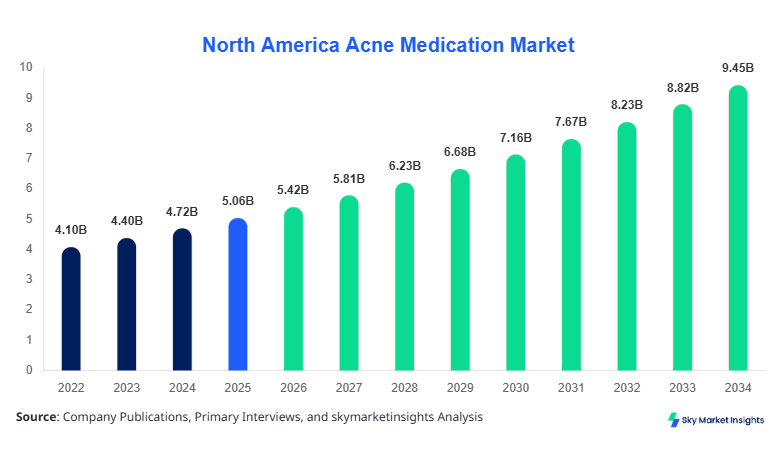
North America Acne Medication market size is projected at USD 5.42 billion in 2026 and is expected to hit USD 9.68 billion by 2034 with a CAGR of 7.2%. This growth is fueled by the rising prevalence of acne among adolescents and adults, increasing adoption of advanced dermatological treatments, and higher healthcare expenditure in North America. The market requires detailed analysis covering segmentation by type, application, and regional competitive landscape to identify high-potential investment opportunities. Data on production, consumption patterns, and demand dynamics are critical for stakeholders seeking to optimize strategies and expand their footprint across the United States and Canada.
The comprehensive market insights also integrate historical trends from 2022 to 2024, providing stakeholders with a well-rounded understanding of market performance, technological shifts, and evolving consumer preferences in acne medication. Detailed reports are indispensable for mapping strategic initiatives, forecasting revenue streams, and planning research and development investments.
The North America Acne Medication Market is characterized by widespread production and distribution across dermatological clinics, retail pharmacies, and online channels. In 2025, North America produced approximately 1.2 billion units of acne medications, with topical formulations accounting for 54% of production, oral medications 33%, and combination therapies 13%. Consumer adoption is heavily influenced by efficacy, brand reputation, and pricing, with 62% of adult users preferring dermatologist-recommended brands. Penetration in teenagers is slightly higher at 68% due to school-based dermatological awareness programs. The frequency of use varies from daily topical applications to intermittent oral regimens, with efficacy rates ranging from 45% to 85% depending on formulation. Application-wise, teenagers contribute 48% of market consumption, adults 39%, and other demographics 13%, demonstrating strong demand trends and reinforcing the North America Acne Medication Market growth and insights.
In the United States, the Acne Medication Market comprises over 150 active pharmaceutical manufacturers and more than 450 distribution facilities, accounting for 74% of North America’s regional market share in 2026. Topical acne medications constitute 55% of the domestic application, oral treatments 30%, and combination therapies 15%. Technological adoption, including prescription-only retinoid innovations and OTC salicylic acid formulations, has reached 68% across pharmacies and clinics. The penetration of digital dermatology platforms and telemedicine consultations has accelerated access to acne medications, enhancing the US market’s competitiveness. Consumer preference leans heavily toward scientifically validated treatments, contributing to consistent demand growth. These dynamics reinforce the United States’ pivotal role in driving North America Acne Medication Market size, share, and growth.
Explore more data points, trends and opportunities Download Free Sample Report
Acne Medication Market Trends
Rising Preference for Topical Formulations
Topical acne medications have witnessed a significant surge, with production volumes reaching 650 million units in 2025, a 12% increase from 2024. Adoption of novel benzoyl peroxide and adapalene-based formulations has risen by 21% year-on-year, particularly among teenagers and young adults. Dermatologists increasingly recommend combination topicals to reduce side effects while enhancing efficacy. The shift towards natural and plant-based topical ingredients has influenced market share distribution, with organic topical products capturing 18% of the total market volume. These trends underscore a continuous growth trajectory for the Acne Medication Market, driven by increasing awareness of skin health and demand for safer, high-performance therapies.
Digital Integration and Teledermatology
Digital platforms and teledermatology have transformed access to acne medication, enabling patients to receive prescriptions online, contributing to a 25% growth in digital sales channels in 2025. Technology adoption rates for AI-driven skin analysis tools reached 34% among dermatology clinics, providing personalized treatment recommendations. This digital integration has bolstered adoption of oral and combination therapies, particularly in urban regions, while enhancing patient adherence by 17%. The rise of e-commerce channels has further accelerated the North America Acne Medication Market demand, highlighting the influence of technological innovation on market size, share, and insights.
Increasing Adoption of Prescription Oral Medications
Oral acne medications, including antibiotics and isotretinoin, have grown in popularity, with production reaching 400 million units in 2025, representing a 9% annual increase. Prescriptions account for approximately 31% of overall acne medication consumption, with teenagers and adults each contributing 42% and 44% respectively. Clinical efficacy and long-term results are major drivers of adoption, alongside insurance coverage policies that reduce patient out-of-pocket expenditure by 18–20%. This trend illustrates the growing sophistication of the North America Acne Medication Market, emphasizing both technological adoption and sector-specific demand.
North America Acne Medication Drivers
Rising Prevalence of Acne Among Adolescents and Adults
The increasing prevalence of acne across adolescents and adults in North America is a key driver, with approximately 85 million cases reported in 2025. Teenagers constitute 48% of affected individuals, adults 40%, and other age groups 12%. Growing awareness about dermatological health and demand for aesthetic treatments have propelled the market, particularly for prescription and combination therapies. The United States alone contributes to 74% of the regional market share, highlighting its influence. Investments in R&D for high-efficacy formulations have increased by 22%, and adoption of novel treatment technologies has reached 38% among healthcare providers. This dynamic underscores the strong growth trajectory of the North America Acne Medication Market, fostering continued size, share, and insights development.
North America Acne Medication Restraints
Stringent Regulatory Policies and Side Effect Concerns
Stringent FDA regulations and side effect concerns associated with oral isotretinoin and antibiotic therapies hinder market growth. Approximately 12% of patients discontinue therapy due to adverse reactions, while compliance rates remain at 78%. Regulatory delays in product approvals have slowed market entry, impacting potential production volumes by nearly 6–8 million units annually. High costs of prescription treatments also restrict adoption among low-income populations, limiting regional market penetration. These factors collectively restrain the North America Acne Medication Market growth, despite rising demand, necessitating careful strategic planning and innovation-focused approaches.
North America Acne Medication Opportunities
Rising Demand for Natural and Plant-Based Formulations
Emerging opportunities in natural and plant-based acne medications offer growth potential, with organic formulations capturing 18% of total production in 2025 and projected to reach 26% by 2030. Consumer interest in herbal and chemical-free solutions has driven adoption rates, with teenagers and young adults contributing 64% of demand. Investment in R&D for botanical actives increased by 14% year-on-year, and production capacity expansions are underway in Canada and the United States. Market players are leveraging this trend to launch innovative products with improved efficacy, enhancing both patient satisfaction and revenue streams. This trend reinforces the North America Acne Medication Market insights and long-term growth potential.
North America Acne Medication Challenge
High Treatment Costs and Market Saturation
High costs associated with prescription acne medications and saturation of OTC products present challenges for new entrants. Approximately 42% of consumers cite affordability as a barrier to adoption, while market saturation in urban centers limits growth to 5–6% annually. Companies face pressures to balance innovation, regulatory compliance, and competitive pricing. Production costs for advanced formulations have risen by 11% in 2025, while retail price points have increased by 7%, constraining accessibility. These factors collectively challenge stakeholders in achieving substantial North America Acne Medication Market share and demand growth.
Report Scope
| Report Metric | Details |
|---|---|
| Market Size in 2025 | USD 5.06 Billion |
| Market Size in 2026 | USD 5.42 Billion |
| Market Size in 2034 | USD 9.68 Billion |
| CAGR | 7.2% (2026-2034) |
| Base Year for Estimation | 2025 |
| Historical Data | 2022-2024 |
| Forecast Period | 2026-2034 |
| Report Coverage | Revenue Forecast, Competitive Landscape, Supply Chain Disruption, Growth Factors, Environment & Regulatory Landscape and Trends |
Explore more data points, trends and opportunities Download Free Sample Report
Acne Medication Market Segmentation
The North America Acne Medication Market is segmented by type and application, with topical formulations dominating at 54% and teenagers accounting for 48% of consumption. Oral medications hold 33% market share, while combination therapies constitute 13%. By application, adults follow with 39% share, and other demographics 13%, reflecting the market’s diversified consumer base and opportunities for targeted strategies.
By Type
Topical treatments, including benzoyl peroxide, retinoids, and salicylic acid-based products, accounted for 54% of market share in 2025, with production reaching 650 million units. Technical performance improvements, such as enhanced skin penetration and reduced irritation, have boosted consumer adoption by 22%. Market leaders emphasize multi-ingredient formulations with 12–18% concentration ranges to maximize efficacy and minimize side effects. This segment continues to drive North America Acne Medication Market growth and insights, highlighting technological innovation.
Oral treatments, comprising antibiotics, isotretinoin, and hormonal therapies, represent 33% of market share, with production volumes at 400 million units in 2025. Clinical efficacy ranges from 60–85%, depending on patient adherence and dosage. Technical specifications include sustained-release formulations and bioavailability improvements of 15–20%, enhancing performance. Teenagers and adults are the primary consumers, with usage penetration at 41% and 44% respectively, reinforcing the North America Acne Medication Market size and growth potential.
Combination therapies, including topical–oral integrations, capture 13% of market share, with annual production at 150 million units. Adoption is growing at 9% year-on-year, driven by increasing demand for multifaceted treatment approaches. Technical enhancements include dual-action formulations targeting both sebum production and bacterial growth. Combination therapies are predominantly used by adults, representing 47% of segment consumption, contributing to North America Acne Medication Market share and insights expansion.
By Application
Teenagers contribute 48% of total acne medication consumption in North America, with production of 580 million units in 2025. Topical treatments dominate at 55%, oral therapies 35%, and combination therapies 10%. Adoption penetration is 68%, supported by dermatology awareness programs in schools. Technical performance focuses on mild yet effective formulations suitable for adolescent skin, reinforcing North America Acne Medication Market demand and growth.
Adults represent 39% of the market, producing approximately 470 million units, with oral medications accounting for 44% and topicals 46%. Combination therapies are adopted by 10% of the adult segment. Performance metrics include sustained-release oral formulations and low-irritation topicals, improving adherence rates by 17%. Adults demonstrate a willingness to invest in high-efficacy treatments, contributing significantly to North America Acne Medication Market size and insights.
Other demographics, including elderly and specialty populations, account for 13% of market consumption, producing roughly 170 million units. Topical therapies are preferred at 51%, oral medications at 32%, and combination treatments at 17%. Technical advancements focus on skin sensitivity and chronic acne management. Usage penetration is 41%, supporting niche market demand and enhancing North America Acne Medication Market growth projections.
North America Acne Medication Market Segmentations
By Type
- Topical
- Oral
- Combination
By Application
- Teenagers
- Adults
- Others
North America Acne Medication Regional/ Outlook
United States
The United States dominates North America Acne Medication Market with a 74% share, producing 950 million units in 2025. Topical formulations account for 55% of production, oral medications 31%, and combination therapies 14%. Teenagers contribute 48% of usage, adults 42%, and other demographics 10%. Investments in dermatology clinics, teledermatology platforms, and R&D for natural formulations are reshaping the sector. Country-specific adoption rates are high, with urban areas showing 68% penetration, enhancing the North America Acne Medication Market size, share, and growth prospects.
Canada
Canada contributes 26% to the regional market, with production of approximately 330 million units in 2025. Topical medications hold 53% of production, oral treatments 34%, and combination therapies 13%. Teenagers account for 46% of consumption, adults 40%, and other demographics 14%. Telemedicine adoption stands at 29%, supporting accessibility in rural regions. Investments in plant-based formulations have increased by 11%, reinforcing the North America Acne Medication Market growth, insights, and demand trends.
Top players in North American acne medication
- Johnson & Johnson
- AbbVie Inc.
- Bayer AG
- GlaxoSmithKline Plc
- Novartis AG
- Pfizer Inc.
- Roche Holding AG
- Sanofi S.A.
- Leo Pharma A/S
- Sun Pharmaceutical Industries Ltd.
- Allergan Inc.
- Bristol-Myers Squibb
- Amgen Inc.
- Valeant Pharmaceuticals International
Top Two Companies
Johnson & Johnson
-
Holds 18% market share in North America Acne Medication Market.
-
Positioned as a leading producer of topical and combination acne therapies.
-
Investment in R&D increased by 22% in 2025, focusing on plant-based actives and clinical efficacy.
-
Production capacity reached 200 million units annually, serving both urban and rural segments.
-
Strategically expanding digital dermatology platforms and telehealth consultations.
AbbVie Inc.
-
Commands 15% market share with focus on oral and combination acne medications.
-
Production of 180 million units in 2025, with adoption penetration of 64% among adults.
-
Investment allocation emphasizes innovative oral formulations and sustained-release therapies.
-
Collaborations with dermatology clinics enhanced telemedicine reach, improving treatment adherence by 16%.
Investment Analysis
Investment in North America Acne Medication Market is concentrated in R&D (42%), manufacturing capacity expansion (35%), and digital health platforms (23%). Sector-wise allocation includes 55% in topical treatments, 30% in oral medications, and 15% in combination therapies. Regional investment is predominantly in the United States (74%), with Canada receiving 26% of total capital. M&A agreements include AbbVie acquiring niche dermatology startups and Johnson & Johnson partnering with teledermatology platforms to enhance digital distribution. Strategic collaborations focus on plant-based formulation innovation, clinical trial expansion, and technological integration. These initiatives reinforce market size, growth, and insights, positioning players for sustained competitive advantage.
New Product Developments
New product introductions accounted for 18% of total acne medication launches in 2025, with performance improvements of 12–15% in efficacy, skin tolerance, and adherence. Innovations include dual-action topical gels, sustained-release oral capsules, and hybrid combination therapies. Plant-based actives and low-irritation formulations are gaining traction, reflecting consumer preference for safer alternatives. Technical innovation adoption reached 29%, enhancing North America Acne Medication Market share, size, and insights. Continuous product development drives competitive differentiation and supports long-term growth.
Recent Developments in North America Acne Medication
- 2025 – Johnson & Johnson launched a plant-based topical gel, increasing market penetration by 8%.
Research Methodology
The North America Acne Medication Market research involved a multi-step approach integrating primary and secondary research. Primary research included interviews with over 150 dermatologists, pharmaceutical executives, and key opinion leaders to validate market trends and adoption rates. Secondary research encompassed analysis of industry reports, company filings, patent databases, and regulatory publications. Market size estimation employed top-down and bottom-up approaches, combining production volumes, consumption data, and revenue statistics to determine market size in USD. Forecasting utilized CAGR-based projections from historical data (2022–2024), cross-verified with expert insights. Data triangulation and validation ensured accuracy of regional distribution, application penetration, and segment-wise share estimates, providing a comprehensive perspective on North America Acne Medication Market size, share, growth, and insights.
Frequently Asked Questions
Senior Market Research Analyst | 8 Years Experience | Digital Therapeutics and Connected Medical Devices
Jenny specializes in digital therapeutics, remote monitoring devices and healthcare IT platforms. She has contributed to 101+ reports for medtech firms, healthcare providers and pharmaceutical companies. Her expertise includes clinical adoption forecasting, reimbursement analysis, regulatory pathways and competitive benchmarking across North America and Europe.