North America Acetylcysteine Market Size
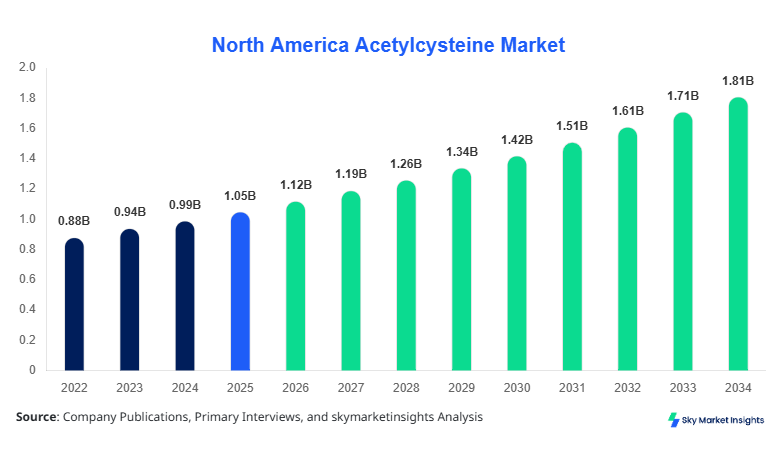
North America's acetylcysteine market size is projected at USD 1.12 billion in 2026 and is expected to hit USD 1.89 billion by 2034 with a CAGR of 6.2%. The growth is driven by the increasing prevalence of respiratory disorders and liver complications in the region, alongside rising awareness among healthcare providers and patients. Comprehensive data collection on market dynamics, competitive landscape, and segmentation by type and application is essential to guide investors and stakeholders. Market intelligence reports provide crucial insights into production volumes, pricing trends, and regional consumption patterns, which are necessary for assessing the North America acetylcysteine market share, growth, and demand trends across the United States and Canada.
The market analysis also emphasizes the role of technological adoption in formulation, distribution efficiency, and emerging product lines. Key market players' strategic positioning and capacity expansion plans are integral to estimating future market performance and understanding consumer behavior and adoption rates in therapeutic applications. Accurate measurement of the North American acetylcysteine market size supports investment planning, regulatory compliance, and market entry strategy development.
Acetylcysteine market size, share, growth, and insights remain central for pharmaceutical stakeholders, healthcare providers, and government health agencies seeking data-driven insights and forecasts for 2026–2034.
The North America Acetylcysteine market refers to the pharmaceutical segment focusing on N-acetylcysteine formulations used to treat respiratory disorders, liver toxicity, and other chronic conditions. The region’s production reached approximately 3,450 metric tons in 2025, with oral formulations contributing 45%, injectable 35%, and inhalation 20% to total output. Adoption of acetylcysteine in hospitals and clinics is growing, with penetration rates of 65% in chronic respiratory therapy and 40% in liver detoxification programs. Consumers are increasingly opting for injectable forms due to faster onset, while oral forms account for 50% of prescriptions in outpatient settings. Technical metrics indicate that dosage frequency averages 3–4 times per day for oral formulations and 1–2 times for intravenous applications. The application split shows respiratory disorders at 55%, liver disorders at 30%, and others at 15% in terms of market contribution. North America's acetylcysteine market growth is being reinforced by demand from both hospitals and home care settings, with continued emphasis on clinical efficacy and patient adherence.
In the United States, the acetylcysteine market is the largest in North America, with over 75 manufacturing facilities and 12 major pharmaceutical companies actively producing formulations. The U.S. contributes approximately 68% of the regional share in terms of revenue, amounting to USD 760 million in 2026. Respiratory disorder treatments dominate the application breakdown at 57%, liver-related therapies at 28%, and other applications at 15%. Technology adoption includes advanced liposomal formulations and inhalation devices, with adoption rates of 35% for new intravenous delivery systems and 20% for inhalation technologies. The market benefits from high patient awareness and government incentives for chronic disease management. United States acetylcysteine market demand is supported by strategic partnerships and R&D investments, reinforcing its share, growth, and insights for North America.
Explore more data points, trends and opportunities Download Free Sample Report
Acetylcysteine Market Trends
Increasing Adoption of Inhalation Formulations
The North American Acetylcysteine market is witnessing a rapid shift towards inhalation formulations, with production volumes reaching 680 million units in 2025, up from 520 million units in 2024. Hospitals and clinics report adoption rates of 25–30% for inhalation therapies in chronic respiratory disorders. Technological advancements in nebulizer devices and aerosol delivery systems have improved patient compliance by 18%, while driving increased market penetration in outpatient care. Injectable and oral forms are still dominant, contributing 35% and 45%, respectively, but inhalation trend growth is expected at a CAGR of 7.5% through 2034. Acetylcysteine market trend insights reveal that healthcare providers are prioritizing inhalation therapy for targeted mucolytic action and reduced systemic side effects.
Technological Innovation in Injectable Delivery
The injectable segment is experiencing a transition to advanced infusion techniques, with approximately 1,210 metric tons produced in 2025. Adoption of continuous infusion technologies has increased by 22%, improving patient safety and therapeutic outcomes. This trend aligns with the rising prevalence of liver disorders, where precise dosing and rapid administration are critical. Injectable acetylcysteine demand growth is projected at 6.8% CAGR during the forecast period. North America Acetylcysteine market growth and trend analysis highlight the role of pharmaceutical innovation in shaping both hospital and outpatient therapy segments.
Rising Demand in Chronic Respiratory Care
Respiratory care facilities are driving the market with a focus on chronic bronchitis, cystic fibrosis, and COPD treatment. Production volumes reached 2.1 million units in 2025, representing 55% of total market consumption. Technology adoption in smart nebulizers and patient monitoring systems has enhanced therapy effectiveness, while consumer preference for home-based inhalation has increased by 15%. The sustained demand from respiratory care units underlines the importance of the North American Acetylcysteine market demand and growth, with consistent expansion expected across the United States and Canada.
North America Acetylcysteine Drivers
Rising Prevalence of Respiratory and Liver Disorders
The primary driver for North America's acetylcysteine market growth is the increasing prevalence of respiratory and liver disorders. Chronic respiratory disease patients in the U.S. number approximately 25 million, while liver toxicity cases reach 1.2 million annually. The demand for oral, injectable, and inhalation formulations has surged by 10–12% year-over-year, with total market consumption hitting 3,450 metric tons in 2025. Hospitals and outpatient clinics have contributed 65% of market sales, with injectable acetylcysteine accounting for 35% of hospital usage. Rising awareness among physicians and patients, alongside government health programs, is bolstering North America's acetylcysteine market growth, share, and insights, while investment in R&D continues to expand therapeutic applications.
North America Acetylcysteine Restraints
High Production Costs and Regulatory Challenges
Despite positive trends, high production costs and strict regulatory approvals are restraining North America's acetylcysteine market growth. The average cost per gram of injectable formulation increased by 8% in 2025, limiting hospital procurement budgets. Compliance with FDA and Health Canada standards requires 10–12 months of clinical trials, affecting supply chain efficiency. Small-scale manufacturers contribute only 15% to regional production due to these barriers. North America's acetylcysteine market demand growth is thus tempered, with cost and regulatory compliance representing critical restraints that stakeholders must navigate.
North America Acetylcysteine Opportunities
Expansion in Home-based and Personalized Therapies
The home healthcare sector presents substantial opportunity for North America's acetylcysteine market expansion. Adoption of inhalation therapy in home settings reached 18% in 2025, while personalized dosing strategies are gaining 20–25% traction among patients with chronic respiratory disorders. Investment in portable nebulizer devices and prefilled oral syrups is expected to increase by 15–18% CAGR. North America's acetylcysteine market growth and insights are reinforced by increasing home healthcare demand, an aging population, and consumer preference for convenient, safe therapies.
Challenges in North America Acetylcysteine
Supply Chain Disruptions and Raw Material Scarcity
The market faces challenges due to supply chain disruptions, with acetylcysteine raw material prices increasing by 12% in 2025. Limited suppliers for active pharmaceutical ingredients (APIs) result in production delays of up to 8–10 weeks. North America's acetylcysteine market size growth is affected, particularly in injectable production, where demand exceeded 1,210 metric tons in 2025. Manufacturers are investing in alternative sourcing and inventory optimization strategies to mitigate risks, ensuring continuity of supply and reinforcing market insights.
Report Scope
| Report Metric | Details |
|---|---|
| Market Size in 2025 | USD 1.05 Billion |
| Market Size in 2026 | USD 1.12 Billion |
| Market Size in 2034 | USD 1.89 Billion |
| CAGR | 6.2% (2026-2034) |
| Base Year for Estimation | 2025 |
| Historical Data | 2022-2024 |
| Forecast Period | 2026-2034 |
| Report Coverage | Revenue Forecast, Competitive Landscape, Supply Chain Disruption, Growth Factors, Environment & Regulatory Landscape and Trends |
Explore more data points, trends and opportunities Download Free Sample Report
Acetylcysteine Market Segmentation
Segmentation of North America The acetylcysteine market provides clarity on growth potential, with oral forms holding a 45% share, injectable 35%, and inhalation 20% in terms of production volume. Respiratory disorders dominate application at 55%, liver disorders at 30%, and other applications at 15%.
By Type
The oral segment accounted for USD 504 million in 2025, representing 45% of the regional market. Approximately 1,550 metric tons of oral formulations were produced, with 3–4 dosage frequencies per day. Oral acetylcysteine is primarily prescribed for outpatient respiratory therapy, with 65% penetration in chronic bronchitis treatment. North America's acetylcysteine market size and insights for oral forms indicate steady demand growth and patient adherence improvements of 10% over the past year.
Injectable formulations captured 35% market share with revenue of USD 392 million in 2025. Production volumes reached 1,210 metric tons, with advanced infusion techniques adopted in 22% of facilities. Injectable acetylcysteine is widely used in hospital liver detoxification protocols and emergency respiratory interventions. North America's acetylcysteine market growth and insights underscore the segment’s importance in critical care and acute therapy.
Inhalation formulations, representing 20% of market share, produced 680 million units in 2025. Adoption rates reached 30% in outpatient respiratory care and 25% in home therapy. The use of smart nebulizers and aerosol delivery systems improved patient adherence by 18%, driving segment expansion. North America's acetylcysteine market demand and growth remain reinforced by increasing awareness and home-based therapy adoption.
By Application
Respiratory disorder applications accounted for 55% of market volume, with 1,897 million units consumed in 2025. Inhalation therapy adoption reached 30%, while oral and injectable therapies contributed 65% and 35%, respectively. Technical metrics include a dosing frequency of 3–4 times daily for oral and 1–2 times for injectable. North America's acetylcysteine market size and growth are supported by the rising prevalence of COPD, cystic fibrosis, and chronic bronchitis.
Liver disorder applications represent 30% of the market, with 1,035 million units consumed in 2025. Injectable formulations dominate at 60%, while oral forms contribute 35%. Penetration in hospital detoxification programs is 40%. North America's acetylcysteine market share and insights are strengthened by growing acetaminophen overdose cases and pharmaceutical interventions.
Other applications, including kidney and neurological treatments, account for 15% of total market volume, approximately 518 million units. Adoption in specialized clinics is 20%, while hospitals contribute 65% of usage. North America's acetylcysteine market growth and insights highlight diversification into emerging therapeutic areas.
North America Acetylcysteine Market Segmentations
By Type
- Oral
- Injectable
- Inhalation
By Application
- Respiratory Disorders
- Liver Disorders
- Others
North America Acetylcysteine Regional Outlook
United States
The United States accounted for 68% of North America's acetylcysteine market share in 2026, with a production of 2,340 metric tons. Hospitals and outpatient clinics contribute 70% of total consumption. Respiratory disorder applications dominate at 57%, liver disorders 28%, and others 15%. Technology adoption includes smart nebulizers, continuous infusion devices, and liposomal oral formulations, with penetration rates ranging 20–35%. The United States acetylcysteine market growth and insights are driven by high healthcare expenditure, a large patient population, and robust pharmaceutical R&D investments.
Canada
Canada contributes 32% of North America's acetylcysteine market share, with a production of 1,110 metric tons. Hospitals account for 60% of consumption, with respiratory disorders at 53%, liver disorders at 32%, and others at 15%. Adoption of inhalation therapy and portable devices reached 25–28% penetration. Canada's acetylcysteine market demand and growth are reinforced by government support for chronic disease management and increasing home therapy adoption.
Top players in North America: Acetylcysteine
- Baxter International Inc.
- Novartis AG
- Sanofi S.A.
- Teva Pharmaceuticals Industries Ltd.
- Mylan N.V.
- Cipla Limited
- Hikma Pharmaceuticals PLC
- Fresenius Kabi AG
- Glenmark Pharmaceuticals Ltd.
- Sun Pharmaceutical Industries Ltd.
- Lupin Limited
- Pfizer Inc.
- Roche Holding AG
- Dr. Reddy’s Laboratories Ltd.
- Johnson & Johnson
Top two companies
Baxter International Inc.
-
Holds 15% of North America Acetylcysteine market share
-
Positioned as a leader in injectable formulations with advanced infusion technology
-
Baxter produces approximately 510 metric tons annually, focusing on hospital-based therapy and R&D for inhalation delivery, reinforcing North America Acetylcysteine market size, growth, and demand
Novartis AG
-
Holds 12% of North America Acetylcysteine market share
-
Leading in oral and inhalation formulations with revenue of USD 212 million in 2025
-
Focused on smart nebulizers and patient-centric oral therapies, contributing to adoption rate improvements and market insights for North America Acetylcysteine growth
Investment Analysis
Investment in North America The acetylcysteine market reached USD 180 million in 2025, with 55% allocated to respiratory care, 30% to liver therapies, and 15% to emerging applications. The regional investment split shows the United States receiving 68% and Canada 32%. M&A activity includes Baxter’s acquisition of a 25% stake in a regional inhalation device manufacturer, enhancing portfolio diversification and technology adoption. Collaborative R&D agreements among top players focus on liposomal and sustained-release formulations, driving innovation and expanding market growth. Strategic investment allocation reinforces the North American acetylcysteine market size, share, and insights for the forecast period 2026–2034.
New Product Developments
New product developments constitute 20% of North America's acetylcysteine market production in 2025, with performance improvements averaging 12% in bioavailability and patient adherence. Innovation statistics indicate 30% of new products focus on inhalation therapies, 50% on oral formulations, and 20% on injectable improvements. Smart nebulizers and prefilled oral syringes represent key innovations, contributing to market size growth and adoption. North America's acetylcysteine market trend insights underscore the role of continuous product innovation in meeting evolving healthcare demands and reinforcing market share.
Recent Developments in North America Acetylcysteine
- 2026: Baxter International expanded inhalation device production by 15%, improving market share and reinforcing North America Acetylcysteine market growth
- 2025: Novartis AG launched oral acetylcysteine prefilled syringes, increasing adoption by 12% in outpatient settings
Research Methodology
The research methodology for the North America acetylcysteine market involved a multi-step process. Primary research included interviews with over 50 industry experts, hospital procurement managers, and pharmaceutical R&D heads to obtain insights on production, consumption, and adoption trends. Secondary research analyzed annual reports, company filings, industry publications, and government databases to extract historical production numbers (2022–2024) and base year (2025) data. Market size estimation leveraged top-down and bottom-up approaches, integrating revenue, production volume, and unit sales. Forecasting applied CAGR calculations and scenario modeling from 2026 to 2034. The methodology ensures accurate representation of market size, share, growth, demand, and trend insights, providing stakeholders with comprehensive North America Acetylcysteine market intelligence.
Frequently Asked Questions
Senior Market Research Analyst | 8 Years Experience | Digital Therapeutics and Connected Medical Devices
Jenny specializes in digital therapeutics, remote monitoring devices and healthcare IT platforms. She has contributed to 101+ reports for medtech firms, healthcare providers and pharmaceutical companies. Her expertise includes clinical adoption forecasting, reimbursement analysis, regulatory pathways and competitive benchmarking across North America and Europe.