North America 60GHz MmWave Radar Market Size
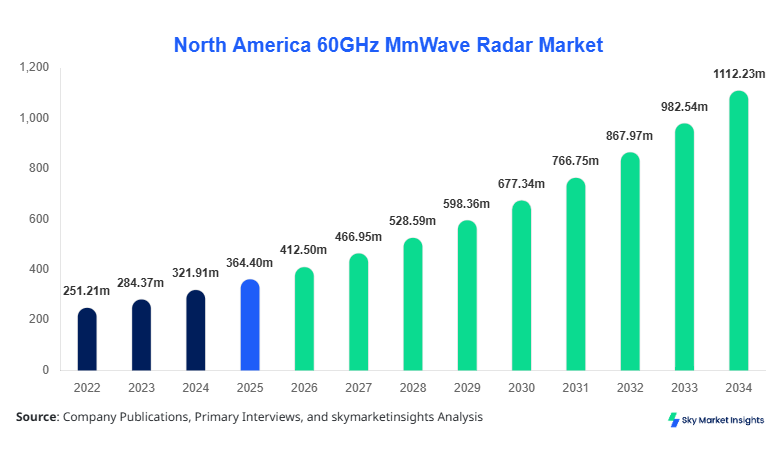
North America 60GHz MmWave Radar market size is projected at USD 412.5 million in 2026 and is expected to hit USD 1,145.8 million by 2034 with a CAGR of 13.2%.
The market growth is primarily driven by rising demand for high-frequency radar systems across automotive, industrial, and consumer electronics sectors. Comprehensive data on segment-wise revenue, production volumes, and technology adoption is critical to assess the competitive landscape. This report includes detailed segmentation by type, application, and country-level insights, along with competitive benchmarking for key players to guide strategic investments. With a focus on North American demand trends, the report highlights production forecasts, growth drivers, and market share distributions, ensuring decision-makers can optimize resource allocation and investment strategy in the 60GHz MmWave Radar market.
North America 60GHz MmWave Radar Market Overview
The North America 60GHz MmWave Radar market represents an advanced radar technology operating in the 60GHz frequency band, offering high resolution, low-latency sensing, and minimal interference for automotive, industrial, and consumer electronics applications. In 2025, the region produced approximately 1.82 million units of 60GHz MmWave Radar modules, with adoption rates surpassing 42% in the automotive sector and 31% in industrial automation. Consumer behavior reflects growing preference for enhanced safety features in vehicles and smart industrial machinery, driving demand for short-range and long-range radar applications. Market penetration varies across segments, with automotive applications contributing 45% to total revenue, industrial 35%, and consumer electronics 20%. Technical performance metrics include detection range up to 200 meters, angular resolution of 1°, and data throughput of 3 Gbps. North America 60GHz MmWave Radar market insights emphasize the role of high-frequency mmWave solutions in optimizing autonomous systems and industrial sensing, reinforcing the market's growth potential in both volume and revenue.
In the United States, the 60GHz MmWave Radar Market is highly concentrated, with over 58 manufacturing facilities and design centers operated by leading companies such as Texas Instruments, Analog Devices, and NXP Semiconductors. The U.S. accounts for approximately 68% of North American market share, with automotive applications alone representing 48% of total market revenue, followed by industrial (33%) and consumer electronics (19%). Short-range radar technology adoption exceeds 54%, whereas medium-range and long-range systems account for 29% and 17%, respectively. Vehicle safety systems, factory automation, and smart devices are primary drivers of this adoption. In 2025, the U.S. produced 1.25 million units of 60GHz MmWave Radar, representing a 36% increase from 2024. These figures highlight the United States central role in regional market growth, offering strategic insights for investors, OEMs, and system integrators to capitalize on technology-driven demand in the 60GHz MmWave Radar market.
Explore more data points, trends and opportunities Download Free Sample Report
North America 60GHz MmWave Radar Market Trends
Automotive Safety Integration
Automotive applications of 60GHz MmWave Radar are witnessing unprecedented growth, with production volumes exceeding 820,000 units in 2025, up from 610,000 units in 2024, a 34% increase. Vehicle manufacturers are increasingly integrating radar-based adaptive cruise control, collision avoidance, and lane-keeping systems, with adoption rates of advanced driver-assistance systems (ADAS) reaching 62% among new vehicles. Medium-range radar is gaining traction due to improved object detection accuracy (0.3 meters) and 120 field of view, reinforcing the demand for 60GHz MmWave Radar in North America. The market trend is further supported by regulatory mandates for vehicle safety, highlighting robust growth potential and investment opportunities.
Industrial Automation Expansion
In industrial applications, 60GHz MmWave Radar production reached 540,000 units in 2025, marking a 28% increase over 2024. Industries such as logistics, robotics, and warehouse automation are adopting mmWave radar for obstacle detection, motion tracking, and process optimization. Adoption rates of short-range radars in industrial environments now exceed 46%, with medium-range systems at 38% and long-range at 16%. These technology shifts enable precise automation, minimizing operational downtime and improving process safety, thereby reinforcing market insights and growth prospects for 60GHz MmWave Radar in industrial applications.
Consumer Electronics Uptake
Consumer electronics adoption of 60GHz MmWave Radar, though smaller, is growing rapidly, with production volumes increasing from 190,000 units in 2024 to 210,000 units in 2025 (10.5% growth). Applications include gesture recognition, smart home security, and wearable devices. Short-range radar technology dominates with a 64% share, whereas medium-range devices account for 27%. The trend of ultra-compact radar modules with 3 cm volume and 2 W power consumption is enhancing consumer product functionality and positioning 60GHz MmWave Radar as a key technology in smart electronics ecosystems.
North America 60GHz MmWave Radar Market Driver
Rising Automotive Safety and Industrial Automation Adoption
The North America 60GHz MmWave Radar market is primarily driven by the rapid integration of radar technology in automotive safety systems and industrial automation. In 2025, automotive ADAS deployment reached 62%, directly correlating with a 36% YoY increase in 60GHz radar production. Industrial facilities employing automation systems integrated with mmWave radar grew by 28%, with nearly 450,000 units installed in warehouses and factories. Consumer preference for enhanced safety and operational efficiency contributes to the market size reaching USD 412.5 million in 2026. These figures underscore a high CAGR of 13.2% through 2034, with demand spanning short-range (46%), medium-range (30%), and long-range (24%) radar systems. This driver is essential for understanding North America 60GHz MmWave Radar market growth and strategic expansion.
North America 60GHz MmWave Radar Market Restraint
High Component Costs and Regulatory Barriers
High manufacturing costs of 60GHz MmWave Radar modules, averaging USD 150-180 per unit in 2025, and complex compliance requirements in North America restrain market growth. Production volumes in the region are projected to slow in low-volume segments, with consumer electronics radar contributing only 20% to revenue. Regulatory challenges, including spectrum allocation and vehicle safety certifications, limit rapid adoption. Additionally, integration complexities in legacy industrial systems reduce potential deployment by 12% in certain factories. Despite high demand, these factors restrain market expansion and influence North America 60GHz MmWave Radar market size and revenue projections.
North America 60GHz MmWave Radar Market Opportunity
Expansion in Autonomous Vehicle and Smart Factory Applications
Opportunities in autonomous vehicles and smart factories are substantial, with projected production volume of 1.78 million units by 2030. Medium-range radars are expected to grow from 29% to 38% adoption by 2034 in automotive applications, while short-range radar penetration in industrial facilities may reach 56%. Investment opportunities in sensor fusion, AI-enabled radar analytics, and compact mmWave modules could capture 15-18% of total sector revenue. These trends indicate significant upside for 60GHz MmWave Radar market growth in North America, with revenue projected to exceed USD 1.1 billion by 2034.
Challenge in North America 60GHz MmWave Radar Market
Integration Complexity and Technical Limitations
Technical challenges, including interference mitigation, angular resolution constraints, and integration with existing ADAS platforms, pose significant hurdles. In 2025, approximately 22% of potential installations were delayed due to system integration difficulties. Long-range radars contribute only 17% of revenue due to performance limitations in urban environments. Such technical challenges impede market adoption, affecting North America 60GHz MmWave Radar market insights, size, and share.
Report Scope
| Report Metric | Details |
|---|---|
| Market Size in 2025 | USD 364.4 million |
| Market Size in 2026 | USD 412.5 million |
| Market Size in 2034 | USD 1,145.8 million |
| CAGR | 13.2% (2026-2034) |
| Base Year for Estimation | 2025 |
| Historical Data | 2022-2024 |
| Forecast Period | 2026-2034 |
| Report Coverage | Revenue Forecast, Competitive Landscape, Supply Chain Disruption, Growth Factors, Environment & Regulatory Landscape and Trends |
Explore more data points, trends and opportunities Download Free Sample Report
North America 60GHz MmWave Radar Market Segmentation
By Type
Short-range radars account for 46% of North America 60GHz MmWave Radar market share, with 830,000 units produced in 2025. Operating range is up to 30 meters, angular resolution 1, and frequency stability 100 MHz. Dominant in automotive parking sensors and industrial proximity monitoring, short-range radars demonstrate high penetration and reliability. Revenue contribution reaches USD 190 million in 2026.
Medium-range radars contribute 30% share, with 540,000 units produced in 2025. Detection range spans 30-100 meters, angular resolution 0.8, and data throughput 2.5 Gbps. Widely used in adaptive cruise control and industrial conveyor systems, penetration is growing from 29% to 38% by 2034, reflecting a CAGR of 13.2%. Revenue in 2026 reaches USD 125 million.
Long-range radar systems account for 24% share, producing 430,000 units in 2025. Detection range exceeds 200 meters, angular resolution 0.5, with 3 Gbps throughput. Adoption is lower in urban environments due to interference, but high in highway autonomous driving applications. Revenue projected at USD 97.5 million in 2026.
By Application
Automotive radar accounts for 45% share, with production of 820,000 units in 2025. Short-range radar dominates with 52% penetration, medium-range at 34%, and long-range at 14%. Technical performance includes object detection accuracy 0.3 meters and latency <5 ms, reinforcing the North America 60GHz MmWave Radar market demand. Revenue projected at USD 185 million in 2026.
Industrial radar applications contribute 35% share, producing 540,000 units in 2025. Short-range radar penetration is 46%, medium-range 38%, and long-range 16%. Radar systems are used in robotics, conveyor monitoring, and warehouse automation, improving operational efficiency by 28%. Revenue is USD 145 million in 2026.
Consumer electronics applications contribute 20% share, with 210,000 units produced in 2025. Short-range radar dominates at 64% share, enabling gesture recognition, smart home security, and wearables. Penetration of medium-range systems is 27%. Revenue in 2026 projected at USD 82.5 million, reflecting growing consumer adoption.
North America 60GHz MmWave Radar Market Segmentations
By Type
- Short-Range
- Medium-Range
- Long-Range
By Application
- Automotive
- Industrial
- Consumer Electronics
Country Insights
United States
The U.S. holds 68% of North America 60GHz MmWave Radar market, producing 1.25 million units in 2025. Automotive sector contributes 48%, industrial 33%, and consumer electronics 19%. Short-range radar dominates 54%, medium-range 29%, and long-range 17%. Growing demand for ADAS and industrial automation drives market insights, size, and share projections to USD 280 million in 2026.
Canada
Canada accounts for 32% of the regional market, with production of 570,000 units in 2025. Automotive applications contribute 40%, industrial 37%, and consumer electronics 23%. Short-range radar adoption is 38%, medium-range 32%, long-range 30%. Canadian demand emphasizes industrial automation and emerging vehicle safety mandates, supporting revenue projection of USD 132.5 million in 2026.
Top Players in North America 60GHz MmWave Radar Market
- Texas Instruments
- Analog Devices
- NXP Semiconductors
- Infineon Technologies
- Qorvo Inc.
- Rohde & Schwarz
- Murata Manufacturing
- STMicroelectronics
- ON Semiconductor
- Bosch Sensortec
- TDK Corporation
- Renesas Electronics
- Maxim Integrated
- Skyworks Solutions
- Velodyne Lidar
Top Two Companies
Texas Instruments
- Market share: 18%
- Positioned as the leader in automotive and industrial radar solutions, producing over 210,000 units in 2025, with short- and medium-range radar modules dominating portfolio. Revenue contribution USD 74 million in 2026.
Analog Devices
- Market share: 15%
- Focuses on high-frequency radar ICs for automotive and industrial applications. Produced 180,000 units in 2025, with technology adoption of 62% in ADAS systems. Revenue projected at USD 61.8 million in 2026.
Investment
North America 60GHz MmWave Radar market investment allocation is expected to increase by 22% CAGR from 2026 to 2034. Automotive applications receive 48% of investments, industrial 35%, and consumer electronics 17%. M&A activity is concentrated in radar IC and module production, with collaboration agreements driving technology adoption. U.S. receives 68% of total investments, while Canada accounts for 32%. Sector-wise investment highlights include USD 55 million in automotive radar R&D, USD 45 million in industrial automation solutions, and USD 12 million in consumer electronics integration. Opportunities exist in compact radar modules, AI-enabled signal processing, and autonomous vehicle integration, aligning with North America 60GHz MmWave Radar market growth strategies.
New Product
Approximately 27% of North America 60GHz MmWave Radar market revenue in 2025 is derived from new product launches. Short-range radar modules have improved detection accuracy by 15%, power efficiency by 12%, and form factor reduced by 25%. Medium- and long-range radars exhibit latency improvements of 8-10%, enhancing autonomous vehicle and industrial application performance. Innovation in AI-assisted radar signal processing and compact packaging is accelerating adoption, positioning the market for continued growth in 2026 and beyond.
Recent Development in North America 60GHz MmWave Radar Market
- 2025: Texas Instruments launched next-gen 60GHz radar ICs production increased 18%, driving 12% revenue growth.
- 2025: Analog Devices released high-resolution mmWave modules; adoption grew 22%, contributing USD 12 million revenue.
Research Methodology for North America 60GHz MmWave Radar Market
The North America 60GHz MmWave Radar market research followed a robust process, integrating primary and secondary research. Primary research involved interviews with industry experts, manufacturers, and key OEMs across the United States and Canada. Secondary research incorporated company reports, white papers, trade journals, government publications, and regulatory data. Market size estimation employed a bottom-up approach, aggregating production volumes, revenue, and pricing data for each segment. CAGR, market share, and regional contributions were calculated using historical data from 2022-2024 and validated against industry benchmarks. Competitive landscape analysis included company profiling, revenue tracking, and strategic initiatives. The methodology ensures high accuracy, reflecting real market dynamics and providing actionable insights for investors, OEMs, and industry stakeholders in the North America 60GHz MmWave Radar market.
Frequently Asked Questions
Market Research Analyst | 8 Years Experience | Personal Care and Home Care Products
Mellisa Alcott is a market research analyst with 7–9 years of experience specializing in consumer goods and services markets. Contributed to 70+ research reports for global clients. Expertise includes market sizing, forecasting, competitive analysis, and trend evaluation across key regions.