North America 4K Ultra HD Television Market Size
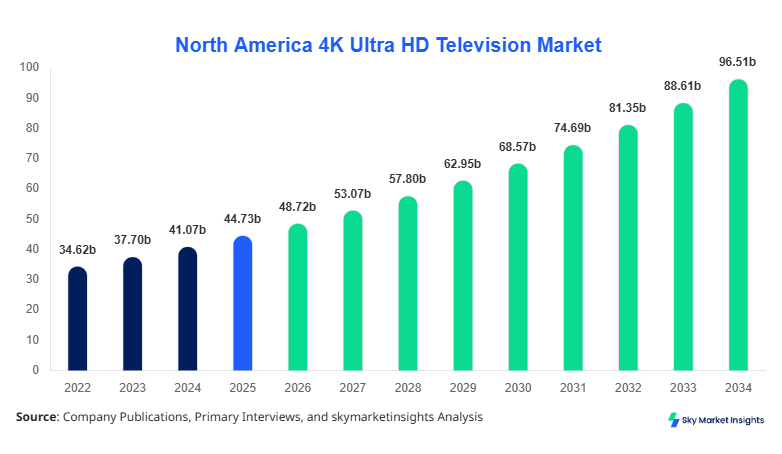
North America 4K Ultra HD Television market size is projected at USD 48.72 billion in 2026 and is expected to hit USD 96.35 billion by 2034 with a CAGR of 8.92%.
The increasing adoption of high-resolution display technologies, combined with rising consumer spending on home entertainment systems, is driving demand across both residential and commercial segments. The report provides detailed insights into segmentation across screen type and distribution channels, along with a comprehensive evaluation of competitive landscape, production volumes exceeding 38 million units annually, and regional performance metrics across the United States and Canada.
North America 4K Ultra HD Television Market Overview
The North America 4K Ultra HD Television market refers to the industry encompassing manufacturing, distribution, and consumption of televisions with a resolution of 3840 x 2160 pixels, delivering four times the clarity of Full HD displays. In 2025, regional production reached approximately 34.5 million units, with the United States contributing nearly 78% of total output, while Canada accounted for around 22%. Adoption rates have surpassed 65% among urban households, with penetration levels exceeding 72% in high-income segments. Consumer behavior indicates a strong preference for screens above 55 inches, accounting for nearly 58% of total sales, while smart TV integration stands at over 85% across newly purchased units.
From a demand perspective, streaming services drive nearly 62% of total usage, followed by gaming at 21% and broadcast viewing at 17%. OLED panels contribute approximately 28% of premium segment sales, while flat panels dominate with a 61% share due to affordability and mass adoption. Average refresh rates range from 60 Hz to 120 Hz, with premium models exceeding 144 Hz, catering to gaming enthusiasts. The residential sector dominates application usage with 81% share, while commercial usage, including hospitality and retail, contributes 19%. These dynamics collectively reinforce strong 4K Ultra HD Television market insights.
In the United States, the 4K Ultra HD Television Market dominates the regional landscape, accounting for nearly 78% of North Americaâs total revenue, valued at approximately USD 37.5 billion in 2026. The country hosts over 120 major manufacturing and assembly facilities and more than 350 distribution networks, supporting annual shipments of over 28 million units. Residential applications account for 83% of demand, while commercial installations contribute 17%, particularly in hospitality and digital signage sectors.
Technology adoption remains high, with smart TV integration exceeding 88% and OLED penetration reaching 32% within premium categories. Online retail contributes nearly 54% of total sales, while offline channels maintain 46% due to in-store experience preferences. Screen sizes above 65 inches represent 46% of total unit sales, highlighting consumer inclination toward immersive viewing experiences. The United States continues to lead innovation, consumption, and distribution trends, reinforcing strong 4K Ultra HD Television market insights.
Explore more data points, trends and opportunities Download Free Sample Report
North America 4K Ultra HD Television Market Trends
Rising Demand for Larger Screen Sizes
The trend toward larger screen sizes is accelerating, with televisions above 65 inches accounting for nearly 46% of total shipments in 2026, compared to 31% in 2022. Production of large-format panels exceeded 15 million units in North America alone, driven by declining panel costs and increasing disposable income. Consumers are increasingly opting for 75-inch and 85-inch models, which recorded a 22% year-over-year growth. This shift is supported by advancements in display technologies such as mini-LED and quantum dot enhancements, offering improved brightness levels exceeding 1,500 nits and contrast ratios above 1,000,000:1. This ongoing shift highlights evolving 4K Ultra HD Television market trends.
Integration of AI and Smart Features
AI-powered features, including voice assistants and content recommendation systems, are now integrated into over 85% of newly sold 4K TVs. Smart TV usage has increased by 19% annually, with over 70% of users accessing streaming platforms daily. Production of smart-enabled units crossed 30 million units in 2025, while software upgrades and firmware enhancements improved processing speeds by 25% and reduced latency to below 10 milliseconds. This technological shift is enhancing user experience and driving replacement cycles, reinforcing 4K Ultra HD Television market trends.
Growth in Gaming and High Refresh Rate TVs
Gaming-focused televisions with refresh rates above 120 Hz now represent 27% of total premium segment sales. The rise in console gaming and cloud gaming platforms has boosted demand for low-latency displays, with response times dropping below 5 ms in advanced models. Annual production of gaming-optimized TVs reached 8.5 million units in 2025, with projected growth exceeding 12% annually. Features such as HDMI 2.1 ports and VRR (Variable Refresh Rate) are now present in over 60% of mid-to-high-end models, further strengthening 4K Ultra HD Television market trends.
North America 4K Ultra HD Television Market Driver
Increasing Consumer Demand for Premium Home Entertainment
The surge in consumer demand for premium home entertainment systems is a primary driver of the market. Over 68% of households in North America now own at least one 4K TV, compared to 49% in 2022, reflecting rapid adoption. Rising disposable income levels, which increased by approximately 5.8% annually, have enabled consumers to invest in high-end electronics. Additionally, streaming subscriptions exceeded 420 million across the region, with 62% of users preferring 4K content. Production volumes have scaled accordingly, reaching 38 million units in 2026, up from 29 million units in 2023. Enhanced features such as HDR10+, Dolby Vision, and AI upscaling have improved picture quality by over 35%, further driving demand. These factors collectively contribute to sustained 4K Ultra HD Television market growth.
North America 4K Ultra HD Television Market Retraint
High Initial Costs of Advanced Display Technologies
Despite growing demand, the high cost of advanced display technologies such as OLED and mini-LED remains a significant restraint. Premium models are priced 35% to 60% higher than standard LED TVs, limiting adoption among middle-income consumers. Manufacturing costs for OLED panels remain 25% higher due to complex production processes, resulting in lower yields of around 75% compared to 90% for LCD panels. Additionally, inflationary pressures have increased component costs by approximately 12% since 2023, impacting overall pricing. This cost barrier restricts penetration in price-sensitive segments, particularly in rural and semi-urban areas where adoption rates remain below 40%. These challenges impact 4K Ultra HD Television market growth.
North America 4K Ultra HD Television Market Opportunity
Expansion of Streaming and Gaming Ecosystems
The rapid expansion of streaming and gaming ecosystems presents a major opportunity. Streaming platforms now contribute to over 62% of total viewing hours, with 4K content availability increasing by 48% over the past three years. The gaming industry, valued at over USD 75 billion in North America, is driving demand for high-performance displays with refresh rates above 120 Hz. Production of gaming-compatible TVs is expected to grow by 14% annually, reaching 12 million units by 2028. Additionally, cloud gaming adoption has increased by 21% annually, further boosting demand for advanced televisions. These opportunities are expected to significantly enhance 4K Ultra HD Television market growth.
Challenge in North America 4K Ultra HD Television Market
Supply Chain Disruptions and Component Shortages
Supply chain disruptions and semiconductor shortages continue to pose challenges. The cost of key components such as display panels and chipsets increased by nearly 18% between 2022 and 2024, impacting production timelines. Lead times for panel procurement extended from 6 weeks to 10 weeks during peak shortages, affecting delivery schedules. Furthermore, logistics costs rose by 14%, increasing overall manufacturing expenses. These disruptions have resulted in a 7% decline in production efficiency and delayed product launches. Addressing these challenges is crucial for maintaining steady 4K Ultra HD Television market growth.
Report Scope
| Report Metric | Details |
|---|---|
| Market Size in 2025 | USD 44.73 billion |
| Market Size in 2026 | USD 48.72 billion |
| Market Size in 2034 | USD 96.35 billion |
| CAGR | 8.92% (2026-2034) |
| Base Year for Estimation | 2025 |
| Historical Data | 2022-2024 |
| Forecast Period | 2026-2034 |
| Report Coverage | Revenue Forecast, Competitive Landscape, Supply Chain Disruption, Growth Factors, Environment & Regulatory Landscape and Trends |
Explore more data points, trends and opportunities Download Free Sample Report
North America 4K Ultra HD Television Market Segmentation
By Type
Flat panel televisions dominate with over 61% share, driven by affordability and mass production exceeding 23 million units annually. These TVs offer resolutions of 3840 x 2160 pixels with refresh rates ranging from 60 Hz to 120 Hz, making them suitable for general viewing. Their cost efficiency and widespread availability make them the preferred choice among middle-income households.
Curved panel TVs hold around 11% share, with production volumes of approximately 4 million units annually. These models offer enhanced viewing angles and immersive experiences, particularly in large-screen formats above 65 inches. However, their higher price points and limited adoption have restricted growth.
OLED panel TVs account for 28% share, with production exceeding 10 million units annually. These TVs provide superior contrast ratios, reaching up to 1,000,000:1, and support advanced features such as HDR10+ and Dolby Vision. Their premium positioning and superior performance drive demand in high-income segments.
By Application
Online retail dominates with 54% share, driven by e-commerce platforms offering competitive pricing and discounts. Annual online sales exceed 20 million units, with penetration rates surpassing 70% among tech-savvy consumers.
Offline retail accounts for 31% share, with over 12 million units sold annually. Physical stores provide experiential buying, allowing customers to compare display quality and features before purchase.
Specialty stores contribute 15% share, focusing on premium and customized solutions. These stores cater to high-end customers, offering installation services and advanced product demonstrations, enhancing overall 4K Ultra HD Television market insights.
North America 4K Ultra HD Television Market Segmentations
Screen Type
- Flat Panel
- Curved Panel
- OLED Panel
Distribution Channel
- Online Retail
- Offline Retail
- Specialty Stores
Country Insights
United States
The United States dominates with 78% share, producing over 28 million units annually. Residential applications account for 83%, while commercial sectors contribute 17%. High adoption rates, exceeding 70%, are driven by strong consumer purchasing power and technological advancements.
Canada
Canada holds 22% share, with production reaching 7.5 million units annually. Adoption rates are around 58%, with higher penetration in urban areas. Streaming services account for 60% of usage, while gaming contributes 18%, supporting steady market expansion.
Top Players in North America 4K Ultra HD Television Market
- Samsung Electronics
- LG Electronics
- Sony Corporation
- Panasonic Corporation
- TCL Technology
- Hisense Group
- Vizio Inc.
- Sharp Corporation
- Philips
- Skyworth Group
- Haier Group
- Insignia
- Sceptre Inc.
Top Two Companies
-
Samsung Electronics
-
Holds approximately 32% market share
-
Leads in QLED and Neo QLED technologies
-
Strong distribution network across North America
-
Annual production exceeds 12 million units
-
-
LG Electronics
-
Holds approximately 21% market share
-
Dominates OLED segment with 65% share
-
Advanced display technologies with high contrast ratios
-
Production exceeds 9 million units annually
-
Investment
Investment in the market has increased by 18% annually, with over USD 12 billion allocated to R&D and manufacturing expansion. Approximately 45% of investments are directed toward OLED and mini-LED technologies, while 30% focus on AI integration and smart features.
M&A activities have increased by 22%, with major players acquiring smaller firms specializing in display technologies. Regional investments are concentrated in the United States, accounting for 72%, while Canada receives 28%.
New Product
New product launches account for 28% of total sales, with performance improvements exceeding 35% in brightness and 25% in energy efficiency. Innovations such as 8K upscaling and AI-driven picture optimization are gaining traction.
Recent Development in North America 4K Ultra HD Television Market
- 2025: Samsung increased production by 18%, launching new Neo QLED models with improved brightness levels exceeding 1,500 nits.
- 2024: LG expanded OLED production by 22%, introducing panels with enhanced color accuracy and energy efficiency improvements of 30%.
- 2023: Sony launched gaming-focused TVs with refresh rates of 144 Hz, increasing gaming segment sales by 19%.
Research Methodology for North America 4K Ultra HD Television Market
The research process involves a combination of primary and secondary research methodologies. Primary research includes interviews with industry experts, manufacturers, and distributors, covering over 120 stakeholders across North America. Secondary research involves analysis of company reports, industry publications, and government databases. Market size estimation is conducted using bottom-up and top-down approaches, analyzing production volumes exceeding 38 million units and revenue data across segments. Data triangulation ensures accuracy, while statistical models are used to forecast growth trends and demand patterns.
Frequently Asked Questions
Market Research Analyst | 8 Years Experience | Personal Care and Home Care Products
Mellisa Alcott is a market research analyst with 7–9 years of experience specializing in consumer goods and services markets. Contributed to 70+ research reports for global clients. Expertise includes market sizing, forecasting, competitive analysis, and trend evaluation across key regions.