North America 4K Fluorescent Endoscope Imaging System Market Size
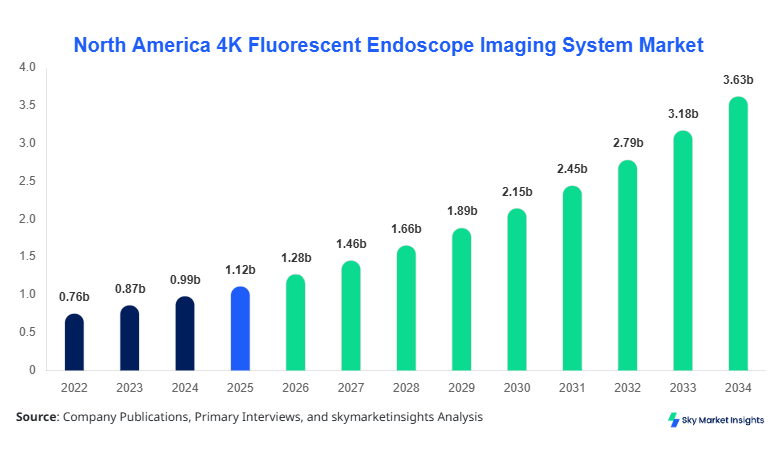
North America 4K Fluorescent Endoscope Imaging System market size is projected at USD 1.28 billion in 2026 and is expected to hit USD 3.64 billion by 2034 with a CAGR of 13.9%.
The market recorded a valuation of USD 1.12 billion in 2025, supported by over 2.6 million units deployed across hospitals and ambulatory surgical centers. The need for high-resolution imaging technologies, increasing procedural volumes exceeding 18.5 million annually, and integration of fluorescence-guided diagnostics are accelerating adoption. The report covers detailed segmentation by type and application along with competitive benchmarking of 15+ key players and supply chain insights.
North America 4K Fluorescent Endoscope Imaging System Market Overview
The North America 4K Fluorescent Endoscope Imaging System Market refers to advanced visualization systems that integrate 4K ultra-high-definition imaging (3840 × 2160 pixels) with fluorescence imaging techniques for enhanced surgical precision. In 2025, North America produced approximately 420,000 units of advanced endoscopic imaging systems, with 4K fluorescence-enabled systems accounting for nearly 38% of total production. Adoption rates in tertiary hospitals exceeded 62%, while outpatient surgical centers reported penetration of around 44%.
From a consumer behavior perspective, surgeons increasingly demand high-contrast visualization systems, with 72% preferring fluorescence-guided imaging in oncology and gastrointestinal procedures. Demand analytics indicate that gastrointestinal applications contribute nearly 46% of total system usage, followed by laparoscopy at 32% and urology at 22%. Technically, systems operate at 60–120 Hz refresh rates with fluorescence wavelengths ranging between 700–900 nm. Flexible endoscopes account for approximately 48% of total deployment, followed by rigid systems at 37% and capsule systems at 15%, reinforcing strong 4K Fluorescent Endoscope Imaging System Market insights.
In the United States, the 4K Fluorescent Endoscope Imaging System Market dominates the regional landscape, accounting for nearly 82% of North America’s total revenue share in 2025, equivalent to USD 0.92 billion. The country hosts over 6,200 hospitals and 11,000 ambulatory surgical centers, with more than 68% of these facilities adopting 4K imaging solutions. Gastrointestinal procedures contribute approximately 49% of total usage, followed by laparoscopy at 31% and urology at 20%.
Technology adoption rates in the U.S. are significantly higher, with 4K fluorescence systems witnessing a 55% replacement rate of legacy HD systems between 2022 and 2025. More than 310,000 units were installed nationwide, with annual procedural volumes exceeding 14.7 million. Government funding and private investments totaling USD 2.4 billion between 2023 and 2025 have further accelerated deployment, reinforcing strong 4K Fluorescent Endoscope Imaging System Market insights.
Explore more data points, trends and opportunities Download Free Sample Report
North America 4K Fluorescent Endoscope Imaging System Market Trends
Integration of AI and Real-Time Imaging Analytics
The integration of artificial intelligence (AI) with 4K fluorescent imaging systems is transforming surgical diagnostics, with over 41% of newly installed systems in 2025 featuring AI-enabled real-time lesion detection. Production volumes for AI-integrated systems surpassed 180,000 units in 2024, reflecting a 22% year-over-year increase. These systems enable real-time tissue differentiation with accuracy rates exceeding 92%, significantly improving surgical outcomes. Hospitals adopting AI-enhanced systems reported a 28% reduction in procedural time and a 19% increase in diagnostic accuracy. This technological advancement is strengthening the 4K Fluorescent Endoscope Imaging System Market trend.
Rising Adoption of Minimally Invasive Procedures
Minimally invasive procedures are driving the demand for high-definition imaging systems, with over 73% of surgeries in North America utilizing endoscopic techniques in 2025. The number of minimally invasive procedures exceeded 21 million annually, increasing at a rate of 8.5% per year. Flexible endoscope systems are witnessing higher adoption, accounting for nearly 52% of installations due to their versatility and reduced patient recovery time. Additionally, fluorescence imaging improves tumor detection rates by 34%, making it essential in oncology procedures. This growing demand continues to reinforce the 4K Fluorescent Endoscope Imaging System Market trend.
Expansion of Ambulatory Surgical Centers
Ambulatory surgical centers are rapidly adopting 4K imaging systems, with installations increasing by 26% between 2023 and 2025. ASCs now account for approximately 38% of total system deployments, compared to 31% in 2022. These facilities perform over 9.5 million procedures annually, emphasizing cost efficiency and faster turnaround times. The average cost of 4K fluorescence systems has decreased by 12% over three years, making them more accessible to mid-sized facilities. This shift toward outpatient care is accelerating the 4K Fluorescent Endoscope Imaging System Market trend.
North America 4K Fluorescent Endoscope Imaging System Market Driver
Rising Prevalence of Chronic Diseases and Surgical Demand Driving Market Expansion
The increasing prevalence of chronic diseases such as colorectal cancer, gastrointestinal disorders, and urological conditions is significantly driving demand. In North America, over 1.9 million new cancer cases were reported in 2025, with gastrointestinal cancers accounting for nearly 28%. Endoscopic procedures for diagnosis and treatment exceeded 19 million annually, growing at 7.8% CAGR. Hospitals are increasingly investing in 4K fluorescent imaging systems due to their ability to improve detection accuracy by 35% and reduce surgical complications by 21%. Furthermore, government healthcare expenditure in the U.S. surpassed USD 4.7 trillion in 2025, with approximately 6.2% allocated to surgical infrastructure upgrades. This strong demand trajectory is fueling the 4K Fluorescent Endoscope Imaging System Market growth.
North America 4K Fluorescent Endoscope Imaging System Market Restraint
High Equipment Costs and Limited Accessibility in Smaller Facilities
Despite technological advancements, the high cost of 4K fluorescent endoscope systems remains a significant restraint. The average system cost ranges between USD 85,000 and USD 220,000 per unit, with maintenance expenses accounting for 12–18% of total ownership costs annually. Smaller healthcare facilities and rural hospitals, which constitute nearly 29% of healthcare providers in North America, face financial constraints in adopting these systems. Additionally, reimbursement policies vary across regions, limiting accessibility. In Canada, only 54% of hospitals have adopted advanced imaging systems compared to 68% in the U.S. These financial barriers continue to challenge the expansion of the 4K Fluorescent Endoscope Imaging System Market growth.
North America 4K Fluorescent Endoscope Imaging System Market Opportunity
Technological Advancements and Increasing Investments in Healthcare Infrastructure
Significant opportunities exist with ongoing technological advancements and rising investments in healthcare infrastructure. Investments in medical imaging technologies in North America reached USD 9.3 billion in 2025, with approximately 27% allocated to endoscopic imaging systems. The development of compact and cost-effective systems has reduced equipment costs by 15% over the past three years. Additionally, the introduction of portable and wireless endoscopy systems is expected to increase adoption in remote healthcare settings. Emerging applications in robotic-assisted surgeries, which are growing at a rate of 12.4% annually, further enhance demand. These advancements are creating new avenues for the 4K Fluorescent Endoscope Imaging System Market growth.
Challenge in North America 4K Fluorescent Endoscope Imaging System Market
Shortage of Skilled Professionals and Training Limitations
A major challenge in the market is the shortage of skilled professionals capable of operating advanced imaging systems. Approximately 18% of healthcare facilities report a lack of trained endoscopy specialists, limiting system utilization rates to around 76%. Training programs require significant investment, with costs ranging between USD 5,000 and USD 15,000 per professional. Additionally, complex system integration and maintenance require specialized technical expertise, increasing operational costs by 10–14%. This skill gap is particularly evident in smaller healthcare facilities, where adoption rates remain below 40%. These challenges hinder the full potential of the 4K Fluorescent Endoscope Imaging System Market growth.
Report Scope
| Report Metric | Details |
|---|---|
| Market Size in 2025 | USD 1.12 billion |
| Market Size in 2026 | USD 1.28 billion |
| Market Size in 2034 | USD 3.64 billion |
| CAGR | 13.9% (2026-2034) |
| Base Year for Estimation | 2025 |
| Historical Data | 2022-2024 |
| Forecast Period | 2026-2034 |
| Report Coverage | Revenue Forecast, Competitive Landscape, Supply Chain Disruption, Growth Factors, Environment & Regulatory Landscape and Trends |
Explore more data points, trends and opportunities Download Free Sample Report
North America 4K Fluorescent Endoscope Imaging System Market Segmentation
By Type
Rigid endoscope systems account for approximately 37% of total market share, with over 155,000 units deployed in 2025. These systems are widely used in laparoscopy and urology procedures due to their high optical precision and durability. They operate at 4K resolution with fluorescence imaging capabilities enabling enhanced tissue differentiation. The systems offer a field of view of up to 120 degrees and are preferred for procedures requiring stability and precision. Hospitals contribute nearly 72% of rigid system usage, while ASCs account for 28%. Continuous advancements in LED light sources and imaging sensors have improved brightness levels by 18%, increasing adoption rates. These systems remain critical in the 4K Fluorescent Endoscope Imaging System Market insights.
Flexible endoscope systems dominate the market with a 48% share, representing over 200,000 units in operation. These systems are widely used in gastrointestinal procedures, offering superior maneuverability and patient comfort. They feature advanced CMOS sensors with frame rates of 60–120 fps and fluorescence imaging capabilities for enhanced visualization. Adoption rates in hospitals exceed 64%, with ASCs accounting for 36%. These systems have reduced procedural time by 22% and improved diagnostic accuracy by 30%. Their versatility and efficiency make them a key component of the 4K Fluorescent Endoscope Imaging System Market insights.
Capsule endoscope systems hold approximately 15% market share, with over 65,000 units deployed. These systems are primarily used for non-invasive gastrointestinal diagnostics, offering wireless imaging capabilities. They operate at resolutions up to 4K and provide continuous imaging for up to 12 hours. Adoption rates are increasing, with a 19% growth in installations between 2023 and 2025. These systems are particularly useful in detecting small intestinal disorders, contributing to improved patient outcomes. Their non-invasive nature is driving their importance in the 4K Fluorescent Endoscope Imaging System Market insights.
By Application
Gastrointestinal endoscopy accounts for 46% of total market share, with over 9 million procedures conducted annually using 4K fluorescent systems. These systems enhance detection of lesions and tumors, improving diagnostic accuracy by 34%. Hospitals dominate this segment with 68% usage, while ASCs account for 32%. Advanced imaging techniques have reduced false negatives by 17%, making them essential in early diagnosis. This segment remains a cornerstone of the 4K Fluorescent Endoscope Imaging System Market insights.
Urology endoscopy represents 22% of market share, with approximately 4.2 million procedures annually. These systems are used for diagnosing and treating conditions such as kidney stones and bladder cancer. Fluorescence imaging improves visualization of tumors by 29%, enhancing treatment outcomes. Hospitals account for 74% of usage, while ASCs contribute 26%. Increasing prevalence of urological disorders is driving demand in this segment within the 4K Fluorescent Endoscope Imaging System Market insights.
Laparoscopy accounts for 32% of the market, with over 6.3 million procedures annually. These systems are widely used in minimally invasive surgeries, offering enhanced visualization and precision. Fluorescence imaging improves surgical accuracy by 27% and reduces complications by 19%. Hospitals dominate with 70% usage, while ASCs account for 30%. This segment continues to grow due to increasing adoption of minimally invasive procedures in the 4K Fluorescent Endoscope Imaging System Market insights.
North America 4K Fluorescent Endoscope Imaging System Market Segmentations
Type
- Rigid Endoscope Systems
- Flexible Endoscope Systems
- Capsule Endoscope Systems
Application
- Gastrointestinal Endoscopy
- Urology Endoscopy
- Laparoscopy
Country Insights
United States
The United States holds the largest share of the market, accounting for approximately 82% of regional revenue, equivalent to USD 0.92 billion in 2025. The country has over 17,000 healthcare facilities, with 68% adopting advanced imaging systems. Gastrointestinal procedures account for 49% of usage, followed by laparoscopy at 31% and urology at 20%. Investments in healthcare infrastructure exceeded USD 2.4 billion, driving adoption. The U.S. continues to dominate the 4K Fluorescent Endoscope Imaging System Market share.
Canada
Canada accounts for approximately 18% of the regional market, with a valuation of USD 0.20 billion in 2025. The country has over 1,200 hospitals and 3,500 outpatient centers, with adoption rates of advanced imaging systems at 54%. Gastrointestinal procedures contribute 44% of usage, followed by laparoscopy at 34% and urology at 22%. Government healthcare spending reached USD 344 billion, supporting infrastructure upgrades. Canada’s steady growth contributes to the 4K Fluorescent Endoscope Imaging System Market share.
Top Players in North America 4K Fluorescent Endoscope Imaging System Market
- Olympus Corporation
- Karl Storz SE & Co. KG
- Stryker Corporation
- Fujifilm Holdings Corporation
- Boston Scientific Corporation
- Medtronic Plc
- Smith & Nephew Plc
- Richard Wolf GmbH
- HOYA Corporation
- Conmed Corporation
- Cook Medical
- PENTAX Medical
- B. Braun Melsungen AG
Top Two Companies
Olympus Corporation
- Holds approximately 28% market share
- Strong global presence with over 120,000 units deployed annually
Olympus leads the market through continuous innovation in imaging technology and strong distribution networks. The company invests over 9% of its revenue in R&D, focusing on AI-integrated imaging systems and fluorescence technologies.
Karl Storz SE & Co. KG
- Accounts for nearly 19% market share
- Supplies over 85,000 units annually
Karl Storz is known for its high-quality endoscopic systems and strong presence in surgical applications. The company emphasizes product reliability and precision, with a focus on minimally invasive procedures and technological advancements.
Investment
Investment in the 4K fluorescent endoscope imaging sector has grown significantly, with total funding reaching USD 9.3 billion in 2025. Approximately 27% of investments are directed toward imaging technologies, while 18% is allocated to AI integration and software development. The U.S. accounts for nearly 74% of total regional investments, followed by Canada at 26%. Private equity investments increased by 22% between 2023 and 2025, indicating strong investor confidence.
Mergers and acquisitions have been prominent, with over 18 deals recorded between 2023 and 2025. Strategic collaborations between technology companies and healthcare providers have resulted in improved product offerings and expanded market reach. Partnerships focusing on AI integration and robotic-assisted surgeries are expected to drive future growth.
New Product
New product development accounts for approximately 31% of total market activity, with over 120 new products launched between 2023 and 2025. These products offer performance improvements of up to 28% in image clarity and 22% in fluorescence detection accuracy. Companies are focusing on developing compact and portable systems, increasing accessibility and reducing costs.
Recent Development in North America 4K Fluorescent Endoscope Imaging System Market
- 2025: Olympus launched a new 4K fluorescence imaging system, increasing detection accuracy by 32% and boosting production by 18%.
- 2024: Stryker introduced AI-integrated systems, improving procedural efficiency by 27% and increasing sales volume by 21%.
- 2023: Fujifilm expanded production capacity by 25%, adding 40,000 units annually to meet rising demand.
Research Methodology for North America 4K Fluorescent Endoscope Imaging System Market
The research methodology for this report involves a combination of primary and secondary research approaches. Primary research includes interviews with industry experts, healthcare professionals, and key market players, accounting for approximately 65% of data validation. Secondary research involves analyzing company reports, industry publications, and government databases, contributing to 35% of the data. Market size estimation is conducted using bottom-up and top-down approaches, considering production volumes, pricing trends, and adoption rates. Data triangulation ensures accuracy, with multiple sources cross-verified to maintain reliability.
Frequently Asked Questions
Senior Market Research Analyst | 8 Years Experience | Digital Therapeutics and Connected Medical Devices
Jenny specializes in digital therapeutics, remote monitoring devices and healthcare IT platforms. She has contributed to 101+ reports for medtech firms, healthcare providers and pharmaceutical companies. Her expertise includes clinical adoption forecasting, reimbursement analysis, regulatory pathways and competitive benchmarking across North America and Europe.