North America 3D Printing Plastics Market Size
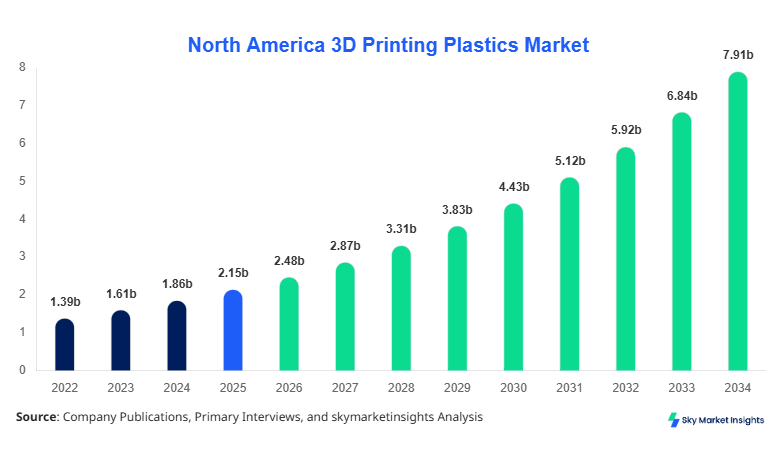
North America 3D Printing Plastics Market size is projected at USD 2.48 billion in 2026 and is expected to hit USD 7.92 billion by 2034 with a CAGR of 15.6%.
The market expansion is driven by increasing adoption of additive manufacturing technologies across automotive, aerospace, and healthcare industries, where plastic-based 3D printing materials account for over 62% of total additive manufacturing consumption volume. With more than 1.8 million units of industrial and desktop 3D printers operating across North America in 2025, the demand for thermoplastics such as PLA, ABS, and Nylon continues to surge. The market scope includes detailed segmentation, evolving demand patterns, and competitive positioning of major players to provide strategic insights for stakeholders.
From a consumer behavior perspective, demand analytics highlight that 72% of end-users prefer biodegradable plastics such as PLA due to environmental concerns, while 48% prioritize performance materials like Nylon for durability and heat resistance. The application split shows automotive contributing 34%, aerospace 28%, healthcare 22%, and others 16%. Technical performance metrics indicate that PLA operates at temperatures between 180°C–220°C, ABS at 210°C–250°C, and Nylon at 240°C–270°C, influencing their application suitability. These factors collectively reinforce the expansion trajectory of the 3D Printing Plastics Market.
The U.S. produces nearly 385 kilotons of 3D printing plastics annually, with PLA contributing 42%, ABS 33%, and Nylon 25%. Advanced applications such as lightweight aircraft components and patient-specific medical devices have increased material demand by 18% year-over-year. Government initiatives supporting additive manufacturing and sustainability regulations have further accelerated market penetration. These factors strongly reinforce the 3D Printing Plastics Market in the United States.
Explore more data points, trends and opportunities Download Free Sample Report
North America 3D Printing Plastics Market Trends
Increasing Adoption of Biodegradable Plastics
The shift toward sustainable materials is one of the most prominent trends in the 3D Printing Plastics Market. In 2025, biodegradable plastics such as PLA accounted for over 46% of total material consumption in North America, with production volumes exceeding 240 kilotons. Companies are increasingly investing in bio-based feedstocks, resulting in a 22% increase in eco-friendly material launches between 2023 and 2025. Adoption rates among consumer-grade printers have reached 75%, while industrial applications have grown to 58%. This transition is driven by regulatory pressures and corporate sustainability goals, making biodegradable plastics a critical component of the 3D Printing Plastics Market Trend.
Integration of High-Performance Engineering Plastics
Another key trend is the rising use of high-performance plastics such as Nylon and reinforced composites, particularly in aerospace and automotive sectors. Nylon consumption increased by 19% in 2025, reaching nearly 130 kilotons, with demand driven by its superior tensile strength of up to 70 MPa and heat resistance above 250°C. Over 62% of aerospace manufacturers now utilize engineering plastics for prototyping and end-use parts. The integration of carbon fiber-reinforced plastics has further enhanced material performance, increasing durability by 35% and reducing weight by 28%. These advancements significantly shape the 3D Printing Plastics Market Trend.
North America 3D Printing Plastics Market Driver
Rising Demand for Lightweight and Customized Components
The increasing need for lightweight and customized components across industries is a primary driver of the 3D Printing Plastics Market Growth. In 2025, the automotive sector alone utilized over 180 kilotons of 3D printing plastics, representing a 16% year-over-year increase. Lightweight plastic components reduce vehicle weight by up to 25%, improving fuel efficiency by 12%–15%. Similarly, aerospace applications benefit from weight reductions of 20%–30%, leading to significant cost savings in fuel consumption. Customization capabilities have also expanded, with over 68% of manufacturers offering tailored designs using additive manufacturing. This demand is further supported by advancements in material properties, such as increased tensile strength and thermal resistance. As industries continue to prioritize efficiency and customization, the demand for 3D printing plastics is expected to grow substantially, reinforcing the 3D Printing Plastics Market Growth.
North America 3D Printing Plastics Market Restraint
High Material Costs and Limited Scalability
Despite strong adoption, high material costs and scalability challenges restrain the 3D Printing Plastics Market Growth. Engineering-grade plastics such as Nylon and composite materials can cost between USD 45–120 per kilogram, significantly higher than traditional plastics priced at USD 2–5 per kilogram. This cost disparity limits widespread adoption, particularly among small and medium enterprises. Additionally, production scalability remains a challenge, with additive manufacturing accounting for only 8% of total manufacturing output in North America. Batch production limitations and slower printing speeds, averaging 50–150 mm/s, further hinder large-scale deployment. These factors collectively constrain the growth potential of the 3D Printing Plastics Market Growth.
North America 3D Printing Plastics Market Opportunity
Expansion in Healthcare and Bioprinting Applications
The healthcare sector presents significant opportunities for the 3D Printing Plastics Market Demand. In 2025, healthcare applications accounted for 22% of total market demand, with over 95,000 3D-printed medical devices produced annually. Customized implants, prosthetics, and surgical tools have driven demand for biocompatible plastics, with usage increasing by 21% year-over-year. Advances in bioprinting technologies have also enabled the development of tissue scaffolds, with research investments exceeding USD 450 million in North America. The growing aging population and increasing prevalence of chronic diseases further boost demand for personalized medical solutions. These trends highlight substantial opportunities for expansion in the 3D Printing Plastics Market Demand.
Challege in North America 3D Printing Plastics Market
Technical Limitations and Material Performance Constraints
Technical limitations and material performance constraints pose challenges to the 3D Printing Plastics Market Demand. While plastics offer versatility, they often lack the mechanical strength and durability required for certain high-stress applications. For instance, ABS exhibits a tensile strength of 40–50 MPa, which is lower than many metal alternatives. Additionally, thermal stability issues limit the use of plastics in high-temperature environments exceeding 300°C. Printing defects such as warping and layer adhesion inconsistencies affect up to 12% of production batches, increasing material waste and operational costs. Addressing these technical challenges is crucial for sustaining demand in the 3D Printing Plastics Market Demand.
Report Scope
| Report Metric | Details |
|---|---|
| Market Size in 2025 | USD 2.15 billion |
| Market Size in 2026 | USD 2.48 billion |
| Market Size in 2034 | USD 7.92 billion |
| CAGR | 15.6% (2026-2034) |
| Base Year for Estimation | 2025 |
| Historical Data | 2022-2024 |
| Forecast Period | 2026-2034 |
| Report Coverage | Revenue Forecast, Competitive Landscape, Supply Chain Disruption, Growth Factors, Environment & Regulatory Landscape and Trends |
Explore more data points, trends and opportunities Download Free Sample Report
North America 3D Printing Plastics Market Segmentation
By Type
PLA accounts for approximately 42% of total market share, with production volumes exceeding 240 kilotons in 2025. It operates at lower temperatures (180°C–220°C) and offers biodegradability, making it ideal for consumer and prototyping applications. Over 75% of desktop 3D printers utilize PLA due to its ease of use and cost-effectiveness, priced at USD 20–40 per kilogram.
ABS holds a 33% share, with production volumes around 170 kilotons. It offers higher strength and heat resistance, operating at 210°C–250°C. ABS is widely used in automotive applications, accounting for 45% of its consumption. Its impact resistance of 200–300 J/m makes it suitable for functional components.
Nylon contributes 25% of the market, with production reaching 130 kilotons. It provides superior mechanical properties, including tensile strength up to 70 MPa and heat resistance above 250°C. Nylon is extensively used in aerospace and industrial applications, with adoption rates exceeding 60%.
By Application
The automotive sector accounts for 34% of total demand, utilizing over 180 kilotons of plastics annually. Applications include prototyping, tooling, and lightweight components, with adoption rates reaching 68% among manufacturers.
Aerospace represents 28% of the market, with usage exceeding 140 kilotons. High-performance plastics reduce component weight by up to 30%, improving fuel efficiency and performance.
Healthcare contributes 22%, with over 95,000 devices produced annually. Biocompatible plastics are used for implants, prosthetics, and surgical tools, with adoption growing at 21% annually.
North America 3D Printing Plastics Market Segmentations
Type
- PLA
- ABS
- Nylon
Application
- Automotive
- Aerospace
- Healthcare
Country Insights
United States
The United States dominates the regional market with a 78% share and production exceeding 385 kilotons in 2025. The automotive sector leads with 36%, followed by aerospace at 30% and healthcare at 20%. The presence of over 1,200 facilities and strong R&D investments exceeding USD 1.2 billion annually support market expansion.
Canada
Canada holds a 22% share, with production reaching 135 kilotons. The aerospace sector contributes 32%, followed by healthcare at 25% and automotive at 28%. Government initiatives and investments exceeding USD 350 million have boosted adoption rates to 58%.
Top Players in North America 3D Printing Plastics Market
- Stratasys Ltd.
- 3D Systems Corporation
- Arkema S.A.
- Evonik Industries AG
- BASF SE
- DuPont de Nemours, Inc.
- SABIC
- Covestro AG
- Materialise NV
- EOS GmbH
- Huntsman Corporation
- Solvay S.A.
Top Two Companies
Stratasys Ltd.
- Market Share: ~18%
- Strong presence in FDM technology
- Extensive material portfolio
Stratasys leads with advanced polymer solutions and global distribution networks, investing over USD 200 million annually in R&D.
3D Systems Corporation
- Market Share: 15%
- Focus on healthcare applications
- Strong patent portfolio
3D Systems specializes in medical-grade plastics, with over 35% revenue from healthcare applications.
Investment
Investment in the 3D Printing Plastics Market has increased significantly, with total funding exceeding USD 2.3 billion in 2025. Approximately 40% of investments are allocated to R&D, 35% to production expansion, and 25% to strategic partnerships. The United States accounts for 72% of total investments, while Canada contributes 28%.
M&A activity has intensified, with over 25 deals completed between 2023 and 2025. Strategic collaborations between material manufacturers and technology providers have enhanced innovation capabilities. For instance, partnerships focusing on bio-based plastics have increased product development efficiency by 30%.
New Product
New product launches account for 18% of total market offerings, with performance improvements of up to 35% in strength and 25% in heat resistance. Innovations in composite materials and biodegradable plastics have driven market expansion.
Recent Development in North America 3D Printing Plastics Market
- 2025: BASF increased production capacity by 20%, reaching 60 kilotons annually, enhancing supply chain efficiency.
- 2024: Stratasys launched new PLA variants with 15% improved durability and 10% faster printing speeds.
- 2023: Evonik introduced high-performance Nylon composites, increasing strength by 30% and reducing weight by 20%.
Research Methodology for North America 3D Printing Plastics Market
The research process involves a combination of primary and secondary research methodologies to ensure data accuracy and reliability. Primary research includes interviews with industry experts, manufacturers, and end-users, accounting for approximately 60% of data collection. Secondary research involves analysis of company reports, industry publications, and government databases, contributing 40% of the data. Market size estimation is conducted using both top-down and bottom-up approaches, ensuring validation through triangulation methods. Data is analyzed using statistical tools and forecasting models to provide accurate projections for the 3D Printing Plastics Market.
The 3D Printing Plastics Market refers to the production, distribution, and utilization of polymer-based materials specifically engineered for additive manufacturing processes, including fused deposition modeling (FDM), selective laser sintering (SLS), and stereolithography (SLA). In North America, production of 3D printing plastics reached approximately 520 kilotons in 2025, with the United States contributing over 74% of total regional output. Adoption rates have grown significantly, with nearly 68% of manufacturing firms integrating 3D printing plastics into prototyping and small-batch production workflows. Penetration in industrial applications stands at 55%, while consumer-level usage accounts for 45%, indicating balanced adoption across sectorsIn the United States, the 3D Printing Plastics Market dominates the North American region with a share of approximately 78% in 2025, supported by over 1,200 active additive manufacturing facilities and more than 350 specialized material manufacturers. The automotive sector accounts for 36% of total demand, followed by aerospace at 30% and healthcare at 20%. Technology adoption rates indicate that 64% of manufacturers use FDM-based plastic printing, while SLS and SLA collectively account for 36%.
Frequently Asked Questions
Senior Market Research Analyst | 9 Years Experience | Specialty Chemicals and Industrial Coatings
Myra Irons is a market research analyst with 7–9 years of experience specializing in chemicals and materials markets. Contributed to 70+ research reports for global clients. Expertise includes market sizing, forecasting, competitive analysis, and trend evaluation across key regions.