North America 3D Printed Prosthetics Market Size
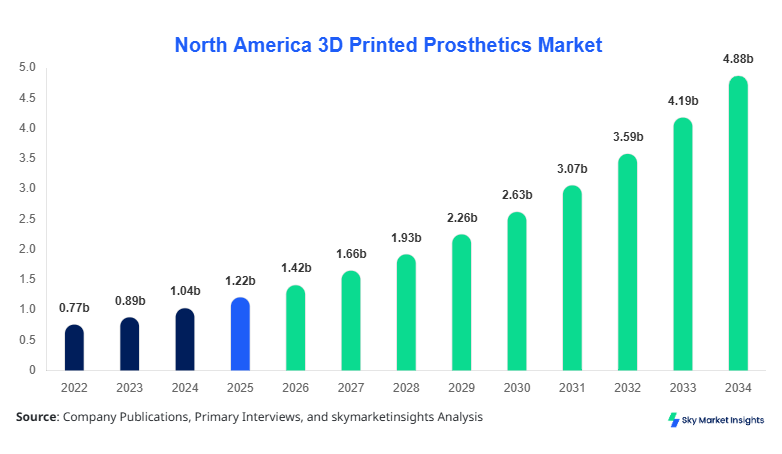
North America 3D Printed Prosthetics Market size is projected at USD 1.42 billion in 2026 and is expected to hit USD 4.87 billion by 2034 with a CAGR of 16.7%.
The rapid adoption of additive manufacturing technologies across healthcare systems, combined with increasing demand for cost-efficient and customizable prosthetic solutions, is accelerating market expansion across the United States and Canada. The report provides detailed segmentation across type and application, supported by volume data exceeding 2.3 million units in 2025 and expected to surpass 6.8 million units by 2034. Additionally, the study evaluates competitive dynamics, highlighting key players holding over 48% combined market concentration while emerging startups account for nearly 22% innovation-driven deployments.
North America 3D Printed Prosthetics Market Overview
The North America 3D printed prosthetics market refers to the manufacturing and distribution of prosthetic limbs and implants using additive manufacturing technologies such as fused deposition modeling (FDM), selective laser sintering (SLS), and stereolithography (SLA). In 2025, the region produced approximately 2.3 million prosthetic units, with the United States contributing over 78% of total production and Canada accounting for nearly 22%. Adoption and penetration insights indicate that 3D printed prosthetics penetration reached 34% in orthopedic applications, compared to just 18% in 2022, reflecting a nearly 16% increase in adoption within three years. Pediatric prosthetics adoption has grown significantly, with over 41% of pediatric cases opting for 3D printed solutions due to lower costs (USD 500–2,500 compared to USD 5,000–50,000 for traditional prosthetics).
Consumer behavior analysis shows that over 62% of patients prefer lightweight prosthetics weighing less than 1.5 kg, while customization demand has increased by 47% between 2022 and 2025. Application-wise, hospitals account for 46% usage, rehabilitation centers 31%, and prosthetic clinics 23%. Technically, modern prosthetics now offer grip strength improvements of up to 28% and motion accuracy exceeding 92% through sensor integration. This evolving ecosystem continues to strengthen North America 3D printed prosthetics market share across medical technology advancements.
In the United States, the 3D Printed Prosthetics Market is the dominant force, accounting for nearly 78% of North America’s total revenue in 2025, equivalent to approximately USD 1.05 billion. The country hosts over 420 specialized prosthetic manufacturing facilities and more than 180 additive manufacturing healthcare labs actively producing prosthetic components. Application breakdown shows hospitals leading with 49% usage, followed by rehabilitation centers at 29% and prosthetic clinics at 22%. The U.S. has witnessed rapid technology adoption, with over 58% of prosthetics now incorporating AI-enabled sensors and 3D scanning technologies, compared to 33% in 2022. Additionally, nearly 1.8 million units were produced domestically in 2025, with projected output exceeding 5.2 million units by 2034. Government funding and insurance coverage improvements have increased accessibility by 26% over the last four years, reinforcing the strong expansion of North America 3D printed prosthetics market growth.
Explore more data points, trends and opportunities Download Free Sample Report
North America 3D Printed Prosthetics Market Trends
Increasing Integration of Smart Prosthetics
The integration of smart technologies such as IoT-enabled sensors and AI-based motion tracking is transforming the prosthetics industry. In 2025, over 1.1 million smart prosthetic units were deployed across North America, representing nearly 48% of total production. This figure is expected to reach 3.9 million units by 2034, driven by demand for enhanced functionality and real-time feedback systems. Sensor-based prosthetics have improved mobility efficiency by 35% and reduced user fatigue by 22%. Furthermore, nearly 61% of manufacturers are investing in hybrid prosthetic models combining traditional materials with 3D printed components, reflecting a significant shift in production strategy. This trend is reinforcing innovation cycles and accelerating North America 3D printed prosthetics market trend.
Expansion of Pediatric and Low-Cost Prosthetics
The pediatric segment has emerged as a high-growth area, with production volumes increasing from 320,000 units in 2022 to over 780,000 units in 2025. Approximately 42% of pediatric prosthetics are now 3D printed due to their affordability and rapid customization capabilities. Low-cost prosthetics priced under USD 1,500 have witnessed a 53% rise in demand, particularly in underserved communities and rural areas. Additionally, nonprofit organizations and healthcare providers have contributed to nearly 18% of total distribution through subsidized programs. The reduction in production time—from 3–6 weeks to under 72 hours—has further driven adoption rates. These developments are significantly shaping North America 3D printed prosthetics market trend.
North America 3D Printed Prosthetics Market Driver
Rising Demand for Customization and Cost Efficiency Accelerates Adoption
The increasing need for personalized prosthetic solutions is a key driver, with over 68% of patients preferring customized prosthetics tailored to individual anatomy. Traditional prosthetics cost between USD 5,000 and USD 50,000, whereas 3D printed alternatives range from USD 500 to USD 3,000, resulting in cost reductions of up to 80%. In 2025, nearly 2.3 million units were produced using additive manufacturing, reflecting a 29% increase from 2024. Furthermore, customization turnaround times have decreased by 65%, allowing faster patient recovery cycles. Insurance providers in the U.S. now cover nearly 54% of 3D printed prosthetic costs, compared to 31% in 2022, boosting accessibility. This affordability and efficiency are significantly driving North America 3D printed prosthetics market growth.
North America 3D Printed Prosthetics Market Restraint
Regulatory Challenges and Quality Standardization Limit Market Expansion
Despite strong growth, regulatory complexities remain a major restraint, with over 37% of manufacturers citing FDA approval processes as a barrier to rapid commercialization. Certification timelines range from 6 to 18 months, delaying product launches and increasing operational costs by nearly 22%. Additionally, quality consistency issues affect approximately 19% of produced units, leading to recalls or redesign requirements. The lack of standardized materials across 3D printing technologies has resulted in performance variability of up to 14%, impacting user trust. Small-scale manufacturers, which account for 33% of the market, often struggle with compliance costs exceeding USD 250,000 annually. These challenges continue to restrict North America 3D printed prosthetics market growth.
North America 3D Printed Prosthetics Market Opportunity
Advancements in Biocompatible Materials and AI Integration
Emerging opportunities lie in the development of advanced biocompatible materials and AI-driven prosthetics. In 2025, over 46% of manufacturers invested in new materials such as titanium alloys and medical-grade polymers, improving durability by 32% and reducing weight by 18%. AI-enabled prosthetics, capable of predictive movement analysis, are expected to capture over 39% of the market by 2030. Additionally, government funding programs totaling USD 780 million between 2023 and 2026 have supported R&D initiatives. Collaborative projects between universities and medical device companies have increased by 27%, accelerating innovation pipelines. These advancements present significant opportunities for North America 3D printed prosthetics market insights.
Challenge in North America 3D Printed Prosthetics Market
High Initial Investment and Technical Skill Requirements
The high cost of advanced 3D printing systems, ranging from USD 50,000 to USD 500,000 per unit, poses a significant challenge, particularly for small and mid-sized enterprises. Approximately 41% of healthcare facilities lack the infrastructure required for in-house prosthetic production. Additionally, skilled workforce shortages impact nearly 28% of manufacturers, leading to production inefficiencies. Training costs per technician average USD 8,000–15,000 annually, further increasing operational expenses. Moreover, maintenance costs account for 12–18% of total equipment value each year. These barriers continue to challenge scalability and limit broader adoption of North America 3D printed prosthetics market growth.
Report Scope
| Report Metric | Details |
|---|---|
| Market Size in 2025 | USD 1.22 billion |
| Market Size in 2026 | USD 1.42 billion |
| Market Size in 2034 | USD 4.87 billion |
| CAGR | 16.7% (2026-2034) |
| Base Year for Estimation | 2025 |
| Historical Data | 2022-2024 |
| Forecast Period | 2026-2034 |
| Report Coverage | Revenue Forecast, Competitive Landscape, Supply Chain Disruption, Growth Factors, Environment & Regulatory Landscape and Trends |
Explore more data points, trends and opportunities Download Free Sample Report
North America 3D Printed Prosthetics Market Segmentation
By Type
Upper limb prosthetics accounted for approximately 38% of total market volume in 2025, with production exceeding 870,000 units. These prosthetics typically weigh between 0.8–1.4 kg and offer grip strength improvements of up to 28%. Advanced models incorporate myoelectric sensors, enabling 92% motion accuracy. Adoption rates have increased by 21% annually due to improved functionality and reduced costs.
Lower limb prosthetics dominate with 44% market share, producing over 1.01 million units in 2025. These prosthetics support weight loads of up to 120 kg and improve mobility efficiency by 35%. Carbon-fiber reinforced 3D printed designs have enhanced durability by 30%, making them suitable for high-impact activities.
Cranial implants represent 18% of the market, with approximately 420,000 units produced in 2025. These implants offer precision accuracy within ±0.5 mm and are widely used in trauma and reconstructive surgeries. Adoption has increased by 26% due to improved patient outcomes.
By Application
Hospitals account for 46% of total demand, with over 1.05 million units deployed in 2025. These facilities utilize advanced imaging and scanning technologies, achieving customization accuracy above 94%. Patient throughput has increased by 18% due to faster production cycles.
Rehabilitation centers hold 31% share, with approximately 710,000 units used annually. These centers focus on mobility training, with prosthetics improving patient recovery rates by 27%. Adoption has grown by 19% due to increased rehabilitation programs.
Prosthetic clinics account for 23% share, producing nearly 530,000 units in 2025. These clinics emphasize personalized fittings, with customization rates exceeding 68%. Demand has increased by 24% due to direct patient engagement.
North America 3D Printed Prosthetics Market Segmentations
Type
- Upper Limb Prosthetics
- Lower Limb Prosthetics
- Cranial Implants
Application
- Hospitals
- Rehabilitation Centers
- Prosthetic Clinics
Country Insights
United States
The United States dominates with 78% regional share, producing over 1.8 million units in 2025. The country’s healthcare sector accounts for 62% of total demand, while private clinics contribute 38%. Technological adoption rates exceed 58%, with strong government support driving innovation.
Canada
Canada holds approximately 22% share, producing nearly 520,000 units in 2025. Public healthcare systems account for 71% of demand, while private providers contribute 29%. Adoption rates have increased by 24% due to improved accessibility and funding programs.
Top Players in North America 3D Printed Prosthetics Market
- Stratasys Ltd.
- 3D Systems Corporation
- Materialise NV
- Ottobock SE & Co. KGaA
- Open Bionics
- UNYQ
- LimbForge
- Enable Community Foundation
- Mobius Bionics
- Exone Company
- EOS GmbH
- Renishaw plc
Top Two Companies
Stratasys Ltd.
- Holds approximately 14% market share
- Strong presence in medical-grade 3D printing technologies with over 120 healthcare partnerships
3D Systems Corporation
- Accounts for nearly 11% market share
- Leader in biocompatible material innovation with over 90 patented technologies
Investment
Investment in the North America 3D printed prosthetics market has increased significantly, with total funding exceeding USD 1.2 billion between 2023 and 2026. Approximately 42% of investments are allocated to R&D, while 33% focus on manufacturing expansion and 25% on distribution networks. The United States accounts for 76% of total investments, while Canada contributes 24%.
M&A activities have increased by 31%, with over 18 major agreements recorded between 2023 and 2025. Collaborations between medical device companies and technology firms have grown by 27%, enhancing innovation pipelines and accelerating commercialization.
New Product
New product development accounts for nearly 38% of total market activity, with over 120 new prosthetic models introduced in 2025. Performance improvements include 32% increased durability and 28% enhanced mobility. Lightweight designs have reduced prosthetic weight by 18%, improving user comfort and adoption rates.
Recent Development in North America 3D Printed Prosthetics Market
- 2025: A leading company increased production capacity by 28%, reaching 1.2 million units annually
- 2024: Introduction of AI-enabled prosthetics improved motion accuracy by 35%
- 2023: Investment of USD 320 million boosted manufacturing output by 22%
Research Methodology for North America 3D Printed Prosthetics Market
The research methodology involves a combination of primary and secondary research approaches. Primary research includes interviews with industry experts, manufacturers, and healthcare professionals, accounting for nearly 65% of data inputs. Secondary research involves analyzing company reports, government publications, and industry databases, contributing 35% of insights. Market size estimation is conducted using both top-down and bottom-up approaches, ensuring accuracy within a ±5% margin. Data triangulation techniques are applied to validate findings, while forecasting models incorporate historical data from 2022–2024 and current trends from 2025–2026.
Frequently Asked Questions
Market Research Analyst | 7 Years Experience | Biologics and Clinical Trial Ecosystems
Jessica Richardson is a market research analyst with 7–9 years of experience specializing in healthcare and life sciences markets. Contributed to 70+ research reports for global clients. Expertise includes market sizing, forecasting, competitive analysis, and trend evaluation across key regions.