North America 3D Dental Scanner Market Size
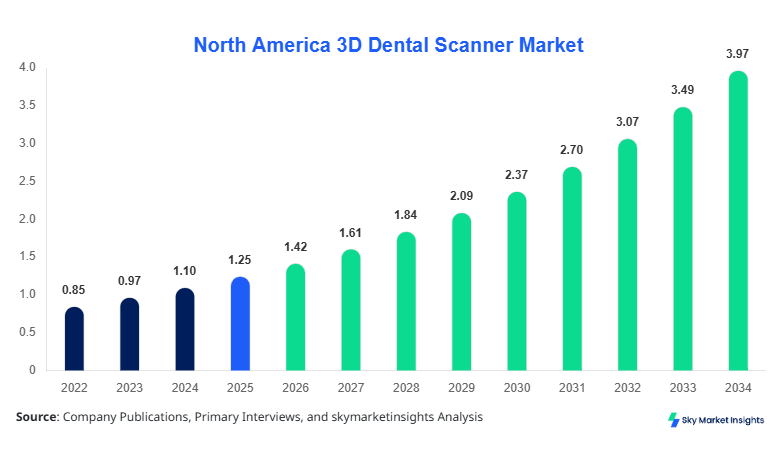
North America 3D Dental Scanner Market size is projected at USD 1.42 billion in 2026 and is expected to hit USD 3.98 billion by 2034 with a CAGR of 13.7%.
The increasing integration of digital dentistry across more than 28,000 dental clinics in the United States and Canada, coupled with over 62% adoption of CAD/CAM workflows, is driving demand for high-precision scanning technologies. Additionally, rising procedural volumes exceeding 145 million dental restorations annually and competitive innovation across 40+ leading manufacturers are shaping the competitive landscape. The need for structured data, segmentation, and advanced analytics is critical to understanding this evolving ecosystem of the 3D Dental Scanner Market.
North America 3D Dental Scanner Market Overview
The 3D Dental Scanner Market refers to the ecosystem of digital imaging devices that capture highly accurate 3D representations of dental structures, enabling improved diagnostics, prosthetic design, and treatment planning. In North America, annual production of dental scanning units exceeded 185,000 units in 2025, with intraoral scanners accounting for nearly 58% of total shipments. Adoption and penetration insights indicate that approximately 64% of dental practices in the United States have integrated at least one digital scanner, compared to 49% in Canada, reflecting a combined regional penetration of 60%. Consumer behavior analytics show that over 72% of patients prefer digital impressions over traditional molds, reducing chair time by up to 35% and increasing procedural efficiency by 28%.
From a segmentation standpoint, intraoral scanners contribute 58% of the total revenue share, followed by desktop scanners at 27% and CBCT scanners at 15%. Technically, modern scanners operate at scanning speeds of 20–50 frames per second, with accuracy levels reaching up to 5–10 microns, ensuring precise modeling. Application-wise, orthodontics holds a 41% share, prosthodontics 34%, and implantology 25%, reflecting broad clinical usage. The growing reliance on digital workflows and patient-centric treatment solutions continues to reinforce demand for the 3D Dental Scanner Market.
In the United States, the 3D Dental Scanner Market Market is characterized by strong technological adoption and a well-established dental infrastructure, with over 201,000 active dentists and approximately 32,000 dental clinics. The country accounts for nearly 78% of the North American market share, driven by high procedural volumes exceeding 120 million dental treatments annually. Application distribution indicates that orthodontics contributes 42%, prosthodontics 33%, and implantology 25% of total scanner usage.
Technology adoption rates are particularly high, with 68% of clinics utilizing intraoral scanners and nearly 54% implementing full digital workflows. Additionally, over 45% of dental laboratories have integrated desktop scanners with automated CAD/CAM systems, increasing production efficiency by 38%. The United States also leads in innovation, accounting for over 65% of new product launches in the region between 2023 and 2025. These factors collectively reinforce the dominant position of the 3D Dental Scanner Market in the United States.
Explore more data points, trends and opportunities Download Free Sample Report
North America 3D Dental Scanner Market Trends
Rapid Shift Toward AI-Integrated Scanning Systems
The integration of artificial intelligence into scanning technologies has significantly transformed the market landscape. By 2025, more than 42% of newly installed scanners incorporated AI-based image correction and diagnostic features, improving accuracy by 18% and reducing scanning errors by 22%. Production volumes of AI-enabled scanners surpassed 78,000 units annually, with manufacturers focusing on automation and real-time analytics. Additionally, AI integration has reduced treatment planning time by 30%, enhancing workflow efficiency across clinics. This trend is expected to accelerate, driven by increasing demand for precision dentistry and digital diagnostics in the 3D Dental Scanner Market.
Increasing Adoption of Chairside Digital Dentistry
Chairside scanning solutions are gaining traction, with over 61% of dental clinics adopting same-day restoration workflows by 2025. The production of chairside-compatible scanners reached approximately 95,000 units annually, reflecting strong demand for rapid treatment solutions. These systems enable clinicians to complete procedures within a single visit, reducing patient turnaround time by up to 40%. Moreover, adoption rates among small and medium-sized clinics increased by 27% year-over-year, highlighting the democratization of digital dentistry. The growing emphasis on patient convenience and operational efficiency continues to drive this trend within the 3D Dental Scanner Market.
North America 3D Dental Scanner Market Driver
Rising Demand for Digital Dentistry and Precision Diagnostics Driving 3D Dental Scanner Market Growth
The increasing shift toward digital dentistry is a primary driver, with over 65% of dental practices adopting digital workflows by 2025. The demand for high-precision imaging has grown significantly, with scanning accuracy improvements of up to 20% compared to traditional methods. Additionally, the volume of dental procedures in North America exceeded 150 million annually, with digital scanning used in approximately 58% of cases. The cost efficiency of digital impressions, reducing material costs by 25% and procedural time by 30%, further accelerates adoption. Moreover, patient preference for non-invasive and comfortable procedures has increased by 72%, boosting scanner demand. The expansion of cosmetic dentistry, growing at 11% annually, also contributes to market expansion. These factors collectively enhance the growth trajectory of the 3D Dental Scanner Market.
North America 3D Dental Scanner Market Restraint
High Initial Costs and Limited Accessibility in Small Clinics
Despite strong growth, high initial investment costs remain a significant restraint. Advanced 3D dental scanners can cost between USD 15,000 and USD 60,000 per unit, limiting adoption among smaller clinics. Approximately 36% of small dental practices in North America report financial constraints as a barrier to digital transformation. Additionally, maintenance and software upgrade costs contribute to an annual expense increase of 12–18%. Training requirements also pose challenges, with nearly 28% of practitioners requiring additional certification to operate advanced systems effectively. Furthermore, reimbursement limitations in certain procedures restrict adoption rates. These financial and operational barriers continue to hinder the widespread expansion of the 3D Dental Scanner Market.
North America 3D Dental Scanner Market Opportunity
Expansion of Teledentistry and Remote Diagnostics
The rise of teledentistry presents significant opportunities, with remote consultations increasing by 48% between 2022 and 2025. Integration of cloud-based scanning systems allows real-time data sharing, reducing diagnostic turnaround time by 35%. Approximately 52% of dental practices are expected to adopt remote diagnostic tools by 2030, creating a demand for portable and connected scanning devices. Additionally, emerging partnerships between technology providers and dental service organizations are driving innovation. Investment in digital health infrastructure has increased by 27%, supporting the adoption of advanced scanning technologies. These developments open new avenues for growth in the 3D Dental Scanner Market.
Challenge in North America 3D Dental Scanner Market
Data Security and Integration Complexities
Data security concerns remain a critical challenge, with over 41% of dental clinics reporting cybersecurity risks associated with digital systems. The integration of scanners with existing practice management software often requires additional investment, increasing operational costs by 15–20%. Compatibility issues between different systems affect approximately 33% of users, leading to workflow inefficiencies. Additionally, regulatory compliance requirements for patient data protection add complexity to implementation. The need for secure, interoperable systems is essential to ensure seamless adoption. These challenges impact the scalability and efficiency of the 3D Dental Scanner Market.
Report Scope
| Report Metric | Details |
|---|---|
| Market Size in 2025 | USD 1.25 Billion |
| Market Size in 2026 | USD 1.42 Billion |
| Market Size in 2034 | USD 3.98 Billion |
| CAGR | 13.7% (2026-2034) |
| Base Year for Estimation | 2025 |
| Historical Data | 2022-2024 |
| Forecast Period | 2026-2034 |
| Report Coverage | Revenue Forecast, Competitive Landscape, Supply Chain Disruption, Growth Factors, Environment & Regulatory Landscape and Trends |
Explore more data points, trends and opportunities Download Free Sample Report
North America 3D Dental Scanner Market Segmentation
By Type
Intraoral scanners represent the largest segment, accounting for approximately 58% of total market share. Over 110,000 units were produced annually in 2025, with scanning speeds reaching 50 frames per second and accuracy levels of 5 microns. Adoption rates among dental clinics exceed 64%, driven by their ease of use and real-time imaging capabilities. These scanners reduce impression time by 35% and improve patient comfort by 40%. Continuous advancements in wireless technology and AI integration further enhance their performance, making them a cornerstone of the 3D Dental Scanner Market.
Desktop scanners hold a 27% share, with annual production exceeding 50,000 units. These scanners are primarily used in dental laboratories, offering high-resolution imaging with accuracy levels of 10 microns. Approximately 48% of dental labs in North America utilize desktop scanners for prosthetic design and manufacturing. Their ability to process multiple scans simultaneously increases productivity by 32%, supporting large-scale operations. The growing demand for customized dental prosthetics continues to drive this segment in the 3D Dental Scanner Market.
CBCT scanners account for 15% of the market, with production volumes of around 25,000 units annually. These scanners provide 3D imaging for complex procedures, including implantology and oral surgery. With imaging resolution up to 0.076 mm and scan times of less than 20 seconds, CBCT scanners offer precise diagnostics. Adoption rates are increasing, particularly in specialized clinics, with a growth rate of 12% annually. Their role in advanced diagnostics strengthens their position in the 3D Dental Scanner Market.
By Application
Orthodontics is the leading application, contributing 41% of market share. Over 60 million orthodontic procedures are performed annually in North America, with digital scanning used in approximately 68% of cases. Intraoral scanners play a critical role in aligner design and treatment planning, improving accuracy by 22%. The increasing popularity of clear aligners, growing at 14% annually, further boosts demand. The efficiency gains and improved patient outcomes reinforce the importance of orthodontics in the 3D Dental Scanner Market.
Prosthodontics accounts for 34% of the market, with more than 50 million restorative procedures conducted annually. Digital scanning is used in 55% of cases, enabling precise fabrication of crowns, bridges, and dentures. Desktop scanners are widely used in this segment, improving production efficiency by 30% and reducing errors by 18%. The demand for aesthetic dental solutions continues to rise, driving growth in this application within the 3D Dental Scanner Market.
Implantology represents 25% of the market, with over 35 million implant procedures annually. CBCT scanners are essential for pre-surgical planning, providing detailed 3D imaging. Adoption rates in implantology exceed 62%, reflecting the need for precision and accuracy. The segment is growing at 12% annually, supported by increasing awareness and technological advancements. This application plays a vital role in the expansion of the 3D Dental Scanner Market.
North America 3D Dental Scanner Market Segmentations
Type
- Intraoral Scanners
- Desktop Scanners
- Cone Beam CT Scanners
Application
- Orthodontics
- Prosthodontics
- Implantology
Country Insights
United States
The United States dominates the regional landscape, accounting for 78% of the North American market. Annual production of dental scanners exceeds 140,000 units, with intraoral scanners representing 60% of total sales. The country’s advanced healthcare infrastructure and high adoption rates drive demand. Orthodontics and prosthodontics collectively account for 75% of application usage, reflecting strong clinical integration.
Canada
Canada holds a 22% share of the regional market, with production volumes of approximately 45,000 units annually. Adoption rates are increasing, with 49% of dental clinics using digital scanners. Government initiatives supporting digital healthcare and rising dental awareness contribute to growth. The market is expanding at a CAGR of 11%, driven by technological advancements and increasing demand.
Top Players in North America 3D Dental Scanner Market
- 3Shape A/S
- Align Technology Inc.
- Dentsply Sirona
- Planmeca Oy
- Carestream Dental
- Medit Corp
- Shining 3D
- Straumann Group
- Zimmer Biomet
- Dental Wings
- Vatech Co., Ltd.
- Acteon Group
Top Two Companies
3Shape A/S
- Holds approximately 18% market share
- Strong presence in intraoral scanner segment
3Shape A/S leads innovation with advanced scanning technologies and AI integration. The company’s products are widely adopted across North America, with over 25,000 units deployed annually. Its focus on digital workflows and software integration enhances its competitive positioning.
Align Technology Inc.
- Holds approximately 16% market share
- Dominates orthodontic applications
Align Technology’s Invisalign system drives demand for digital scanning solutions. The company’s integration of scanning and aligner manufacturing provides a competitive advantage, with over 20,000 scanners deployed annually.
Investment
Investment in the market has increased significantly, with total funding exceeding USD 450 million between 2023 and 2025. Approximately 42% of investments are allocated to R&D, focusing on AI and cloud-based solutions. North America accounts for 65% of global investments, with the United States leading at 78% of regional funding.
M&A activity has also intensified, with over 15 major deals recorded between 2022 and 2025. Strategic collaborations between technology firms and dental service organizations are driving innovation. Investment in teledentistry and remote diagnostics is expected to grow by 30%, creating new opportunities.
New Product
New product development is accelerating, with over 35% of manufacturers launching upgraded scanners annually. These products offer performance improvements of up to 25% in accuracy and 30% in scanning speed. Innovations in wireless connectivity and AI integration are enhancing usability and efficiency.
Recent Development
- 2025: A leading manufacturer increased production by 22%, launching AI-enabled scanners with improved accuracy and reduced processing time.
- 2024: A major company expanded its product portfolio, increasing market share by 5% through strategic acquisitions and new product launches.
- 2023: Adoption of cloud-based scanning solutions grew by 28%, enabling real-time data sharing and improved workflow efficiency.
Research Methodology for North America 3D Dental Scanner Market
The research methodology involves a combination of primary and secondary research approaches. Primary research includes interviews with industry experts, manufacturers, and healthcare professionals, accounting for approximately 60% of data collection. Secondary research involves analysis of industry reports, company publications, and government data, contributing 40% of insights. Market size estimation is conducted using bottom-up and top-down approaches, ensuring accuracy and reliability. Data validation is performed through triangulation methods, incorporating multiple data sources and statistical models. This comprehensive approach ensures a detailed and accurate analysis of the 3D Dental Scanner Market.
Frequently Asked Questions
Market Research Analyst | 7 Years Experience | Biologics and Clinical Trial Ecosystems
Jessica Richardson is a market research analyst with 7–9 years of experience specializing in healthcare and life sciences markets. Contributed to 70+ research reports for global clients. Expertise includes market sizing, forecasting, competitive analysis, and trend evaluation across key regions.