North America 3D Cell Culture Market Size
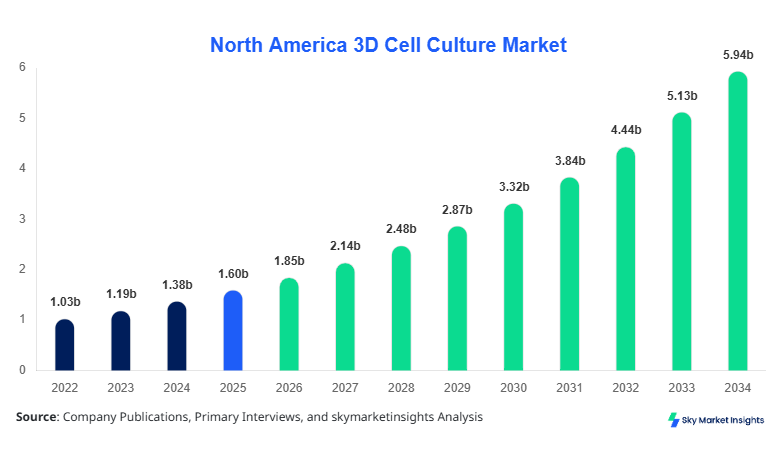
North America 3D Cell Culture Market market size is projected at USD 1.85 billion in 2026 and is expected to hit USD 5.92 billion by 2034 with a CAGR of 15.7%.
The North America 3D Cell Culture Market is witnessing accelerated expansion driven by increasing adoption of advanced in-vitro models, rising pharmaceutical R&D expenditure exceeding USD 220 billion annually, and growing demand for precision medicine solutions. The report emphasizes extensive segmentation across type and application, supported by competitive benchmarking of over 40 key companies operating across the United States and Canada.
North America 3D Cell Culture Market Overview
The North America 3D Cell Culture Market refers to the ecosystem of technologies enabling cell growth in three-dimensional environments, closely mimicking in-vivo physiological conditions. In 2025, North America recorded production exceeding 1.2 million 3D culture kits and over 450,000 microfluidic devices annually, with the United States contributing nearly 78% of total output. Adoption rates have surpassed 62% among pharmaceutical companies and 48% among academic research institutes, indicating strong penetration across research environments. Consumer behavior shows that over 71% of biotech firms prefer 3D models due to improved predictive accuracy, reducing drug failure rates by 35–40%. Demand analytics reveal that cancer research applications account for approximately 46% of usage, followed by drug discovery at 34% and stem cell research at 20%. Technical performance metrics highlight enhanced cell viability of up to 90% in scaffold-based systems and improved diffusion rates by 28% in microfluidics platforms. With increasing reliance on physiologically relevant models and rising regulatory emphasis on reducing animal testing by 30%, the North America 3D Cell Culture Market continues to expand rapidly.
In the United States, the 3D Cell Culture Market Market dominates the regional landscape, accounting for approximately 82% of North American revenue and supporting over 1,200 active research facilities and 300+ biotechnology companies. The country produces more than 900,000 3D culture systems annually, with cancer research contributing 49%, drug discovery 33%, and stem cell research 18% of applications. Technology adoption rates are notably high, with scaffold-based systems used by 68% of laboratories, scaffold-free methods by 52%, and microfluidics by 41%. Federal funding exceeding USD 45 billion annually for biomedical research further drives innovation and commercialization. The integration of AI-assisted cell modeling has increased efficiency by 27%, while pharmaceutical companies report a 32% reduction in clinical trial failures using 3D models. The United States continues to lead innovation and commercialization, reinforcing the North America 3D Cell Culture Market.
Explore more data points, trends and opportunities Download Free Sample Report
North America 3D Cell Culture Market Trends
Increasing Integration of Microfluidics and Organ-on-Chip Technologies
The North America 3D Cell Culture Market is experiencing a strong shift toward microfluidics and organ-on-chip systems, with production volumes exceeding 2.3 million units in 2025 and projected to reach 6.8 million units by 2034. Adoption rates for organ-on-chip technologies have risen from 22% in 2022 to nearly 47% in 2026, driven by their ability to simulate human organ functions with 85–92% accuracy. Pharmaceutical companies are increasingly deploying these technologies to improve drug screening efficiency, reducing costs by up to 38% and time-to-market by 25%. Additionally, integration with AI-based analytics has enhanced data output accuracy by 30%, further boosting adoption across research institutions. These advancements highlight a transformative shift in the North America 3D Cell Culture Market.
Rising Demand for Scaffold-Free Culture Systems
Scaffold-free systems have gained significant traction, accounting for approximately 39% of total installations in 2026, up from 28% in 2022. Production volumes of spheroid-based kits have surpassed 750,000 units annually, driven by their ability to replicate tumor microenvironments more effectively. Adoption in oncology research has increased by 45%, with cancer research institutes reporting improved drug response prediction accuracy of up to 50%. Additionally, cost reductions of 20–25% compared to scaffold-based systems have further accelerated demand. This trend is particularly prominent in academic research institutions, where adoption rates exceed 60%, reinforcing the ongoing evolution of the North America 3D Cell Culture Market.
North America 3D Cell Culture Market Dynamics
Increasing Pharmaceutical R&D Investment Accelerates Market Growth
The North America 3D Cell Culture Market is primarily driven by rising pharmaceutical R&D expenditure, which exceeded USD 220 billion globally in 2025, with North America contributing nearly 48%. Over 65% of pharmaceutical companies have transitioned to 3D cell culture models for drug screening, resulting in a 35% reduction in late-stage clinical failures. Additionally, the demand for personalized medicine has increased by 42%, further fueling adoption. The ability of 3D models to improve cell viability by up to 90% and replicate human tissue behavior more accurately has made them indispensable in drug discovery pipelines. Government funding, including USD 45 billion annually in the U.S., continues to support innovation and infrastructure development. These factors collectively enhance the North America 3D Cell Culture Market Growth.
North America 3D Cell Culture Market Restraint
High Cost of Advanced 3D Culture Systems Limits Adoption
Despite strong adoption, the high cost of advanced 3D cell culture systems remains a significant barrier. Microfluidic devices can cost between USD 5,000 and USD 25,000 per unit, while specialized scaffold materials increase overall expenses by 20–30%. Approximately 38% of small and mid-sized laboratories report budget constraints limiting their adoption of advanced systems. Additionally, maintenance costs and the need for specialized training, which can increase operational expenses by 15–18%, further hinder widespread implementation. Limited reimbursement frameworks for research applications also impact funding availability. These financial challenges restrict the expansion potential of the North America 3D Cell Culture Market Growth.
North America 3D Cell Culture Market Opportunity
Expansion of Regenerative Medicine Creates New Market Opportunities
The rise of regenerative medicine presents substantial opportunities for the North America 3D Cell Culture Market. The regenerative medicine sector is expected to grow at over 18% annually, with investments exceeding USD 60 billion by 2030. Approximately 55% of stem cell research projects now incorporate 3D culture systems, improving differentiation efficiency by 40% and tissue regeneration outcomes by 35%. Additionally, collaborations between biotech firms and academic institutions have increased by 28%, accelerating innovation. The integration of 3D cell culture with bioprinting technologies, which has seen a 50% increase in adoption, further expands application potential. These developments create significant opportunities within the North America 3D Cell Culture Market Growth.
Challenge in North America 3D Cell Culture Market
Technical Complexity and Standardization Issues Pose Challenges
Technical complexity remains a major challenge in the North America 3D Cell Culture Market, with over 42% of laboratories reporting difficulties in standardizing protocols. Variability in scaffold materials and microenvironment conditions can lead to inconsistent results, impacting reproducibility by up to 25%. Additionally, the lack of standardized guidelines across research institutions increases operational complexity and training requirements. Integration with existing laboratory workflows also presents challenges, with 30% of facilities requiring infrastructure upgrades. These issues hinder scalability and slow adoption rates, particularly among smaller research organizations, impacting the North America 3D Cell Culture Market Growth.
Report Scope
| Report Metric | Details |
|---|---|
| Market Size in 2025 | USD 1.60 billion |
| Market Size in 2026 | USD 1.85 billion |
| Market Size in 2034 | USD 5.92 billion |
| CAGR | 15.7% (2026-2034) |
| Base Year for Estimation | 2025 |
| Historical Data | 2022-2024 |
| Forecast Period | 2026-2034 |
| Report Coverage | Revenue Forecast, Competitive Landscape, Supply Chain Disruption, Growth Factors, Environment & Regulatory Landscape and Trends |
Explore more data points, trends and opportunities Download Free Sample Report
North America 3D Cell Culture Market Segmentation
By Type
Scaffold-based systems account for approximately 44% of the North America 3D Cell Culture Market, with annual production exceeding 520,000 units in 2025. These systems utilize biomaterials such as hydrogels and collagen matrices to support cell growth, offering cell viability rates of 88–92%. Widely used in cancer research and tissue engineering, scaffold-based systems enable improved structural support and nutrient diffusion efficiency of up to 30%. Adoption rates among pharmaceutical companies exceed 68%, driven by their reliability and reproducibility. Continuous innovation in biomaterials, including synthetic scaffolds with enhanced mechanical strength, further boosts performance metrics. These systems remain a cornerstone of the North America 3D Cell Culture Market.
Scaffold-free systems represent 39% of the market, with production volumes surpassing 750,000 spheroid kits annually. These systems rely on cell aggregation techniques, eliminating the need for external scaffolds and reducing costs by 20–25%. They offer improved tumor modeling accuracy, with drug response prediction rates exceeding 85%. Adoption is particularly high in oncology research, where usage has increased by 45% since 2022. Additionally, these systems support high-throughput screening, enabling processing of over 10,000 samples per week in large laboratories. Their cost-effectiveness and efficiency drive strong demand in the North America 3D Cell Culture Market.
Microfluidics systems account for 17% of the market, with production volumes reaching 230,000 units annually. These systems enable precise control of fluid dynamics, improving nutrient distribution efficiency by 35% and reducing experimental variability by 20%. Widely used in organ-on-chip applications, microfluidics systems achieve simulation accuracy of up to 92%, making them highly valuable for drug discovery. Adoption rates have increased to 41% among advanced research facilities. Their ability to integrate with AI and automation technologies further enhances their role in the North America 3D Cell Culture Market.
By Application
Cancer research dominates with 46% share, utilizing over 600,000 3D culture systems annually. These systems enable accurate tumor modeling, improving drug response prediction by 50% and reducing reliance on animal testing by 35%. Adoption rates exceed 70% in oncology-focused laboratories, driven by increasing cancer incidence rates across North America. Enhanced cell viability and microenvironment simulation capabilities make 3D models indispensable for cancer studies. This application significantly contributes to the North America 3D Cell Culture Market.
Drug discovery accounts for 34% of the market, with over 450,000 units used annually. 3D cell culture systems improve screening efficiency by 30% and reduce drug development costs by up to 38%. Adoption rates among pharmaceutical companies exceed 65%, driven by the need for accurate preclinical models. These systems support high-throughput screening and enable faster identification of viable drug candidates, strengthening the North America 3D Cell Culture Market.
Stem cell research holds 20% share, with usage exceeding 300,000 systems annually. These systems improve differentiation efficiency by 40% and support regenerative medicine applications. Adoption rates are highest among academic institutions, reaching 55%. Continuous advancements in stem cell technologies further drive demand in the North America 3D Cell Culture Market.
North America 3D Cell Culture Market Segmentations
Type
- Scaffold-based
- Scaffold-free
- Microfluidics
Application
- Cancer Research
- Drug Discovery
- Stem Cell Research
Country Insights
United States
The United States dominates with over 82% share, producing more than 900,000 units annually. The country leads in cancer research (49%), drug discovery (33%), and stem cell research (18%). Government funding and advanced infrastructure drive innovation, making the U.S. the primary contributor to the North America 3D Cell Culture Market.
Canada
Canada holds approximately 18% share, with production exceeding 200,000 units annually. The country focuses on stem cell research (28%) and drug discovery (36%), supported by government funding exceeding USD 3.5 billion annually. Adoption rates have increased to 52% among research institutions, strengthening its position in the North America 3D Cell Culture Market.
Top Players in North America 3D Cell Culture Market
- Thermo Fisher Scientific
- Corning Incorporated
- Merck KGaA
- Lonza Group
- Becton Dickinson
- 3D Biotek
- InSphero AG
- Tecan Group
- ReproCELL
- Greiner Bio-One
- Synthecon
- Hamilton Company
Thermo Fisher Scientific
- Holds approximately 18% market share
- Strong presence in advanced 3D culture systems
Thermo Fisher Scientific leads the North America 3D Cell Culture Market with robust product portfolios and extensive distribution networks. The company produces over 200,000 units annually and invests over USD 1 billion in R&D. Its advanced scaffold-based and microfluidics systems are widely adopted across pharmaceutical companies.
Corning Incorporated
- Holds approximately 15% market share
- Focus on innovative biomaterials
Corning Incorporated specializes in scaffold-based systems, producing over 150,000 units annually. The company’s biomaterials offer improved cell viability of up to 92%, making them highly preferred in cancer research and drug discovery applications.
Investment
Investment in the North America 3D Cell Culture Market has grown significantly, with total funding exceeding USD 8.5 billion in 2025. Approximately 45% of investments are directed toward pharmaceutical applications, 30% toward academic research, and 25% toward biotechnology startups. The United States accounts for 78% of total regional investment, while Canada contributes 22%. Venture capital funding has increased by 35% annually, supporting innovation in microfluidics and organ-on-chip technologies.
M&A activity has intensified, with over 25 major acquisitions recorded between 2023 and 2026. Strategic collaborations between biotech firms and academic institutions have increased by 28%, focusing on regenerative medicine and personalized therapies. These developments highlight strong investment potential in the North America 3D Cell Culture Market.
New Product
New product development in the North America 3D Cell Culture Market has increased by 32% annually, with over 120 new products launched in 2025. These innovations focus on improving cell viability by 25–30% and reducing experimental variability by 20%. Advanced microfluidics systems now offer 40% higher precision, while scaffold materials have improved mechanical strength by 35%, driving technological advancement.
Recent Development in North America 3D Cell Culture Market
- 2025: Thermo Fisher increased production by 22%, launching advanced microfluidics systems improving efficiency by 30%.
- 2024: Corning introduced new biomaterials, increasing cell viability by 28% and boosting adoption rates by 20%.
- 2023: Lonza expanded manufacturing capacity by 18%, producing 50,000 additional units annually.
Research Methodology for North America 3D Cell Culture Market
The research methodology for the North America 3D Cell Culture Market involves a combination of primary and secondary research. Primary research includes interviews with over 50 industry experts, including executives from pharmaceutical companies, biotechnology firms, and research institutions. Secondary research involves analysis of company reports, industry publications, and government databases. Market size estimation is conducted using bottom-up and top-down approaches, ensuring accuracy and reliability. Data triangulation techniques are applied to validate findings, while forecasting models incorporate historical data from 2022–2024 and current trends from 2026 to project future growth.
Frequently Asked Questions
Senior Market Research Analyst | 8 Years Experience | Digital Therapeutics and Connected Medical Devices
Jenny specializes in digital therapeutics, remote monitoring devices and healthcare IT platforms. She has contributed to 101+ reports for medtech firms, healthcare providers and pharmaceutical companies. Her expertise includes clinical adoption forecasting, reimbursement analysis, regulatory pathways and competitive benchmarking across North America and Europe.