Middle East and Africa Positive Material Identification Market Size
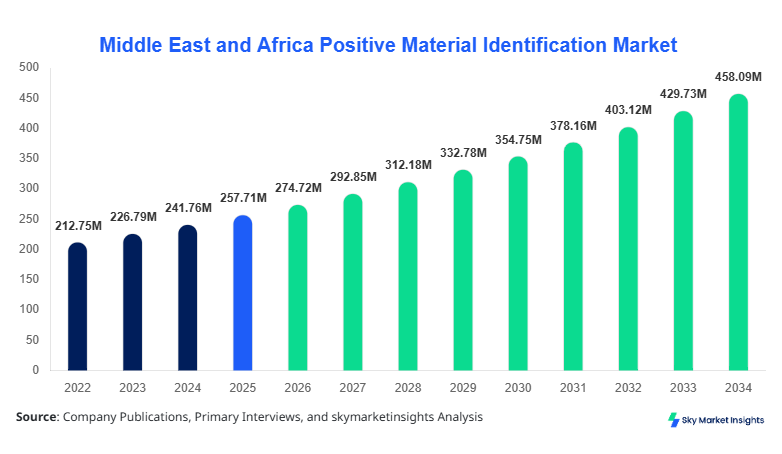
Middle East and Africa Positive Material Identification Market size is projected at USD 274.72 million in 2026 and is expected to hit USD 455.08 million by 2034 with a CAGR of 6.6%. The industry expands from USD 257.94 million in the 2025 base year, representing an absolute forecast-period addition of approximately USD 180.36 million. Demand analysis requires detailed evaluation across technique, offering, form factor, end-use industry, and country-level adoption, alongside assessment of portable analyzer innovation, industrial inspection requirements, and the competitive landscape.
Key Takeaways
- The United Arab Emirates dominates geographically at USD 110.64 million in 2026, equivalent to approximately 40.27% of the regional total, and reaches USD 182.02 million by 2034 at a 6.42% CAGR.
- Turkey is the fastest-growing covered country with a 6.84% CAGR, increasing from USD 14.83 million in 2026 to USD 25.18 million by 2034.
- X-ray Fluorescence (XRF) dominates technique segmentation with USD 125.53 million in 2026, approximately 45.69% of the technique total, reaching USD 208.37 million in 2034.
- Laser-induced breakdown spectroscopy (LIBS) is the fastest-growing technique at a 6.86% CAGR and advances from USD 55.13 million in 2026 to USD 93.74 million by 2034.
- Nigeria represents an emerging country opportunity, expanding from USD 17.18 million in 2026 to USD 28.65 million in 2034 at a 6.60% CAGR.
Positive material identification (PMI) comprises analytical processes and instruments used to determine alloy composition and verify whether metals conform to specified chemistry requirements. In 2026, XRF contributes approximately 45.69% of technique revenue, OES about 34.24%, and LIBS approximately 20.07%. Country concentration remains significant: the UAE contributes approximately 40.27%, South Africa 21.69%, and Saudi Arabia 15.79% of the USD 274.72 million country total. By 2034, the UAE alone contributes USD 182.02 million, while South Africa reaches USD 100.32 million.
Explore more data points, trends and opportunities Download Free Sample Report
Middle East and Africa Positive Material Identification Market Trends
Portable analyzers and faster field-based alloy verification reshape inspection workflows
Portable XRF and LIBS systems are increasingly replacing workflows dependent on sample transport and centralized laboratory analysis. Current handheld XRF platforms can operate across approximately -10°C to 50°C, use excitation systems reaching 50–55 kV, and weigh around 1.9 kg, supporting refinery, mining, recycling, and fabrication inspection in demanding environments. Evident also specifies testing of hot surfaces up to 425°C for PMI applications.
Industrial users increasingly prioritize sub-second or near-real-time identification, digital result transfer, and high-throughput field testing. SciAps states that its 2.8-lb X-550 can provide an initial result in less than 1 second for most PMI applications, while newer XRF platforms incorporate Wi-Fi, Bluetooth, cloud connectivity, silicon-drift detectors, and automated grade comparison. These capabilities support thousands of field measurements while reducing laboratory turnaround and material-mix risks.
Middle East and Africa Positive Material Identification Market Drivers
High hydrocarbon throughput strengthens material-verification requirements
Oil and gas infrastructure remains a major PMI demand generator because pipelines, valves, pressure vessels, welds, and process equipment require alloy verification under corrosion and high-temperature conditions. The UAE averaged approximately 3.4 million barrels/day of crude production during 2025 and held about 4.2 million barrels/day of effective capacity; production reached a reported 4.1 million barrels/day in June 2026. PMI systems capable of operating at temperatures reaching 425°C and identifying residual-element risks therefore have direct applicability across refinery and upstream asset-integrity programs.
Middle East and Africa Positive Material Identification Market Restraints
Capital intensity and analytical limitations constrain universal deployment
No single technology addresses every elemental-analysis requirement. XRF instruments may operate with 8–50 kV excitation and multiple beam filters, while applications involving carbon and certain light elements can require alternative techniques or longer testing cycles. Instruments must also function across temperatures of roughly -10°C to 50°C and humidity approaching 90%, increasing ruggedization and calibration requirements. Consequently, operators balancing hundreds or thousands of tests against equipment, training, calibration, and certification costs may retain third-party testing for specialized assignments.
Middle East and Africa Positive Material Identification Market Opportunities
Mining, recycling and digital field analysis broaden addressable applications
PMI suppliers can extend beyond refinery inspection into mineral exploration, grade control, recycling, fabrication, and environmental analysis. Next-generation handheld systems combine 55 kV excitation, approximately 1.9 kg operating weight, IP64 protection, 3 mm optional beam spots, and wireless data transfer. Such specifications enable rapid ore/waste decisions, scrap sorting, contaminant screening, and field mapping, creating opportunities for equipment vendors and inspection-service providers to increase instrument utilization across multiple industrial workflows.
Challenges in Middle East and Africa Positive Material Identification Market
Maintaining measurement consistency across harsh and diverse operating environments
Regional inspection programs encounter temperature, dust, moisture, geometry, calibration, and operator-related variability. Modern analyzers address these constraints through 4-foot/1.3-meter drop testing, IP54–IP64 protection, 10%–90% operating humidity tolerance, 8-position filtration, and silicon-drift detectors. Nevertheless, consistent interpretation across thousands of measurements requires standardized calibration, trained technicians, documented procedures, and integration with material certificates, particularly where trace-element contamination or residual-element limits determine asset acceptance.
Report Scope
| Report Metric | Details |
|---|---|
| Market Size in 2025 | USD 257.71 Million |
| Market Size in 2026 | USD 274.72 Million |
| Market Size in 2034 | USD 455.08 Million |
| CAGR | 6.6% (2026-2034) |
| Base Year for Estimation | 2025 |
| Historical Data | 2022-2024 |
| Forecast Period | 2026-2034 |
| Report Coverage | Revenue Forecast, Competitive Landscape, Supply Chain Disruption, Growth Factors, Environment & Regulatory Landscape and Trends |
Explore more data points, trends and opportunities Download Free Sample Report
Middle East and Africa Positive Material Identification Market Segmentation
The industry is segmented by technique, offering, form factor, and end use. Among techniques, XRF accounts for approximately 45.69% of 2026 revenue, compared with 34.24% for OES and 20.07% for LIBS. Equipment—particularly handheld analyzers—supports field inspection, while software manages identification records and services address onsite and laboratory testing.
By Technique
X-ray Fluorescence (XRF) is the largest technique, increasing from USD 117.82 million in 2025 to USD 125.53 million in 2026 and USD 208.37 million in 2034 at a 6.54% CAGR. Its approximately 45.69% 2026 contribution reflects broad applicability in alloy identification, scrap sorting, fabrication, and refinery inspection.
LIBS is the fastest-growing technique at a 6.86% CAGR, rising from USD 55.13 million in 2026 to USD 93.74 million by 2034. OES remains substantial, progressing from USD 94.08 million to USD 153.15 million at a 6.28% CAGR.
By Offering
Equipment represents the principal operational component, led by portable/handheld and benchtop analyzers used for elemental verification. Within the quantified technique pool of USD 274.74 million in 2026, XRF-based systems represent USD 125.53 million, illustrating the commercial importance of instrument-led field analysis.
Software and services—including onsite PMI and third-party laboratory testing—complement equipment through documentation, traceability, data management, and specialist analysis. LIBS, the fastest-growing quantified technology supporting equipment workflows, records a 6.86% CAGR through 2034.
By Form Factor
Handheld/portable systems hold strong operational importance because measurements can be performed directly on pipelines, welds, valves, fabricated components, scrap, and mining samples. XRF, the largest quantified technique associated extensively with portable deployment, reaches USD 208.37 million by 2034 at a 6.54% CAGR.
Fixed/benchtop systems remain relevant where controlled testing, repeatability, and centralized laboratory workflows are priorities. LIBS represents the fastest-growing quantified technique at 6.86% CAGR, supporting continued technology diversification across portable and controlled-analysis environments.
By End Use
Oil and gas represents a core application environment because alloy verification is critical across pressure-containing equipment, piping, valves, welds, and corrosion-management programs. XRF leads the quantified technology base at USD 125.53 million in 2026 and USD 208.37 million in 2034, registering 6.54% CAGR.
Aerospace and defense, metals and mining, automotive, power generation, pharmaceuticals, scrap and recycling, construction, and industrial fabrication broaden demand. LIBS records the fastest quantified technique CAGR of 6.86%, supported by requirements for rapid elemental identification and increasingly mobile inspection.
Middle East and Africa Positive Material Identification Market Segmentations
By Technique
- X-ray Fluorescence (XRF)
- Optical Emission Spectroscopy (OES)
- Laser-induced breakdown spectroscopy (LIBS)
By Offering
-
Equipment
- Portable/Handheld Analyzers
- Benchtop Analyzers
- Software
-
services
- Onsite PMI Services
- Third-party Laboratory Testing
By Form Factor
- Handheld/Portable
- Fixed/Benchtop
By End Use
- Oil and Gas
- Aerospace and Defense
- Metals and Mining
- Automotive
- Power Generation
- Pharmaceuticals
- Scrap and Recycling
- Construction
- Manufacturing/Industrial Fabrication
Middle East and Africa Positive Material Identification Market Country Outlook
United Arab Emirates
The UAE accounts for approximately 40.27% of the 2026 regional total, with revenue increasing from USD 110.64 million to USD 182.02 million by 2034 at 6.42% CAGR. Oil and gas, petrochemicals, fabrication, aviation, and construction underpin adoption.
Saudi Arabia
Saudi Arabia contributes approximately 15.79% in 2026. Revenue increases from USD 43.37 million to USD 71.03 million by 2034 at 6.36% CAGR, supported by refinery, petrochemical, pipeline, power, mining, and industrial-fabrication requirements.
South Africa
South Africa represents approximately 21.69% of 2026 revenue and reaches USD 100.32 million by 2034 from USD 59.58 million, recording 6.73% CAGR. Mining, metals processing, power, manufacturing, and recycling provide a diversified application base.
Egypt
Egypt contributes approximately 10.60% in 2026, increasing from USD 29.12 million to USD 47.88 million by 2034 at 6.41% CAGR. Hydrocarbons, construction, power infrastructure, and industrial fabrication support inspection activity.
Nigeria
Nigeria accounts for approximately 6.25% in 2026. The country progresses from USD 17.18 million to USD 28.65 million by 2034 at 6.60% CAGR, with oil and gas infrastructure providing a central demand base.
Turkey
Turkey represents approximately 5.40% in 2026 but records the fastest country CAGR at 6.84%. Revenue advances from USD 14.83 million in 2026 to USD 25.18 million by 2034, supported by manufacturing, metals, automotive, construction, energy, and recycling applications.
Top players in Middle East and Africa Positive Material Identification Market
- Thermo Fisher Scientific Inc.
- Evident Scientific
- Hitachi High-Tech Corporation
- SciAps, Inc.
- Bruker Corporation
- AMETEK, Inc.
- Olympus/Evident
- Malvern Panalytical
- Rigaku Corporation
- Oxford Instruments plc
- Shimadzu Corporation
- HORIBA, Ltd.
- Thermo Scientific Niton
Top two companies
-
Thermo Fisher Scientific Inc. — Competitive positioning
Thermo Fisher participates through its Niton handheld XRF portfolio and maintains strong positioning in portable elemental analysis for metals, mining, manufacturing, and inspection. Exact regional company percentage shares are not provided in the mandatory dataset and therefore are not fabricated. Its competitive position is supported by portable workflows, alloy libraries, field usability, and established analytical-instrument distribution.
-
Evident Scientific — Competitive positioning
Evident competes through Vanta handheld XRF systems targeting PMI, scrap, manufacturing, and mining applications. Exact regional company percentage shares are unavailable in the supplied numerical tables. Vanta platforms support testing on surfaces up to 425°C, while newer configurations provide 50–55 kV excitation, silicon-drift detection and rugged field designs, strengthening the company's position in portable PMI applications.
Recent Developments in Middle East and Africa Positive Material Identification Market
- 2026: Evident's current Vanta Max platform emphasizes 55 kV configurations, IP64 protection, approximately 1.9 kg weight and wireless field-data capabilities for demanding mining and elemental-analysis applications.
- 2026: Regional asset-integrity requirements remained substantial as UAE crude production reached approximately 4.1 million barrels/day in June, increasing the scale of infrastructure exposed to inspection and materials-verification requirements.
- 2025: Evident launched its next-generation Vanta Element handheld XRF series on January 22, introducing two models designed for rapid alloy identification, scrap sorting and metal manufacturing.
- 2025: Vanta Element systems incorporated silicon-drift detection and automated on-screen grade comparison intended to increase alloy-testing throughput and reduce material mix-ups.
- 2025–2026: Portable PMI competition increasingly emphasized rapid measurements; SciAps' X-550 weighs approximately 2.8 lb and delivers initial results in less than 1 second for most PMI applications.
Research Methodology
The assessment uses 2025 as the base year, 2026 as the current year, historical reference years of 2022–2024, and a forecast horizon extending through 2034. The supplied numerical tables serve as the primary source for market totals, country contributions, technique values and CAGRs. Percentage contributions are calculated directly from the provided 2026 totals; qualitative assessment incorporates technology specifications, industrial activity, product developments, end-use exposure and publicly available manufacturer and energy-industry information. No unavailable segment, company-share, production, or revenue figures are fabricated.
Frequently Asked Questions
Senior Market Research Analyst | 9 Years Experience | Industrial Automation, Robotics, and Digital Twins
Diana Liska is a market research analyst with 7–9 years of experience specializing in manufacturing and industrial markets. Contributed to 70+ research reports for global clients. Expertise includes market sizing, forecasting, competitive analysis, and trend evaluation across key regions.