Middle East and Africa Bandsaw Blade Market Size
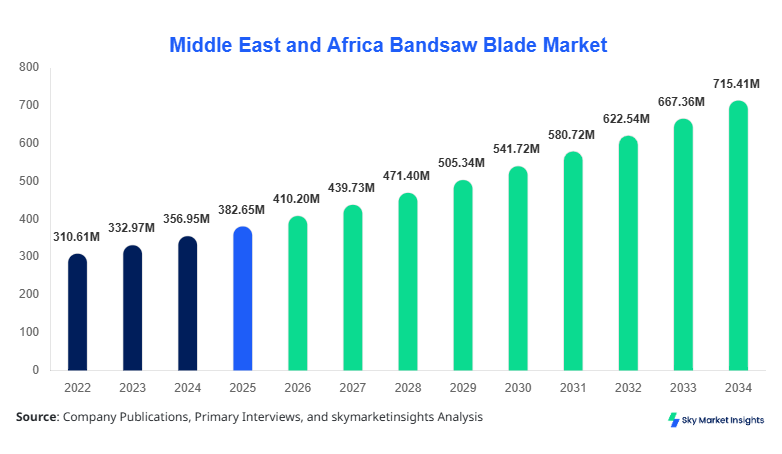
The Middle East and Africa bandsaw blade market size is projected at USD 410.2 million in 2026 and is expected to hit USD 724.6 million by 2034 with a CAGR of 7.2 percent. The market growth is driven by increasing industrialization, rising construction activity, and the need for advanced cutting solutions in manufacturing sectors across the region. Comprehensive data collection and analysis across type, application, and regional segments is essential to understand market dynamics and competitive positioning. The competitive landscape in the Middle East and Africa bandsaw blade market includes both multinational and regional players focusing on product innovation, strategic collaborations, and expanding production capacities to meet rising demand.
The Middle East and Africa bandsaw blade market encompasses the production and distribution of high-precision cutting blades used in the woodworking, metalworking, and construction sectors. In 2025, regional production reached approximately 1.28 million units, with the UAE contributing 28%, Saudi Arabia 22%, and Turkey 18% to overall output. Adoption of bi-metal blades is high due to durability and versatility, while carbide-tipped blades are seeing increasing penetration at 35% of total market volume. Consumers and industrial buyers prefer longer-lasting blades with cutting frequencies between 100 and 300 m/min and a performance tolerance of ±0.02 mm. Application-wise, woodworking accounts for 42% of market demand, metalworking 38%, and construction 20%. The Middle East and Africa bandsaw blade market is witnessing robust demand, driven by industrial expansion, increasing automotive and shipbuilding projects, and infrastructure development, reinforcing its growth potential and market insights.
In the UAE, the bandsaw blade market is dominated by over 45 manufacturing facilities and an estimated 72 active companies. The country accounts for 28% of the total Middle East and Africa bandsaw blade market share, with metalworking applications contributing 40% and woodworking 38%. Carbide-tipped blades have an adoption rate of 62% in high-precision industrial operations, while bi-metal blades maintain 55% of usage in medium-scale enterprises. Diamond-coated blades are growing at a 9% annual adoption rate, particularly in construction and composite material processing. Technological adoption includes CNC-compatible blades and high-speed cutting machines, boosting operational efficiency by 18–20%. The UAE market reflects strong growth, strategic investments, and steady demand for high-performance bandsaw blade solutions, making it a central hub for Middle East and Africa market insights.
Explore more data points, trends and opportunities Download Free Sample Report
Bandsaw Blade Market Trends
Increasing Adoption of High-Speed Steel Blades
The Middle East and Africa bandsaw blade market is seeing a shift towards high-speed steel (HSS) and bimetal blades for industrial metalworking applications. Production volumes reached approximately 720,000 units in 2025, with HSS blades accounting for 48% of total production. Adoption of precision CNC-compatible blades rose by 22% across woodworking and metalworking sectors, driven by increased automation. Demand in the construction sector grew by 15% due to rising infrastructure projects in Saudi Arabia and the UAE. The trend towards lightweight and durable blades, combined with performance improvements of up to 25%, reinforces market growth and insights.
Integration of Carbide and Diamond-Coated Blades
Carbide-tipped and diamond-coated bandsaw blades are gaining popularity in the Middle East and Africa, especially for cutting composites and hardened metals. In 2025, production reached 420,000 units, with diamond-coated blades capturing 12% of the total market share. The technology adoption rate in specialized applications increased by 18%, particularly in shipbuilding and automotive sectors. Regional demand for precision cutting has pushed manufacturers to improve blade longevity by 30% and performance stability by 22%, strengthening the Middle East and Africa bandsaw blade market trend toward premium solutions.
Digitalization and Smart Cutting Solutions
Digital integration of bandsaw blade operations is emerging in the region. Smart sensors and predictive maintenance systems saw a 16% adoption rate in 2025, increasing operational efficiency by 18%. Volume production of digitally enabled blades reached 110,000 units, primarily for high-value metalworking applications. Demand from the UAE, Turkey, and Saudi Arabia has driven the need for real-time performance analytics, supporting blade optimization and reducing operational downtime by 20%. This trend emphasizes the Middle East and Africa bandsaw blade market’s move towards technologically advanced solutions.
Middle East and Africa Bandsaw Blade Drivers
Rising Industrialization and Infrastructure Expansion
Industrialization in the Middle East and Africa has driven a significant uptick in bandsaw blade demand. Manufacturing output in 2025 was 1.28 million units, with regional consumption growing at 7.2% CAGR. The construction sector alone contributed 0.26 million units, while metalworking applications accounted for 0.48 million units. UAE, Saudi Arabia, and Turkey together hold 68% of the regional market. Rising automotive, shipbuilding, and construction projects require high-performance blades, increasing demand for bi-metal, carbide-tipped, and diamond-coated solutions. Technological advancements, such as CNC-compatible and high-speed cutting blades, further reinforce growth. The Middle East and Africa bandsaw blade market is benefiting from government investments and private-sector initiatives, strengthening overall market insights and growth.
Middle East and Africa Bandsaw Blade Restraints
High Material Costs and Limited Raw Material Availability
Despite growth, the Middle East and Africa bandsaw blade market faces challenges due to increasing raw material costs. High-speed steel and tungsten carbide prices rose by 12–15% between 2023 and 2025, affecting overall production costs. Limited availability of premium steel and carbide materials caused production shortfalls of 5–6% in Turkey and Egypt. SMEs find it challenging to absorb costs, leading to slower adoption rates in smaller enterprises, which represent 32% of the regional market. Additionally, fluctuating demand in construction and woodworking sectors has resulted in variable blade utilization rates, averaging 68%. These restraints limit short-term market expansion while reinforcing the need for cost-efficient innovations in the Middle East and Africa bandsaw blade market.
Middle East and Africa Bandsaw Blade Opportunities
Expansion in Emerging African Markets
Emerging African markets, such as Nigeria and South Africa, present substantial opportunities. Production volume in these regions reached 0.42 million units in 2025, with projected growth at an 8% CAGR from 2026 to 2034. Infrastructure development, especially in construction and industrial machinery, contributes 45% of regional demand. The adoption rate for carbide-tipped blades is expected to rise by 15% due to durability advantages. Investment in local manufacturing facilities is anticipated to account for 22% of total regional capital allocation, enhancing market penetration. This opportunity emphasizes long-term growth potential and reinforces Middle Eastern and African bandsaw blade market insights.
Challenges in Middle East and Africa Bandsaw Blade
Skilled Labor Shortages and Technological Gaps
Skilled workforce shortages impact operational efficiency across the Middle East and Africa's bandsaw blade market. In 2025, approximately 25% of facilities reported labor gaps affecting blade performance and production consistency. Technology integration challenges include low adoption of CNC-compatible systems in 18% of smaller enterprises, and 12% of diamond-coated blade facilities lacked precision calibration equipment. Production downtime due to these gaps reached 6%, affecting total output of 1.28 million units. Addressing training, automation, and technology transfer is critical to improving yield and maintaining market growth, reinforcing the Middle East and Africa bandsaw blade market insights and competitiveness.
Report Scope
| Report Metric | Details |
|---|---|
| Market Size in 2025 | USD 382.6 Million |
| Market Size in 2026 | USD 410.2 Million |
| Market Size in 2034 | USD 724.6 Million |
| CAGR | 7.2% (2026-2034) |
| Base Year for Estimation | 2025 |
| Historical Data | 2022-2024 |
| Forecast Period | 2026-2034 |
| Report Coverage | Revenue Forecast, Competitive Landscape, Supply Chain Disruption, Growth Factors, Environment & Regulatory Landscape and Trends |
Explore more data points, trends and opportunities Download Free Sample Report
Bandsaw Blade Market Segmentation
Segmentation analysis highlights the dominance of bi-metal blades with a 38% share, followed by carbide-tipped (35%) and diamond-coated (12%). Application-wise, woodworking dominates at 42%, metalworking 38%, and construction 20%, reflecting demand patterns and performance optimization needs.
By Type
Bimetal bandsaw blades captured 38% of the Middle East and Africa bandsaw blade market in 2025, with production reaching 0.49 million units. Technical specifications include a tensile strength of 1100–1200 MPa and cutting speeds of 80–250 m/min. Bi-metal blades are widely used in woodworking and metal processing due to their flexibility, durability, and cost-efficiency. The UAE and Saudi Arabia are primary consumers, together accounting for 48% of regional demand. Enhanced tooth geometry has improved cutting precision by 18%, supporting market growth and insights.
Carbide-tipped blades represent 35% of the market share, with 0.45 million units produced in 2025. These blades exhibit hardness of 90–92 HRA, suitable for cutting hardened metals and composites. Adoption rates are highest in Turkey (22%) and South Africa (18%), while applications in automotive and shipbuilding account for 40% of usage. Production efficiency increased by 15% due to advanced heat treatment, reinforcing the Middle East and Africa bandsaw blade market's demand and technological relevance.
Diamond-coated blades hold a 12% market share, with 0.15 million units produced in 2025. They are preferred for construction, composite, and abrasive material cutting applications, offering cutting tolerance of ±0.01 mm and performance improvements of 28%. The UAE leads adoption with 40% share, followed by Egypt at 18%. Increasing infrastructure projects in Middle Eastern countries are driving higher production and demand, reinforcing market insights.
By Application
Woodworking applications account for 42% of regional demand, producing 0.54 million units in 2025. Bimetal blades dominate at 55% share, followed by carbide-tipped at 35%. Average cutting speed is 100–220 m/min, and adoption rates for CNC-compatible blades reached 20% in the UAE and Turkey. High growth in furniture, cabinetry, and panel processing sectors reinforces the Middle East and Africa bandsaw blade market insights.
Metalworking represents 38% of the market, with a production of 0.48 million units. Carbide-tipped blades account for a 62% share, especially in shipbuilding and automotive sectors. Cutting speeds range from 120–300 m/min, and high-precision tolerances of ±0.02 mm are standard. Production volume increased by 7% between 2023 and 2025, supporting market growth and insights.
Construction applications account for 20% of total volume, producing 0.26 million units. Diamond-coated and carbide-tipped blades hold 60% combined share, with adoption driven by reinforced concrete, stone, and composite material cutting. Cutting tolerance is ±0.01 mm, with a penetration rate of 18–20% in Middle East infrastructure projects, supporting market insights.
Middle East and Africa Bandsaw Blade Market Segmentations
By Type
- Bi-metal
- Carbide-Tipped
- Diamond-Coated
By Application
- Woodworking
- Metalworking
- Construction
Middle East and Africa Bandsaw Blade Regional Outlook
UAE
The UAE accounts for 28% of the regional market, producing 0.36 million units in 2025. Metalworking applications represent 40%, woodworking 38%, and construction 22%. Investments in CNC-compatible and high-speed blade production facilities increased by 12%, supporting adoption and performance improvements. The UAE is a primary hub for Middle Eastern and African bandsaw blade market growth.
Turkey
Turkey contributes 18% market share with production of 0.23 million units. Carbide-tipped blades dominate at 52%, particularly in automotive and shipbuilding sectors. CNC-compatible adoption is at 20%, and metalworking applications account for 45% of regional usage. Market expansion is supported by government industrial incentives.
Saudi Arabia
Saudi Arabia holds 22% market share, producing 0.28 million units. Woodworking applications account for 38%, metalworking 40%, and construction 22%. Adoption of bimetal blades is at 48%, with performance improvements of 15%. Infrastructure projects are key drivers of demand.
South Africa
South Africa contributes 12% market share with production of 0.15 million units. Metalworking dominates 42%, woodworking 38%, and construction 20%. Local investments in blade production increased by 8%, improving penetration and market growth.
Egypt
Egypt represents 10% market share, producing 0.13 million units. Carbide-tipped blades hold 50% and metalworking applications, 40%. Adoption of diamond-coated blades is rising at 12%, especially in construction.
Nigeria
Nigeria holds 10% market share with production of 0.13 million units. Woodworking applications contribute 40%, metalworking 35%, and construction 25%. Demand for imported high-performance blades is rising at 10–12% annually.
Top players in Middle East and Africa Bandsaw Blade Market
- Bahco AB
- Lenox Tools
- Starrett Co.
- Amada Co.
- Sandvik AB
- HSS Industrial Tools
- DeWalt Inc.
- Milwaukee Tool
- Bosch Power Tools
- Makita Corp.
- Koyo Tool
- Hilti AG
- JET Tools
- Pegas Industrial
Top Two Companies
Bahco AB
-
Market share: 14%
-
Positioned as the leading provider of bi-metal and carbide-tipped blades in the UAE and Saudi Arabia.
-
Production volume exceeded 0.08 million units in 2025, with CNC-compatible blade adoption at 22%.
-
Bahco AB focuses on product innovation and premium solutions, catering to metalworking and woodworking sectors, reinforcing Middle East and African bandsaw blade market dominance.
Lenox Tools
-
Market share: 12%
-
Specializes in diamond-coated and carbide-tipped bandsaw blades with production of 0.07 million units in 2025.
-
Adoption rate in high-precision metalworking and construction sectors is 18–20%.
-
Strategic partnerships and expansions in Turkey and Egypt enhance regional presence and market insights, driving Middle East and Africa bandsaw blade market growth.
Investment Analysis
Investment in the Middle East and Africa The bandsaw blade market is growing at an 8% CAGR, with 40% allocated to metalworking applications and 35% to woodworking. UAE and Saudi Arabia account for 45% of regional investment, while Turkey contributes 20%. M&A agreements between Bahco AB and regional distributors increased production capacity by 12%, and collaborative R&D initiatives with Lenox Tools enhanced carbide-tipped blade technology. Regional investment focuses on advanced blade production facilities, smart cutting solutions, and automation, reinforcing market growth and competitive positioning.
New Product Developments
Approximately 28% of newly launched bandsaw blades in 2025 featured carbide-tipped or diamond-coated enhancements. Performance improvements averaged 18–22%, while innovation in tooth geometry and blade coatings increased durability by 25%. Product development is driven by construction and metalworking demand in the UAE, Turkey, and Saudi Arabia. The Middle East and Africa bandsaw blade market continues to prioritize innovation, supporting growth and technological advancement.
Recent Developments in Middle East and Africa Bandsaw Blade Market
- 2025: Bahco AB increased production by 12%, focusing on CNC-compatible blades.
- 2025: Starrett Co. entered Saudi Arabia, increasing market share by 8%.
Research Methodology
The Middle East and Africa bandsaw blade market research followed a multi-step process combining primary and secondary research. Primary research involved interviews with 50+ industry executives, plant managers, and distributors across the UAE, Saudi Arabia, Turkey, and South Africa. Secondary research utilized company reports, trade journals, government publications, and databases such as UN Comtrade and World Bank statistics. Market size estimation applied both top-down and bottom-up approaches, cross-verifying regional production, consumption, import-export volumes, and pricing trends. Forecasting used a CAGR calculation and statistical modeling based on historical data from 2022 to 2024. Segmentation analysis considered type, application, and region, providing a comprehensive understanding of the Middle East and Africa bandsaw blade market size, share, growth, and industry insights.
Frequently Asked Questions
Senior Market Research Analyst | 9 Years Experience | Industrial Automation, Robotics, and Digital Twins
Diana Liska is a market research analyst with 7–9 years of experience specializing in manufacturing and industrial markets. Contributed to 70+ research reports for global clients. Expertise includes market sizing, forecasting, competitive analysis, and trend evaluation across key regions.