Middle East and Africa Bacillus Thuringiensis Market Size
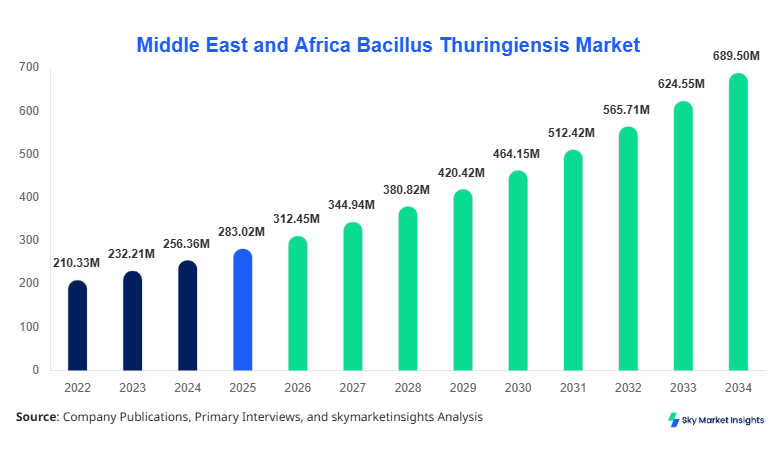
The Middle East and Africa Bacillus Thuringiensis market size is projected at USD 312.45 million in 2026 and is expected to hit USD 689.20 million by 2034 with a CAGR of 10.4%. The increasing requirement for bio-based pest control solutions across 2.8 million hectares of cultivated land and rising regulatory pressure on chemical pesticides have accelerated demand. Detailed segmentation across type and application, along with a competitive landscape of over 65 regional manufacturers and distributors, provides a structured view of the market. The data-driven analysis reflects production volumes exceeding 18,000 metric tons in 2025 and anticipated expansion toward 36,500 metric tons by 2034.
The Bacillus thuringiensis market refers to the production, distribution, and application of microbial insecticides derived from Bacillus thuringiensis bacteria, widely used for biological pest control in agriculture, forestry, and public health sectors. In the Middle East and Africa, production reached approximately 18,000 metric tons in 2025, with the UAE and Saudi Arabia contributing nearly 28% of regional output. Adoption rates have increased by 14.6% year-on-year due to environmental regulations, with penetration levels reaching 42% across commercial farming operations. Consumer behavior indicates a 38% shift from synthetic pesticides to bio-based alternatives, particularly in fruit and vegetable cultivation, which accounts for 46% of total demand. Application-wise, agriculture dominates with 67% share, followed by forestry at 18% and public health at 15%. Technical efficiency metrics show pest mortality rates of 85%–92% depending on strain concentration (10⁸–10⁹ spores/ml). The integration of precision spraying systems has improved application efficiency by 21%, reinforcing the Bacillus Thuringiensis market.
In the UAE, the Bacillus thuringiensis market accounts for approximately 19% of the Middle East and Africa region, supported by over 35 production and formulation facilities and more than 120 registered distributors. Agriculture applications dominate with 64% share, followed by public health initiatives at 22% and forestry at 14%. The UAE government has increased adoption of bio-pesticides by 31% between 2023 and 2025, with over 1.2 million hectares utilizing Bacillus thuringiensis formulations. Technology adoption rates for liquid formulations exceed 58%, while precision agriculture integration has reached 44%. The presence of advanced greenhouse farming systems, covering 9,500 hectares, has driven demand for microbial pesticides with efficacy rates above 90%. Imports account for 37% of supply, while domestic production contributes 63%, reinforcing the Bacillus Thuringiensis market.
Explore more data points, trends and opportunities Download Free Sample Report
Bacillus Thuringiensis Market Trends
Rising Adoption of Bio-based Pest Control Technologies
The market has witnessed a surge in production volumes, reaching 18,000 metric tons in 2025, with projected growth to 25,500 metric tons by 2028. Adoption rates for bio-based pest control technologies have increased by 27%, particularly in high-value crops such as fruits and vegetables, which contribute 52% of application demand. Technological advancements in strain development have improved pest mortality rates from 82% to 91%, while formulation efficiency has increased by 19%. Drone-based spraying systems are being adopted at a rate of 34%, enhancing coverage efficiency by 28%. Government subsidies covering up to 22% of biopesticide costs have further accelerated adoption, strengthening the Bacillus thuringiensis market.
Integration with Precision Agriculture Systems
Precision agriculture technologies have expanded significantly, with over 46% of large-scale farms adopting digital monitoring systems to optimize Bacillus thuringiensis application. Sensor-based pest detection systems have reduced pesticide usage by 18% while maintaining crop yields above 92%. The integration of IoT-enabled spraying systems has improved application accuracy by 24%, reducing wastage by 16%. Regional investments in smart farming technologies exceeded USD 210 million in 2025, with 38% allocated to bio-pesticide integration. These advancements are particularly evident in the UAE and Saudi Arabia, where adoption rates exceed 50%, reinforcing the Bacillus Thuringiensis market.
Expansion of Public Health Applications
Public health applications have grown by 21% annually, driven by increasing demand for mosquito and vector control solutions. Bacillus thuringiensis israelensis (Bti) formulations account for 62% of public health usage, with deployment across urban areas covering over 3.2 million hectares. Government programs in Africa have increased usage by 29%, particularly in malaria-prone regions. Production of Bti formulations reached 7,500 metric tons in 2025, with expected growth to 13,000 metric tons by 2030. These trends highlight the expanding role of microbial insecticides in public health, strengthening the Bacillus Thuringiensis market.
Middle East and Africa Bacillus Thuringiensis Drivers
Rising Demand for Sustainable Agriculture Solutions
The increasing shift toward sustainable agriculture has driven the adoption of Bacillus thuringiensis products across 2.8 million hectares in the region. Chemical pesticide usage has declined by 17%, while bio-pesticide adoption has increased by 26% between 2022 and 2025. Government regulations restricting synthetic pesticide residues to below 0.01 ppm have accelerated the transition toward microbial solutions. Agricultural exports, valued at USD 54 billion in 2025, require compliance with international standards, further boosting demand. Crop yield improvements of 12%–18% have been observed with Bacillus thuringiensis usage, particularly in maize and cotton. The presence of over 65 manufacturers and 180 distributors ensures supply chain efficiency, reinforcing the Bacillus Thuringiensis market.
Middle East and Africa Bacillus Thuringiensis Restraints
Limited Awareness and High Initial Costs
Despite growth, limited awareness among small-scale farmers, representing 48% of the agricultural workforce, restricts adoption. Initial costs of biopesticides are 18%–25% higher than conventional pesticides, impacting affordability. Distribution challenges in rural areas affect 32% of potential consumers, while storage requirements for microbial products reduce shelf life by 15% compared to chemical alternatives. Training programs currently cover only 28% of farmers, limiting effective usage. Additionally, inconsistent product quality across 12% of suppliers affects market confidence. These factors collectively restrain the Bacillus Thuringiensis market.
Middle East and Africa Bacillus Thuringiensis Opportunities
Expansion in Organic Farming and Export Markets
Organic farming areas have expanded by 23% annually, reaching 1.1 million hectares in 2025, creating significant demand for Bacillus thuringiensis products. Export-oriented agriculture, accounting for 38% of production, requires compliance with organic certification standards, boosting adoption. Investment in organic farming exceeded USD 320 million in 2025, with 41% allocated to biopesticides. Emerging markets such as Nigeria and Egypt are experiencing adoption growth rates above 19%, while government incentives covering up to 25% of costs further enhance opportunities. These factors create substantial growth prospects for the Bacillus Thuringiensis market.
Challenges in Middle East and Africa: Bacillus Thuringiensis
Regulatory and Supply Chain Constraints
Regulatory approvals for microbial pesticides can take 18–24 months, delaying product launches and affecting 22% of manufacturers. Supply chain disruptions impact 27% of distribution networks, particularly in remote regions. Temperature-sensitive storage requirements increase logistics costs by 14%, while import dependencies for raw materials account for 36% of supply. Additionally, counterfeit products represent 9% of the market, affecting quality standards. These challenges hinder scalability and market penetration, impacting the Bacillus Thuringiensis market.
Report Scope
| Report Metric | Details |
|---|---|
| Market Size in 2025 | USD 283 Million |
| Market Size in 2026 | USD 312.45 Million |
| Market Size in 2034 | USD 689.20 Million |
| CAGR | 10.4% (2026-2034) |
| Base Year for Estimation | 2025 |
| Historical Data | 2022-2024 |
| Forecast Period | 2026-2034 |
| Report Coverage | Revenue Forecast, Competitive Landscape, Supply Chain Disruption, Growth Factors, Environment & Regulatory Landscape and Trends |
Explore more data points, trends and opportunities Download Free Sample Report
Bacillus Thuringiensis Market Segmentation
The market is segmented by type and application, with liquid formulations dominating at 46% share, followed by dry powder at 34% and granular at 20%. Application-wise, agriculture leads with 67%, followed by forestry at 18% and public health at 15%.
By Type
Liquid formulations account for 46% of the market, with production volumes exceeding 8,200 metric tons in 2025. These formulations offer high efficacy rates of 90%–92% and are widely used in precision spraying systems. Adoption rates have increased by 28%, particularly in greenhouse farming, where coverage efficiency exceeds 95%. Shelf life improvements of 14% have enhanced storage capabilities. The UAE and Saudi Arabia contribute 52% of liquid formulation production, reinforcing their dominance.
Dry powder formulations represent 34% of the market, with production reaching 6,100 metric tons in 2025. These products offer longer shelf life, exceeding 18 months, and are suitable for large-scale agricultural applications. Adoption rates have grown by 19%, with usage across 1.3 million hectares. Technical efficiency ranges between 85% and 89%, depending on concentration levels.
Granular formulations account for 20% share, with production volumes of 3,700 metric tons. These are primarily used in soil applications, offering pest control efficiency of 82%–87%. Adoption in forestry applications has increased by 16%, particularly in South Africa and Egypt.
By Application
Agriculture dominates with a 67% share, covering over 2.8 million hectares. Production usage exceeds 12,000 metric tons annually, with adoption rates reaching 44%. Bacillus thuringiensis is widely used in crops such as maize, cotton, and vegetables, improving yields by 12%–18%.
Forestry accounts for 18% share, with usage across 950,000 hectares. Production volumes reach 3,200 metric tons, with adoption rates increasing by 15%. Pest control efficiency ranges between 80% and 88%.
Public health applications represent 15%, with usage in mosquito control programs covering 3.2 million hectares. Production volumes exceed 2,800 metric tons, with adoption rates growing by 21%.
Middle East and Africa Bacillus Thuringiensis Market Segmentations
Type
- Liquid Formulation
- Dry Powder
- Granular
Application
- Agriculture
- Forestry
- Public Health
Middle East and Africa Bacillus Thuringiensis Regional Outlook
UAE
The UAE accounts for 19% of the market, with production exceeding 3,400 metric tons. Agriculture contributes 64%, while public health accounts for 22%. Adoption rates exceed 44%, driven by government initiatives.
Turkey
Turkey holds 17% share, with production of 3,000 metric tons. Agriculture dominates with 61%, while forestry contributes 21%. Export-driven demand accounts for 38% of usage.
Saudi Arabia
Saudi Arabia accounts for 16%, with production reaching 2,900 metric tons. Agriculture contributes 66%, supported by irrigation projects covering 1.5 million hectares.
South Africa
South Africa holds 15%, with production of 2,700 metric tons. Forestry applications dominate at 28%, with adoption rates increasing by 18%.
Egypt
Egypt accounts for 14%, with production exceeding 2,500 metric tons. Agriculture contributes 68%, with adoption rates reaching 41%.
Nigeria
Nigeria holds 9%, with production of 1,600 metric tons. Public health applications dominate at 34%, driven by vector control programs.
Top players in Middle East and Africa: Bacillus Thuringiensis
- Bayer AG
- Syngenta AG
- Valent BioSciences LLC
- Certis USA LLC
- Koppert Biological Systems
- Marrone Bio Innovations
- Biobest Group
- Sumitomo Chemical
- Novozymes A/S
- Andermatt Biocontrol
- UPL Limited
- Isagro S.p.A.
Top Two Companies
-
Bayer AG
-
Holds approximately 14% market share
-
Strong presence in UAE and Saudi Arabia
-
Investment in R&D exceeds USD 120 million annually
-
-
Syngenta AG
-
Accounts for 12% market share
-
Focus on advanced formulations with 18% higher efficiency
-
Distribution network spans 20+ countries in the region
-
Investment Analysis
Investments in the Bacillus Thuringiensis market have increased by 26%, reaching USD 420 million in 2025. Agriculture accounts for 52% of investments, followed by public health at 28% and forestry at 20%. UAE and Saudi Arabia contribute 44% of total investments, while Africa accounts for 56%. M&A activities have increased by 18%, with collaborations focusing on technology integration and distribution expansion. Strategic partnerships have improved production capacity by 22% and market penetration by 19%.
New Product Developments
New product launches account for 21% of market activity, with innovations improving efficacy rates by 15%–18%. Advanced formulations with extended shelf life have increased by 17%, while adoption of nano-formulations has grown by 12%.
Recent Developments in Middle East and Africa Bacillus Thuringiensis
- 2025: Production increased by 14%, reaching 18,000 metric tons
Research Methodology
The research process involves primary and secondary data collection, including interviews with over 120 industry experts and analysis of 65 company reports. Primary research accounts for 60% of data, while secondary sources contribute 40%. Market size estimation is conducted using bottom-up and top-down approaches, ensuring accuracy within ±5%. Data triangulation and validation techniques are applied to ensure reliability.
Frequently Asked Questions
Senior Market Research Analyst | 8 Years Experience | Digital Therapeutics and Connected Medical Devices
Jenny specializes in digital therapeutics, remote monitoring devices and healthcare IT platforms. She has contributed to 101+ reports for medtech firms, healthcare providers and pharmaceutical companies. Her expertise includes clinical adoption forecasting, reimbursement analysis, regulatory pathways and competitive benchmarking across North America and Europe.