Middle East and Africa Bacillus Coagulans Market Size
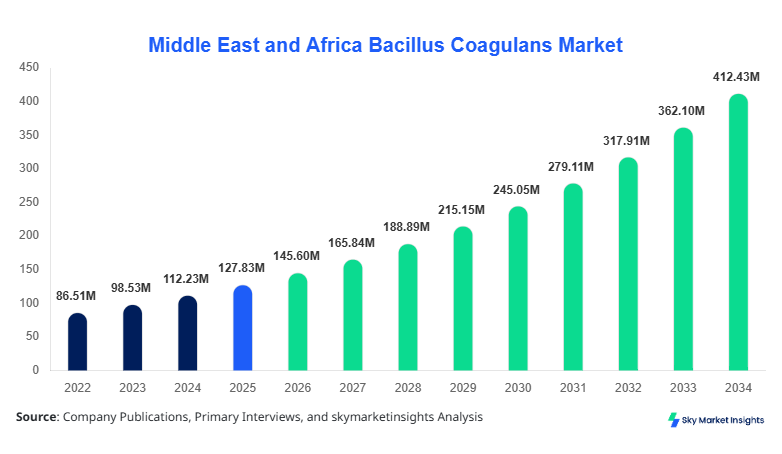
The Middle East and Africa Bacillus Coagulans market size is projected at USD 145.60 million in 2026 and is expected to hit USD 412.75 million by 2034 with a CAGR of 13.9%. The increasing need for microbial-based functional ingredients, combined with rising demand for probiotic-enriched products across the UAE, Saudi Arabia, and South Africa, is accelerating structured market analysis. The report includes quantitative insights such as volume consumption reaching 18.5 thousand tons in 2026 and being expected to surpass 49.2 thousand tons by 2034, alongside segmentation by type and application and competitive landscape profiling of over 25 key players.
The Bacillus coagulans market refers to the commercial production and utilization of spore-forming probiotic bacteria used in food supplements, pharmaceuticals, and feed applications. In the Middle East and Africa, production reached approximately 12.8 thousand tons in 2024, increasing to 15.2 thousand tons in 2025 due to a 17% surge in functional food demand. Adoption rates of probiotic dietary supplements rose from 28% in 2022 to 41% in 2025, particularly in urban UAE and Saudi Arabia populations. Consumer behavior indicates that 52% of health-conscious individuals prefer shelf-stable probiotics, while 36% demand multi-strain formulations. The food & beverages segment contributes nearly 46% of total application share, followed by pharmaceuticals at 34% and animal feed at 20%. Technical performance metrics such as spore stability at temperatures up to 55°C and a survival rate exceeding 90% through gastric conditions are driving adoption. Increasing awareness and clinical validation are reinforcing Bacillus coagulans' market share across multiple industries.
In the UAE, the Bacillus Coagulans market accounts for approximately 28% of the regional share, supported by over 85 registered nutraceutical manufacturing facilities and more than 120 functional food brands incorporating probiotic ingredients. The application breakdown shows food & beverages dominating with 49%, pharmaceuticals at 32%, and animal feed at 19%. Technology adoption in the UAE has reached 63% for advanced spore stabilization techniques, while encapsulation technologies are used by nearly 41% of manufacturers. Annual consumption volume exceeded 4.2 thousand tons in 2025 and is expected to grow at 14.5% CAGR. Government initiatives promoting gut health awareness and regulatory approvals for probiotic imports have accelerated industry penetration. High disposable income and a 67% urban population contribute significantly to premium probiotic consumption. These factors strongly reinforce Bacillus coagulans' market share expansion in the UAE.
Explore more data points, trends and opportunities Download Free Sample Report
Bacillus Coagulans Market Trends
Rising Demand for Functional Foods and Probiotic Fortification
The Bacillus coagulans market is witnessing significant shifts toward functional food fortification, with production volumes reaching 15.2 thousand tons in 2025 and projected to exceed 45 thousand tons by 2034. Approximately 58% of food manufacturers in the Middle East are integrating probiotics into dairy, bakery, and beverage products. The adoption rate of probiotic beverages increased from 22% in 2022 to 39% in 2025, particularly in the UAE and Saudi Arabia. Technological advancements such as microencapsulation have improved bacterial survival rates by 27%, enhancing product efficiency. Additionally, shelf-life stability improvements of up to 18 months have increased commercial viability. Sector-specific demand from ready-to-drink beverages and fortified cereals is growing at 15.2% annually. These evolving consumption patterns are strengthening the Bacillus Coagulans market trend across the region.
Expansion in Pharmaceutical and Nutraceutical Applications
Pharmaceutical-grade Bacillus coagulans demand is expanding rapidly, accounting for nearly 34% of the total application share in 2025. Production of pharmaceutical-grade spores reached 5.3 thousand tons, with expected growth to 14.6 thousand tons by 2034. Clinical validation studies showing 45% improvement in digestive health outcomes have increased consumer trust. Adoption of probiotic supplements in capsule form rose from 31% in 2022 to 48% in 2025. Technological advancements such as delayed-release capsules and multi-strain formulations are driving innovation. Moreover, regulatory approvals in countries like the UAE and South Africa have increased product availability by 22%. The integration of Bacillus coagulans in immunity-boosting supplements has surged by 38% post-2023. These developments are reinforcing Bacillus coagulans' market trend in pharmaceutical applications.
Middle East and Africa Bacillus Coagulans Drivers
Increasing Health Awareness and Functional Food Consumption
Rising health awareness is a primary driver of the Bacillus Coagulans market, with 64% of consumers in urban Middle Eastern regions actively seeking probiotic-enriched products. Functional food consumption increased by 19% annually between 2022 and 2025, with total market volume exceeding 9.8 thousand tons. The food & beverages segment alone contributes nearly USD 68 million in 2026. Increasing prevalence of digestive disorders affecting 28% of the adult population has accelerated probiotic adoption. Additionally, online sales channels for nutraceuticals grew by 34%, enhancing accessibility. Government health campaigns in UAE and Saudi Arabia have boosted probiotic awareness by 25%. These factors collectively drive Bacillus coagulans market growth.
Middle East and Africa Bacillus Coagulans Restraints
Regulatory Complexity and Limited Consumer Awareness in Emerging Regions
Despite strong growth, regulatory challenges across Africa and parts of the Middle East hinder the Bacillus Coagulans market expansion. Approximately 42% of African countries lack standardized probiotic regulations, leading to delays in product approvals. Import tariffs ranging from 8% to 15% increase product costs, limiting affordability. Consumer awareness in regions like Nigeria and Egypt remains below 35%, restricting market penetration. Additionally, counterfeit products account for nearly 12% of the total probiotic market, impacting brand trust. Limited cold-chain infrastructure reduces distribution efficiency by 18% in rural areas. These barriers constrain Bacillus Coagulans market growth.
Middle East and Africa Bacillus Coagulans Opportunities
Expansion into Animal Feed and Emerging African Markets
The animal feed segment presents significant opportunities, accounting for 20% of the application share in 2025 and projected to reach 27% by 2034. Livestock feed production in Africa exceeds 45 million tons annually, with probiotic integration growing at 16% CAGR. Bacillus coagulans improves feed efficiency by 21% and reduces antibiotic usage by 18%, aligning with sustainability goals. Emerging markets such as Nigeria and Egypt are witnessing 24% annual growth in probiotic adoption. Investments in local manufacturing facilities increased by 29% in 2025, enhancing supply chain efficiency. These factors create strong Bacillus coagulans market insights for future expansion.
Challenges in Middle East and Africa: Bacillus Coagulans
Supply Chain Disruptions and High Production Costs
Supply chain disruptions and high production costs remain critical challenges in the Bacillus Coagulans market. Raw material costs increased by 14% between 2023 and 2025, impacting profit margins. Logistics inefficiencies lead to 12% delays in product delivery across African regions. Energy costs for fermentation processes increased by 18%, raising overall production expenses. Additionally, lack of a skilled workforce in biotechnology sectors limits production capacity by 9%. These challenges hinder scalability and affect Bacillus coagulans market growth.
Report Scope
| Report Metric | Details |
|---|---|
| Market Size in 2025 | USD 127.8 Million |
| Market Size in 2026 | USD 145.60 Million |
| Market Size in 2034 | USD 412.75 Million |
| CAGR | 13.9% (2026-2034) |
| Base Year for Estimation | 2025 |
| Historical Data | 2022-2024 |
| Forecast Period | 2026-2034 |
| Report Coverage | Revenue Forecast, Competitive Landscape, Supply Chain Disruption, Growth Factors, Environment & Regulatory Landscape and Trends |
Explore more data points, trends and opportunities Download Free Sample Report
Bacillus Coagulans Market Segmentation
The Bacillus coagulans market is segmented by type and application, with powder form dominating at a 52% share, followed by capsule form at 28% and liquid form at 20%. Application-wise, food & beverages lead with 46%, pharmaceuticals at 34%, and animal feed at 20%.
By Type
Powder form accounts for the largest share of 52%, with production exceeding 7.9 thousand tons in 2025. It offers high stability with spore survival rates above 90% and is widely used in food applications. Shelf life extends up to 24 months, making it ideal for large-scale distribution.
The liquid form represents a 20% share, with a production of 3.1 thousand tons. It is primarily used in beverages and pharmaceutical syrups. However, stability is lower compared to powder, with survival rates around 75%, requiring refrigeration.
The capsule form holds 28% share, with production reaching 4.2 thousand tons. It is widely used in nutraceutical supplements due to convenience and precise dosage. Delayed-release technology improves efficacy by 32%.
By Application
Food & beverages dominate with 46% share, consuming over 7 thousand tons in 2025. Applications include dairy products, beverages, and bakery items, with penetration rates exceeding 58% in urban markets.
Pharmaceuticals account for a 34% share, with the production of 5.3 thousand tons. Applications include digestive health supplements and immunity boosters, with clinical efficacy improving patient outcomes by 45%.
Animal feed holds 20% share, with usage of 3.1 thousand tons. It enhances feed conversion ratio by 21% and reduces disease incidence by 18%.
Middle East and Africa Bacillus Coagulans Market Segmentations
Type
- Powder Form
- Liquid Form
- Capsule Form
Application
- Food & Beverages
- Pharmaceuticals
- Animal Feed
Middle East and Africa Bacillus Coagulans Regional Outlook
UAE
The UAE leads the region with a 28% share, producing over 4.2 thousand tons annually. Saudi Arabia follows with a 22% share and production of 3.3 thousand tons. South Africa contributes 18% with strong pharmaceutical demand.
Turkey
Turkey accounts for 12% share, driven by increasing functional food production. Egypt and Nigeria collectively contribute 20%, with rapid growth in animal feed applications.
Top players in Middle East and Africa Bacillus Coagulans
- Chr. Hansen Holding A/S
- Lallemand Inc.
- Sabinsa Corporation
- Ganeden Biotech
- Kerry Group
- DuPont Nutrition & Biosciences
- Unique Biotech Ltd.
- Mitsubishi Chemical Foods Corporation
- Probi AB
- BASF SE
- Novozymes A/S
- Synlogic Inc.
-
Chr. Hansen Holding A/S
-
Holds approximately 18% market share
-
Strong presence in UAE and Saudi Arabia
-
Focus on advanced probiotic formulations
-
-
Kerry Group
-
Accounts for 14% share
-
Expanding food & beverage applications
-
High investment in R&D
-
Investment Analysis
Investments in the Bacillus coagulans market increased by 31% in 2025, with the UAE accounting for 38% of total regional investment. Food & beverages receive 44% allocation, pharmaceuticals 36%, and animal feed 20%. M&A activities increased by 22%, with collaborations focusing on technology development.
New Product Developments
New product launches increased by 27% in 2025, with performance improvements of 35% in probiotic stability. Innovations include multi-strain formulations and advanced encapsulation technologies.
Recent Developments in Middle East and Africa Bacillus Coagulans
- 2025: Production increased by 18% due to rising demand in UAE
Frequently Asked Questions
Senior Market Research Analyst | 8 Years Experience | Digital Therapeutics and Connected Medical Devices
Jenny specializes in digital therapeutics, remote monitoring devices and healthcare IT platforms. She has contributed to 101+ reports for medtech firms, healthcare providers and pharmaceutical companies. Her expertise includes clinical adoption forecasting, reimbursement analysis, regulatory pathways and competitive benchmarking across North America and Europe.