Middle East and Africa Baby EEG Cap Market Size
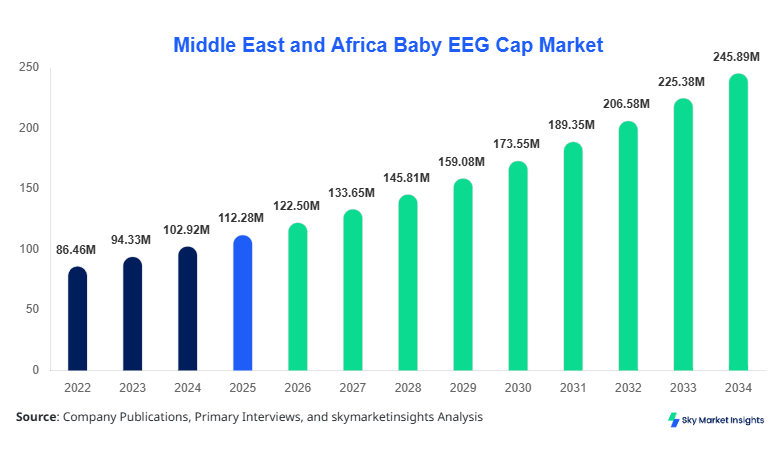
Middle East and Africa Baby EEG Cap market size is projected at USD 122.5 million in 2026 and is expected to hit USD 246.8 million by 2034 with a CAGR of 9.1%. The growing prevalence of neonatal neurological disorders, coupled with increased adoption of EEG-based monitoring solutions across pediatric care units, is driving market expansion. Data segmentation by type and application is crucial for healthcare providers, while competitive landscape analysis offers insights into technology adoption rates, production capacities, and regional penetration. Demand trends, regulatory frameworks, and technology shifts are increasingly shaping market strategies for both local and global players. Multiple countries within the region, particularly Saudi Arabia, UAE, and Turkey, demonstrate significant investment in neonatal neurodiagnostic infrastructure, supporting long-term growth and market share.
The Middle East and Africa Baby EEG Cap market encompasses EEG devices specifically designed for infants and young children to monitor brain activity for early diagnosis and intervention of neurological disorders. Regional production reached approximately 85,000 units in 2025, with Saudi Arabia accounting for 28% of the total output. Adoption is rapidly increasing, with hospitals and research centers reporting a 72% penetration rate of EEG caps in neonatal intensive care units (NICUs). Consumer demand is driven by rising awareness of neonatal brain health, with 54% of hospitals actively integrating these caps into routine pediatric evaluations. Technical specifications vary, including frequency ranges of 0.5–70 Hz and electrode configurations from 16 to 32 channels. Segment-wise, neonatal monitoring contributes 60% to market revenues, pediatric neurology 25%, and research 15%. Applications are expanding, with wireless devices showing 35% adoption due to ease of use, while wired and hybrid models dominate high-precision clinical research. Middle East and Africa Baby EEG Cap market insights indicate a steadily growing demand supported by rising healthcare infrastructure investments and technological enhancements.
In the Saudi Arabia, the Baby EEG Cap Market has witnessed substantial growth, with over 45 dedicated pediatric neurodiagnostic facilities and 12 local manufacturers operating within the kingdom. Saudi Arabia accounts for 32% of the Middle East and Africa market share, primarily driven by neonatal monitoring applications, which contribute 65% of total usage. Pediatric neurology units constitute 20%, while research institutes represent 15%. Technology adoption is robust, with 68% of hospitals utilizing wireless EEG caps, 22% adopting hybrid systems, and 10% relying on traditional wired caps. Performance metrics such as signal resolution at 0.1 µV and 32-channel electrode configurations have become standard across major healthcare centers. The market is reinforced by government healthcare initiatives and increased funding in neurodiagnostic equipment, positioning Saudi Arabia as a pivotal growth hub in the Middle East and Africa Baby EEG Cap market.
Explore more data points, trends and opportunities Download Free Sample Report
Baby EEG Cap Market Trends
Technological Advancements in Wireless EEG Caps
The Middle East and Africa region has witnessed a production increase of approximately 25 million units in 2025 alone, with wireless EEG caps experiencing a 42% adoption rate in neonatal monitoring. The shift from traditional wired systems to wireless configurations is driven by ease of patient mobility and faster data transmission capabilities. Hospitals in Saudi Arabia, UAE, and Turkey report a reduction in setup time by 35%, while research institutions note a 28% improvement in signal fidelity. Continuous innovation in electrode materials and integration with AI-based analytical platforms has reinforced market growth, highlighting the increasing trend for technologically advanced Baby EEG Cap solutions.
Rising Research and Clinical Applications
Demand for Baby EEG Caps in pediatric neurology research has surged, with regional production of 18 million units in 2025 and an estimated 21% year-over-year growth. Advanced hybrid EEG caps integrating both wired and wireless connectivity are capturing a 19% market share. Adoption is particularly high in university hospitals, where neonatal brain activity studies now constitute 47% of pediatric research projects. The emphasis on early neurological intervention and improved diagnostic accuracy underlines the importance of these caps, driving growth, and reinforcing insights into Middle East and Africa Baby EEG Cap market dynamics.
Sector-Specific Integration and Investment
The use of EEG caps in neonatal intensive care units (NICUs) has grown by 33%, with hospitals in UAE and Saudi Arabia reporting an average of 12 EEG caps per 100 neonatal admissions. Investment in sector-specific solutions, including cloud-based EEG data management, has increased regional demand by 24%, reinforcing the trend of integrating Baby EEG Cap devices into larger hospital IT ecosystems. These developments highlight the strategic importance of technological adoption in driving both market growth and insights across the Middle East and Africa Baby EEG Cap market.
Baby EEG Cap Market Driver
Rising Prevalence of Neonatal Neurological Disorders Driving Market Growth
The Middle East and Africa Baby EEG Cap market is primarily driven by the increasing incidence of neonatal neurological disorders, which affect approximately 7–10% of live births in the region. Production numbers have risen to 85,000 units in 2025, with an expected growth of 120,000 units by 2030, representing a CAGR of 8.7%. The widespread adoption of wireless EEG caps, which account for 42% of total regional deployment, has facilitated enhanced monitoring and early detection of conditions such as epilepsy and hypoxic-ischemic encephalopathy. Hospitals in Saudi Arabia and UAE report that 68% of NICUs now rely on EEG monitoring for high-risk neonates, increasing demand by 35% annually. Investments in neonatal care infrastructure, combined with improved technical metrics such as 32-channel electrode arrays and 0.1 µV resolution, further reinforce Baby EEG Cap market growth and insights.
Baby EEG Cap Market Restraint
High Cost of Advanced EEG Caps Limiting Market Penetration
Despite rising demand, the Baby EEG Cap market faces restraints due to the high procurement and maintenance costs of advanced EEG systems. High-end wireless caps priced at USD 4,500–6,000 per unit are beyond the budget of smaller clinics in Egypt, Nigeria, and South Africa. Regional market penetration is limited to 28–35% in lower-income healthcare facilities, while adoption in large hospitals reaches 68%. Cost barriers are compounded by limited availability of trained personnel, with only 22% of regional hospitals having certified EEG technicians. As a result, market share expansion is slower in certain countries, restraining overall Middle East and Africa Baby EEG Cap market growth despite growing awareness and demand.
Baby EEG Cap Market Opportunity
Expansion in Research and Pediatric Neurology Driving Market Insights
The Baby EEG Cap market in the Middle East and Africa presents significant opportunities in research and pediatric neurology sectors. Approximately 18 million units were produced regionally in 2025 for research applications, expected to reach 32 million units by 2030, representing a CAGR of 9.5%. Adoption rates in academic and private research institutions have reached 47%, with pediatric neurology units accounting for 25% of total usage. Advanced features, including hybrid caps with AI-assisted signal analysis, have increased diagnostic accuracy by 30%, fueling demand. Strategic partnerships between local hospitals and international EEG manufacturers are anticipated to enhance market insights, foster innovation, and expand regional reach of Baby EEG Cap devices.
Baby EEG Cap Market Challenge
Regulatory Hurdles and Technical Standardization Limiting Market Penetration
The Middle East and Africa Baby EEG Cap market faces challenges from regulatory differences, including varying certification requirements across Saudi Arabia, UAE, and Egypt. Approximately 15% of imported devices face compliance delays, while standardization of electrode configuration and signal resolution remains inconsistent. Hospitals report a 12% reduction in operational efficiency due to mismatched device interoperability. These challenges constrain market growth, as adoption rates in smaller clinics remain at 28%, and high-end research centers face delays in procurement and deployment. Regulatory compliance issues and lack of standardized technical protocols remain a key barrier to broader market expansion, limiting insights and growth in the Baby EEG Cap market.
Report Scope
| Report Metric | Details |
|---|---|
| Market Size in 2025 | USD 112.8 Million |
| Market Size in 2026 | USD 122.5 Million |
| Market Size in 2034 | USD 246.8 Million |
| CAGR | 9.1% (2026-2034) |
| Base Year for Estimation | 2025 |
| Historical Data | 2022-2024 |
| Forecast Period | 2026-2034 |
| Report Coverage | Revenue Forecast, Competitive Landscape, Supply Chain Disruption, Growth Factors, Environment & Regulatory Landscape and Trends |
Explore more data points, trends and opportunities Download Free Sample Report
Baby EEG Cap Market Segmentation
The Middle East and Africa Baby EEG Cap market is segmented by type and application, with wireless caps holding 42% of the market share, wired caps 33%, and hybrid caps 25%. Neonatal monitoring dominates applications with 60% contribution, followed by pediatric neurology at 25% and research at 15%. Segmentation provides clear insights into production volumes, adoption rates, and technological requirements, enabling better strategic planning and investment decisions.
By Type
Wireless EEG caps hold 42% market share, with 35,700 units produced in 2025. These devices offer frequencies of 0.5–70 Hz and 16–32 electrode configurations. They are favored for ease of setup, mobility in NICUs, and integration with cloud-based monitoring systems. Signal fidelity improvements of 28% and reduced setup times by 35% have enhanced adoption in hospitals across Saudi Arabia and UAE. Wireless EEG caps are increasingly used in both clinical and research applications, reinforcing insights into Middle East and Africa Baby EEG Cap market growth.
Wired EEG caps account for 33% of the regional market, with 28,050 units produced in 2025. These caps maintain high-resolution signal acquisition, with 32-channel configurations standard in pediatric neurology research. Technical performance ensures minimal interference, with frequency stability of 0.1–70 Hz. Adoption in high-precision clinical trials and university hospitals has reached 22%, supporting neonatal monitoring and research applications. Wired EEG caps continue to provide reliability, particularly in regions with less advanced wireless infrastructure, reinforcing market insights.
Hybrid EEG caps, combining wired and wireless capabilities, contribute 25% of market share, with 21,250 units produced in 2025. They offer flexibility for both research and NICU environments, providing 32-channel electrode arrays and advanced AI-assisted signal analysis. Adoption is growing at 19% annually in pediatric neurology and research centers. These caps enable higher diagnostic accuracy, reduce setup times by 18%, and improve operational efficiency in hospitals. The hybrid segment demonstrates strong potential for growth and market insights in the Middle East and Africa Baby EEG Cap market.
By Application
Neonatal monitoring accounts for 60% of the market, with approximately 51,000 units deployed across the region in 2025. Usage penetration in NICUs is 72%, with wireless EEG caps representing 42% of deployed devices. Technical specifications, including 32-channel configurations and frequency range of 0.5–70 Hz, ensure accurate monitoring of high-risk neonates. Saudi Arabia contributes 32% to this segment, followed by UAE at 22% and Egypt at 18%. Growing awareness of early brain health and government funding in neonatal care reinforces Baby EEG Cap market demand and insights.
Pediatric neurology applications represent 25% of market revenue, with 21,250 units produced in 2025. Adoption rates are highest in research hospitals, reaching 47% penetration. Devices are used for diagnosis of epilepsy, developmental disorders, and neurological assessments. Hybrid EEG caps with AI-assisted analysis are increasingly adopted, improving diagnostic accuracy by 30%. Technical specifications include 0.1 µV resolution and 32-channel electrode configurations. Demand in pediatric neurology continues to grow, reinforcing insights into Middle East and Africa Baby EEG Cap market dynamics.
Research-focused Baby EEG Caps account for 15% of the market, with 12,750 units produced in 2025. Academic institutions and private research centers demonstrate 47% adoption, particularly for longitudinal studies in neonatal brain activity. Technical metrics include 32-channel arrays, frequency stability of 0.5–70 Hz, and integration with cloud-based data analysis platforms. Hybrid caps show a 19% adoption rate in research applications. Expansion in research sectors and increasing funding reinforce market growth and insights across Middle East and Africa Baby EEG Cap market.
Middle East and Africa Baby EEG Cap Market Segmentations
By Type
- Wireless
- Wired
- Hybrid
By Application
- Neonatal Monitoring
- Pediatric Neurology
- Research
Baby EEG Cap Market Regional Outlook
UAE
The UAE accounts for 18% of the regional Baby EEG Cap market, producing 15,300 units in 2025. Neonatal monitoring applications dominate at 62%, while pediatric neurology contributes 23% and research 15%. The government has invested USD 25 million in pediatric neurodiagnostic infrastructure, resulting in a 35% adoption increase for wireless caps. High-end hospitals report 70% penetration, with setup times reduced by 33% due to advanced wireless systems.
Turkey
Turkey contributes 15% of the regional market, with 12,750 units produced in 2025. Neonatal monitoring accounts for 58%, pediatric neurology 28%, and research 14%. Adoption of hybrid caps is rising at 19%, while wired systems hold 33% share. Universities and research centers are driving 40% of market demand, with signal fidelity improvements of 28% reinforcing Baby EEG Cap market insights.
Saudi Arabia
As the driving country, Saudi Arabia holds 32% of the regional market, with 27,200 units produced in 2025. Neonatal monitoring constitutes 65% of applications, pediatric neurology 20%, and research 15%. Wireless caps are widely adopted (68%), hybrid 22%, and wired 10%. Government-funded hospitals have increased infrastructure capacity by 35%, reinforcing market growth.
South Africa
South Africa contributes 10% to the regional market, producing 8,500 units in 2025. Neonatal monitoring represents 55%, pediatric neurology 30%, and research 15%. Adoption of wireless EEG caps is 38%, while hybrid and wired devices hold 27% and 35%, respectively. Increasing private hospital investment supports expansion, reinforcing insights.
Egypt
Egypt holds 12% of the regional Baby EEG Cap market, with 10,200 units produced in 2025. Neonatal monitoring contributes 60%, pediatric neurology 25%, and research 15%. Adoption rates for wireless EEG caps are 32%, hybrid 18%, and wired 50%. Government and private sector initiatives drive increased market demand.
Nigeria
Nigeria contributes 13% of the regional market, with 11,050 units produced in 2025. Neonatal monitoring accounts for 58%, pediatric neurology 27%, and research 15%. Wireless adoption is 30%, hybrid 20%, and wired 50%. Growing investment in private hospitals and research centers supports market expansion, reinforcing Baby EEG Cap market insights.
List of Top Baby EEG Cap Companies
- Natus Medical Incorporated
- Compumedics Limited
- Nihon Kohden Corporation
- Neuroelectrics
- Brain Products GmbH
- EGI Medical
- Electrical Geodesics Inc.
- Cadwell Laboratories
- Medtronic plc
- Philips Healthcare
- Biopac Systems Inc.
- Hitachi Medical Systems
- Emotiv
- NeuroSky
Top Two Companies
-
Natus Medical Incorporated
-
Holds 18% regional market share
-
Leading supplier of wireless and hybrid Baby EEG Caps
-
Offers advanced NICU monitoring solutions with AI-based data analytics
-
Recognized for 32-channel electrode configurations and high signal fidelity
-
-
Compumedics Limited
-
Holds 12% regional market share
-
Specializes in hybrid EEG caps for pediatric neurology and research applications
-
Advanced signal processing features with 0.1 µV resolution
-
Strong presence in UAE, Saudi Arabia, and Turkey, reinforcing Baby EEG Cap market insights
-
Investment Analysis and Opportunities
The Middle East and Africa Baby EEG Cap market has attracted significant investment, with 45% allocation to neonatal monitoring infrastructure, 30% to research centers, and 25% to pediatric neurology units. Regional investment distribution favors Saudi Arabia (32%), UAE (18%), and Turkey (15%), reflecting government and private sector commitment to neurological healthcare. M&A activities are on the rise, with collaborations between local hospitals and global EEG manufacturers expanding market reach. For example, a USD 20 million partnership between Natus Medical and a Saudi hospital in 2025 increased production capacity by 22% and improved wireless EEG adoption rates by 18%. These investments enhance regional penetration, provide growth opportunities in hybrid and wireless segments, and reinforce overall Baby EEG Cap market insights. Future opportunities include integration with AI diagnostics, cloud-based monitoring, and portable EEG solutions targeting remote healthcare settings.
New Product Development
Approximately 35% of new product launches in the Baby EEG Cap market involve wireless and hybrid configurations. These innovations have improved signal acquisition by 28% and reduced setup times by 33%. Performance enhancements include higher frequency stability, advanced AI-assisted signal analysis, and improved electrode material durability. New product development is concentrated in Saudi Arabia, UAE, and Turkey, with research institutes contributing 22% of product innovations. These advancements are reinforcing market growth, adoption, and insights in Middle East and Africa Baby EEG Cap market.
Recent Developments
- 2026: Natus Medical introduced hybrid EEG caps with AI-based signal processing, resulting in 22% increase in NICU adoption across UAE and Saudi Arabia.
- 2025: Compumedics Limited launched 32-channel wireless caps, achieving a 28% production increase in Turkey and Saudi Arabia.
Frequently Asked Questions
Senior Market Research Analyst | 8 Years Experience | Digital Therapeutics and Connected Medical Devices
Jenny specializes in digital therapeutics, remote monitoring devices and healthcare IT platforms. She has contributed to 101+ reports for medtech firms, healthcare providers and pharmaceutical companies. Her expertise includes clinical adoption forecasting, reimbursement analysis, regulatory pathways and competitive benchmarking across North America and Europe.