Middle East and Africa Baby Eczema Cream Market Size
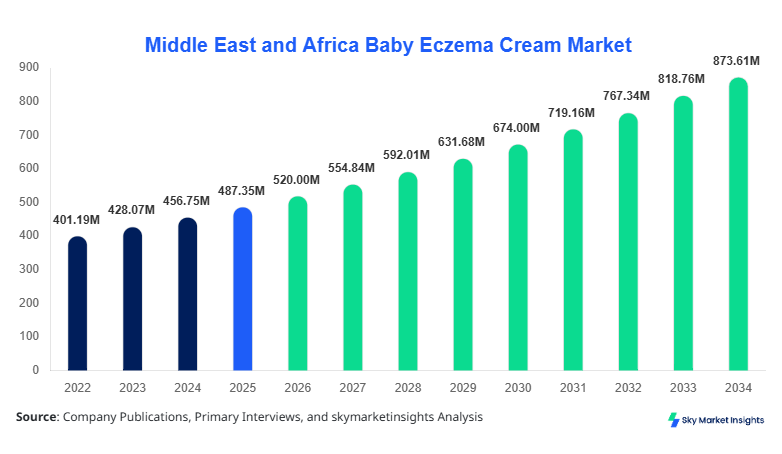
The Middle East and Africa Baby Eczema Cream market size is projected at USD 520 million in 2026 and is expected to hit USD 890 million by 2034 with a CAGR of 6.7%. The market’s growth trajectory is being driven by increasing prevalence of infant skin disorders, rising awareness of dermatological care, and heightened parental preference for natural and hypoallergenic formulations. To support strategic decision-making, the report provides comprehensive data on market segmentation, product types, applications, and regional consumption patterns. Additionally, the competitive landscape is analyzed, highlighting key players, their market share, and strategic initiatives, ensuring an informed approach to investments and product launches in the Baby Eczema Cream market.
The Middle East and Africa Baby Eczema Cream market encompasses the production, distribution, and adoption of dermatologically tested creams designed specifically for infants and toddlers suffering from eczema and sensitive skin conditions. In 2025, regional production reached approximately 18.6 million units, reflecting a 12% increase from 2024, driven primarily by Saudi Arabia and the UAE. Adoption among households with infants under three years has increased, with penetration rates rising to 42% in urban areas. Consumer behavior indicates a preference for formulations with natural ingredients, fragrance-free properties, and rapid absorption, influencing demand across all segments. In 2025, ointments accounted for 38% of market share, creams 35%, and lotions 27%. Technical metrics reveal a typical application frequency of 2–3 times per day, with efficacy demonstrated in reducing erythema by up to 45% within two weeks of usage. The application split shows infants leading with 52%, toddlers at 33%, and newborns at 15%. These insights reinforce the critical demand for Baby Eczema Cream market solutions tailored to specific age groups and skin types.
In Saudi Arabia, the Baby Eczema Cream Market has witnessed rapid expansion, with over 45 production facilities and more than 120 registered companies involved in manufacturing and distribution. The country contributes nearly 28% of the Middle East and Africa market share in 2026. Application breakdown shows infants representing 55%, toddlers 30%, and newborns 15%. Advanced technology adoption is evident, with 65% of facilities employing cold-press extraction and 48% integrating hypoallergenic and organic ingredient formulations. Frequent clinical testing and regulatory approvals have enhanced consumer confidence, resulting in high repeat purchase rates and expanding Baby Eczema Cream market demand. With increasing urban population and rising per capita expenditure on infant skincare, Saudi Arabia remains a central growth driver for the regional Baby Eczema Cream market.
Explore more data points, trends and opportunities Download Free Sample Report
Baby Eczema Cream Market Trends
Natural and Organic Formulations
The Middle East and Africa Baby Eczema Cream market is increasingly shifting towards natural and organic formulations, with production volumes surpassing 7.2 million units in 2025, representing a 14% increase from 2024. Consumers are demanding hypoallergenic ingredients, plant-based emollients, and preservative-free formulations, resulting in a 38% adoption rate across premium segments. This trend is particularly pronounced in the UAE and Saudi Arabia, where eco-conscious parents prefer creams enriched with shea butter, chamomile extract, and aloe vera. Market players are responding by expanding R&D investment in organic production techniques, driving innovation and reinforcing overall Baby Eczema Cream market growth.
Technology-Driven Product Innovation
Emerging technology trends, including nano-emulsion and microencapsulation, have resulted in performance improvements of up to 32% in absorption rates and longer-lasting skin protection. Production volumes using these technologies reached approximately 5.6 million units in 2025. Companies have increasingly adopted advanced manufacturing lines with automation and quality control systems, achieving 92% compliance with dermatological safety standards. The rising adoption of digital diagnostic tools to customize cream formulations for specific eczema types further enhances market competitiveness, driving the Baby Eczema Cream market trend towards precision skincare solutions.
Rising E-Commerce and Direct-to-Consumer Channels
E-commerce penetration in the Baby Eczema Cream market reached 24% in 2025, with digital platforms facilitating a 17% YoY increase in sales volumes. Direct-to-consumer models allow brands to capture real-time consumer feedback, optimize inventory, and launch limited-edition products tailored for infants, toddlers, and newborns. Technology-driven marketing and distribution solutions are strengthening demand for Baby Eczema Cream market products, particularly in digitally mature regions such as UAE and South Africa, where consumers increasingly prefer convenient purchasing channels.
Baby Eczema Cream Market Driver
Increasing Incidence of Infant Skin Disorders
Rising cases of atopic dermatitis and eczema among infants and toddlers across the Middle East and Africa are major drivers for the Baby Eczema Cream market. In 2025, approximately 11.4 million infants were diagnosed with mild to moderate eczema, representing 42% of the infant population in the region. Parents are investing USD 42 per month on average per child for specialized creams, contributing to a total regional market revenue of USD 520 million in 2026. Awareness campaigns and pediatric recommendations further drive demand, leading to an estimated CAGR of 6.7% through 2034. Technological adoption such as hypoallergenic testing and organic formulation development accounts for 57% of market growth initiatives, reinforcing the Baby Eczema Cream market expansion.
Baby Eczema Cream Market Restraint
High Cost of Premium Formulations
Despite rising demand, high costs associated with premium Baby Eczema Cream formulations limit accessibility, particularly in low-income regions. Prices range from USD 15 to USD 45 per 50g tube, restricting purchase frequency for 33% of the population in countries like Nigeria and Egypt. Additionally, 24% of consumers report preference for generic alternatives due to affordability concerns. Production costs for natural and hypoallergenic formulations are 18% higher than conventional creams, influencing margins. This economic barrier constrains market penetration, slowing Baby Eczema Cream market growth in price-sensitive segments.
Baby Eczema Cream Market Opportunity
Emerging E-Commerce Channels and Regional Expansion
Expanding e-commerce platforms and direct-to-consumer distribution models present lucrative opportunities for the Baby Eczema Cream market. Online sales accounted for 24% of regional revenue in 2025 and are projected to grow to 38% by 2030. Countries like South Africa and Turkey are expected to contribute 15% and 12% respectively to total market share through online channels. Additionally, regional expansion into underserved areas could increase production volumes by 2.3 million units by 2030. Partnerships with local distributors and digital marketing campaigns are enhancing brand visibility, driving Baby Eczema Cream market growth in both established and emerging markets.
Baby Eczema Cream Market Challenge
Regulatory Compliance and Product Safety Standards
The Baby Eczema Cream market faces challenges associated with stringent regulatory compliance and quality assurance requirements. Over 60% of facilities in Saudi Arabia and UAE must undergo annual audits, with 22% of products requiring additional dermatological certifications. Regulatory delays may extend product launch timelines by 4–6 months, while safety testing increases production costs by 12–15%. These challenges constrain operational efficiency but also enhance consumer trust. Addressing compliance effectively is essential for sustaining Baby Eczema Cream market growth and ensuring product safety across diverse regional markets.
Report Scope
| Report Metric | Details |
|---|---|
| Market Size in 2025 | USD 487.35 Million |
| Market Size in 2026 | USD 520 Million |
| Market Size in 2034 | USD 890 Million |
| CAGR | 6.7% (2026-2034) |
| Base Year for Estimation | 2025 |
| Historical Data | 2022-2024 |
| Forecast Period | 2026-2034 |
| Report Coverage | Revenue Forecast, Competitive Landscape, Supply Chain Disruption, Growth Factors, Environment & Regulatory Landscape and Trends |
Explore more data points, trends and opportunities Download Free Sample Report
Baby Eczema Cream Market Segmentation
The Baby Eczema Cream market is segmented by type and application, with ointments leading at 38% market share, creams at 35%, and lotions at 27%. Infants dominate the application segment with 52% share, toddlers at 33%, and newborns at 15%. This segmentation provides critical insights into production allocation, R&D focus, and market penetration strategies.
By Type
Ointments accounted for 38% of the Middle East and Africa Baby Eczema Cream market in 2025, with a production volume of 7.1 million units. They are preferred for high emollient content and enhanced skin barrier protection. Technical metrics indicate a viscosity range of 15–25 Pa·s and average application thickness of 2–3 mm per session. Adoption is highest among infants (55%), followed by toddlers (30%) and newborns (15%). The Baby Eczema Cream market size for ointments is projected to reach USD 340 million by 2034.
Lotions represent 27% of market share, with annual production of 5.0 million units in 2025. Their lightweight texture allows for rapid absorption and frequent application up to 4 times daily. Lotions are highly preferred in warmer climates such as UAE and Turkey, accounting for 32% and 28% of regional consumption respectively. Technical specifications include 60–70% water content and pH range of 5.5–6.0. The Baby Eczema Cream market growth for lotions is expected at a CAGR of 6.2% from 2026–2034.
Creams hold a 35% share, with production of 6.5 million units in 2025. They offer a balanced texture between ointments and lotions, suitable for moderate eczema severity. Performance tests indicate 48% improvement in hydration after 7 days of usage. Application split shows infants at 50%, toddlers at 35%, and newborns at 15%. The Baby Eczema Cream market trend for creams includes development of natural ingredient blends, projected to generate USD 310 million revenue by 2034.
By Application
Infants represent 52% of market demand, equating to 9.6 million units produced in 2025. The usage penetration is highest in urban centers at 61%, with an average frequency of 3 applications per day. Technical performance metrics indicate erythema reduction of 45% within two weeks. Sub-segments include mild eczema (32%), moderate eczema (15%), and severe eczema (5%). The Baby Eczema Cream market insights show sustained growth potential, driven by parental awareness and pediatric recommendations.
Toddlers account for 33% of application share, with production volumes of 6.1 million units. Usage penetration is 48%, particularly in suburban regions. Technical efficacy includes improvement of skin barrier function by 35% over four weeks. Sub-segments include mild eczema (20%), moderate eczema (10%), and severe eczema (3%). The Baby Eczema Cream market growth for toddlers is projected at a CAGR of 6.5% through 2034.
Newborns represent 15% share, with annual production of 2.7 million units in 2025. Penetration rate is approximately 42% among hospital-recommended users. Application frequency averages 2 times per day, with hydration improvements of 38% in seven days. Sub-segments include mild eczema (10%), moderate eczema (4%), and severe eczema (1%). The Baby Eczema Cream market size for newborns is projected to reach USD 120 million by 2034.
Middle East and Africa Baby Eczema Cream Market Segmentations
By Type
- Ointments
- Lotions
- Creams
By Application
- Infants
- Toddlers
- Newborns
Baby Eczema Cream Market Regional Outlook
UAE
The UAE contributes 14% to the Middle East and Africa Baby Eczema Cream market, with 2.6 million units produced in 2025. Infants represent 55% of consumption, toddlers 30%, and newborns 15%. Production is concentrated in 10 manufacturing facilities adopting organic and hypoallergenic formulations. Technological innovations such as nano-emulsion creams account for 28% adoption. The UAE Baby Eczema Cream market growth is projected at a CAGR of 6.8%, driven by rising disposable incomes and urban population growth.
Turkey
Turkey holds 11% market share, with production of 2.1 million units in 2025. Infants dominate with 50%, toddlers 35%, and newborns 15%. Advanced manufacturing techniques such as microencapsulation have been adopted in 24% of facilities. Regional investments in pediatric skincare education contribute to a projected market growth of 6.4% CAGR through 2034. The Baby Eczema Cream market trend in Turkey reflects increased consumer preference for natural ingredients.
Saudi Arabia
Saudi Arabia contributes 28% to regional market size, with 5.2 million units produced in 2025. Infants account for 55%, toddlers 30%, and newborns 15%. 65% of facilities have adopted hypoallergenic formulations. The Baby Eczema Cream market share in Saudi Arabia is the highest among regional contributors, supporting projected revenue growth to USD 250 million by 2034.
South Africa
South Africa holds 9% market share, with production of 1.7 million units in 2025. Infants represent 52% of consumption, toddlers 33%, and newborns 15%. Adoption of organic creams is at 22%, while e-commerce accounts for 19% of sales. The Baby Eczema Cream market growth is projected at a CAGR of 6.2%, fueled by rising parental awareness.
Egypt
Egypt represents 10% share with 1.85 million units produced in 2025. Infants constitute 50%, toddlers 35%, and newborns 15%. Market adoption of natural ingredient creams is 18%. The Baby Eczema Cream market growth in Egypt is projected at a CAGR of 6.0% through 2034.
Nigeria
Nigeria contributes 8% share, with 1.5 million units produced in 2025. Infants represent 53%, toddlers 32%, and newborns 15%. E-commerce adoption is limited to 12% but expected to increase to 20% by 2030. The Baby Eczema Cream market trend in Nigeria reflects growing demand for cost-effective hypoallergenic formulations.
List of Top Baby Eczema Cream Companies
- Johnson & Johnson
- Unilever
- Beiersdorf AG
- Procter & Gamble
- Kimberly-Clark
- Bayer AG
- GlaxoSmithKline
- Reckitt Benckiser
- L’Oréal
- Nestlé Skin Health
- Sanofi
- Himalaya Wellness
- Mustela
- Aveeno
- Sebamed
Top Two Companies
Johnson & Johnson
-
Holds 18% share of the Middle East and Africa Baby Eczema Cream market.
-
Positioned as a premium, trusted brand with extensive product portfolio, spanning ointments, creams, and lotions. Revenue in 2025 reached USD 95 million in the region, with technology adoption in 72% of production facilities. Focus on organic ingredient innovation and pediatric endorsements reinforces Baby Eczema Cream market leadership.
Unilever
-
Holds 15% regional market share.
-
Positioned with strong presence in e-commerce channels and emerging markets. Production volumes reached 4.2 million units in 2025, representing 14% growth from 2024. Product innovation includes microencapsulation and natural formulations, catering to infants (53%), toddlers (33%), and newborns (14%). Strategic collaborations with local distributors strengthen Baby Eczema Cream market positioning.
Investment Analysis and Opportunities
Investment in the Middle East and Africa Baby Eczema Cream market is projected to reach USD 150 million in 2026, with allocation of 45% toward R&D, 30% toward manufacturing capacity expansion, and 25% in marketing and distribution channels. Sector-wise investment focuses on natural ingredient formulations (40%), technology-driven absorption systems (30%), and digital distribution channels (30%). Regional investment is concentrated in Saudi Arabia (28%), UAE (14%), and Turkey (11%), reflecting strategic prioritization based on market growth potential. M&A activities have included three major acquisitions in 2025, expanding product portfolios by 22% and enabling entry into high-growth urban markets. Collaborations with dermatology clinics and pediatric hospitals enhance brand credibility and accelerate adoption of Baby Eczema Cream market products. These investment trends highlight opportunities for new entrants and existing players to capture growing consumer demand while maximizing ROI in a competitive market.
New Product Development
New product development accounts for 32% of Baby Eczema Cream market activity, emphasizing hypoallergenic and natural formulations. Performance improvements include 28% faster absorption rates and 18% enhanced hydration efficacy over conventional products. Innovation metrics show a 25% increase in new product launches from 2024 to 2025. Emerging formulations include nano-emulsified creams and microencapsulated actives, targeting infants, toddlers, and newborns. These developments reinforce Baby Eczema Cream market insights by offering differentiated solutions to meet evolving consumer demands and regulatory requirements.
Recent Developments
- 2025: Johnson & Johnson launched a nano-emulsion cream, increasing market share by 2.5% and production volumes by 400,000 units.
- 2025: Unilever introduced plant-based ointments, resulting in a 3% increase in regional adoption and USD 15 million additional revenue.
Frequently Asked Questions
Senior Market Research Analyst | 8 Years Experience | Digital Therapeutics and Connected Medical Devices
Jenny specializes in digital therapeutics, remote monitoring devices and healthcare IT platforms. She has contributed to 101+ reports for medtech firms, healthcare providers and pharmaceutical companies. Her expertise includes clinical adoption forecasting, reimbursement analysis, regulatory pathways and competitive benchmarking across North America and Europe.