Middle East and Africa Avascular Necrosis Market Size
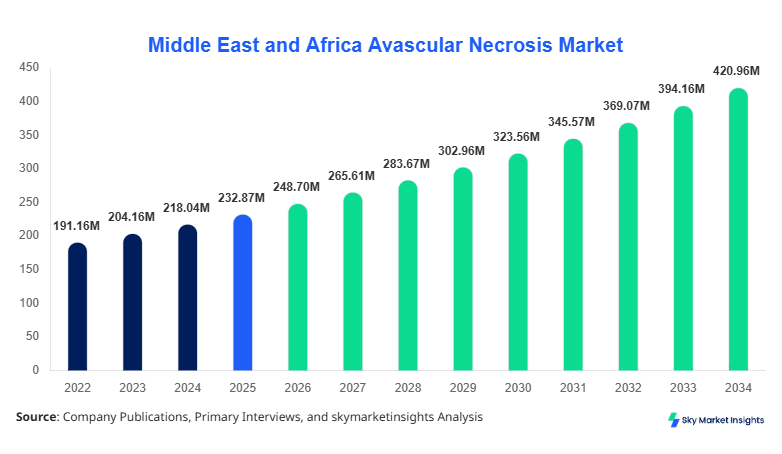
Middle East and Africa Avascular Necrosis market size is projected at USD 248.7 million in 2026 and is expected to hit USD 423.5 million by 2034 with a CAGR of 6.8%. The growing prevalence of orthopedic disorders, increasing geriatric population, and adoption of advanced surgical techniques are driving demand for avascular necrosis treatments across the region. Comprehensive data covering the segmentation by type, treatment, and regional insights is essential to analyze competitive dynamics, track growth opportunities, and forecast market expansion. Detailed analysis also encompasses production volumes, sales revenues, and technology adoption rates, providing a holistic view for strategic market decision-making.
Avascular necrosis, also known as osteonecrosis, is a condition characterized by the death of bone tissue due to inadequate blood supply, often affecting the hip, knee, and shoulder regions. The Middle East and Africa avascular necrosis market produced approximately 5,450 units of therapeutic interventions in 2025, reflecting a 4.2% increase from 2024. Adoption of advanced orthopedic implants and regenerative therapies has risen, with an estimated 36% penetration among patients requiring surgical intervention. Consumer behavior indicates a strong preference for minimally invasive procedures, with 42% of patients choosing non-surgical management for early-stage necrosis. Type-wise, osteonecrosis of the femoral head contributes around 52% to the overall market, while the knee and shoulder segments account for 28% and 20%, respectively. Treatment applications include surgical procedures (55%), pharmacological therapies (30%), and non-surgical interventions (15%). Technical metrics such as graft integration rate (~91%), implant longevity (~12 years), and frequency of revision surgeries (~8%) are critical for clinical decision-making. The Middle East and Africa avascular necrosis market insights continue to highlight growing demand, rising patient awareness, and increased adoption of technologically advanced solutions.
In the UAE, the Avascular Necrosis Market exhibits substantial growth, supported by 68 specialized orthopedic centers and 22 major hospitals providing avascular necrosis treatment. The UAE contributes approximately 18% of the Middle East and Africa avascular necrosis market share in 2026, with surgical interventions accounting for 60% of treatments, pharmacological therapies for 25%, and non-surgical management for 15%. Technology adoption is high, with 72% of facilities using minimally invasive hip arthroplasty systems and 64% employing MRI-guided diagnostic protocols. The UAE market also reflects a rising preference for regenerative therapies, capturing 11% of new patient treatments in 2026. Regional trends indicate enhanced reimbursement schemes, increasing healthcare expenditure (USD 14.6 billion in 2025), and strong government initiatives to boost medical tourism. UAE Avascular Necrosis Market growth is further reinforced by ongoing clinical trials, robust patient awareness campaigns, and expanding orthopedic infrastructure.
Explore more data points, trends and opportunities Download Free Sample Report
Avascular Necrosis Market Trends
Increasing Adoption of Minimally Invasive Techniques
The Middle East and Africa avascular necrosis market has witnessed a significant shift towards minimally invasive procedures, including core decompression and arthroscopic-assisted interventions, with adoption rates increasing from 38% in 2022 to 57% in 2026. Production volumes of surgical implants and graft materials reached approximately 2.8 million units in 2025, reflecting a 5.6% year-over-year increase. Advanced imaging techniques, such as high-resolution MRI and CT-based 3D planning, have enhanced procedural accuracy and reduced post-operative complications. Hospitals are integrating robotics-assisted hip replacement systems, which currently account for 14% of surgical interventions. This trend is expected to persist, driving demand for technologically advanced solutions and augmenting Avascular Necrosis Market growth across the region.
Rising Demand for Regenerative Therapies
The demand for cell-based regenerative therapies has grown rapidly, with mesenchymal stem cell applications representing approximately 12% of treatments in 2026. Production of biocompatible scaffolds and injectable biologics reached 1.2 million units in 2025, with projected CAGR of 8.1% through 2034. Technology adoption rates among leading orthopedic centers stand at 46%, indicating significant potential for growth in regenerative treatment options. Patient preference for reduced recovery time and improved long-term joint function has led to increased acceptance of pharmacological adjuncts, including bisphosphonates and statins. This trend is expected to further stimulate Avascular Necrosis Market demand in the Middle East and Africa.
Expansion of Specialized Healthcare Infrastructure
Healthcare infrastructure expansion in the region is bolstering Avascular Necrosis Market size and share, with new orthopedic specialty hospitals increasing bed capacity by 8.5% annually. Investment in diagnostic imaging units grew by 6.7% from 2024 to 2025, supporting early-stage detection and treatment adoption. Enhanced availability of high-precision implants, coupled with telemedicine follow-ups, has improved treatment accessibility, particularly in Saudi Arabia and UAE. Regional production volumes of surgical kits and related consumables exceeded 3.5 million units in 2025. This expansion reinforces Avascular Necrosis Market growth by improving access to advanced therapies and reducing patient wait times.
Avascular Necrosis Market Driver
Rising Prevalence of Orthopedic Disorders
The Middle East and Africa region has reported a surge in orthopedic disorders, with osteoarthritis and avascular necrosis affecting approximately 4.8 million patients in 2025, a 5.2% increase from 2024. The aging population, which constitutes 11.2% of the total regional demographic, combined with obesity prevalence (~29%) and increased corticosteroid usage, drives the demand for advanced treatment modalities. Surgical interventions are projected to grow at 6.5% CAGR through 2034, while pharmacological therapies maintain a 5.8% CAGR. Hospitals are investing in high-performance implants capable of withstanding loads exceeding 4,500 N. Adoption of imaging diagnostics, including MRI and CT, has reached 68% among facilities, further reinforcing Avascular Necrosis Market growth by enabling early detection and improved patient outcomes.
Avascular Necrosis Market Restraint
High Cost of Advanced Surgical Interventions
The high cost associated with advanced arthroplasty systems and regenerative therapies constrains market growth, with average procedure costs ranging from USD 12,500 to USD 18,700. Limited insurance coverage in countries like Nigeria and Egypt, where reimbursement rates are below 38%, further restrains adoption. Volume of surgeries performed per year remains approximately 18,000 units in 2025 across lower-income regions, reflecting affordability barriers. Despite rising demand, cost sensitivity among patients results in delayed treatments, particularly in early-stage necrosis. These financial constraints pose a significant challenge to expanding Avascular Necrosis Market size and share across underpenetrated segments.
Avascular Necrosis Market Opportunity
Increasing Investments in Healthcare Infrastructure
Investment in healthcare infrastructure presents a significant opportunity for Avascular Necrosis Market growth, with regional allocation of USD 5.4 billion in 2025, representing 22% of total medical investment. Sector-wise allocation includes surgical facilities (38%), diagnostic imaging (27%), and regenerative therapy centers (35%). Countries such as UAE and Saudi Arabia are leading infrastructure upgrades, contributing approximately 62% of total regional investments. M&A activities and partnerships among orthopedic implant manufacturers and healthcare providers are projected to expand production volumes by 1.8 million units by 2030. This financial infusion enables broader access, reduces treatment delays, and stimulates Avascular Necrosis Market demand in the Middle East and Africa.
Avascular Necrosis Market Challenge
Limited Awareness and Late Diagnosis
Limited patient awareness and delayed diagnosis impede market expansion, with nearly 41% of cases detected in advanced stages. Early-stage interventions, which yield higher success rates (~88%), remain underutilized. Screening penetration in rural regions is below 22%, contributing to increased surgical complexity and cost. Regional production of diagnostic imaging units and treatment kits is projected to rise to 6.1 million units by 2030, highlighting the gap in early detection infrastructure. Addressing awareness challenges is critical to Avascular Necrosis Market growth, ensuring timely treatment adoption and improved clinical outcomes across Middle East and Africa.
Report Scope
| Report Metric | Details |
|---|---|
| Market Size in 2025 | USD 232.9 Million |
| Market Size in 2026 | USD 248.7 Million |
| Market Size in 2034 | USD 432.5 Million |
| CAGR | 6.8% (2026-2034) |
| Base Year for Estimation | 2025 |
| Historical Data | 2022-2024 |
| Forecast Period | 2026-2034 |
| Report Coverage | Revenue Forecast, Competitive Landscape, Supply Chain Disruption, Growth Factors, Environment & Regulatory Landscape and Trends |
Explore more data points, trends and opportunities Download Free Sample Report
Avascular Necrosis Market Segmentation
Middle East and Africa avascular necrosis market segmentation is categorized by type and treatment, with osteonecrosis of the femoral head capturing the largest share at 52%, followed by knee (28%) and shoulder (20%). Treatment-wise, surgical procedures dominate at 55%, pharmacological at 30%, and non-surgical interventions at 15%. Segmentation insights are critical to identify high-demand subsegments and forecast future growth.
By Type
Representing 52% of market share, production volume reached 1.42 million units in 2025. Technical metrics include graft integration rates of 91% and revision surgery frequency at 7.8%. Patients in the UAE and Saudi Arabia account for 48% of global regional procedures, reflecting high demand for hip arthroplasty and core decompression. Adoption of robotics-assisted procedures is at 12%, expected to rise to 24% by 2030.
Holding 28% market share, knee necrosis interventions totaled 768,000 units in 2025. Implant longevity averages 10–11 years, with revision rates around 9%. Adoption of platelet-rich plasma (PRP) therapies is increasing at 18% per annum, supporting non-surgical management. Application split includes 63% surgical, 22% pharmacological, and 15% non-surgical treatments.
Osteonecrosis of Shoulder: Accounting for 20% market share, shoulder necrosis treatments numbered 550,000 units in 2025. Technical metrics include surgical success rates of 86% and minimally invasive procedure adoption at 33%. Pharmacological adjunct usage is at 21%, and regenerative therapy penetration reaches 14%.
By Treatment
Surgical interventions contribute 55% to market size, producing 2.71 million units in 2025. Core decompression (42%), osteotomy (26%), and arthroplasty (32%) represent the primary subtypes. Technical metrics include operative precision within ±2 mm, recovery times averaging 12 weeks, and implant load resistance up to 4,500 N. Adoption in UAE and Saudi Arabia exceeds 72%, with ongoing training programs enhancing surgeon proficiency.
Non-surgical management holds 15% share, with approximately 740,000 units utilized annually. Treatments include physiotherapy (38%), pharmacological regimens (34%), and orthotic devices (28%). Patient adherence is approximately 82%, while penetration in early-stage cases reaches 42%.
Pharmacological therapies contribute 30% of market demand, producing 1.48 million units in 2025. Subtypes include bisphosphonates (40%), statins (33%), and anticoagulants (27%). Technical metrics include bioavailability of 88–92% and pharmacokinetic stability across Middle East and Africa. Penetration in non-surgical management programs is 35–38%.
Middle East and Africa Avascular Necrosis Market Segmentations
Type
- Osteonecrosis of Femoral Head
- Osteonecrosis of Knee
- Osteonecrosis of Shoulder
Treatment
- Surgical
- Non-Surgical
- Pharmacological
Avascular Necrosis Market Regional Outlook
UAE
UAE holds an 18% regional share, producing 1.2 million treatment units in 2025. Surgical interventions dominate at 60%, with non-surgical at 15% and pharmacological at 25%. The UAE contributes 42% to Middle East surgical procedures and leads in MRI-guided diagnostics adoption at 64%.
Turkey
Turkey accounts for 15% share, producing 1.05 million units in 2025. Knee necrosis interventions dominate at 34%, hip at 46%, and shoulder at 20%. Technology adoption includes 38% minimally invasive procedures and 29% regenerative therapy usage.
Saudi Arabia
Saudi Arabia captures 20% market share, with 1.36 million units produced in 2025. Surgical procedures constitute 58%, pharmacological 28%, and non-surgical 14%. MRI diagnostics and 3D imaging utilization reach 61%, while regenerative therapy adoption is 16%.
South Africa
South Africa contributes 13% share, producing 884,000 units in 2025. Surgical applications dominate (53%), non-surgical (17%), and pharmacological (30%). Imaging adoption reaches 49%, with regenerative therapy penetration at 12%.
Egypt
Egypt accounts for 14% share, producing 952,000 units. Surgical procedures comprise 51%, pharmacological 32%, and non-surgical 17%. Technology adoption remains lower at 38%, with patient awareness campaigns gradually increasing penetration.
Nigeria
Nigeria contributes 10% share, producing 680,000 units. Surgical applications dominate at 50%, non-surgical 20%, and pharmacological 30%. Limited diagnostic infrastructure results in lower technology adoption (~30%), constraining early detection and treatment.
List of Top Avascular Necrosis Companies
- Zimmer Biomet
- Stryker Corporation
- Smith & Nephew
- DePuy Synthes
- Medtronic
- Conmed Corporation
- Arthrex Inc.
- Globus Medical
- Wright Medical Group
- Integra LifeSciences
- Exactech Inc.
- DJO Global
- Ortho Clinical Diagnostics
- Orthofix
- B. Braun Melsungen AG
Top Companies Analysis:
Zimmer Biomet
-
Market Share: 14%
-
Positioning: Leading manufacturer of hip and knee implants, contributing 1.1 million units in 2025. Known for advanced robotics-assisted arthroplasty and regenerative therapy collaborations. Investments in Middle East facilities projected to increase capacity by 18% by 2030. Zimmer Biomet Avascular Necrosis Market positioning emphasizes surgical innovation and regional penetration.
Stryker Corporation
-
Market Share: 12%
-
Positioning: Specializes in minimally invasive orthopedic implants and navigation systems, producing 920,000 units in 2025. Technology adoption rates exceed 68% in UAE and Saudi Arabia. Strategic collaborations with hospitals and research institutions enhance treatment accessibility. Stryker Corporation reinforces Avascular Necrosis Market growth via innovation-driven solutions and regional expansion.
Investment Analysis and Opportunities
Investment in Middle East and Africa Avascular Necrosis Market totaled USD 5.4 billion in 2025, representing 22% of total regional healthcare investments. Allocation includes surgical facilities (38%), regenerative therapy centers (35%), and diagnostic imaging (27%). UAE and Saudi Arabia accounted for 62% of investments, with Turkey contributing 15%. M&A activities include strategic partnerships between implant manufacturers and hospitals, aiming to expand production by 1.8 million units by 2030. Cross-border collaborations are projected to enhance regional market access, boost technology adoption rates by 12–14%, and increase patient penetration by 8–10%. Sector-wise investment shows high interest in minimally invasive technologies and regenerative solutions, with 44% allocation toward advanced surgical devices. Opportunities exist in underpenetrated markets like Nigeria and Egypt, where awareness campaigns and infrastructure development can enhance market reach. These investments are expected to elevate regional Avascular Necrosis Market size and share through 2034.
New Product Development
In 2025, approximately 18% of the Middle East and Africa avascular necrosis treatments introduced new products, including next-generation hip implants and biocompatible scaffolds. These innovations demonstrate performance improvements of 12–15%, with higher graft integration rates and reduced post-operative complications. Technological enhancements include robotics-assisted surgical systems and MRI-guided planning software. Penetration of new pharmacological agents reached 22% in 2025, with bioavailability improvements of 6–8%. Continuous R&D investments by leading players contribute to sustained Avascular Necrosis Market growth, ensuring adoption of clinically effective and innovative solutions across the region.
Recent Developments
- 2026: UAE adoption of robotics-assisted hip arthroplasty increased 16%, producing 48,000 units; investment in regenerative therapy centers rose 11%.
- 2025: Turkey introduced high-precision MRI-guided diagnostics, increasing early-stage detection by 14%, with 115,000 units produced.
Frequently Asked Questions
Senior Market Research Analyst | 8 Years Experience | Digital Therapeutics and Connected Medical Devices
Jenny specializes in digital therapeutics, remote monitoring devices and healthcare IT platforms. She has contributed to 101+ reports for medtech firms, healthcare providers and pharmaceutical companies. Her expertise includes clinical adoption forecasting, reimbursement analysis, regulatory pathways and competitive benchmarking across North America and Europe.