Middle East and Africa Automated Mining Equipment Market Size
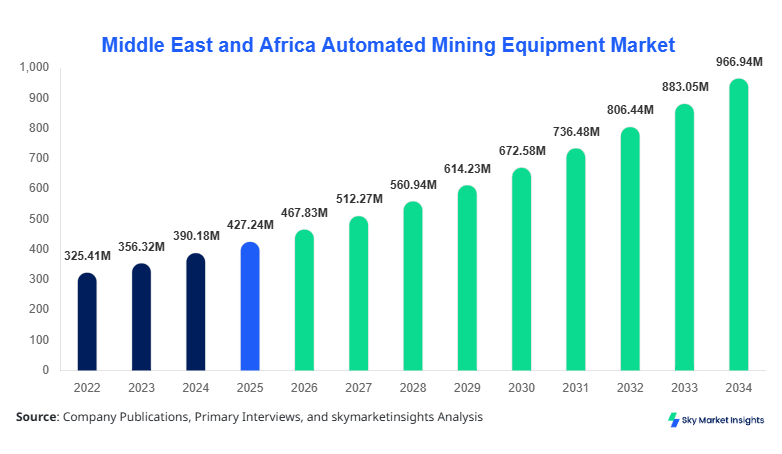
Middle East and Africa Automated Mining Equipment Market size is projected at USD 467.83 million in 2026 and is expected to hit USD 1,001.06 million by 2034 with a CAGR of 9.5%. The assessment evaluates country-level demand, equipment categories, mineral applications, deployment models, automation levels, software solutions, end users, technology adoption, and the competitive landscape across the forecast period.
Key Takeaways
- The United Arab Emirates dominates with USD 194.43 million and a 41.56% share in 2026; Nigeria is the fastest-growing country at a 10.33% CAGR.
- Autonomous haul trucks lead equipment demand with USD 136.04 million and a 29.07% share in 2026.
- Automated drilling rigs are the fastest-growing equipment category, advancing from USD 87.12 million in 2026 to USD 194.63 million by 2034 at a 10.57% CAGR.
- The United Arab Emirates is forecast to reach USD 423.19 million by 2034 at a 10.21% CAGR, contributing 42.27% of the regional total.
- Egypt and Nigeria collectively represent USD 65.97 million in 2026 and are projected to reach USD 142.88 million by 2034.
The Automated Mining Equipment Market encompasses autonomous haulage, drilling, loading, excavation, blasting, robotic, and remote-controlled machinery supported by navigation, fleet-management, safety, and predictive-maintenance platforms. Regional revenue increases from USD 425.42 million in 2025 to USD 467.83 million in 2026. Autonomous haul trucks contribute 29.07% of equipment revenue, automated drilling rigs 18.62%, autonomous loaders 14.23%, and robotic mining equipment 10.30%. The six covered countries collectively represent the supplied regional total, led by the United Arab Emirates at 41.56%, South Africa at 22.36%, and Saudi Arabia at 15.63%.
Explore more data points, trends and opportunities Download Free Sample Report
Middle East and Africa Automated Mining Equipment Market Trends
Mixed-Fleet Autonomy and Electrified Operations Reshape Mine Design
Mining automation is progressing from isolated machine control toward connected fleets integrating high-precision positioning, artificial intelligence, digital twins, collision avoidance, and centralized dispatch. Caterpillar reported that its autonomous trucks had hauled more than 8.6 billion tonnes by September 2024, while Komatsu's FrontRunner fleet exceeded 700 commercial deployments in February 2024, including over 100 ultra-class 400-ton trucks. These operating volumes strengthen acceptance of interoperable haulage and continuous 24-hour fleet control.
Technology development increasingly combines autonomy with battery-electric and trolley-assist platforms. Epiroc reported over 3,900 driverless machines in 2025, 13% more than in 2024, while a mixed fleet at Roy Hill included 78 autonomous haul trucks and approximately 250 ancillary vehicles operating continuously. Remote dozing platforms can allow 1 operator to supervise as many as 4 machines, improving labor utilization by up to 300% relative to one-operator-per-machine configurations.
Middle East and Africa Automated Mining Equipment Market Drivers
Mine Safety, Productivity, and Ore-Grade Pressure Accelerate Automation
Autonomous equipment enables 24-hour operating cycles, standardized speeds, lower idle time, and reduced human exposure to blasting areas, unstable slopes, heat, dust, and underground hazards. Caterpillar's autonomous fleet had travelled more than 147 million km without a reported lost-time injury by an earlier operational milestone and moved approximately 1.2 billion tonnes during 2021 alone. With automated drilling capable of maintaining centimeter-level guidance and autonomous haulage supporting utilization rates above 90% in optimized operations, miners are prioritizing equipment that can raise throughput by 10%–20% and reduce fuel consumed per tonne.
Middle East and Africa Automated Mining Equipment Market Restraints
High Integration Costs and Uneven Digital Infrastructure Limit Deployment
Fully autonomous sites require private LTE or 5G connectivity, redundant control rooms, high-accuracy positioning, cybersecurity, machine retrofits, and workforce retraining. Conversion may involve fleets of 50–100 vehicles, hundreds of sensors, and multi-year implementation schedules, while communications interruptions lasting even 1–2 minutes can affect synchronized haul cycles. Mines with fewer than 10–20 mobile units often face weaker economies of scale, and legacy equipment spanning 3 or more OEM brands increases software-integration and certification costs.
Middle East and Africa Automated Mining Equipment Market Opportunities
Retrofit Platforms Expand the Addressable Installed Base
OEM-agnostic conversion systems create opportunities where operators cannot replace entire fleets. Mixed-fleet deployments can integrate 70–80 autonomous trucks alongside more than 200 support vehicles, while predictive-maintenance platforms can process millions of machine signals and reduce unplanned downtime by 10%–25%. Battery-electric drilling, autonomous trolley haulage, and energy-monitoring software also support mine-level emissions targets, particularly where diesel equipment accounts for more than 30% of operational emissions.
Challenges in Middle East and Africa Automated Mining Equipment Market
Cybersecurity, Skills Availability, and Interoperability Remain Operational Barriers
A connected mine may incorporate 1,000 or more mobile and fixed assets across haulage, drilling, processing, and maintenance networks. Integrating 3–5 proprietary control environments creates latency, data-governance, and safety-certification risks. Operators must simultaneously retrain dispatchers, technicians, and engineers, maintain system availability above 99%, and protect networks against unauthorized access. The transition also shifts staffing requirements from vehicle operation toward software, mechatronics, analytics, and remote-control competencies.
Report Scope
| Report Metric | Details |
|---|---|
| Market Size in 2025 | USD 427.22 Million |
| Market Size in 2026 | USD 467.83 Million |
| Market Size in 2034 | USD 1001.06 Million |
| CAGR | 9.5% (2026-2034) |
| Base Year for Estimation | 2025 |
| Historical Data | 2022-2024 |
| Forecast Period | 2026-2034 |
| Report Coverage | Revenue Forecast, Competitive Landscape, Supply Chain Disruption, Growth Factors, Environment & Regulatory Landscape and Trends |
Explore more data points, trends and opportunities Download Free Sample Report
Middle East and Africa Automated Mining Equipment Market Segmentation
The market is segmented by equipment type, mineral type, deployment mode, automation level, software solution, and end user. Autonomous haul trucks hold 29.07% of equipment revenue in 2026, followed by automated drilling rigs at 18.62% and autonomous loaders at 14.23%.
By Equipment Type
Autonomous haul trucks are the largest category, increasing from USD 124.01 million in 2025 to USD 136.04 million in 2026 and USD 285.31 million by 2034 at a 9.70% CAGR. Their leadership reflects high truck utilization, repetitive haul routes, and measurable fuel-per-tonne improvements across surface mines.
Automated drilling rigs are the fastest-growing category at a 10.57% CAGR, rising to USD 194.63 million by 2034. Autonomous loaders reach USD 141.31 million, robotic equipment USD 100.68 million, dozers and excavators USD 90.83 million, and automated blasting systems USD 84.99 million by 2034.
By Mineral Type
Metallic mining—including gold, copper, iron, and nickel—is the principal application because large, repetitive operations can deploy fleets exceeding 50 units and process millions of tonnes annually. Non-metallic minerals, coal, and rare-earth operations increasingly adopt automated drilling, grade control, and material tracking.
Rare-earth and critical-mineral projects represent the strongest emerging application because precise ore control and recovery are essential where grades can fall below 1%. No separate revenue or CAGR allocation for mineral types was supplied; consequently, country and equipment totals are not redistributed across these categories.
By Deployment Mode
On-site fully autonomous systems lead advanced greenfield projects, while retrofit automation addresses installed fleets with service lives commonly exceeding 10 years. OEM-integrated solutions combine factory-installed controls, safety systems, and fleet software across 1 centralized operating environment.
Retrofit automation is gaining momentum as mines convert mixed fleets without replacing every vehicle. Implementations involving 78 autonomous trucks and approximately 250 ancillary vehicles demonstrate the scalability of OEM-agnostic architecture; no deployment-mode revenue split was supplied.
By Level of Automation
Semi-automated platforms remain important for drilling, loading, and dozing, where 1 operator may remotely supervise as many as 4 units. Fully autonomous systems provide the highest utilization potential through continuous operation, while remote-controlled equipment removes personnel from high-risk zones.
Fully autonomous adoption is advancing fastest in haulage and drilling, supported by fleets exceeding 700 deployed trucks in 2024 and 1,000 commissioned Komatsu ultra-class autonomous trucks by April 2026. No category-specific regional CAGR was supplied.
By Software Solution
Fleet management is the foundational software category, coordinating trucks, shovels, routes, stockpiles, and maintenance events in real time. Navigation, collision avoidance, tele-remote control, predictive maintenance, and energy monitoring can process thousands of asset signals per second.
Predictive maintenance and energy monitoring are emerging rapidly as operators target 10%–25% reductions in unplanned downtime and lower diesel consumption per tonne. Software-specific revenue and CAGR figures were not supplied and therefore remain unallocated.
By End-User
Surface mining is the primary end-user because haul roads, repeatable routes, and large fleets favor autonomous trucks, drills, dozers, and loaders. Underground mining emphasizes tele-remote loading, collision avoidance, ventilation efficiency, and personnel tracking at depths that may exceed 1,000 meters.
Underground automation is gaining adoption as control rooms relocate operators to the surface and production levels run remotely over 24-hour schedules. No separate surface-versus-underground revenue allocation was supplied.
Middle East and Africa Automated Mining Equipment Market Segmentations
By Equipment Type
- Autonomous Haul Trucks
- Automated Drilling Rigs
- Autonomous Loaders
- Robotic Mining Equipment
- Dozers and Excavators
- Automated Blasting Systems
- Remote-Controlled Equipment
- Others (Grinders, Crushers, Graders)
By Mineral Type
- Metallic (Gold, Copper, Iron, Nickel, etc.)
- Non-Metallic (Limestone, Potash, Phosphate)
- Coal
- Rare Earth Minerals
By Deployment Mode
- On-Site (Fully Autonomous Sites)
- Retrofit Automation
- OEM-Integrated Solutions
By Level of Automation
- Semi-Automated
- Fully Autonomous
- Remote-Controlled
By Software Solution
- Fleet Management
- Navigation and Guidance
- Collision Avoidance and Safety
- Tele-remote Operations
- Predictive Maintenance
- Energy and Emissions Monitoring
By End-User
- Surface Mining
- Underground Mining
Middle East and Africa Automated Mining Equipment Market Country Outlook
United Arab Emirates Automated Mining Equipment Market
The United Arab Emirates leads at USD 194.43 million in 2026, equal to 41.56% of the regional total. Revenue is forecast to reach USD 423.19 million by 2034 at a 10.21% CAGR, supported by investment in digitally managed mineral production and industrial diversification.
Saudi Arabia Automated Mining Equipment Market
Saudi Arabia contributes USD 73.12 million, or 15.63%, in 2026. The market is projected to reach USD 154.82 million by 2034 at a 9.83% CAGR, with metallic, phosphate, and industrial-mineral operations supporting automated drilling and fleet-management deployment.
South Africa Automated Mining Equipment Market
South Africa accounts for USD 104.61 million and 22.36% in 2026, making it the second-largest country. Revenue reaches USD 215.90 million by 2034 at a 9.48% CAGR, driven by extensive surface and underground gold, platinum-group-metal, coal, and iron-ore production.
Egypt Automated Mining Equipment Market
Egypt represents USD 40.30 million, or 8.61%, in 2026 and is forecast to reach USD 86.51 million by 2034 at a 10.02% CAGR. Gold and phosphate developments support drilling, excavation, and remote fleet monitoring.
Nigeria Automated Mining Equipment Market
Nigeria is the fastest-growing country at a 10.33% CAGR, advancing from USD 25.67 million in 2026 to USD 56.37 million by 2034. Its regional contribution increases from 5.49% to 5.63%, supported by gold, coal, limestone, and emerging critical-mineral projects.
Turkey Automated Mining Equipment Market
Turkey generates USD 29.70 million in 2026, representing 6.35% of regional revenue. The country is projected to reach USD 64.27 million by 2034 at a 10.13% CAGR, with metallic and non-metallic mines adopting automated drilling, loading, and safety platforms.
Top players in Middle East and Africa Automated Mining Equipment Market
- Caterpillar Inc.
- Komatsu Ltd.
- Sandvik AB
- Epiroc AB
- Hitachi Construction Machinery Co., Ltd.
- Liebherr Group
- Hexagon AB
- ABB Ltd.
- Siemens AG
- Autonomous Solutions, Inc.
- Wenco International Mining Systems Ltd.
- RCT
- Thiess Group
- SafeAI, Inc.
- Pronto AI
Top Two Companies
- Caterpillar Inc.: Exact regional percentage share is not publicly disclosed. Caterpillar occupies a leading position through MineStar Command, autonomous haulage, drilling, dozing, underground loading, and integrated fleet-management capabilities. By September 2024, Command-equipped trucks had autonomously hauled more than 8.6 billion tonnes across hundreds of trucks and dozens of sites on 3 continents. Its installed equipment base, dealer network, mixed-site safety architecture, and ability to integrate autonomous, semi-autonomous, and remote-controlled machines reinforce its competitive position.
- Komatsu Ltd.: Exact regional percentage share is not publicly disclosed. Komatsu is a major autonomous-haulage competitor through FrontRunner and DISPATCH. Commercial deployments exceeded 700 trucks in February 2024, including more than 100 units of the 400-ton 980E-AT; by April 2026, the company had commissioned its 1,000th ultra-class autonomous haul truck. Ten trucks had also surpassed 100,000 autonomous operating hours each. Komatsu's positioning is strengthened by real-time digital-twin dispatch, trolley-assist development, interoperable fleet control, and experience dating to the first commercial FrontRunner deployment in 2008.
Recent Developments in Middle East and Africa Automated Mining Equipment Market
- 2026: Epiroc secured a large African order for autonomous and electric surface-mining equipment.
- 2026: Komatsu commissioned its 1,000th ultra-class autonomous haul truck equipped with FrontRunner.
- 2025: Epiroc received a MSEK 115 Ghana order covering underground trucks, loaders, drill rigs, and digital situational-awareness technology.
- 2025: Komatsu demonstrated an autonomous, battery-ready electric-drive truck operating on a dynamic trolley line.
Research Methodology
The study applies top-down and bottom-up validation across 6 countries, 8 equipment categories, 4 mineral groups, 3 deployment modes, 3 automation levels, 6 software categories, and 2 end-user groups. Supplied 2025, 2026, and 2034 values were treated as the controlling dataset. Shares were calculated as segment revenue divided by the corresponding supplied total, while qualitative findings were triangulated using OEM disclosures, fleet milestones, product documentation, and dated corporate announcements. No unsupported segment-level revenue was allocated where the input tables supplied no numerical split.
Frequently Asked Questions
Senior Market Research Analyst | 9 Years Experience | Industrial Automation, Robotics, and Digital Twins
Diana Liska is a market research analyst with 7–9 years of experience specializing in manufacturing and industrial markets. Contributed to 70+ research reports for global clients. Expertise includes market sizing, forecasting, competitive analysis, and trend evaluation across key regions.