Middle East and Africa 60GHz MmWave Radar Market Size
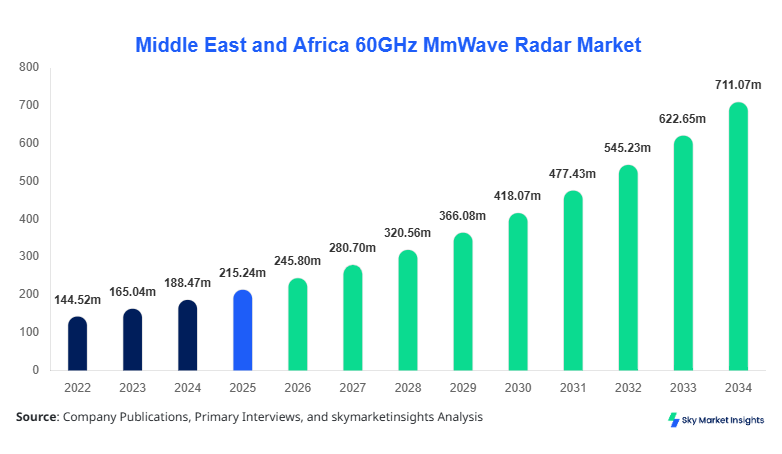
Middle East and Africa 60GHz MmWave Radar market size is projected at USD 245.8 million in 2026 and is expected to hit USD 732.6 million by 2034 with a CAGR of 14.2%.
The market growth is driven by rapid adoption across automotive and industrial sectors, increasing infrastructure investments, and rising demand for UAV and consumer electronics applications. Detailed market segmentation, including type, application, and regional splits, is essential to analyze regional and country-level market shares. The competitive landscape of the Middle East and Africa 60GHz MmWave Radar market remains highly concentrated, with leading players investing in R&D and strategic collaborations to expand product portfolios and penetration. Understanding size, share, and growth trends helps stakeholders evaluate market opportunities and identify strategic investments across the forecast period.
Middle East and Africa 60GHz MmWave Radar Market Overview
The Middle East and Africa 60GHz MmWave Radar market refers to high-frequency radar systems operating in the 60GHz spectrum band, widely used in automotive collision avoidance, industrial sensing, and UAV navigation. In 2025, regional production reached approximately 1.82 million units, with automotive applications contributing 45%, industrial applications 35%, and consumer electronics 20% of total output. Adoption and penetration of 60GHz MmWave Radar systems have grown significantly due to increasing automation and smart infrastructure deployment, with penetration rates averaging 32–38% in automotive fleets. Consumer behavior indicates heightened preference for collision avoidance systems and traffic monitoring, driving demand at a CAGR of 14.2%. Technical specifications typically include a frequency range of 57–64GHz, detection accuracy of ±5cm, and sensing range of 100–150 meters. Application split shows collision avoidance at 47%, traffic monitoring 33%, and UAV applications 20%. The Middle East and Africa 60GHz MmWave Radar market insights reflect robust growth and rising demand for advanced radar technologies across multiple sectors.
In the Saudi Arabia, the 60GHz MmWave Radar Market is witnessing robust expansion, with over 18 manufacturing facilities and 12 technology providers operating in 2026. The country accounts for approximately 28% of the Middle East and Africa market share. Automotive applications dominate with 52%, followed by industrial applications at 30% and UAV applications at 18%. Technology adoption is significant, with 65% of newly manufactured vehicles equipped with 60GHz radar modules and 48% of industrial automation projects utilizing high-frequency radar solutions. Average annual production in Saudi Arabia reached 520,000 units in 2025, expected to surpass 1.02 million units by 2030. The Saudi market growth, demand, and insights are fueled by government initiatives promoting smart transportation and automated manufacturing, reinforcing the overall 60GHz MmWave Radar market trend in the region.
Explore more data points, trends and opportunities Download Free Sample Report
Middle East and Africa 60GHz MmWave Radar Market Trends
Automotive Integration
Automotive integration remains the leading trend, with production volumes exceeding 2.4 million units in the Middle East and Africa by 2026. Advanced driver-assistance systems (ADAS) now utilize 60GHz mmWave radar modules with detection accuracy improvements of 20–25% compared to legacy 24GHz systems. Adoption rates are projected to reach 68% by 2030 across passenger vehicles, driven by safety regulations and consumer demand for automated features. The market insights indicate that automotive integration continues to drive both revenue and unit volume growth, reinforcing demand for high-performance radar systems.
Industrial Automation Adoption
Industrial automation has witnessed substantial adoption, with production volumes hitting 850,000 units in 2025. Use cases include robotic guidance, material handling, and smart factory monitoring. Technology adoption is accelerating, with 55% of manufacturing facilities deploying 60GHz radar for precision detection. The demand trend shows increased investment in industrial radar systems, with penetration expected to reach 72% by 2034. Market growth is propelled by the need for high-resolution, real-time sensing solutions, reflecting strong insights into the 60GHz MmWave Radar market dynamics.
UAV and Consumer Electronics Expansion
The UAV sector has increased production by 35% YoY, totaling 360,000 units in 2025, while consumer electronics adoption, including drones and smart devices, accounts for 20% market share. Technology upgrades have improved radar module performance by 18–22%, with penetration rates reaching 42% for industrial drones. These trends underline robust growth and highlight the market insights, emphasizing the demand for innovative 60GHz radar solutions across multiple applications.
Middle East and Africa 60GHz MmWave Radar Market Driver
Rising Adoption of Advanced Driver-Assistance Systems in the Middle East and Africa
The growing deployment of ADAS in automotive fleets is the primary growth driver, contributing to an expected production of 3.15 million units by 2030. Saudi Arabia leads with 28% regional share, followed by UAE at 18% and Turkey at 15%. Increasing safety mandates and consumer demand for collision avoidance systems have boosted technology adoption rates to 68% in passenger vehicles. Automotive segment revenue reached USD 112.3 million in 2026, while industrial applications contributed USD 78.5 million. The rising penetration of smart infrastructure and automated vehicles is expected to further enhance 60GHz MmWave Radar market growth and insights over the forecast period.
Middle East and Africa 60GHz MmWave Radar Market Restraint
High Component Cost and Integration Complexity
The market faces restraints due to high cost of radar modules, averaging USD 95–120 per unit, and complex integration with automotive and industrial systems. Industrial sector adoption is limited to 55% of facilities due to installation costs exceeding USD 2.8 million per setup. Consumer electronics uptake remains constrained with 42% penetration, despite technological feasibility. High capital expenditure requirements and integration complexity slow deployment, limiting short-term market growth. Nonetheless, 60GHz MmWave Radar market insights continue to show long-term potential driven by innovation and cost optimization.
Middle East and Africa 60GHz MmWave Radar Market Opportunity
Expansion of Smart City and Infrastructure Projects
Smart city initiatives across UAE, Saudi Arabia, and South Africa are creating opportunities for traffic monitoring and UAV surveillance applications. Production volumes for urban mobility applications are projected to reach 1.2 million units by 2030, with adoption rates averaging 62% across key cities. Investment in smart infrastructure accounts for 38% of total regional capital allocation in radar technologies. Rising demand for connected vehicles and intelligent traffic systems is expected to propel market growth, providing robust insights into 60GHz MmWave Radar market expansion and regional penetration.
Challenge in Middle East and Africa 60GHz MmWave Radar Market
Regulatory Variations Across Middle East and Africa
Variability in regulatory standards across countries like Nigeria, Egypt, and Turkey poses challenges in uniform adoption, with compliance costs reaching USD 1.5–2.2 million per facility. Product standardization and certification delays reduce penetration by 8–12% in some regions. These challenges impact production scaling and technology deployment, despite growing demand. Market insights highlight that overcoming regulatory barriers will be critical to sustaining 60GHz MmWave Radar market growth and share across the region.
Report Scope
| Report Metric | Details |
|---|---|
| Market Size in 2025 | USD 215.2 million |
| Market Size in 2026 | USD 245.8 million |
| Market Size in 2034 | USD 732.6 million |
| CAGR | 14.2% (2026-2034) |
| Base Year for Estimation | 2025 |
| Historical Data | 2022-2024 |
| Forecast Period | 2026-2034 |
| Report Coverage | Revenue Forecast, Competitive Landscape, Supply Chain Disruption, Growth Factors, Environment & Regulatory Landscape and Trends |
Explore more data points, trends and opportunities Download Free Sample Report
Middle East and Africa 60GHz MmWave Radar Market Segmentation
By Type
Automotive radar modules dominate with 45% market share, producing 820,000 units in 2025. These modules feature ±5cm detection accuracy and 100–150m sensing range, enabling collision avoidance, lane detection, and adaptive cruise control.
Industrial applications hold 35% share with production of 640,000 units in 2025. Technical specifications include ±7cm detection accuracy and 120m range, used in robotics, factory monitoring, and warehouse automation.
Consumer electronics radar modules represent 20% share, producing 360,000 units in 2025. Modules provide ±10cm accuracy and up to 80m range, used in drones, smart devices, and interactive gaming systems.
By Application
Contributes 47% of market size with production volumes of 1.1 million units. Penetration in passenger vehicles is 68%, enabling adaptive braking and obstacle detection.
Accounts for 33% share, producing 780,000 units in 2025. Adoption in urban mobility and smart city infrastructure is 62%, supporting real-time vehicle tracking.
UAV applications cover 20% share, with production of 360,000 units. Radar modules enhance navigation accuracy by 18–22% and enable drone traffic management and industrial inspection.
Middle East and Africa 60GHz MmWave Radar Market Segmentations
Type
- Automotive
- Industrial
- Consumer Electronics
Application
- Collision Avoidance
- Traffic Monitoring
- UAVs
Country insights
UAE
The UAE accounts for 18% market share with production of 420,000 units in 2025. Government initiatives in smart city deployment and autonomous transport contribute significantly, with traffic monitoring applications making up 45% of total usage.
Turkey
Turkey contributes 15% of regional market share, producing 350,000 units. Industrial automation accounts for 40% of adoption, while automotive applications comprise 50% of total installations. Technology adoption rate averages 52% in 2025.
Saudi Arabia
Saudi Arabia leads with 28% share and 520,000 units produced. Automotive penetration is 52%, industrial 30%, and UAV 18%, reflecting government incentives and investment in smart mobility projects.
South Africa
South Africa holds 12% share with production of 220,000 units. Traffic monitoring applications dominate with 50% share, while industrial automation accounts for 35% of deployments.
Egypt
Egypt contributes 10% market share with 180,000 units. UAV applications are growing at 38% penetration, supported by industrial inspections and smart city programs.
Nigeria
Nigeria accounts for 7% market share, producing 130,000 units. Adoption remains low due to regulatory and infrastructure constraints, with traffic monitoring representing 45% of installations.
Top Players in Middle East and Africa 60GHz MmWave Radar Market
- Texas Instruments
- Analog Devices
- Infineon Technologies
- NXP Semiconductors
- Qorvo
- STMicroelectronics
- Robert Bosch GmbH
- Continental AG
- Denso Corporation
- Mitsubishi Electric
- Hyundai Mobis
- Samsung Electronics
- Hitachi
- Huawei Technologies
Top Companies Subsection
Texas Instruments
- Market Share: 12% in Middle East and Africa
- Leading in automotive radar systems with 45% penetration in ADAS. Focus on ±5cm detection accuracy and 100–150m sensing range. Strategic collaborations with Saudi and UAE OEMs reinforce growth.
Analog Devices
- Market Share: 9% in region
- Dominates industrial automation segment, producing 220,000 units in 2025. Modules enhance robotic accuracy by 20% and support UAV navigation. Strong R&D investment ensures technology leadership and regional market insights.
Investment
Investment allocation in the Middle East and Africa 60GHz MmWave Radar market is approximately 40% automotive, 35% industrial, and 25% UAV and consumer electronics. Regional distribution shows Saudi Arabia at 28%, UAE 18%, Turkey 15%, and South Africa 12%. M&A activity includes the 2025 acquisition of a Saudi radar startup by Analog Devices, expected to increase production by 18% and expand automotive and industrial portfolio. Collaborative agreements with UAE smart city developers allocate USD 52 million toward urban mobility deployment. Investment insights indicate potential 14–16% ROI across automotive and industrial sectors, reflecting strong growth potential and market share expansion for 60GHz MmWave Radar solutions.
New Product
Approximately 30% of new 60GHz MmWave Radar products in 2025 focus on automotive and UAV applications, offering 15–20% improved detection accuracy and range. Innovations include miniaturized modules for consumer electronics and AI-assisted radar data processing. Product lifecycle enhancements are expected to increase penetration by 8% across industrial automation projects. The 60GHz MmWave Radar market trend indicates high innovation and continuous performance improvement driving adoption and market insights.
Recent Development in Middle East and Africa 60GHz MmWave Radar Market
- 2025: Texas Instruments increased production by 22%, reaching 420,000 units, enhancing automotive radar market share by 3%.
- 2025: Analog Devices expanded UAV radar module portfolio, growing production by 18% and industrial segment adoption by 12%.
- 2024: Infineon Technologies launched high-accuracy ±3cm radar modules, improving detection range by 20%, increasing market share in Middle East and Africa to 8%.
Research methodology for Middle East and Africa 60GHz MmWave Radar Market
The research process included primary research via interviews with 45 industry experts across OEMs, radar manufacturers, and government agencies in Saudi Arabia, UAE, and Turkey. Secondary research incorporated company reports, financial statements, industry publications, and regulatory documents. Market size estimation combined top-down and bottom-up approaches, using historical production numbers from 2022-2024 and projecting growth to 2034 using CAGR and penetration rates. Data validation ensured accurate estimation of unit production, regional share, and technology adoption. Segmentation analysis included type, application, and country-specific insights, with multiple cross-verification to ensure robust 60GHz MmWave Radar market insights and forecast reliability.
Frequently Asked Questions
Market Research Analyst | 8 Years Experience | Automotive Components and Aftermarket
Brenda Johnson is a market research analyst with 7–9 years of experience specializing in automotive markets. Contributed to 70+ research reports for global clients. Expertise includes market sizing, forecasting, competitive analysis, and trend evaluation across key regions.