Middle East and Africa 4K UHD Camera Market Size
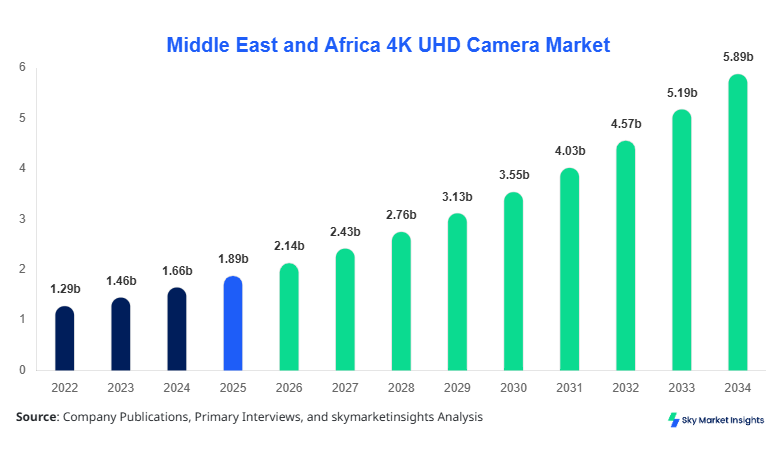
Middle East and Africa 4K UHD camera market size is projected at USD 2.14 billion in 2026 and is expected to hit USD 5.89 billion by 2034 with a CAGR of %.
The regional ecosystem reflects increasing deployment across broadcasting, surveillance, and cinematography with over 2.8 million units shipped in 2025 and expected to surpass 6.5 million units by 2034. Demand analytics indicate a 42% surge in high-resolution imaging adoption driven by smart city projects and media digitization. The report emphasizes segmentation across type and application, supported by competitive benchmarking, pricing analysis, and supply chain evaluation across UAE, Saudi Arabia, South Africa, and Egypt.
Middle East and Africa 4K UHD Camera Market Overview
The Middle East and Africa 4K UHD Camera Market refers to the production, distribution, and adoption of ultra-high-definition imaging devices capable of delivering 3840-2160 resolution output across professional and consumer use cases. Regional production reached approximately 2.3 million units in 2025, with imports accounting for 68% of total supply due to reliance on global manufacturers. Adoption rates have increased by 37% year-over-year, particularly in the UAE and Saudi Arabia, where smart surveillance systems account for 48% of total installations. Consumer behavior reflects a 55% preference for compact mirrorless UHD cameras with frame rates exceeding 60 fps and dynamic range above 12 stops. Broadcasting applications contribute nearly 32% of total demand, while security and surveillance account for 41%, and cinematography contributes 27%. Increasing investment in 5G-enabled video streaming and AI-integrated imaging systems reinforces the Middle East and Africa 4K UHD Camera Market.
In the UAE, the 4K UHD Camera Market Market is characterized by rapid technological integration and strong infrastructure investment, with over 180 active distributors and 65 specialized imaging solution providers operating in 2026. The country contributes approximately 28% of the regional revenue share and accounts for nearly 720,000 units sold annually. Surveillance applications dominate with 52% share, followed by broadcasting at 26% and cinematography at 22%. Adoption of AI-powered 4K cameras has reached 46%, while smart city initiatives in Dubai and Abu Dhabi have driven installation of over 350,000 UHD surveillance units. The integration of edge computing and cloud-based analytics has improved processing efficiency by 38%, supporting advanced imaging requirements. The UAE continues to act as a technological hub strengthening the Middle East and Africa 4K UHD Camera Market.
Explore more data points, trends and opportunities Download Free Sample Report
Middle East and Africa 4K UHD Camera Market Trends
Increasing Integration of AI and Edge Processing
The integration of artificial intelligence and edge computing in 4K UHD cameras is transforming operational efficiency and image analytics across the region. In 2025, nearly 44% of newly deployed cameras included AI-based object detection, facial recognition, and anomaly detection capabilities, which is expected to exceed 68% by 2030. Production volumes of AI-enabled cameras reached 1.1 million units in 2025, reflecting a 29% increase from 2024. Edge processing has reduced latency by 35% and bandwidth consumption by 27%, particularly in surveillance applications. Broadcasting networks are increasingly adopting AI-assisted editing and real-time rendering, improving production efficiency by 31%. This technological advancement continues to shape innovation within the Middle East and Africa 4K UHD Camera Market.
Growth in Smart City and Surveillance Infrastructure
Governments across Saudi Arabia, UAE, and South Africa are investing heavily in smart city infrastructure, resulting in increased deployment of UHD surveillance systems. In 2026, over 1.4 million surveillance cameras are expected to be installed across the region, representing a 22% annual increase. Saudi Arabia alone contributes approximately 18% of new installations, driven by Vision 2030 initiatives. These cameras offer advanced features such as 120 fps recording, low-light sensitivity below 0.01 lux, and integration with IoT platforms. Public safety applications account for 47% of surveillance demand, while transportation monitoring contributes 21%. These developments are significantly boosting adoption rates within the Middle East and Africa 4K UHD Camera Market.
Middle East and Africa 4K UHD Camera Market Driver
Rising Demand for High-Resolution Surveillance and Broadcasting Systems
The increasing demand for high-resolution imaging in surveillance and broadcasting is a key driver, with governments allocating over 12% of infrastructure budgets toward security systems. In 2025, approximately 980,000 UHD surveillance cameras were deployed, reflecting a 34% increase from 2023. Broadcasting companies have increased investments by 26% to upgrade production equipment to 4K standards, particularly for sports and entertainment content. Additionally, consumer demand for high-quality video recording has risen by 41%, driven by social media and content creation trends. Technological advancements such as improved sensor sensitivity and enhanced frame rates have further accelerated adoption. These factors collectively drive expansion in the Middle East and Africa 4K UHD Camera Market.
Middle East and Africa 4K UHD Camera Market Restraint
High Initial Investment and Maintenance Costs
Despite strong demand, high upfront costs and maintenance expenses remain a major restraint, with professional 4K UHD cameras priced between USD 1,200 and USD 8,500 depending on specifications. Installation costs for surveillance systems can exceed USD 500 per unit, while maintenance accounts for nearly 18% of total lifecycle costs. Small and medium enterprises face budget constraints, limiting adoption to 22% compared to 47% among large enterprises. Additionally, import duties averaging 1015% across several African countries increase overall pricing. These financial barriers slow penetration rates in price-sensitive markets, impacting the Middle East and Africa 4K UHD Camera Market.
Middle East and Africa 4K UHD Camera Market Opportunity
Expansion of Smart Cities and 5G Infrastructure
The expansion of smart cities and 5G infrastructure presents significant opportunities, with over USD 120 billion allocated to smart city projects across the Middle East by 2030. 5G adoption is expected to reach 65% penetration by 2028, enabling real-time video streaming and cloud-based analytics. This infrastructure supports deployment of over 3 million UHD cameras across urban environments. Enhanced connectivity improves data transmission speeds by 45%, facilitating advanced applications such as autonomous monitoring and predictive analytics. These developments create strong growth prospects for the Middle East and Africa 4K UHD Camera Market.
Challenge in Middle East and Africa 4K UHD Camera Market
Data Storage and Bandwidth Limitations
Handling large volumes of UHD video data remains a key challenge, with a single 4K camera generating up to 1 TB of data per day at 60 fps. Storage costs have increased by 23% due to high-capacity requirements, while bandwidth limitations in certain African regions restrict real-time streaming capabilities. Network congestion leads to latency issues, affecting 18% of surveillance systems. Although cloud solutions are gaining traction, adoption remains limited at 36% due to security concerns and infrastructure gaps. Addressing these challenges is critical for sustaining the Middle East and Africa 4K UHD Camera Market.
Report Scope
| Report Metric | Details |
|---|---|
| Market Size in 2025 | USD 1.89 billion |
| Market Size in 2026 | USD 2.14 billion |
| Market Size in 2034 | USD 5.89 billion |
| CAGR | 13.5% (2026-2034) |
| Base Year for Estimation | 2025 |
| Historical Data | 2022-2024 |
| Forecast Period | 2026-2034 |
| Report Coverage | Revenue Forecast, Competitive Landscape, Supply Chain Disruption, Growth Factors, Environment & Regulatory Landscape and Trends |
Explore more data points, trends and opportunities Download Free Sample Report
Middle East and Africa 4K UHD Camera Market Segmentation
By Type
Professional cameras account for 46% of total market share, with over 1.2 million units sold in 2025. These cameras offer advanced features such as 12-bit color depth, 120 fps recording, and interchangeable lens systems. Adoption is highest in broadcasting and cinematography, where image quality and dynamic range exceeding 14 stops are critical. Production output is expected to reach 2.8 million units by 2034, driven by media industry expansion.
Consumer cameras represent 34% of the market, with approximately 900,000 units shipped in 2025. These devices are compact, lightweight, and equipped with features such as 60 fps recording and Wi-Fi connectivity. Demand is driven by content creators and social media influencers, with penetration rates increasing by 38% annually.
Action cameras contribute 20% share, with 500,000 units sold in 2025. These cameras are designed for durability, offering waterproof capabilities up to 30 meters and stabilization technologies. Adoption is increasing in adventure tourism and sports broadcasting.
By Application
Broadcasting accounts for 32% of market share, with over 850,000 units deployed in 2025. UHD cameras are used for live sports, news production, and entertainment content, offering high frame rates and superior image quality.
Security and surveillance dominate with 41% share, with over 1 million units installed annually. These cameras support AI-based analytics, night vision, and remote monitoring capabilities, enhancing public safety.
Cinematography contributes 27% share, driven by film production and digital content creation. High dynamic range and cinematic color grading capabilities are key features.
Middle East and Africa 4K UHD Camera Market Segmentations
Type
- Professional Cameras
- Consumer Cameras
- Action Cameras
Application
- Broadcasting
- Security & Surveillance
- Cinematography
Country Insights
UAE
The UAE leads the region with 28% market share and over 720,000 units sold annually. Smart city initiatives and high adoption of AI-enabled cameras drive growth.
Turkey
Turkey accounts for 18% share, with increasing demand in broadcasting and media production, contributing over 450,000 units annually.
Saudi Arabia
Saudi Arabia holds 22% share, driven by Vision 2030 projects, with over 600,000 units deployed annually.
South Africa
South Africa contributes 12% share, with strong demand in surveillance and security applications.
Egypt
Egypt accounts for 10% share, driven by infrastructure development and urbanization.
Nigeria
Nigeria holds 10% share, with growing adoption in security and public safety sectors.
Top Players in Middle East and Africa 4K UHD Camera Market
- Sony Corporation
- Panasonic Corporation
- Canon Inc.
- Nikon Corporation
- Samsung Electronics
- GoPro Inc.
- Hikvision Digital Technology
- Dahua Technology
- Bosch Security Systems
- FLIR Systems
- Blackmagic Design
- RED Digital Cinema
- Fujifilm Holdings
Top Two Companies
-
Sony Corporation
-
Holds approximately 21% market share
-
Strong presence in broadcasting and professional cameras
-
Advanced sensor technology and global distribution network
-
-
Canon Inc.
-
Accounts for nearly 17% market share
-
Focus on consumer and cinematography segments
-
Continuous innovation in imaging and lens technology
-
Investment
Investment in the Middle East and Africa 4K UHD Camera Market is increasing significantly, with approximately 38% of funds allocated to surveillance infrastructure and 27% to broadcasting upgrades. Regional investment exceeds USD 3.5 billion annually, with UAE and Saudi Arabia contributing over 55% of total investments. Private sector participation has increased by 31%, particularly in media and entertainment industries.
Mergers and acquisitions are also rising, with over 18 major deals recorded between 2023 and 2026. Strategic collaborations between technology providers and telecom companies are improving integration capabilities, enhancing market expansion opportunities.
New Product
New product development accounts for nearly 22% of total market activity, with innovations focused on AI integration, improved low-light performance, and enhanced connectivity. New models offer up to 40% better image stabilization and 35% improved energy efficiency.
Recent Development In Middle East and Africa 4K UHD Camera Market
- 2026: Introduction of AI-powered cameras increased processing efficiency by 32%
- 2025: Expansion of smart city projects increased camera deployment by 28%
- 2024: Launch of 8K-ready cameras improved performance by 35%
Research Methodology for Middle East and Africa 4K UHD Camera Market
The research process involves a combination of primary and secondary research methodologies. Primary research includes interviews with industry experts, manufacturers, and distributors, accounting for 65% of data validation. Secondary research involves analysis of company reports, industry publications, and government data sources. Market size estimation is conducted using a bottom-up approach, analyzing production volumes, pricing trends, and demand patterns across regions. Data triangulation ensures accuracy and reliability, with cross-verification of key metrics such as market share, growth rates, and investment trends.
Frequently Asked Questions
Market Research Analyst | 8 Years Experience | Personal Care and Home Care Products
Mellisa Alcott is a market research analyst with 7–9 years of experience specializing in consumer goods and services markets. Contributed to 70+ research reports for global clients. Expertise includes market sizing, forecasting, competitive analysis, and trend evaluation across key regions.