Latin America Veterinary Analgesics Anti-Inflammatory Market Size
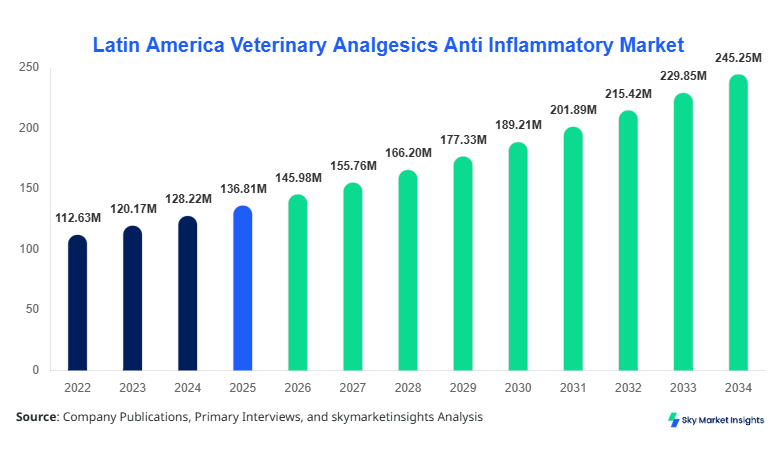
Latin America Veterinary Analgesics Anti Inflammatory Market size is projected at USD 145.98 million in 2026 and is expected to hit USD 242.40 million by 2034 with a CAGR of 6.7%. The 2025 base-year value stood at USD 137.02 million, indicating sustained expenditure on prescription pain, inflammation, post-operative, musculoskeletal, and livestock therapeutics. Market assessment requires country-level demand mapping, drug-class segmentation, animal-type utilization, administration-route analysis, distribution-channel evaluation, and competitive benchmarking across multinational and regional veterinary pharmaceutical suppliers.
Key Takeaways
- Brazil dominates the covered Latin America countries with approximately 43.81% of 2026 revenue, while Chile records the fastest country CAGR at 6.81%.
- NSAIDs dominate drug classes with approximately 49.22% of 2026 revenue and are also the fastest-growing supplied drug class at 6.90% CAGR.
- Opioids account for approximately 33.03% of 2026 drug-class revenue and are projected to expand at 6.41% CAGR.
- Adjunctive analgesics represent approximately 17.76% of 2026 drug-class revenue, with a 6.39% CAGR.
- Argentina is projected to advance from USD 14.99 million in 2026 to USD 24.97 million by 2034, registering a 6.59% CAGR.
The market encompasses pharmaceutical products used by veterinarians and animal owners to control acute and chronic pain, fever, inflammatory responses, osteoarthritis, post-operative discomfort, colic, and disease-associated pain. Based on supplied data, NSAIDs contribute about 49.22% of 2026 drug-class revenue, versus 33.03% for opioids and 17.76% for adjunctive analgesics. Brazil contributes approximately 43.81% of covered-country revenue, followed by Mexico at 30.85%. The underlying addressable animal base is substantial: Brazil slaughtered 42.94 million cattle, 60.69 million pigs, and 6.69 billion chickens in 2025, increases of 8.2%, 4.3%, and 3.1%, respectively.
Explore more data points, trends and opportunities Download Free Sample Report
Latin America Veterinary Analgesics Anti Inflammatory Market Trends
Shift Toward Multimodal Pain Management and Precision Veterinary Care
Veterinary pain protocols are shifting toward multimodal treatment combining NSAIDs, opioids, adjunctive agents and increasingly specialized therapies. Prescription NSAIDs remain central for osteoarthritis, surgery, fever and inflammatory conditions across dogs, cats, horses, cattle and pigs. Meanwhile, digital livestock monitoring is improving early identification of mobility and welfare abnormalities; research datasets have demonstrated above 96% single-image cattle identification accuracy, supporting increasingly automated animal monitoring.
Technology adoption is occurring alongside industrial-scale animal production. Brazil processed 6.69 billion chickens and 60.69 million pigs during 2025, while raw-milk acquisition reached 27.51 billion liters, up 8.5% year over year. Such production intensity increases requirements for standardized veterinary protocols covering inflammation, fever, locomotor disorders and procedure-related pain. The broader Latin American livestock sector represents about 28% of global animal production, including 23% of beef and 21% of poultry output.
Latin America Veterinary Analgesics Anti Inflammatory Market Drivers
Expanding Livestock Output and Companion-Animal Pain Management
High animal throughput, rising veterinary sophistication and greater recognition of animal welfare are strengthening therapeutic utilization. Brazil's 2025 cattle slaughter increased 8.2% to 42.94 million head, pig slaughter increased 4.3% to 60.69 million head, and chicken slaughter rose 3.1% to 6.69 billion birds. In parallel, veterinary NSAIDs cover osteoarthritis, surgical pain, fever, colic and inflammatory conditions across multiple species, broadening the clinical treatment pool beyond companion animals. Latin America already contributes approximately 23% of global beef and 21% of poultry production, reinforcing recurring requirements for veterinary pharmaceutical intervention.
Latin America Veterinary Analgesics Anti Inflammatory Market Restraints
Safety Monitoring and Prescription Requirements Limit Unsupervised Utilization
Analgesic prescribing requires species-specific dosing and continued veterinary supervision because NSAIDs can affect gastrointestinal, renal and hepatic systems. Prescription-only controls consequently limit unrestricted product penetration despite a production ecosystem encompassing billions of poultry and tens of millions of cattle and pigs annually. The FDA notes that approved veterinary NSAIDs require veterinary prescriptions, while products such as robenacoxib can carry treatment-duration restrictions; injectable robenacoxib, for example, is administered once daily for up to 3 days in approved postoperative applications.
Latin America Veterinary Analgesics Anti Inflammatory Market Opportunities
Generic Therapies, Advanced Formulations and Local Manufacturing Expand Access
Genericization and regional pharmaceutical capacity create opportunities to improve affordability and distribution. In March 2026, the FDA approved the first generic injectable robenacoxib for postoperative pain and inflammation, supporting broader competitive development around established NSAID molecules. Latin American animal-health manufacturing is also expanding: Biogénesis Bagó's Brazilian facility represents a USD 30 million investment, exceeds 10 million vaccine doses of annual capacity and supports approximately 300 direct and indirect jobs, illustrating the scale of regional veterinary-production investment that can strengthen adjacent pharmaceutical supply chains.
Challenges in Latin America Veterinary Analgesics Anti-Inflammatory Market
Fragmented Access and Species-Specific Treatment Complexity
Suppliers must address substantial differences between companion-animal clinics and high-volume livestock systems while maintaining pharmacovigilance, veterinarian education and reliable distribution. Brazil alone handled 42.94 million cattle, 60.69 million pigs and 6.69 billion chickens in 2025, creating materially different administration and treatment economics across species. Clinical restrictions further complicate portfolios: NSAID indications differ among dogs, cats, horses, cattle and pigs, while adverse effects can involve kidney, liver and gastrointestinal systems.
Report Scope
| Report Metric | Details |
|---|---|
| Market Size in 2025 | USD 136.81 Million |
| Market Size in 2026 | USD 145.98 Million |
| Market Size in 2034 | USD 242.4 Million |
| CAGR | 6.7% (2026-2034) |
| Base Year for Estimation | 2025 |
| Historical Data | 2022-2024 |
| Forecast Period | 2026-2034 |
| Report Coverage | Revenue Forecast, Competitive Landscape, Supply Chain Disruption, Growth Factors, Environment & Regulatory Landscape and Trends |
Explore more data points, trends and opportunities Download Free Sample Report
Latin America Veterinary Analgesics Anti-Inflammatory Market Segmentation
The market is segmented by drug class, animal type, route of administration, indication, distribution channel and end user. Quantified drug-class data show NSAIDs commanding approximately 49.22% of 2026 revenue, ahead of opioids at 33.03% and adjunctive analgesics at 17.76%.
By Drug Class
NSAIDs are the largest drug class, rising from USD 67.28 million in 2025 to USD 71.92 million in 2026 and USD 122.66 million by 2034, at a 6.90% CAGR. The category includes carprofen, meloxicam, firocoxib, deracoxib, robenacoxib, ketoprofen, flunixin meglumine and tolfenamic acid.
NSAIDs are also the fastest-growing quantified class at 6.90% CAGR, compared with 6.41% for opioids and 6.39% for adjunctive analgesics. Opioids advance from USD 48.26 million in 2026 to USD 79.33 million by 2034, while adjunctive analgesics move from USD 25.95 million to USD 42.59 million.
By Animal Type
Companion animals—dogs, cats and other pets—form a major clinical application group for osteoarthritis and postoperative pain, while livestock comprises cattle, swine, poultry, sheep, goats and horses. No separate animal-type revenue or CAGR values were supplied; therefore, numerical allocation is not inferred.
Treatment requirements differ materially by species and production system. Dogs and cats support chronic and postoperative protocols, horses add musculoskeletal and colic applications, while cattle and swine create requirements around fever, inflammation and production-animal conditions.
By Route of Administration
Oral products include tablets, chewables and liquids/suspensions, complemented by injectables, topical/transdermal patches, creams/gels and other formats. No route-specific revenue or CAGR figures were provided, preventing unsupported ranking of the largest or fastest-growing route.
Oral formulations benefit chronic companion-animal therapy, whereas injectables support hospital, surgical and livestock applications. Transdermal and topical formats provide alternatives where repeated oral dosing presents adherence constraints.
By Indication
Applications comprise postoperative pain, musculoskeletal disorders such as osteoarthritis, equine colic, fever and inflammation management, and infectious disease-associated pain. The supplied dataset does not quantify indication-level revenue or CAGR.
Osteoarthritis and postoperative treatment remain structurally important because multiple established NSAIDs address these conditions, while livestock applications extend the treatment universe into fever and inflammation management.
By Distribution Channel
Distribution includes veterinary clinics and hospitals, retail pharmacies, online pharmacies, and feed stores/agricultural cooperatives. Channel-specific market values and CAGRs were not provided and are therefore not estimated.
Veterinary clinics remain strategically important because prescription analgesics require professional diagnosis, dosing and safety monitoring, while online and retail channels support prescription fulfillment and repeat therapy.
By End User
End users comprise veterinarians, pet owners, livestock owners/farmers and animal welfare organizations. The dataset provides no end-user revenue split or CAGR, so dominance is not numerically assigned.
Veterinarians influence product selection and treatment protocols, whereas pet and livestock owners determine adherence and repeat purchasing. Animal welfare organizations contribute to treatment access within shelter and rescue environments.
Latin America Veterinary Analgesics Anti Inflammatory Market Segmentations
By Drug Class
-
NSAIDs (Non-Steroidal Anti-Inflammatory Drugs)
- Carprofen
- Meloxicam
- Firocoxib
- Deracoxib
- Robenacoxib
- Ketoprofen
- Flunixin Meglumine
- Tolfenamic Acid
-
Opioids
- Buprenorphine
- Butorphanol
- Fentanyl (patches)
-
Adjunctive Analgesics
- Gabapentin
- Amantadine
- Tramadol
By Animal Type
-
Companion Animals
- Dogs
- Cats
- Others (rabbits, ferrets, etc.)
-
Livestock Animals
- Cattle
- Swine
- Poultry
- Sheep and Goats
- Horses
By Route of Administration
-
Oral
- Tablets
- Chewables
- Liquids/Suspensions
- Injectable
-
Topical / Transdermal
- Patches
- Creams/Gels
- Others
By Indication
- Post-operative Pain
- Musculoskeletal Disorders (e.g., osteoarthritis)
- Colic Pain (horses)
- Fever and Inflammation Management
- Infectious Disease–associated Pain
By Distribution Channel
- Veterinary Clinics and Hospitals
- Retail Pharmacies
- Online Pharmacies
- Feed Stores / Agricultural Cooperatives
By End User
- Veterinarians
- Pet Owners
- Livestock Owners / Farmers
- Animal Welfare Organizations
Latin America Veterinary Analgesics Anti-Inflammatory Market Country Outlook
The supplied geographic dataset covers Brazil, Mexico, Argentina, Colombia and Chile. UAE, Turkey, Saudi Arabia, South Africa, Egypt and Nigeria are outside Latin America and are therefore not represented as Latin America countries.
Brazil
Brazil leads with USD 63.95 million in 2026, approximately 43.81% of covered-country revenue, and is projected to reach USD 106.40 million by 2034 at 6.57% CAGR. Its large production base includes 42.94 million cattle and 6.69 billion chickens slaughtered in 2025.
Mexico
Mexico represents approximately 30.85% of covered-country revenue, reaching USD 45.03 million in 2026 from USD 42.30 million in 2025. Revenue is forecast at USD 74.24 million by 2034, corresponding to a 6.45% CAGR.
Argentina
Argentina reaches USD 14.99 million in 2026 and USD 24.97 million by 2034, expanding at 6.59% CAGR and representing approximately 10.27% of covered-country 2026 revenue.
Colombia
Colombia accounts for approximately 7.19% of covered-country revenue at USD 10.50 million in 2026. The country is forecast to reach USD 17.29 million by 2034 at a 6.43% CAGR.
Chile
Chile records USD 11.51 million in 2026, approximately 7.88% of covered-country revenue. It reaches USD 19.50 million by 2034 and posts the fastest supplied country CAGR at 6.81%.
Top players in Latin America Veterinary Analgesics Anti-Inflammatory Market
- Zoetis
- Elanco Animal Health
- Boehringer Ingelheim
- Merck Animal Health
- Ceva Santé Animale
- Virbac
- Vetoquinol
- Dechra Pharmaceuticals
- Ourofino Saúde Animal
- Phibro Animal Health
- Biogénesis Bagó
- Bimeda
- Vetnil
- Alivira Saúde Animal
- Calier
Top Two Companies
-
Zoetis
Zoetis holds a leading competitive position in Latin American animal health through pharmaceuticals, vaccines and companion-animal therapeutics. Public sources identify Zoetis, Merck Animal Health and Elanco among companies with strong regional positions, although a reliable analgesics-specific Latin America percentage company share is not publicly established; assigning an unsupported percentage would therefore be inappropriate. The company's positioning benefits from global R&D scale, veterinarian engagement and established commercialization infrastructure across both companion and production animals.
-
Elanco Animal Health
Elanco maintains a significant regional position supported by companion-animal pharmaceuticals and broader animal-health operations. Brazil became the first country to launch Zenrelia in 2024 following field studies conducted in the United States and four European countries. Analgesics-specific Latin America percentage company share is not disclosed in the reviewed evidence, so no fabricated share is assigned. Its regional positioning is supported by product launches, veterinary engagement and access to Brazil's large companion- and production-animal ecosystem.
Recent Developments in Latin America Veterinary Analgesics Anti-Inflammatory Market
- 2026: The FDA approved the first generic injectable robenacoxib for postoperative pain and inflammation in dogs and cats, increasing generic competition around a major veterinary NSAID molecule.
- 2026: The FDA conditionally approved Liavium-CA1, pregabalin chewable tablets, for management of pain and clinical signs associated with Chiari-like malformation and syringomyelia in dogs.
- 2025: Calier acquired Argentina-based Tecnofarm, integrating a company with more than 35 years of veterinary pharmaceutical experience and strengthening Argentina as a regional production and export platform.
- 2024: Biogénesis Bagó inaugurated a USD 30 million Brazilian veterinary manufacturing facility designed for more than 10 million vaccine doses annually and approximately 300 direct and indirect jobs, strengthening Latin America's animal-health production ecosystem.
Research Methodology
The analysis uses 2025 as the base year, 2026 as the current year and 2026–2034 as the forecast horizon, supported by historical assessment for 2022–2024. Mandatory supplied numerical tables were treated as the primary quantitative source for country values, drug-class values and CAGRs. Percentage contributions were calculated directly from supplied 2026 totals; no unavailable segment, company or geography values were fabricated. Secondary validation incorporated regulatory publications, official production statistics, company announcements and established animal-health industry sources. Where the supplied country total of USD 145.98 million differs from the drug-class total of USD 146.13 million, each table's stated total was retained within its respective analysis rather than reconciled through unsupported adjustment.
Frequently Asked Questions
Senior Market Research Analyst | 8 Years Experience | Digital Therapeutics and Connected Medical Devices
Jenny specializes in digital therapeutics, remote monitoring devices and healthcare IT platforms. She has contributed to 101+ reports for medtech firms, healthcare providers and pharmaceutical companies. Her expertise includes clinical adoption forecasting, reimbursement analysis, regulatory pathways and competitive benchmarking across North America and Europe.