Latin America Decanter Centrifuge Market Size
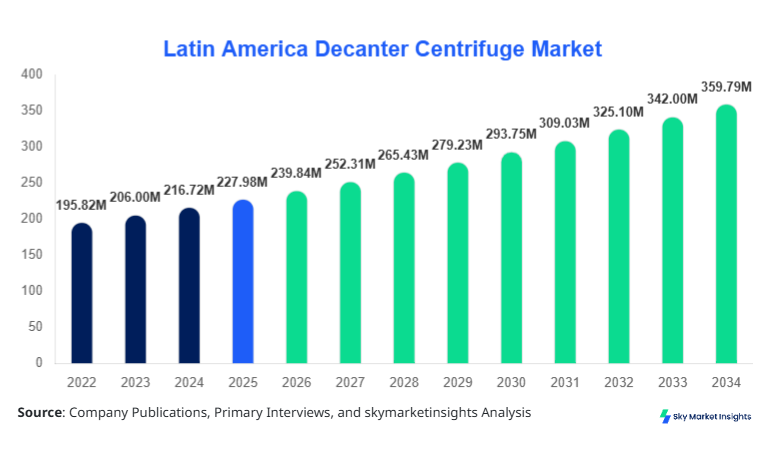
Latin America Decanter Centrifuge Market size is projected at USD 239.84 million in 2026 and is expected to hit USD 363.58 million by 2034 with a CAGR of 5.2%. The industry is expanding from USD 227.69 million in 2025, implying an absolute increase of USD 135.89 million through 2034. The assessment covers design configuration, bowl architecture, operating mode, application, capacity, end-user demand, country-level deployment, technology development, and the competitive landscape.
Key takeaways
- Brazil dominates geographically:Brazil accounts for approximately38.15%of the 2026 total, at USD 91.51 million, and is forecast to reach USD 140.34 million by 2034 at a5.49% CAGR, the fastest rate among the supplied countries.
- Mexico remains the second-largest country:Mexico represents approximately36.07%of 2026 revenue, with USD 86.52 million, rising to USD 130.09 million by 2034 at a5.23% CAGR.
- 2-phase systems dominate design:2-phase decanters represent approximately56.82%of the supplied design-type total in 2026, generating USD 136.25 million and reaching USD 207.99 million by 2034 at a5.43% CAGR.
- 3-phase equipment maintains substantial penetration:The category generates USD 103.54 million in 2026 and is projected at USD 154.97 million by 2034, representing a5.17% CAGR.
- Colombia offers an emerging-country opportunity:Revenue increases from USD 18.28 million in 2026 to USD 27.76 million in 2034 at a5.36% CAGR.
A decanter centrifuge is a continuous solid-liquid or solid-liquid-liquid separation system using high centrifugal forces and differential bowl-scroll rotation to separate materials with different densities. Across the supplied Latin America countries, 2026 revenue totals USD 239.84 million versus USD 227.69 million in 2025. Brazil and Mexico jointly contribute approximately 74.22% of 2026 revenue, while Argentina, Colombia, and Chile account for about 10.49%, 7.62%, and 7.66%, respectively. Within design configurations, 2-phase equipment contributes roughly 56.82%, compared with 43.18% for 3-phase units, demonstrating higher penetration of conventional solid-liquid separation configurations.
Explore more data points, trends and opportunities Download Free Sample Report
Latin America Decanter Centrifuge Market Trends
Energy-Efficient, Automated and Continuous Separation Is Reshaping Equipment Selection
Industrial users are increasingly prioritizing continuous operation, intelligent controls, variable-speed drives, torque optimization, and lower-energy feed systems. Modern equipment can operate with bowl diameters around 400 mm, while new feed-zone technologies can reduce turbulence by more than 80%, lower acceleration power by 40–50%, and reduce overall power consumption by up to 30% compared with conventional configurations.
Wastewater, food processing, mining, oil treatment, chemicals, and pharmaceutical processing are reinforcing demand for enclosed separation equipment capable of handling continuous industrial volumes. In beverage-related applications, complementary water-recirculation technology can lower water consumption by as much as 70%, while wastewater decanters can save several thousand cubic meters of water annually. Continuous automatic operation, reduced filter consumption, and compact installation footprints are therefore becoming important purchasing criteria.
Latin America Decanter Centrifuge Market Drivers
Wastewater Infrastructure and Industrial Water Recovery Accelerate Equipment Deployment
Municipal and industrial operators face rising requirements to recover water, reduce sludge volumes, and lower disposal costs. Modern sludge centrifuges can decrease power requirements by up to 30%, with specialized feed-zone designs reducing turbulence by over 80% and acceleration energy by 40–50%. In parallel, water-saving process technologies can achieve reductions approaching 70%, strengthening the economic case for high-efficiency mechanical separation across utilities, food plants, mines, refineries, and process industries.
Latin America Decanter Centrifuge Market Restraints
Capital Intensity and Maintenance Requirements Limit Faster Replacement Cycles
High-speed rotating equipment requires precision components, scheduled maintenance, wear protection, trained operators, and process-specific optimization. Bowls operating at high centrifugal forces must maintain narrow mechanical tolerances, while feed solids, torque, differential speed, and discharge characteristics can vary materially between applications. Although newer designs target energy savings of up to 30% and acceleration-energy reductions of 40–50%, realizing those efficiencies can require investment in modern controls and upgraded equipment, slowing adoption among smaller operators.
Latin America Decanter Centrifuge Market Opportunities
Mining, Food Processing and Resource Recovery Create New Installation Potential
Water-intensive industries provide a substantial opportunity for closed-loop separation systems. In mining applications, decanters can substantially reduce dependence on settling infrastructure; Flottweg reports applications capable of saving approximately 90% of pond space. Food-grade systems increasingly integrate hygienic construction and Cleaning-In-Place technology, while water-recirculation solutions can reduce centrifuge-related water requirements by as much as 70%, supporting stronger economics across breweries, food processors, mineral operations, and industrial wastewater facilities.
Challenges in Latin America Decanter Centrifuge Market
Feed Variability, Wear and Process Optimization Increase Operational Complexity
Decanter performance depends on solids concentration, differential speed, torque, bowl geometry, throughput, and discharge conditions. Abrasive mining feeds and variable wastewater sludge can increase wear, while hygienic applications require stringent cleaning procedures. New-generation equipment addresses these issues through 400 mm-class compact bowls, modular designs, continuous controls, and feed systems capable of cutting turbulence by more than 80%, but achieving consistent separation performance still depends on correct process configuration and skilled maintenance.
Report Scope
| Report Metric | Details |
|---|---|
| Market Size in 2025 | USD 227.99 Million |
| Market Size in 2026 | USD 239.84 Million |
| Market Size in 2034 | USD 363.58 Million |
| CAGR | 5.2% (2026-2034) |
| Base Year for Estimation | 2025 |
| Historical Data | 2022-2024 |
| Forecast Period | 2026-2034 |
| Report Coverage | Revenue Forecast, Competitive Landscape, Supply Chain Disruption, Growth Factors, Environment & Regulatory Landscape and Trends |
Explore more data points, trends and opportunities Download Free Sample Report
Latin America Decanter Centrifuge Market Segmentation
The industry is segmented by design type, bowl design, operation type, application, capacity, and end-user. Among segments for which mandatory numerical data were supplied, 2-phase systems dominate with approximately 56.82% of 2026 design-type revenue, compared with approximately 43.18% for 3-phase systems.
By Design Type
2-Phase Decanter Centrifuges: The segment rises from USD 129.23 million in 2025 to USD 136.25 million in 2026 and USD 207.99 million by 2034. Its approximately 56.82% contribution in 2026 reflects broad utilization in wastewater, sludge, food, mineral, and industrial solid-liquid separation.
At a 5.43% CAGR, 2-phase equipment is also the faster-growing supplied design category. 3-phase systems, meanwhile, advance at a 5.17% CAGR, supported by processes requiring simultaneous separation of solids and two immiscible liquid phases.
By Bowl Design
Cylindrical-conical bowls are widely suited to continuous clarification and dewatering because the cylindrical section supports settling while the conical section assists solids discharge. Conical Bowl, Cylindrical-Conical Bowl, and Peeler Bowl Design constitute the assessed categories.
No numerical market allocation or CAGR by bowl design was supplied in the mandatory dataset; therefore, no unsupported market value or percentage has been assigned to these subsegments.
By Operation Type
Continuous Operation Centrifuges are structurally important because decanter technology is designed for uninterrupted separation and automatic solids transport. Batch Operation Centrifuges remain relevant where feed conditions or production schedules favor discrete processing cycles.
The supplied dataset does not provide operation-type revenue or CAGR values. Consequently, quantitative dominance or fastest-growth rates are not assigned to either category.
By Application
Wastewater Treatment, Oil and Gas, Food and Beverage, Chemical and Pharmaceutical, Mining and Minerals, and Pulp and Paper represent the principal applications. Wastewater applications benefit particularly from continuous sludge thickening and dewatering, while mining applications emphasize water recovery and solids management.
No application-specific revenue or CAGR was supplied; accordingly, numerical application shares have not been fabricated.
By Capacity
Small Capacity equipment addresses decentralized or lower-throughput operations, Medium Capacity systems serve mid-scale industrial installations, and High Capacity systems support large municipal and process facilities.
The mandatory tables contain no capacity-specific revenue or CAGR figures. Quantitative leadership and fastest-growing capacity classifications therefore cannot be established from the supplied numerical evidence.
By End-User
Municipalities and Utilities, Oil and Gas Companies, Food Processing Companies, Chemical Manufacturers, Mining and Metals Companies, and Pharmaceutical Manufacturers form the principal end-user groups. Their requirements range from sludge dewatering and water recovery to hygienic product clarification.
No end-user revenue split or CAGR was provided, preventing evidence-based numerical ranking of the six end-user categories.
Latin America Decanter Centrifuge Market Segmentations
By Design Type
- 2-Phase Decanter Centrifuges
- 3-Phase Decanter Centrifuges
By Bowl Design
- Conical Bowl
- Cylindrical-Conical Bowl
- Peeler Bowl Design
By Operation Type
- Batch Operation Centrifuges
- Continuous Operation Centrifuges
By Application
- Wastewater Treatment
- Oil and Gas
- Food and Beverage
- Chemical and Pharmaceutical
- Mining and Minerals
- Pulp and Paper
By Capacity
- Small Capacity
- Medium Capacity
- High Capacity
By End-User
- Municipalities and Utilities
- Oil and Gas Companies
- Food Processing Companies
- Chemical Manufacturers
- Mining and Metals Companies
- Pharmaceutical Manufacturers
Latin America Decanter Centrifuge Market Counties Outlook
Brazil
Brazil contributes approximately 38.15% of 2026 Latin America revenue at USD 91.51 million, up from USD 86.75 million in 2025. Revenue is forecast to reach USD 140.34 million by 2034, representing the highest supplied country CAGR of 5.49%. Wastewater, food processing, mining, oil and gas, and bio-processing provide diverse equipment applications.
Mexico
Mexico represents approximately 36.07% in 2026, generating USD 86.52 million versus USD 82.22 million in 2025. By 2034, the country reaches USD 130.09 million at a 5.23% CAGR, maintaining its position as the second-largest supplied national market.
Argentina
Argentina accounts for approximately 10.49% of 2026 revenue, equivalent to USD 25.17 million, compared with USD 23.91 million in 2025. The country is projected to reach USD 37.93 million by 2034, advancing at a 5.26% CAGR.
Colombia
Colombia generates USD 18.28 million in 2026, representing approximately 7.62% of the regional total. Revenue advances from USD 17.35 million in 2025 to USD 27.76 million in 2034, supported by a comparatively strong 5.36% CAGR.
Chile
Chile contributes approximately 7.66% in 2026, with revenue of USD 18.36 million versus USD 17.46 million in 2025. The country reaches USD 27.46 million by 2034 at a 5.16% CAGR, with mining, food and beverage processing, and industrial wastewater treatment representing relevant deployment environments.
Top players in Latin America Decanter Centrifuge Market
- Alfa Laval AB
- GEA Group AG
- Flottweg SE
- ANDRITZ AG
- Pieralisi Maip S.p.A.
- HAUS Centrifuge Technologies
- Centrisys Corporation
- Hiller GmbH
- Tomoe Engineering Co., Ltd.
- Mitsubishi Kakoki Kaisha, Ltd.
- GN Solids Control
- Ferrum Ltd.
Top Two Companies
- Alfa Laval AB
Exact Latin America company revenue share is not disclosed in the supplied dataset and is therefore not estimated. Alfa Laval maintains a prominent competitive position through ALDEC and i-Dec wastewater solutions and its ALDEC G3 VecFlow technology. VecFlow is designed to reduce feed-zone turbulence by more than80%, decrease acceleration power by40–50%, and reduce overall power consumption by up to30%compared with conventional decanters. Its portfolio addresses municipal and industrial sludge thickening and dewatering and benefits from a broad separation-technology service platform.
- Flottweg SE
Exact Latin America company share is likewise not available from the mandatory data. Flottweg competes through specialized wastewater, mining, food, chemical, and industrial separation platforms. ItsFW400 HTS, unveiled at IFAT 2026, incorporates a400 mmbowl and targets higher sludge-dewatering performance, flexibility, and reliability. Its mining-focused systems can reduce settling-pond space requirements by approximately90%in relevant applications, reinforcing its positioning in water recovery and solids-management installations.
Recent Developments in Latin America Decanter Centrifuge Market
- 2026:Flottweg introduced theFW400 HTSfollowing its IFAT 2026 world premiere, targeting sewage and industrial sludge dewatering with a 400 mm drum and enhanced operating flexibility.
- 2026:Flottweg opened a new Process Center focused on application-oriented process development and customer testing for separation technologies.
- 2026:Flottweg highlighted advanced separation solutions for chemical-processing applications at ChemE Show 2026.
- 2025:Flottweg demonstrated decanter-based mining and aggregate water-management solutions capable of reducing pond-space requirements by around90%in applicable installations.
- 2025:Alfa Laval reported continued development of water-efficient separation solutions, including decanter technologies for municipal and industrial wastewater applications and systems capable of reducing centrifuge-related water use by up to70%in applicable beverage processes.
Research Methodology
The analysis uses the supplied 2025, 2026, and 2034 mandatory datasets as the primary quantitative basis. Country shares and design-type contributions were calculated from supplied 2026 totals; no supplied revenue, CAGR, or forecast value was altered. Qualitative assessment incorporates manufacturer information on equipment configuration, energy efficiency, wastewater treatment, mining, food processing, and technology development. Numerical values unavailable for bowl design, operation type, application, capacity, end-user, production volume, and company revenue shares were deliberately not fabricated. The forecast framework evaluates the 2026–2034 period against the 2025 base year and historical context covering 2022–2024.
Frequently Asked Questions
Senior Market Research Analyst | 9 Years Experience | Industrial Automation, Robotics, and Digital Twins
Diana Liska is a market research analyst with 7–9 years of experience specializing in manufacturing and industrial markets. Contributed to 70+ research reports for global clients. Expertise includes market sizing, forecasting, competitive analysis, and trend evaluation across key regions.