Latin America Debt Settlement Market Size
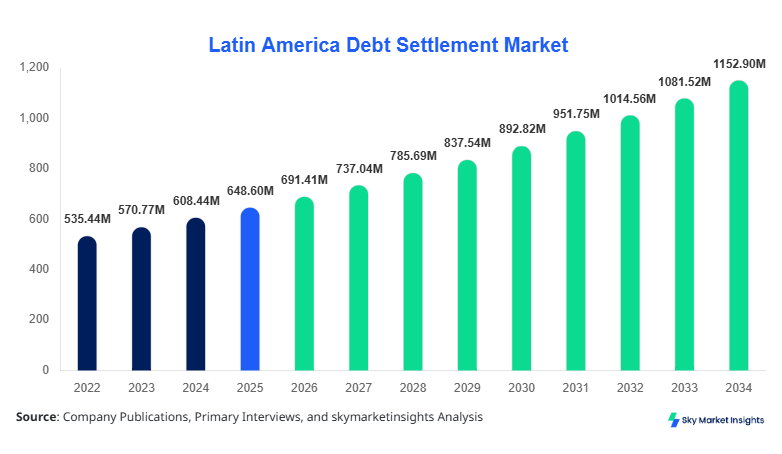
Latin America Debt Settlement Market size is projected at USD 691.41 million in 2026 and is expected to hit USD 1,168.26 million by 2034 with a CAGR of 6.6%. The 2025 base-year value stood at USD 647.53 million, indicating an absolute increase of USD 520.73 million through 2034. Market assessment increasingly requires country-level delinquency data, debt-type segmentation, digital-negotiation penetration, regulatory analysis, and competitive benchmarking to identify commercially addressable settlement opportunities.
Key Takeaways
- Brazil dominates geographically: Brazil accounts for approximately 43.2% of the 2026 total, at USD 298.72 million, and is forecast to reach USD 505.26 million by 2034, registering 6.79% CAGR.
- Chile records the fastest country CAGR: Chile is projected to expand at 6.93%, from USD 56.92 million in 2026 to USD 97.29 million in 2034.
- Credit card settlement dominates by type: Credit Card Debt Settlement represents approximately 34.9% of the type-based 2026 total, generating USD 241.20 million, with 6.70% CAGR.
- Student loans expand fastest: Student Loan Debt Settlement is forecast to register the highest type CAGR of 6.96%, increasing from USD 108.39 million in 2026 to USD 185.68 million by 2034.
- Argentina remains an emerging opportunity: Argentina is projected to rise from USD 73.63 million in 2026 to USD 123.33 million by 2034, at 6.66% CAGR.
The market comprises professional and technology-enabled services through which indebted consumers and enterprises negotiate repayment reductions, revised payment schedules, restructuring, counseling, or settlement agreements with creditors. In 2026, Brazil contributes 43.2%, Mexico 30.8%, Argentina 10.6%, Chile 8.2%, and Colombia 7.1% of the supplied country total. Credit card settlements contribute approximately 34.9% of the type-based market, followed by mortgages at about 20.0%, student loans at 15.7%, personal loans at 11.1%, medical debt at 10.1%, and other categories at 8.3%. Brazil and Mexico therefore jointly account for approximately 74.0% of regional value.
Explore more data points, trends and opportunities Download Free Sample Report
Latin America Debt Settlement Market Trends
Digital Negotiation and AI-enabled Servicing Reshape Borrower Engagement
Digital self-service is becoming central to debt resolution as web platforms, mobile applications, WhatsApp interfaces, automated scoring, and AI-supported negotiations reduce reliance on call-center workflows. Serasa's Brazilian platform works with more than 2,200 partner companies, while its March 2026 campaign advertised discounts of up to 99% and digital settlement through Pix. AI deployment is simultaneously increasing interaction capacity: one international provider reported 70 million connected calls per month in March 2026, while another AI collections provider processes more than 2.5 million monthly calls and serves major Mexican banks.
Technology is also shifting from basic reminder automation toward multilingual conversational agents, dynamic negotiation and behavioral personalization. Recent debt-negotiation research evaluates AI across 13 metrics and 4 dimensions, illustrating the increasing sophistication of automated decision systems. In Brazil, Serasa estimated 41 million debts could meet criteria for the 2026 government renegotiation initiative, potentially removing approximately 7.8 million consumers, or 9.6%, from delinquency under a favorable scenario.
Latin America Debt Settlement Market Drivers
High Consumer Delinquency Expands the Addressable Borrower Pool
Persistent household indebtedness is supporting settlement activity across consumer credit, cards and unsecured loans. Brazil recorded 83.4 million delinquent consumers in the reference scenario used by Serasa in 2026, with a favorable renegotiation outcome potentially reducing the population to roughly 75.4 million. The government initiative covers qualifying financial debts above R$100, overdue between 90 days and 2 years, for consumers earning up to R$8,105, creating a substantial pipeline for structured negotiation services.
Latin America Debt Settlement Market Restraints
Regulatory Complexity and Creditor-dependent Settlement Terms Limit Standardization
Settlement outcomes depend heavily on creditor policies, borrower documentation, aging of debt and national consumer-protection requirements. Even large digital intermediaries cannot independently determine settlement values or installment conditions; creditor partners establish those terms. Serasa indicates settlement discounts can reach 90%, or 99% during promotional campaigns, while post-payment status updates may require up to 5 business days, demonstrating significant variation between offer structures and processing cycles.
Latin America Debt Settlement Market Opportunities
Fintech Integration Opens New Consumer and SME Resolution Channels
Fintech penetration creates opportunities to embed counseling, restructuring and automated settlement directly into lending ecosystems. Mexico provides a particularly relevant SME opportunity: SMEs represent approximately 95% of businesses and provide employment to more than 68% of the population, while access to conventional business credit remains constrained. Across Latin America, integration of digital payments, credit analytics and multilingual servicing can shorten negotiation cycles while enabling platforms to process millions of borrower interactions.
Challenges in Latin America Debt Settlement Market
Balancing Automation, Compliance and Consumer Trust
Automated settlement systems must balance scalability against fairness, privacy and borrower vulnerability. A 2026 experimental study covering 3,514 participants across 11 countries found AI-mediated collection interactions were perceived as more efficient, whereas human interactions generated stronger perceptions of fairness and reciprocity. Providers therefore face the operational challenge of combining high-volume digital servicing with human escalation for bankruptcy, illness, bereavement and other vulnerability signals.
Report Scope
| Report Metric | Details |
|---|---|
| Market Size in 2025 | USD 647.53 Million |
| Market Size in 2026 | USD 691.41 Million |
| Market Size in 2034 | USD 1168.26 Million |
| CAGR | 6.6% (2026-2034) |
| Base Year for Estimation | 2025 |
| Historical Data | 2022-2024 |
| Forecast Period | 2026-2034 |
| Report Coverage | Revenue Forecast, Competitive Landscape, Supply Chain Disruption, Growth Factors, Environment & Regulatory Landscape and Trends |
Explore more data points, trends and opportunities Download Free Sample Report
Latin America Debt Settlement Market Segmentation
The market is segmented by type, service type, end-user and distribution channel. Among quantified debt types, credit cards dominate with approximately 34.9% of 2026 value, while Student Loan Debt Settlement records the highest supplied CAGR at 6.96%.
By Type
Credit Card Debt Settlement is the largest category, increasing from USD 226.05 million in 2025 to USD 241.20 million in 2026 and USD 405.21 million by 2034, at 6.70% CAGR. It represents approximately 34.9% of the 2026 type-based total.
Student Loan Debt Settlement is the fastest-growing category at 6.96% CAGR, compared with 6.84% for personal loans, 6.70% for mortgages, 6.69% for medical debt and 6.67% for others. Student-loan value reaches USD 185.68 million by 2034.
By Service Type
Debt Negotiation Services are positioned as a core service category alongside Debt Counseling Services, Debt Management Plans, Legal Assistance and other services. Numerical service-type revenue and CAGR splits were not supplied, so no unsupported market values are assigned to these categories.
Digital creditor connectivity and automated offer management increasingly complement counseling and legal assistance. The supplied dataset quantifies the overall market at USD 691.41 million in 2026 and USD 1,168.26 million in 2034, providing the applicable market envelope without attributing unsupported service-level shares.
By End-user
Individual Consumers, SMEs and Large Enterprises constitute the identified end-user groups. Consumer settlement remains structurally important because credit-card debt alone contributes USD 241.20 million in 2026, while personal-loan settlement contributes USD 76.80 million.
SMEs provide an expanding commercial use case, particularly where business credit access is limited. The supplied tables do not provide end-user CAGR values; accordingly, the USD 691.41 million 2026 regional total is retained without fabricating individual, SME or enterprise shares.
By Distribution Channel
Online/Digital Platforms and Offline/Traditional Channels form the distribution segmentation. Digital platforms are gaining relevance through mobile apps, websites, automated negotiation and instant-payment integration; however, no channel-specific market values or CAGR figures were provided.
The quantified addressable market rises by USD 476.85 million between 2026 and 2034, from USD 691.41 million to USD 1,168.26 million, creating room for both digital and assisted channels without assigning unsupported channel percentages.
Latin America Debt Settlement Market Segmentations
By Type
- Credit Card Debt Settlement
- Mortgage Debt Settlement
- Student Loan Debt Settlement
- Medical Debt Settlement
- Personal Loan Debt Settlement
- Others
By Service Type
- Debt Negotiation Services
- Debt Counseling Services
- Debt Management Plans
- Legal Assistance for Debt Settlement
- Others
By End-user
- Individual Consumers
- Small and Medium Enterprises
- Large Enterprises
By Distribution Channel
- Online/Digital Platforms
- Offline/Traditional Channels
Latin America Debt Settlement Market Counties Outlook
Brazil
Brazil leads the region with approximately 43.2% of 2026 value. Revenue increases from USD 279.73 million in 2025 to USD 298.72 million in 2026 and USD 505.26 million by 2034, reflecting 6.79% CAGR. Large-scale digital renegotiation infrastructure and tens of millions of delinquent consumers support settlement volumes.
Mexico
Mexico contributes approximately 30.8% in 2026, representing USD 213.05 million, compared with USD 199.50 million in 2025. The country is projected to reach USD 360.34 million by 2034, registering 6.79% CAGR.
Argentina
Argentina accounts for approximately 10.6% of 2026 regional value. The market advances from USD 69.03 million in 2025 to USD 73.63 million in 2026 and USD 123.33 million by 2034, at 6.66% CAGR.
Colombia
Colombia contributes approximately 7.1% in 2026, valued at USD 49.09 million, compared with USD 46.04 million in 2025. It is forecast to reach USD 82.04 million by 2034, recording 6.63% CAGR.
Chile
Chile represents approximately 8.2% of 2026 value and records the fastest supplied country CAGR at 6.93%. Revenue increases from USD 53.23 million in 2025 to USD 56.92 million in 2026 and USD 97.29 million by 2034.
Top players in Latin America Debt Settlement Market
- Serasa Experian
- Resuelve tu Deuda
- Bravo
- Curadeuda
- DB Menos
- Digido
- Grupo Jurídico Empresarial
- Altur
- Konfío
- Creditas
Top Two Companies
- Serasa Experian: Serasa maintains a prominent Brazilian position through its Limpa Nome ecosystem, connecting consumers with more than 2,200 creditor partners through web, app and WhatsApp channels. The platform supports discounts reaching 99% during promotional settlement campaigns and facilitates payment through Pix, boleto and cards. A precise company revenue share of the regional settlement-services industry is not publicly established in the supplied data, and therefore no unsupported percentage is assigned.
- Resuelve tu Deuda/Bravo: The company is positioned around consumer debt negotiation and restructuring across Spanish-speaking markets, including Mexico. Its relevance is supported by the scale of unsecured consumer indebtedness and growing adoption of digitally coordinated repayment programs. A verified percentage share of Latin America industry revenue was not supplied or established by the reviewed sources; assigning a numerical company share would therefore conflict with the requirement to preserve validated numerical information.
Recent Developments in Latin America Debt Settlement Market
- 2026: Brazil's Novo Desenrola initiative targeted qualifying debts above R$100 and could potentially remove about 7.8 million people from delinquency under a favorable scenario.
- 2026: Serasa's March Feirão Limpa Nome involved more than 2,200 partner companies and offered eligible borrowers discounts of up to 99%.
- 2026: AI debt-servicing platforms expanded sharply, with one provider reporting approximately 70 million monthly connected calls and another exceeding 2.5 million debt-related calls per month, including services for Mexican banks.
- 2026: Research introduced DebtBench for persona-enriched debt negotiation and evaluated 16 state-of-the-art LLMs, highlighting accelerating adoption of conversational AI in financial recovery workflows.
- 2025: Research into automated debt negotiation introduced an evaluation framework containing 13 metrics across 4 dimensions, supporting development of more sophisticated multi-agent negotiation systems.
Research Methodology
The analysis uses 2025 as the base year, 2026 as the current year and 2026–2034 as the forecast period, with 2022–2024 representing the historical framework. Mandatory supplied tables were treated as the primary quantitative source for country values, debt-type values and CAGR calculations. Derived percentages were calculated from the supplied USD 691.41 million country total and USD 691.27 million type total; external sources were used only for qualitative industry context and recent developments. No unsupported service-type, end-user, distribution-channel or company-share values were manufactured.
Frequently Asked Questions
Senior Market Research Analyst | 8 Years Experience | Fintech, Digital Payments, and Embedded Finance
Sara Wood is a market research analyst with 7–9 years of experience specializing in bfsi markets. Contributed to 70+ research reports for global clients. Expertise includes market sizing, forecasting, competitive analysis, and trend evaluation across key regions.