Latin America Automated Mining Equipment Market Size
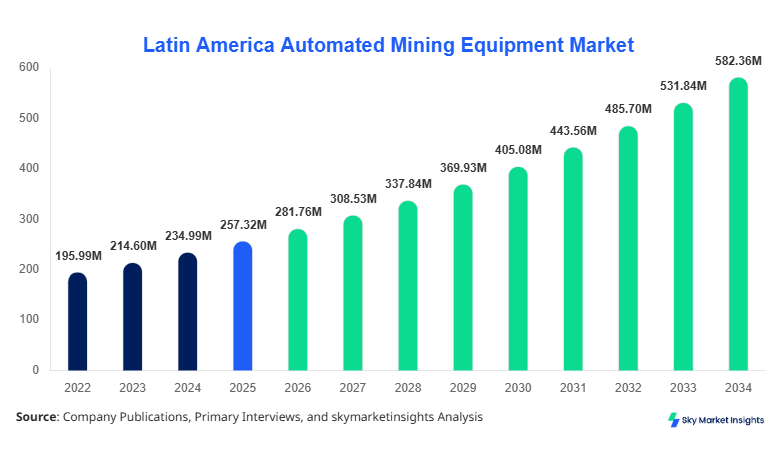
Latin America Automated Mining Equipment Market size is projected at USD 281.76 million in 2026 and is expected to hit USD 579.54 million by 2034 with a CAGR of 9.5%." The assessment covers 5 countries, 8 equipment categories, 6 additional segmentation dimensions, and the competitive positioning of 15 manufacturers and technology providers. Detailed segmentation supports evaluation of automation investment, fleet modernization, safety systems, and vendor strategies during 2026–2034.
Key Takeaways
- Brazil dominated the country landscape with 39.11% of 2026 revenue, equivalent to USD 110.19 million, and is forecast to reach USD 226.08 million by 2034 at a 9.40% CAGR.
- Mexico is the second-largest country, contributing 35.71% or USD 100.63 million in 2026 and advancing to USD 208.14 million by 2034 at 9.51%.
- Autonomous haul trucks led equipment revenue with USD 84.83 million and 30.08% in 2026; the category is also the fastest-growing equipment segment at a 9.83% CAGR.
- Argentina is the fastest-growing covered country at a 9.63% CAGR, with revenue increasing from USD 28.25 million in 2026 to USD 58.95 million in 2034.
- Latin America Automated Mining Equipment Market Share remained concentrated: Brazil and Mexico collectively represented 74.82% of country-based revenue in 2026.
The market comprises autonomous, semi-autonomous, and tele-remote machinery, associated sensors, control platforms, fleet software, and safety systems used in surface and underground extraction. Regional revenue increases from USD 257.47 million in 2025 to USD 281.76 million in 2026, a one-year rise of 9.43%. Autonomous haul trucks contribute 30.08% of equipment-based 2026 revenue, automated drilling rigs account for 17.21%, and autonomous loaders represent 14.18%. Combined, these 3 categories generate 61.47% of the USD 281.98 million equipment-type total, indicating concentrated adoption in haulage, drilling, and material loading.
Explore more data points, trends and opportunities Download Free Sample Report
Latin America Automated Mining Equipment Market Trends
Convergence of Autonomy, Electrification, and Mixed-Fleet Intelligence
Mining automation is shifting from isolated machine control toward connected fleets integrating 3D lidar, high-precision navigation, edge analytics, and centralized dispatch. Caterpillar reports more than 525 autonomous mining trucks operating continuously across 20 sites and over 4.3 billion tonnes hauled without a lost-time injury associated with autonomous operation. Epiroc reported software supplied to more than 3,900 driverless vehicles by the end of 2025, compared with 3,450 one year earlier, an increase of approximately 13.0%.
Electrification is increasingly designed alongside autonomous operation rather than as a separate modernization program. In 2024, Caterpillar presented a 372-tonne autonomous-ready truck and battery-electric underground loaders, while Komatsu demonstrated an autonomous, battery-ready electric-drive truck connected to a dynamic trolley line in 2025. Adoption is expanding from large surface fleets to 4-truck quarry deployments, mixed underground fleets, and tele-remote production zones operating across 2 or 3 shifts.
Latin America Automated Mining Equipment Market Drivers
Safety Improvement and Continuous Production Economics
Removing personnel from blast zones, unstable stopes, and high-traffic haul roads is accelerating investment in autonomous and tele-remote equipment. Automated fleets can support 24-hour operations across 3 shifts while reducing shift-change interruptions and standardizing speed, braking, and payload cycles. Proven deployments now exceed 525 autonomous trucks across 20 sites, while reported autonomous haulage has surpassed 4.3 billion tonnes. These operating benchmarks, combined with potential double-digit improvements in utilization and reductions of more than 10% in avoidable idle time, strengthen the economic case for automation.
Latin America Automated Mining Equipment Market Restraints
High Integration Costs and Legacy-Fleet Complexity Restrain Automated Mining Equipment Market Growth
Brownfield mines often operate fleets spanning 3–5 equipment brands, multiple control generations, and service lives exceeding 10 years. Integration requires wireless coverage, dispatch software, machine-control kits, cybersecurity, operator training, and redundant safety systems. Initial conversion can involve hundreds of sensors and 2 or more control layers per vehicle, while communication interruptions lasting even 1–2 seconds may trigger conservative machine stops. Capital constraints are particularly material for smaller mines operating fewer than 20 production units.
Latin America Automated Mining Equipment Market Opportunities
Retrofit Automation and Interoperable Software Platforms
Retrofit systems create an addressable pathway for mines unable to replace complete fleets. Modular perception, collision-avoidance, and tele-remote packages can be introduced across 1 production area before scaling to 10 or more machines. Epiroc's driverless software footprint rose from 3,450 vehicles to over 3,900 in 2025, illustrating approximately 13.0% annual expansion in connected assets. Predictive-maintenance platforms can additionally consolidate thousands of machine signals and prioritize failures over 24-hour operating cycles.
Challenges in Latin America Automated Mining Equipment Market
Connectivity, Skills Availability, and Cyber-Physical Reliability
Autonomous equipment depends on reliable positioning, low-latency communications, and disciplined change management. Underground operations may require network nodes across several kilometres of tunnels, while surface mines must maintain coverage despite pit expansion and bench changes. A fleet operating 24/7 can generate millions of telemetry points per day, and false-positive stop events of only 1% can affect cycle consistency. Mines must therefore coordinate software engineers, network specialists, equipment technicians, and control-room personnel across 2–3 shifts.
Report Scope
| Report Metric | Details |
|---|---|
| Market Size in 2025 | USD 257.32 Million |
| Market Size in 2026 | USD 281.76 Million |
| Market Size in 2034 | USD 579.54 Million |
| CAGR | 9.5% (2026-2034) |
| Base Year for Estimation | 2025 |
| Historical Data | 2022-2024 |
| Forecast Period | 2026-2034 |
| Report Coverage | Revenue Forecast, Competitive Landscape, Supply Chain Disruption, Growth Factors, Environment & Regulatory Landscape and Trends |
Explore more data points, trends and opportunities Download Free Sample Report
Latin America Automated Mining Equipment Market Segmentation
The market is segmented by equipment type, mineral type, deployment mode, automation level, software solution, and end-user. Autonomous haul trucks held 30.08% of equipment-based revenue in 2026, while the 3 largest equipment categories collectively represented 61.47%. The supplied dataset quantifies equipment type but does not allocate revenue or CAGR across the other 5 segmentation dimensions.
By Equipment Type
Autonomous haul trucks were the largest category, increasing from USD 77.24 million in 2025 to USD 84.83 million in 2026 and USD 179.61 million in 2034. Their 30.08% contribution in 2026 reflects the high economic value of continuous material movement and centralized fleet dispatch.
Autonomous haul trucks are also the fastest-growing category at a 9.83% CAGR. Automated drilling rigs follow at USD 48.53 million in 2026 and USD 102.01 million in 2034 with a 9.73% CAGR, while robotic mining equipment expands at 9.71%.
By Mineral Type
Metallic mining—including copper, gold, iron, and nickel—is the principal application environment because large pits and repetitive haul cycles support automation at fleet scale. The supplied tables assign 0 separate USD values or CAGRs to the 4 mineral categories; consequently, the USD 281.76 million regional total cannot be redistributed reliably by mineral.
Non-metallic minerals, coal, and rare earth minerals represent additional use cases for autonomous haulage, drilling, and safety systems. These 3 categories differ in mine geometry and production cycles, but no defensible fastest-growing mineral category can be identified from the 2025, 2026, and 2034 data provided.
By Deployment Mode
On-site fully autonomous operations combine controlled access, fleet orchestration, and integrated communications, whereas retrofit automation targets existing assets. OEM-integrated solutions provide factory-installed control architecture. The dataset covers 3 deployment modes but supplies 0 mode-specific revenue allocations or growth rates.
Retrofit deployment is particularly relevant to mixed fleets with equipment lives of 10 years or more, while OEM integration favors new mine developments. Market totals remain USD 281.76 million in 2026 and USD 579.54 million in 2034, without a supported split among the 3 modes.
By Level of Automation
Semi-automated systems support functions such as drilling control and collision avoidance; fully autonomous equipment performs defined production cycles; remote-controlled machinery retains human operation from a protected location. No percentage division is provided for these 3 levels.
Fully autonomous haulage benefits repetitive 24-hour cycles, while remote control is suited to hazardous underground zones and blasting areas. Although overall regional CAGR is 9.5%, applying that rate individually to any of the 3 automation levels would be unsupported.
By Software Solution
Fleet management, navigation, collision avoidance, tele-remote operations, predictive maintenance, and energy monitoring form the 6 software categories. These platforms connect machines, control rooms, and maintenance teams, but the supplied market tables contain 0 standalone software revenue figures.
Fleet platforms may integrate hundreds of assets and millions of daily data points, while collision-avoidance applications process multiple sensor streams per second. Neither the largest nor fastest-growing software category can be numerically ranked from the 2025–2034 dataset.
By End-User
Surface mining is associated with autonomous trucks, drills, dozers, and excavators, while underground mining emphasizes loaders, drilling rigs, robotics, and tele-remote systems. The dataset defines 2 end-user groups without assigning separate USD values or CAGRs.
Surface operations can deploy fleets across 3 shifts and broad haul networks; underground sites prioritize remote operation across constrained headings. The USD 584.15 million equipment-based 2034 total cannot be apportioned between the 2 end-users without additional primary data.
Latin America Automated Mining Equipment Market Segmentations
By Equipment Type
- Autonomous Haul Trucks
- Automated Drilling Rigs
- Autonomous Loaders
- Robotic Mining Equipment
- Dozers and Excavators
- Automated Blasting Systems
- Remote-Controlled Equipment
- Others (Grinders, Crushers, Graders)
By Mineral Type
- Metallic (Gold, Copper, Iron, Nickel, etc.)
- Non-Metallic (Limestone, Potash, Phosphate)
- Coal
- Rare Earth Minerals
By Deployment Mode
- On-Site (Fully Autonomous Sites)
- Retrofit Automation
- OEM-Integrated Solutions
By Level of Automation
- Semi-Automated
- Fully Autonomous
- Remote-Controlled
By Software Solution
- Fleet Management
- Navigation and Guidance
- Collision Avoidance and Safety
- Tele-remote Operations
- Predictive Maintenance
- Energy and Emissions Monitoring
By End-User
- Surface Mining
- Underground Mining
Latin America Automated Mining Equipment Market Country Outlook
The supplied regional scope covers Brazil, Mexico, Argentina, Colombia, and Chile. The requested UAE, Turkey, Saudi Arabia, South Africa, Egypt, and Nigeria are outside Latin America and have 0 supplied values; substituting them would conflict with the mandatory dataset.
Brazil Latin America Automated Mining Equipment Market
Brazil leads with USD 110.19 million in 2026, 39.11% of the country total, and USD 226.08 million by 2034 at 9.40%. Its contribution exceeds Chile's by USD 87.90 million in 2026.
Mexico Latin America Automated Mining Equipment Market
Mexico accounts for USD 100.63 million and 35.71% in 2026, reaching USD 208.14 million by 2034 at 9.51%. Brazil and Mexico jointly contribute USD 210.82 million, or 74.82%.
Argentina Latin America Automated Mining Equipment Market
Argentina rises from USD 28.25 million in 2026 to USD 58.95 million in 2034. Its 10.03% contribution and 9.63% CAGR make it the fastest-growing covered country.
Colombia Latin America Automated Mining Equipment Market
Colombia contributes USD 20.40 million, or 7.24%, in 2026 and reaches USD 41.39 million in 2034 at 9.25%. The forecast adds USD 20.99 million over 8 years.
Chile Latin America Automated Mining Equipment Market
Chile represents USD 22.29 million and 7.91% in 2026, advancing to USD 44.98 million by 2034 at 9.17%. Chile exceeds Colombia by USD 1.89 million in 2026.
Top players in Latin America Automated Mining Equipment Market
- Caterpillar
- Komatsu
- Sandvik
- Epiroc
- Hitachi Construction Machinery
- Liebherr
- Volvo Construction Equipment
- Hexagon
- ABB
- Siemens
- Thiess
- ASI Mining
- SafeAI
- Wenco International Mining Systems
- Orica
Top Two Companies
-
Caterpillar: No audited Latin America company percentage was supplied, so a market-share figure is not inferred. Operationally, Caterpillar reports more than 525 autonomous trucks across 20 sites and over 4.3 billion tonnes hauled. Its positioning rests on MineStar Command, factory-integrated equipment, retrofit pathways, and 24/7 fleet operation. In 2024, the company demonstrated autonomous operation of 4 Cat 777 trucks in a quarry application and showcased a 372-tonne autonomous-ready Cat 798 AC.
-
Komatsu: No verified Latin America company percentage is available in the mandatory dataset. Komatsu's competitive position centers on FrontRunner autonomous haulage, electric-drive trucks, trolley integration, and lidar-based perception. In 2026, the company reported commissioning its 1,000th ultra-class autonomous haul truck, following commercial deployment beginning in 2008. Its 2025 multimillion-dollar lidar agreement and autonomous trolley milestone reinforce an integrated autonomy-and-electrification strategy.
Recent Developments in Latin America Automated Mining Equipment Market
- 2026: Komatsu commissioned its 1,000th ultra-class autonomous haul truck.
- 2025: Komatsu entered a multimillion-dollar agreement with Ouster for 3D digital lidar sensors.
- 2025: Epiroc secured its largest-ever order for a major autonomous and electric surface-equipment fleet.
- 2025: Epiroc acquired the remaining 47% of Radlink after purchasing 53% in 2022.
Research Methodology
The analysis uses the supplied 2025, 2026, and 2034 country and equipment tables as the exclusive basis for market forecasts, contributions, and CAGR comparisons. Shares were calculated as segment revenue divided by the corresponding total; for example, Brazil's USD 110.19 million divided by USD 281.76 million equals 39.11%. Equipment calculations use the USD 281.98 million equipment total, while country calculations use USD 281.76 million. The difference between the 2034 totals—USD 584.15 million by equipment and USD 579.54 million by country—is USD 4.61 million and is retained without alteration. Company developments were cross-checked against official manufacturer announcements dated 2024–2026.
Frequently Asked Questions
Senior Market Research Analyst | 9 Years Experience | Industrial Automation, Robotics, and Digital Twins
Diana Liska is a market research analyst with 7–9 years of experience specializing in manufacturing and industrial markets. Contributed to 70+ research reports for global clients. Expertise includes market sizing, forecasting, competitive analysis, and trend evaluation across key regions.