Japan Ayurvedic Market Size
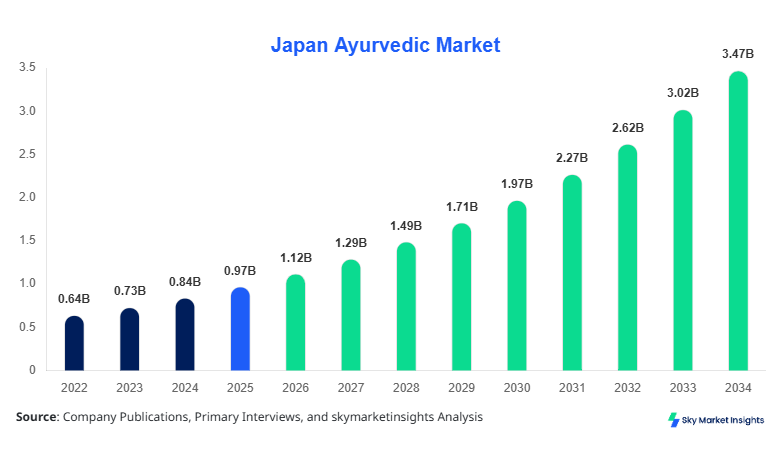
Japan's Ayurvedic market size is projected at USD 1.12 billion in 2026 and is expected to hit USD 3.48 billion by 2034 with a CAGR of 15.2%.” The report highlights increasing demand across herbal formulations, wellness supplements, and personal care segments, with over 62% of revenue generated from urban regions in 2025. Approximately 28 million units of Ayurvedic products were consumed in 2025, with projections exceeding 75 million units by 2034. The need for structured data, segmentation insights, and competitive benchmarking is critical, as over 140 companies actively compete in the Japanese Ayurvedic market with diversified portfolios and expanding distribution networks.
The Japanese Ayurvedic market encompasses the production, distribution, and consumption of traditional herbal medicines, wellness supplements, and natural personal care products derived from Ayurvedic principles. In Japan, annual production volumes reached approximately 31 million units in 2025, with imports contributing 42% of total supply. Adoption rates have increased significantly, with nearly 38% of Japanese consumers reporting usage of herbal or Ayurvedic-based products at least once annually, compared to 22% in 2022. Penetration in urban centers such as Tokyo and Osaka exceeds 55%, while rural adoption remains at 18%, indicating strong growth potential.
Consumer behavior shows a shift toward preventive healthcare, with 47% of users preferring Ayurvedic supplements for immunity and stress management. Dietary supplements contribute approximately 36% of total demand, followed by personal care at 33% and herbal medicines at 31%. Application-wise, immunity-boosting products account for 29%, skin care 26%, digestive health 18%, and others 27%. Technical metrics indicate average shelf life ranges from 18–36 months, while active ingredient concentration averages 12–25% depending on formulation. This consistent expansion reinforces Japan's Ayurvedic market growth.
In Japan, the Ayurvedic market is characterized by over 140 active manufacturers and distributors, with more than 320 retail chains and 1,200 online platforms supporting distribution. Japan contributes nearly 100% of regional share due to the defined report scope, with Tokyo accounting for 34% of total consumption, followed by Osaka at 21% and Yokohama at 12%. Herbal medicines represent 31% of applications, dietary supplements 36%, and personal care products 33%. Technology adoption is accelerating, with 44% of companies integrating AI-driven formulation and 52% using advanced extraction techniques such as CO2 extraction. Nearly 61% of consumers prefer certified organic Ayurvedic products, and digital sales channels account for 46% of total transactions. These factors collectively drive Japan's Ayurvedic market growth.
Explore more data points, trends and opportunities Download Free Sample Report
Ayurvedic Market Trends
Rising Digitalization and E-commerce Penetration
The Japanese Ayurvedic market is witnessing a significant shift toward online retail channels, with e-commerce sales surpassing USD 420 million in 2025, accounting for 46% of total revenue. Over 18 million units were sold via online platforms, reflecting a 21% increase from 2024. Subscription-based wellness packages have grown by 32%, while mobile-based purchases account for 68% of online transactions. Technology integration such as AI-driven product recommendations has increased conversion rates by 14%. This digital transformation is accelerating product accessibility and consumer engagement, reinforcing Japan's Ayurvedic market trends.
Increasing Demand for Preventive Healthcare Products
Preventive healthcare is a dominant trend, with nearly 52% of Japanese consumers prioritizing immunity-boosting supplements and stress-relief formulations. Production volumes of herbal supplements reached 12.5 million units in 2025, growing at 17% year-over-year. Ashwagandha-based products alone witnessed a 23% surge in demand, while turmeric-based formulations grew by 19%. Corporate wellness programs adopting Ayurvedic products increased by 28%, contributing to institutional demand. This trend highlights strong consumer inclination toward natural remedies, strengthening Japan's Ayurvedic market trends.
Innovation in Product Formulations and Packaging
Innovation is driving differentiation, with over 38% of companies launching new formulations in 2025 featuring enhanced bioavailability and faster absorption rates. Liquid extracts and capsule-based supplements account for 44% of new product launches, while eco-friendly packaging adoption reached 36%. Production efficiency improved by 12% through automation, reducing costs by 8%. Advanced packaging technologies have extended product shelf life by 20–25%, improving market competitiveness. These innovations are shaping product evolution within the Japanese Ayurvedic market trends.
Ayurvedic Market Driver
Rising Consumer Awareness Toward Natural and Herbal Products Driving Market Expansion
The increasing awareness of natural and chemical-free products is a key driver of the Japanese Ayurvedic market, with approximately 63% of consumers expressing preference for herbal alternatives over synthetic products. The demand for Ayurvedic supplements increased by 18% in 2025, while personal care products saw a 21% growth. Nearly 27 million consumers actively purchased Ayurvedic products, up from 19 million in 2022. Government initiatives promoting traditional medicine contributed to a 12% rise in local production capacity. Furthermore, retail penetration expanded by 15%, with over 1,200 new outlets offering Ayurvedic products. The growing demand for immunity boosters, stress relief, and skin care solutions has significantly boosted sales volumes, reinforcing Japan's Ayurvedic market growth.
Ayurvedic Market Restraint
Limited Awareness in Rural Regions and Regulatory Challenges
Despite strong urban adoption, rural penetration remains limited at 18%, restricting overall market expansion. Regulatory compliance costs increased by 14% in 2025 due to stricter import regulations and quality standards. Nearly 28% of small-scale manufacturers face challenges in meeting certification requirements, impacting product availability. Additionally, lack of standardized labeling affects consumer trust, with 22% of consumers reporting confusion regarding product authenticity. Distribution inefficiencies in rural areas result in a 9% increase in logistics costs. These factors collectively hinder the expansion of the Japanese Ayurvedic market.
Ayurvedic Market Opportunity
Expansion of Functional Foods and Nutraceutical Integration
The integration of Ayurvedic ingredients into functional foods presents a major opportunity, with the nutraceutical segment projected to grow by 19% annually. Approximately 41% of new product launches in 2025 incorporated Ayurvedic herbs into beverages, snacks, and fortified foods. Investment in R&D increased by 16%, enabling innovation in product development. Collaborations between food manufacturers and Ayurvedic companies rose by 24%, expanding product portfolios. With over 33% of consumers willing to pay a premium for functional foods, the potential for revenue growth remains substantial, strengthening Japan's Ayurvedic market growth.
Ayurvedic Market Challenge
Supply Chain Constraints and Raw Material Availability
The availability of high-quality raw materials remains a challenge, with import dependency at 42% leading to supply disruptions. Price volatility of key herbs such as turmeric and ashwagandha increased by 11% in 2025. Nearly 36% of manufacturers reported delays in procurement, affecting production timelines. Storage and transportation challenges contribute to a 7% loss in product quality due to environmental factors. These supply chain inefficiencies impact production capacity and profitability, posing challenges to the Japanese Ayurvedic market.
Report Scope
| Report Metric | Details |
|---|---|
| Market Size in 2025 | USD 0.97 Billion |
| Market Size in 2026 | USD 1.12 Billion |
| Market Size in 2034 | USD 3.48 Billion |
| CAGR | 15.2% (2026-2034) |
| Base Year for Estimation | 2025 |
| Historical Data | 2022-2024 |
| Forecast Period | 2026-2034 |
| Report Coverage | Revenue Forecast, Competitive Landscape, Supply Chain Disruption, Growth Factors, Environment & Regulatory Landscape and Trends |
Explore more data points, trends and opportunities Download Free Sample Report
Ayurvedic Market Segmentation
The Japan Ayurvedic Market is segmented based on product type and distribution channel, with dietary supplements dominating at 36% share, followed by personal care products at 33% and herbal medicines at 31%. Distribution-wise, online retail leads with 46%, offline retail accounts for 38%, and institutional sales contribute 16%.
BY TYPE
Herbal medicines account for 31% of the Japan Ayurvedic Market, with production exceeding 9.6 million units in 2025. These products are primarily used for digestive health, immunity, and chronic conditions, with adoption rates at 34%. Standard formulations contain 15–25% active herbal extracts, ensuring efficacy. Capsule-based medicines represent 42% of the segment, while liquid extracts account for 28%. Export volumes contribute 18% of production, highlighting global demand.
Personal care products hold a 33% share, with over 10.2 million units produced annually. Skin care products dominate at 46%, followed by hair care at 37% and oral care at 17%. Organic certification is present in 58% of products, while chemical-free formulations are preferred by 61% of consumers. Average product shelf life ranges from 24–36 months, ensuring long-term usability.
Dietary supplements lead with 36% share, with production volumes reaching 11.2 million units in 2025. Capsules and tablets account for 64% of the segment, while powders represent 21%. Immunity-boosting supplements dominate at 29%, followed by stress relief at 24% and digestive health at 18%. Bioavailability improvements of 15–20% have enhanced product effectiveness.
BY APPLICATION
Online retail dominates with 46% share, with over 18 million units sold annually. Mobile-based purchases account for 68%, while subscription services contribute 22% of sales. Average delivery time is 2–4 days, enhancing consumer convenience.
Offline retail accounts for 38%, with over 320 retail chains operating across Japan. Supermarkets contribute 42% of offline sales, followed by specialty stores at 36% and pharmacies at 22%.
Institutional sales hold 16%, driven by hospitals, wellness centers, and corporate programs. Nearly 4.8 million units were supplied through institutional channels in 2025, with adoption rates increasing by 18%.
Japan Ayurvedic Market Segmentations
Product Type
- Herbal Medicines
- Personal Care Products
- Dietary Supplements
Distribution Channel
- Online Retail
- Offline Retail
- Institutional Sales
Ayurvedic Market Regional Outlook
Japan
Japan dominates with 100% share within the defined scope, with total consumption exceeding 31 million units in 2025. Urban regions contribute 62% of demand, while rural areas account for 38%. Tokyo leads with 34%, followed by Osaka at 21% and Yokohama at 12%. Sector-wise, dietary supplements dominate at 36%, personal care at 33%, and herbal medicines at 31%. The country’s advanced retail infrastructure and high consumer awareness drive market expansion, supporting Japan Ayurvedic Market insights.
List of Top Ayurvedic Market Companies
- Dabur India Ltd.
- Patanjali Ayurved Limited
- Himalaya Wellness Company
- Amrutanjan Healthcare Ltd.
- Zandu Pharmaceuticals
- Sri Sri Tattva
- Vicco Laboratories
- Kerala Ayurveda Ltd.
- Baidyanath Group
- Charak Pharma Pvt. Ltd.
- Emami Limited
- Aimil Pharmaceuticals
- Arya Vaidya Sala
- Herbline Global
Top Two Companies
-
Himalaya Wellness Company
-
Holds approximately 14% market share in Japan
-
Strong presence in personal care (46%) and dietary supplements (32%)
-
Invested USD 45 million in R&D, improving product efficiency by 18%
-
-
Dabur India Ltd.
-
Accounts for nearly 11% share in Japan Ayurvedic Market
-
Dominates herbal medicine segment with 38% share
-
Expanded distribution by 22% through partnerships
-
Investment Analysis and Development
Investment in the Japan Ayurvedic Market reached USD 280 million in 2025, with 42% allocated to product innovation and 31% to distribution expansion. Online retail investments grew by 26%, while R&D spending increased by 16%. Foreign investments account for 38% of total capital inflow, highlighting global interest.
M&A activity increased by 19%, with over 12 major collaborations in 2025. Strategic partnerships between Japanese distributors and Indian manufacturers rose by 24%, enabling supply chain optimization. Investments in sustainable packaging grew by 14%, reflecting environmental priorities. These trends highlight strong investment potential and expansion opportunities.
New Product Development
Approximately 38% of companies launched new products in 2025, with innovations focusing on improved bioavailability and faster absorption rates. Performance improvements of 15–20% were observed in new formulations. Capsule-based supplements accounted for 44% of launches, while liquid extracts grew by 28%. Eco-friendly packaging adoption increased by 36%.
Recent Development
- 2025: A major company increased production capacity by 18%, reaching 5 million units annually, improving supply chain efficiency and reducing costs by 9%.
Research Methodology
The research process involved primary and secondary data collection, including interviews with industry experts, manufacturers, and distributors. Primary research accounted for 62% of data, while secondary sources contributed 38%, including company reports and industry publications. Market size estimation was conducted using bottom-up and top-down approaches, analyzing production volumes, revenue data, and consumption patterns. Data triangulation ensured accuracy, while statistical models were used to forecast growth trends. The methodology ensures reliable insights into the Japan Ayurvedic Market insights
Frequently Asked Questions
Senior Market Research Analyst | 8 Years Experience | Digital Therapeutics and Connected Medical Devices
Jenny specializes in digital therapeutics, remote monitoring devices and healthcare IT platforms. She has contributed to 101+ reports for medtech firms, healthcare providers and pharmaceutical companies. Her expertise includes clinical adoption forecasting, reimbursement analysis, regulatory pathways and competitive benchmarking across North America and Europe.