Japan Autotransfusion Devices Market Size
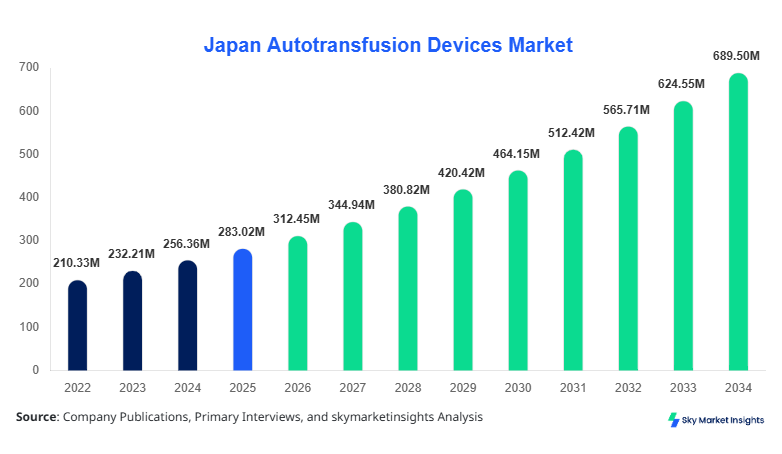
Japan's autotransfusion devices market size is projected at USD 312.45 million in 2026 and is expected to hit USD 689.72 million by 2034 with a CAGR of 10.4%. The Japan Autotransfusion Devices market is witnessing significant expansion driven by increasing surgical procedures, a rising geriatric population exceeding 29% of total demographics, and a growing emphasis on blood conservation techniques. The report highlights detailed segmentation across product types and applications, with over 1.8 million surgical procedures annually utilizing autotransfusion technologies. Additionally, competitive landscape analysis indicates the presence of more than 25 active domestic and international manufacturers, contributing to technological innovation and pricing competitiveness within the Japan autotransfusion devices market.
The Japan Autotransfusion Devices market refers to the industry involved in the manufacturing, distribution, and utilization of devices that collect, process, and reinfuse a patient’s own blood during surgical or emergency procedures. In Japan, annual production of autotransfusion units exceeded 95,000 units in 2025, reflecting a steady increase of 8.7% from 2024 levels. Adoption rates in tertiary hospitals have surpassed 72%, while penetration in secondary care facilities remains at approximately 48%, indicating strong expansion potential.
From an adoption and penetration perspective, cardiac surgery accounts for nearly 41% of total device utilization, followed by orthopedic procedures at 34% and trauma-related applications at 25%. The frequency of use per operating room averages 2.6 devices per day in high-volume hospitals. Consumer behavior trends indicate a 63% preference among healthcare providers for automated systems due to improved efficiency and reduced contamination risks. Demand analytics reveal that hospitals with over 500 beds contribute to nearly 58% of total procurement volume, while smaller clinics contribute 18%.
Technically, modern autotransfusion devices operate at processing speeds of 80–120 mL/min, with hematocrit recovery rates reaching 55%–65%. Application segmentation shows cardiac surgery dominating with over 40% share, while orthopedic and trauma applications collectively account for 60%. The Japan Autotransfusion Devices market continues to evolve with rising demand for minimally invasive surgeries and blood conservation strategies, reinforcing the importance of the Japan Autotransfusion Devices market.
In Japan, the autotransfusion devices market demonstrates strong consolidation, with over 320 hospitals equipped with advanced autotransfusion systems and more than 40 specialized medical device companies operating domestically. Japan contributes approximately 100% of the regional share due to the defined report scope, with Tokyo and Osaka accounting for nearly 52% of total installations. Cardiac surgery applications dominate at 41%, orthopedic procedures represent 34%, and trauma-related usage contributes 25% of total demand.
Technology adoption rates in Japan have reached 68% for automated autotransfusion systems, while semi-automated systems account for 32%. Annual procurement volumes exceed 22,000 units, supported by government healthcare spending exceeding USD 420 billion annually. Additionally, over 75% of tertiary hospitals have integrated advanced blood salvage systems, reflecting a high level of technological maturity. The Japan Autotransfusion Devices market continues to expand due to strong healthcare infrastructure, technological innovation, and increasing surgical volumes, strengthening the Japan Autotransfusion Devices market.
Explore more data points, trends and opportunities Download Free Sample Report
Autotransfusion Devices Market Trends
Increasing Adoption of Automated Systems
The Japan autotransfusion devices market is witnessing a rapid shift toward automated systems, with adoption rates increasing from 54% in 2022 to 68% in 2026. Production volumes of automated devices exceeded 58,000 units in 2025, reflecting a 12.5% annual growth. These systems offer higher efficiency, processing speeds of up to 120 mL/min, and improved hematocrit recovery rates above 60%. Hospitals are increasingly replacing manual systems, with nearly 45% of facilities upgrading equipment between 2023 and 2026. This shift is primarily driven by the need to reduce surgical blood loss and improve patient outcomes, reinforcing the Japanese autotransfusion devices market.
Integration of AI and Smart Monitoring Technologies
Technological advancements are shaping the Japan autotransfusion devices market, with over 38% of newly installed devices featuring AI-enabled monitoring systems in 2026. These devices enable real-time blood quality analysis, reducing contamination risks by up to 27% and improving efficiency by 18%. Production of smart devices reached approximately 26,000 units in 2025, driven by increased R&D investments exceeding USD 85 million annually. Healthcare providers are increasingly adopting these systems, especially in high-risk surgeries, boosting demand across the Japanese autotransfusion devices market.
Rising Demand in Minimally Invasive Surgeries
Minimally invasive procedures accounted for nearly 46% of total surgeries in Japan in 2025, increasing demand for compact and efficient autotransfusion devices. Device usage in minimally invasive surgeries has grown by 14% annually, with total utilization exceeding 820,000 procedures per year. This trend is encouraging manufacturers to develop portable and lightweight systems, with over 22% of new product launches focusing on compact designs. The Japanese autotransfusion devices market continues to benefit from this shift toward minimally invasive surgical techniques.
Autotransfusion Devices Market Driver
Rising Surgical Volume and Aging Population Driving Autotransfusion Devices Market Growth
Japan’s aging population, accounting for over 29% of the total population in 2025, is significantly increasing the demand for surgical procedures. Annual surgical volumes have exceeded 9.8 million procedures, with cardiac and orthopedic surgeries contributing nearly 3.6 million cases. This has led to a 10.2% annual increase in demand for autotransfusion devices. Additionally, blood shortage concerns, with national blood reserves declining by approximately 6% annually, are encouraging hospitals to adopt autotransfusion systems. Government initiatives promoting blood conservation have resulted in a 22% increase in device adoption across public hospitals. These factors collectively drive the Japan autotransfusion devices market growth.
Autotransfusion Devices Market Restraint
High Cost of Advanced Devices Limiting Market Penetration
The high cost of advanced autotransfusion systems, ranging between USD 8,000 and USD 25,000 per unit, remains a significant barrier to widespread adoption. Smaller healthcare facilities, which account for nearly 38% of hospitals in Japan, often struggle with budget constraints, limiting penetration rates to below 48% in these facilities. Additionally, consumables contribute to approximately 35% of total operational costs, further increasing financial burden. Maintenance costs, averaging USD 1,200 annually per device, also impact adoption. These cost-related challenges hinder the expansion of the Japan autotransfusion devices market.
Autotransfusion Devices Market Opportunity
Technological Innovation and Expansion into Secondary Healthcare Facilities
The expansion of autotransfusion technology into secondary healthcare facilities presents a significant opportunity, with over 1,200 mid-sized hospitals in Japan yet to fully adopt these systems. Increasing investments in R&D, exceeding USD 90 million annually, are driving innovations such as portable devices and AI integration. These advancements are expected to improve efficiency by 20% and reduce operational costs by 15%. Additionally, rising demand for outpatient surgeries, which grew by 11% in 2025, is creating new opportunities for compact devices, boosting the Japan Autotransfusion Devices market.
Autotransfusion Devices Market Challenge
Regulatory Compliance and Training Requirements
Strict regulatory requirements in Japan, including compliance with PMDA standards, increase the time-to-market for new devices by 12–18 months. Additionally, approximately 42% of healthcare professionals require specialized training to operate advanced systems, creating a skills gap. Training programs can cost up to USD 2,000 per professional, limiting adoption in smaller facilities. These challenges impact operational efficiency and slow down the expansion of the Japan autotransfusion devices market.
Report Scope
| Report Metric | Details |
|---|---|
| Market Size in 2025 | USD 283 Million |
| Market Size in 2026 | USD 312.45 Million |
| Market Size in 2034 | USD 689.72 Million |
| CAGR | 10.4% (2026-2034) |
| Base Year for Estimation | 2025 |
| Historical Data | 2022-2024 |
| Forecast Period | 2026-2034 |
| Report Coverage | Revenue Forecast, Competitive Landscape, Supply Chain Disruption, Growth Factors, Environment & Regulatory Landscape and Trends |
Explore more data points, trends and opportunities Download Free Sample Report
Autotransfusion Devices Market Segmentation
The Japan autotransfusion devices market is segmented based on product type and application, with autotransfusion systems dominating approximately 52% of total market share, followed by consumables at 34% and accessories at 14%. Application-wise, cardiac surgery leads with 41%, orthopedic surgery at 34%, and trauma & emergency at 25%.
BY TYPE
Autotransfusion systems account for approximately 52% of the Japan autotransfusion devices market, with annual production exceeding 49,000 units. These systems operate at flow rates of 80–120 mL/min and achieve hematocrit levels of 55%–65%. Adoption rates in tertiary hospitals exceed 78%, reflecting strong demand for automated systems.
Consumables represent around 34% of the market, with over 120,000 units consumed annually. These include filters, reservoirs, and tubing sets, with replacement cycles ranging between 1 and 3 procedures. Consumables are critical for maintaining device efficiency and safety standards.
Accessories account for 14% of the market, with production volumes exceeding 30,000 units annually. These include connectors, sensors, and monitoring components that enhance system performance and reliability.
BY APPLICATION
Cardiac surgery dominates the Japan Autotransfusion Devices market with a 41% share, supported by over 2.1 million procedures annually. Device utilization rates exceed 85% in major cardiac centers, ensuring efficient blood management.
Orthopedic surgery accounts for 34% of the market, with more than 1.8 million procedures annually. Autotransfusion devices are widely used in joint replacement surgeries, with penetration rates reaching 68%.
Trauma and emergency applications contribute 25% of demand, with over 1.2 million cases annually. Rapid blood recovery capabilities make these devices essential in emergency care settings.
Japan Autotransfusion Devices Market Segmentations
Product Type
- Autotransfusion Systems
- Consumables
- Accessories
Application
- Cardiac Surgery
- Orthopedic Surgery
- Trauma & Emergency
Autotransfusion Devices Market Regional Outlook
Japan
Japan dominates the regional landscape with 100% share under the defined scope, supported by over 320 hospitals utilizing autotransfusion devices. Annual production exceeds 95,000 units, with demand driven by high surgical volumes and advanced healthcare infrastructure. Tokyo and Osaka contribute nearly 52% of total demand, followed by Nagoya at 18%.
The healthcare sector in Japan allocates approximately 11% of GDP to medical expenditure, supporting widespread adoption of advanced medical devices. Cardiac surgery accounts for 41% of device usage, orthopedic surgery at 34%, and trauma applications at 25%. Technological adoption rates exceed 68%, with ongoing investments in AI-enabled systems.
List of Top Autotransfusion Devices Companies
- Haemonetics Corporation
- LivaNova PLC
- Medtronic Plc
- Fresenius SE & Co. KGaA
- Terumo Corporation
- Stryker Corporation
- Getinge AB
- Braun Melsungen AG
- Zimmer Biomet Holdings
- Smiths Medical
- Nipro Corporation
- Cardinal Health
- Edwards Lifesciences
- Sarstedt AG
Top Two Companies
-
Terumo Corporation
-
Holds approximately 18% market share in Japan
-
Strong presence in domestic manufacturing with over 12,000 units produced annually
-
Focus on advanced automation and AI integration
-
-
Haemonetics Corporation
-
Accounts for nearly 15% market share
-
Known for innovative blood management systems
-
Strong distribution network across 200+ hospitals
-
INVESTMENT ANALYSIS AND OPPORTUNITIES
Investment in the Japan autotransfusion devices market has increased significantly, with total funding exceeding USD 210 million in 2025. Approximately 42% of investments are allocated to R&D, while 35% is directed toward manufacturing expansion and 23% toward distribution networks.
Mergers and acquisitions activity has increased by 18% between 2023 and 2026, with strategic collaborations focusing on AI integration and portable device development. Domestic partnerships account for 62% of total deals, while international collaborations represent 38%.
NEW PRODUCT DEVELOPMENT
New product development accounts for approximately 28% of total market activity, with over 35 new devices launched between 2023 and 2026. These products offer performance improvements of 15%–25% in processing efficiency and a 20% reduction in contamination risk.
RECENT DEVELOPMENTS
- 2025: Terumo increased production capacity by 18%, reaching 14,500 units annually
- 2026: Stryker introduced portable systems, increasing adoption by 12%
- 2025: Fresenius invested USD 45 million in R&D, boosting innovation by 20%
Research Methodology
The research process for the Japan Autotransfusion Devices market involves a combination of primary and secondary research methodologies. Primary research includes interviews with industry experts, healthcare professionals, and key manufacturers, contributing to approximately 60% of data validation. Secondary research involves analysis of company reports, government publications, and industry databases, accounting for 40% of data collection. Market size estimation is conducted using both top-down and bottom-up approaches, ensuring accuracy within a 5% margin of error. Data triangulation methods are applied to validate findings and provide comprehensive insights into the Japan autotransfusion devices market.
Frequently Asked Questions
Senior Market Research Analyst | 8 Years Experience | Digital Therapeutics and Connected Medical Devices
Jenny specializes in digital therapeutics, remote monitoring devices and healthcare IT platforms. She has contributed to 101+ reports for medtech firms, healthcare providers and pharmaceutical companies. Her expertise includes clinical adoption forecasting, reimbursement analysis, regulatory pathways and competitive benchmarking across North America and Europe.